Daily saving graces for hard times

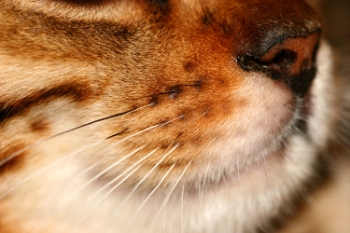
whiskers

Whether you’re in transition and not sure which end is up,  just beginning something that requires a completely new skill set, or letting go of something (or someone) very dear to you, sometimes the hard just doesn’t seem to stop.

“I keep thinking this is going to get easier,” one of my clients who had moved to a new city and started a new job said a while back. “But every day is a challenge I’m not sure I want!”

Something I’ve been noticing over the past several years is that fewer and fewer of us seem to be experiencing those extended periods of time where we just kind of “coast”. I think there are a number of reasons for this, a big one being that our world and our planet are reaching very critical points where change must happen. We can’t “coast”, globally, in certain ways any longer.

And we, as individuals, are never disconnected from the whole of the world we live in. Many of us may have worked hard to cultivate independence, but the fact is that we are undeniably interdependent. What happens to the whole affects us, and vice versa.

***

Today I walked over to Petco to buy some pill pockets for my cat, who’s on medication for inflammatory bowel disease (yes, it’s as lovely as it sounds). My cat is old, but still active, and I want to keep him as comfortable as possible for as long as I can, for as long as he’s around.

In Petco, there were cats up for adoption. Four cats, in cages. Well-kept cages, with comfy beds and food and perches, but cages nonetheless.

One of the cats, a tortoiseshell whose sign informed me that her name was Trooper and that she’d been given up for adoption because “my owner’s girlfriend didn’t like me”, sat up straight and met my gaze with her green eyes. She gave me a commanding meow. She was extremely curious and open to me and everyone in the store. Her adoption fee was only $42.50.

Let me tell you, sometimes I hate going into Petco. I would have loved to take Trooper and another of those cats and offer them a stable and loving home. My gut tells me, though, that it would be too much stress for my existing fur child, whose immune system is not what it once was.

But Trooper served as my “saving grace” today.

Locking eyes with her in Petco circled me back to this truth: I want to be able to take care of me the best I can, so that I can be of greatest service to the people and animals who can best benefit from whatever it is I have to offer.

We can never separate “self-care” from “other-care”. It’s all the same thing when it comes down to it. 

***

And that brings me back to “the hard”.

It’s often when things feel the hardest that we throw self-care out the window. Because “self-care” can feel like just one more thing on an ever-growing, ever-changing to-do list.

But so often self-care is not about doing but about undoing. About letting go of what is not necessary and coming back, every single day, to what is most fundamental for us.

And when we get away from it, life is there to point us back toward it, often in the most unexpected places, as Trooper in Petco did for me this morning.

Here are some ways to weave those everyday “saving graces” into your life, especially when things are hard:

If you are physically able, get out and walk. Your feet on the ground and noticing trees, bird, squirrels, is fundamentally nourishing. You can also combine this with “sit spotting” — finding a good bench and planting yourself there and just noticing for a while. During my last sit spot, I watched the bees interact with a plot of heather, their gold bodies moving in and out of the thick purple, and I saw how the sparrows were keen on the heather too, and how they weren’t bothered by the bees.

Take responsibility for what enters your ears and eyes. When I walk, I often listen to recordings of gifted coaches, teachers, and writers who remind me of the importance of what I do.  In keeping with this, limit social media time to only the aspects of it that feel truly supportive to you. When I’m “in the hard” I don’t spend much time in the Facebook newsfeed, for example, and mostly hang out in Facebook groups that feel the most supportive and connecting to me.

Have a morning ritual. Morning rituals allow us to take responsibility for our state of mind as soon as we wake up — this is extra-important when we’re in tough times. Don’t wait until later when, as writer Edna O’Brien has put it, “the shackles of the day are around you.” Mine is walking, coffee, and morning pages. What about you?

Take time — if only a moment or two — to be truly present with at least one other living being. Your partner, your child, your pet, the person ringing up your purchase at Bed, Bath & Beyond. Presence with another person is rejuvenating and reminds us of that continuum of “self” and “other”.  When things are hard, it’s so easy to slip into isolation, but something as “small” as a smile from a stranger can break us out of it.

And finally: Be open to the grace. Sometimes, in our yearning and longing and weariness for things to change, we adopt a “been there, done that” attitude and don’t notice the exact things that can support us.

What are your daily saving graces when it feels like things are hard? What helps you reconnect with what really matters to you when you’re not at your best? I’d love to hear from you.

By the way, if you’re in the U.S. in the Chicago area and interested in giving a home to a cat like Trooper, I hope you’ll check out Catnap from the Heart. These giant-hearted folks have done so much for homeless animals over the years and will be expanding their facility soon so they can help even more.

Please note my Stellar Self-Care Program is now closed until early 2017, but you can still sign up to work with me one-on-one in other ways. Interested? Find out more, here.

Above image is “Whiskers” © Marilyn Barbone | Dreamstime Stock Photos
Why the downtime you “sneak” doesn’t really count

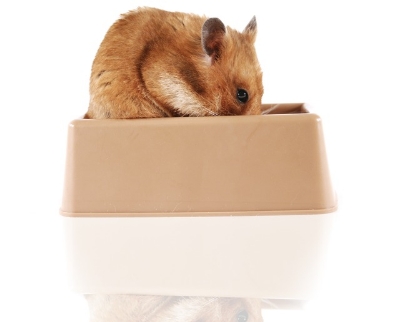
hamster


The other night, I stayed up much later than usual, watching a marathon of the HGTV show Fixer Upper and eating taco-flavored Doritos.

It seemed like a good idea at the time, but I paid for it with stomach discomfort all night and lousy sleep.

The odd thing about it was that, although I had told myself I “needed” this TV and Doritos “binge”, it didn’t really feel good. It didn’t quite seem to scratch the itch I’d thought it would.

I then remembered that my mother had once told me that, before he retired several years ago, my dad would often stay up late watching TV on weeknights, even though he was very tired. “It’s his only way to have time to himself,” she said.

And then I knew what my Fixer Upper-Doritos binge was about (because — honestly? — I don’t even like Doritos that much — they were only in the house because my partner loves them): It was my way of “sneaking” downtime that I wasn’t openly giving to myself. 

What’s going on when we “sneak” things for ourselves? When we do it in secret  — even if the only person we’re hiding from is us?

Geneen Roth, author of many wonderful books on our relationship with food, wrote that as she healed from emotional eating, an important part of her process was to eat in full view of others. Even if what she was eating was a whole chocolate cake.

I realized after my TV-and-Doritos escapade failed to give me what I’d hoped it would that I’d fallen back into an ancient pattern (and ancient IS the right word here, as my ancestors did it, too): believing that I only deserve open-ended time for myself once I’ve “earned” it through achieving.

Through “upping my game”. Through “checking off the to-do list.” Through challenging myself and “succeeding.”

Many people I work with tell me I am gentle, and while gentleness is indeed part of my true nature, I am also very driven. This driven-ness has a positive aspect — I stick to things, I usually do what I say I’m going to do, and I (definitely) know how to push myself.

But this driven part of me has a downside, too — it doesn’t know when to quit. It doesn’t have an “off” switch. It doesn’t always let go when it’s time to let go, either.

So part of the reason I am gentle is because I need to teach myself gentleness. Or maybe I am continually learning to embrace the gentleness that was part of me as a child.

This gentle part of me (and the driven part of me, too!) needs open-handed rest, rejuvenation, kindness, solitude, and daydreaming. It needs it not because I’ve “earned” it, but because I exist and it’s a true need at times. In fact, it’s a true need regularly.

Over and over I revisit the same learning: It’s okay to give myself something just because I feel the need for it.

As my teacher Mark Silver says, we don’t eat or drink once and never need to eat or drink again. We get hungry and thirsty multiple times per day and we fill those needs. We don’t expect that we will never again be hungry or thirsty just because we ate and drank one day.

The same goes for other needs that may not be as apparent (or as culturally acceptable!). I don’t have to “earn” downtime. It is a need, and the need for it will arise again and again. And I can give it to myself because I exist. Not because I “deserve” it.

But I had forgotten this. And the part of me that felt angry and neglected and sad that I had forgotten wanted some kindness, some gentleness, some acknowledgement. It reminded me by staying up late in “binge” mode.

It’s totally okay to watch multiple episodes of Fixer Upper (I love Fixer Upper!) and eat delicious food. As long as I am giving it to myself as a gift. As long as I am enjoying it. A little indulgence can be a truly good thing, especially for those of us who tend to go too far in the other direction and push and deprive ourselves.

But when we can catch ourselves going too far in the other direction — when we notice before we swing too far out of balance — we are giving ourselves the true gift.

And when we’re “sneaking”, there’s a part of us, in that act, that wants to be seen. To be acknowledged. (A client told me a while back that she was “sneaking” time to write in her journal — some part of her wouldn’t allow her full permission to openly connect with herself.)

Our egos can be very tricky here. In my case, I was giving myself downtime here and there — but it was conditional downtime: you can have this, but only if you make up for it by working really hard later.

So the key here is giving ourselves what we need with no strings attached. (Check out my post on the difference between self-care and self-indulgence, here.)

Do you notice yourself “sneaking” something? Is there a message there for you? I’d love to hear from you.

And, if you’re feeling overwhelmed or disconnected from yourself and are needing support, I hope you’ll check out my Stellar Self-Care Coaching Program. I’ll continue enrolling clients in this one-on-one program through August 31, 2016.

Above image © Johanna Goodyear | Dreamstime Stock Photos

The choices that make you who you are

moonplantFrom my living room windows, as I sit in my blue chair, I often see a woman out on her balcony in the condo building across the way.

Her balcony is filled with beautiful plants and flowers and even a small tree in a terra cotta base.  She’s about my age — 40s — and seems peaceful and purposeful as she moves with her watering pitcher from plant to plant, disappearing inside occasionally and reemerging with a full pitcher through the sliding glass door.

I think I am living vicariously through this woman — just a little — because I like the idea of lots of plants, but I’ve learned I don’t want them.

In my old home, from which I moved last year (and wrote about here), I had a room devoted solely to plants.

Many of them were my mother’s plants, lovingly tended for years and years, which I inherited when she moved to the East Coast in 2005. And in 2014, when my sister moved to Michigan, I took her plants as well, several cacti and some succulents known as “chickens and hens”.

The plant room got to be very full, and although I had liked the idea of all these plants when I moved into the house, over time I came to realize that I am simply not a plant person. I am an animal person, and I adore taking care of pets, but plants exhaust me.

A little orange tree that had thrived under my mother’s care for more than thirty years eventually withered under mine. Most of my sister’s plants died after she gave them to me.

A friend of mine saw the metaphor in all this and pointed out to me that I’d been taking care of plants all these years that did not truly belong to me.

It wasn’t that I didn’t like the plants, but I admit I cared for them resentfully. I didn’t really want all these plants but had taken them on because I felt like if I didn’t, they’d end up on the trash heap.

My friend said, “Of course you don’t want them — they’re other people’s cast-offs. You never did want them; you just couldn’t say no.” (I make it sound like she was brutally blunt, but she is actually very kind when she says things like this.)

My friend had a point. It was my mother, not me, who desired a large house filled with plants. And my sister’s plants had been given to her mostly by my mother. And why was I caring for the parts of people’s lives that they’d left behind, when they were no longer willing to do it?

Today, the plant room of my old house a thing of the past, I stare out my window at this woman tending her plants and wonder: what if I actually do want a balcony full of plants? What if I actually want a life like this woman’s? (I have no idea what kind of life this woman has — only that, when the weather turns warm, she turns her attention to her plants). Shouldn’t I have what she has?

***

In truth, I can say for sure — yes, for sure — that I do not want to care for a balcony full of plants.

At least once a week — more than ten months after my move — I feel relief and peace in the fact that I no longer care for those plants.

But I notice — in myself, in the clients I work with, in the communities of which I am part — that we so often look out at others and make assumptions about their lives, and believe we should have what they have, do what they do, be what we perceive them to be.

I’ve noticed myself assuming that the woman across the way must be “successful” in life because she has all these beautiful plants and is able to help them thrive. She’s willing to put in that time and energy and devotion to plants, and I am not. That must mean something good about her, and something bad about me, right?

The fact that I actually do not enjoy caring for plants does not register to my critical mind when it’s comparing my insides to other people’s outsides.

And maybe, just maybe, this woman actually truly wanted all these plants and picked each one out with care, herself. Maybe they were not an inheritance she never wanted to begin with.

Two things bubble to the surface for me as I write this:

1) In the future, starting now, I will remember to say no more to things I really do not want. I will remember that my “no” does not necessarily relegate innocent plants to the trash heap — in fact, my “no” may create currently unseen possibilities, for plants AND people.

2) When I’m comparing myself to “surely-more-successful-than-me” others, I will remember that I have good reasons for my choices, and that making choices based on who I really am and what I truly want is one of my definitions of success. So while a balcony full of thriving plants may equal success for my neighbor, it doesn’t for me — even though I can deeply appreciate the view it creates.

What do you notice about the difference between who you truly are and who you (sometimes) think you should be? How do you connect with what you truly want, as opposed to what you think you should have? I’d love to hear from you.

Do you need support in making your creative work a priority, in a way that works for YOU (not the way you think you should do it)? I’d love to help. Find out if we might be a fit, here.

Above image is “Future Forest”, © Deca Raluca | Dreamstime Stock Photos

On discomfort, sadness, and creativity

reflections

I recently reconnected with a teacher of mine, and, as I shared a frustrating experience with him, he reminded me of the importance of being able to tolerate discomfort.

Even thinking about “tolerating discomfort” makes me … uncomfortable. But I was so grateful for his reminder.

I wrote about allowing discomfort quite a while ago, and it’s a theme I revisit periodically. Because I forget: my mind gets busy trying to make things the way I think they should be SO THAT I am not experiencing discomfort.

But: what if the very discomfort I’m experiencing is exactly what I need to experience in order to grow into the place, the self, the life, I desire?

I am not saying that we should tolerate negativity or abuse or situations we can readily change by willingly acting on our desire to change them.

But sometimes there are situations we cannot readily change — they are not so clear-cut, and there may actually be nothing for us to “do” at this very moment. This is an uncomfortable place to be. It is the space of ambiguity, the (sometimes vast) gray area of uncertainty. Most of us will go to great lengths to not be here.

When I am feeling particularly crabby or “off” or I catch myself slamming into a wall again and again trying to make something happen, there’s a good chance that my mind is actively avoiding discomfort by trying to “move the furniture.”

(“Moving the furniture” is my metaphor for those times in life when there is really no clear action to take, but because fear has a hold on me, I try to do something — anything — in order to feel more control. In other words, the room may be perfectly fine and functional, for now, but I am moving the furniture here and there anyway, trying to predict how I’ll want it next month or next year.)

Something I’ve learned in these past few years of working with some very dear clients is that, frequently, when someone says “I’m stuck”, what’s really going on is an unwillingness to tolerate discomfort.

In an emotional sense, the feeling of stuckness is very real, because the unwillingness to allow the discomfort to be there creates a contraction in the body. It’s like rigidly setting your jaw or tensing your abdomen. There’s no flow.

What happens when we give space to discomfort? What happens when we are not frantically searching for the “right option” or course of action so we can get rid of it, but we simply allow it to be there? Just breathe into it, even for ten seconds or so?

I notice that, often, what is underlying my own discomfort is sadness. Just pure sadness.

This does not make me a “sad person”. Sadness, as Karla McLaren says in her book The Language of Emotions, is “the watery emotion.” It is about letting go and moving on.

We may feel a hint of sadness even about small “letting-go’s”, like finishing a book we’ve dearly loved reading, or donating some clothing we no longer want. And let’s face it, there’s not a lot of space for sadness in Western culture.

But these small sadnesses are part and parcel to letting go, moving on, sorting through what needs to be processed and integrated so we can allow movement and flow into our bodies and our lives.

Speaking of flow, I am experimenting with allowing tears more in my daily life. Obviously, not all situations are appropriate or safe for the expression of tears, but sometimes, tears are a totally good thing when I might normally stifle them, and I’m finding the expression allows people to feel closer to me and creates more real connection.

(I don’t mean I’m going around bawling. I’m just allowing the tears to come forth rather than forcing them back. Like, after I saw Hello, My Name is Doris last week, I let myself be all teary and emotional coming out of the theater, because I loved the character of Doris. In the bathroom, I looked over at the woman at the sinks next to me and saw that she, too, was wiping her eyes, and we shared this lovely, appreciative smile.)

***

Creativity is, at its most essential, the life force moving through us. If we are not allowing discomfort, if we are pushing it down and analyzing or strategizing in order to avoid it, there will be a deadness to anything we attempt to create.

You’ve probably felt it when something you’ve created is a little too “sterile” or “perfect”, with not enough feeling, not enough oomph!, not enough flow. Any chance you were trying to avoid discomfort in some way there? I know I’ve done this in my writing many times.

What do you notice about allowing space for discomfort in your life? What happens if you try it for ten seconds? I’d love to hear your experience.

Do you need support in making your creative work a priority in your life, in a way that works for YOU (not the way you think you should do it!)? I’d love to help. Find out more, here.

Above image © Gjs | Dreamstime Stock Photos

When “good enough” is plenty

coffeegrounds

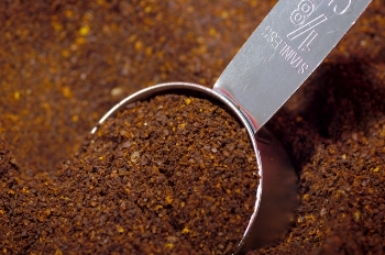
My favorite morning ritual is to go for a walk and get coffee and then walk home. There is something about starting my day this way that just helps. Since I work from home, my “walk for coffee” is a transitional element — it smooths that space between waking and working.

But: the coffee at the places within walking distance just doesn’t really do it for me. Oh, there are many. Major chains, smaller independent places. But something is lacking in the taste of the coffee. It’s either too strong or too weak or it’s not quite the right flavor. Blah!

A few months ago I became obsessed with finding coffee that I could love. I was tired of paying for coffee I wasn’t thrilled with. I convinced myself that if I had better-tasting coffee to start my day, the day would go better. Like, way better.

So I decided to try just making my coffee at home. I did lengthy searches, read copious reviews, and found some fancy new flavors. And I was able to create the coffee I wanted, for the most part. And I felt satisfied. Sort of.

But: the walk. It was missing! And my morning walk is huge for me. It jump-starts my day. It connects me with the creative impulse, with birds, with squirrels and trees. It gets my body moving.

So: I decided I’d make my coffee at home, and then take it with me on my walk.

But: this didn’t work either.

Because: I like going into a coffee place and having that simple interaction with people. There is something about going into a place, talking to people a bit — just a bit, not too much — holding the door, that simple exchange — staring at the bulletin boards, smelling the coffee smells — I like all that. It connects me with the world. I need it.

So, I sat with this coffee conundrum, marveling that this seemingly small thing — really good coffee — had started to take up so very much space in my daily life.

And, eventually, I realized this: the perfect coffee just didn’t really matter that much.

Yes, it would be nice to have the coffee of my dreams on a daily basis, but it was the entirety of the experience I truly needed — walk/coffee/nature/people — and not really the coffee itself. Coffee was only one piece of a bigger thing — my foundational morning ritual.

I also realized something else: In preoccupying myself with my search for the perfect coffee, I was less available — even if only slightly — to the parts of my life that are more important to me. To the parts of my life where, perhaps, I need to take more risks and dial up my commitment. Or simply experience more presence, more of the “enough” of the here and now.

And so, I decided to let it go.

And you know what? Since I let it go, I am totally fine with my coffee, wherever I get it.

Sure, I will probably stumble on amazing coffee somewhere I don’t usually go, that is not near where I live (like the coffee they served at the Indian restaurant that went out of business!), and I will wish I could replicate that taste somehow.

But while fulfilling my desire for the perfect coffee would be nice, it’s not essential.

When it comes down to it, I’m okay with coffee that is good enough.

***

The coffee example is a simple one, but I see a version of this a lot with my clients, who sometimes feel like they need to hit upon the perfect product, or class, or book, or coach (or, in some cases, life path!) in order to feel like they’re really on their way.

While it is important in certain cases to find a great fit, sometimes it’s okay for the fit to be “good enough.”

(If we’ve struggled with perfectionism, and its shady sister, procrastination, we may use a tendency to hold out for the “perfect fit” as a way of keeping ourselves from showing up in ways that scare us. Check out the categories on the right to find my previous posts on perfectionism. )

Pouring energy into these non-essential areas may seem like a small thing, but it’s actually a huge drain on our creative energy to search for perfect when we already have enough.

And even when we are dealing with an area that is truly essential, like a central relationship or the pursuit of our soul’s work, the “search for perfect” can serve as an exquisite distraction from what is already available to us.

Do you see areas like this in your life,  where you’re looking for perfect when “good enough” would suffice? I’d love to hear how you experience this.

Need some support in making your creative work a priority in your life? I’d love to help. Click here to see if we might be a good fit. 

Above image © Dana Rothstein | Dreamstime Stock Photos

When the ideal meets the real

idealreal

One thing getting into my forties has shown me is that a lot of the “ideals” of my twenties and thirties haven’t truly meshed with “the real”.

Now, when I say “the real” here, I’m not necessarily talking about “the real world” — not exactly. I’m talking about what is, when it comes down to it, real and true for me for the whole of who I am.

It’s easy for me to hang out in the land of the ideal. I remember one time, in my twenties, I was explaining to my therapist how disappointed I was in someone I was dating. She nodded and smiled and said, “As usual, your standards are very high.”

She didn’t say it with judgment at all, but with love — in fact, because I felt very accepted by her, I took it as a compliment. (She managed to say this when she could finally get a word in — at least once a session she would have to hold up her hand and say, “Jill, excuse me, may I say something?” Introvert that I am, when I am feeling safe, I can talk and talk and talk.)

I did have high standards — but I think it’s more accurate to say I had certain ideals that I was absolutely certain I needed to live by. And, as life plays out, as we live it, sometimes those ideals crash upon the shores of the real.

It’s not that the ideals are ridiculous or naive (as certain adults used to tell me about my “big dreams” when I was a teenager). It’s not even that the ideals are unattainable (sometimes ideals are very possible for us, especially when they are in keeping with our essential selves).

It’s more that reality provides constraints for our ideals to push up against.  And that who we think we are when we connect to certain ideals may not be who we truly are — or maybe it is, but we change, and our old ideals start to feel more punishing than inspiring.

And this is not a bad thing (though tell that to my twenty-five-year-old self!). In fact, creativity often thrives within constraints. (Why do we need to be creative if there’s nothing to work out, nothing to understand, nothing to make better or see more clearly?!)

When the ideal meets the real, that is when we get to know who we truly are.

I wrote several years ago about my early dream of being an actress, and how I discovered over time that the life of an actor was really not the life I wanted. If I hadn’t given it a shot, though, I never would have understood why.

The reality of me is that I’m much more a writer than an actor. And, as I’ve brought my “ideals around being a writer” into reality, I’ve also learned a lot about what kind of writer I am, and what kind I’m not. I’ve learned a lot about what writing means to me, and what it doesn’t. (In other words, I’m more than a writer. “Writer” is one aspect of me, and writing is a tool through which I express the whole of me. And I’m still learning here.)

***

Spiritual teacher Adyashanti has said that you can have all the ideals you want, but it’s your life experience — your daily reality — that shows you what is true for you.

I had to confront this in my relationships for a lot of years. Although I said I wanted to be with a partner who was fully there for me, the people I allowed into my life back then weren’t really partners at all — they were never truly available to me.

Reality for me clashed with my ideal — what was true for me, I came to see, was that I didn’t really want a partner who was actually there — I wanted the idea of a partner.

It took a lot of peeling back the layers of my ideal for me to comes to terms with what was real — and true — for me. (It’s extremely common in the work I do with clients for them to test out an ideal and discover that they liked the idea of it, but the reality of it is not necessarily a good fit for who they truly are. This is wonderful news: now they get to see what it was in the essence of that ideal that they wanted. Very often, it is the essence we crave, not the actual thing itself.)

If you find your reality pushing up against an ideal, ask yourself:

• What is it about this ideal that inspires me, that moves me? Is there a way I can have the essence of this in my life without needing particular external circumstances?

• Does this ideal even fit me — the real me — anymore?

• Do I simply need more support in order to really live this ideal in my daily life?

What do you notice about how your ideals mesh with reality in your own life? I’d love to hear how this works (or doesn’t!) for you.

This is tough stuff. If you’re in this space and needing support, check out my options for one-on-one coaching and see if you think we might be a good fit. I’d love to help.

Above image is “Clouds Floating Along” © Marilyn Barbone | Dreamstime Stock Photos

Embracing the beauty of being on the fence

ducksonfence

One of the most painful things we can experience, at times, is that feeling of being “on the fence.”

We’re not quite at “yes”, but it doesn’t exactly feel like a “no” either. This can happen with a creative project, a relationship, a job, or even an event we’re not sure we want to attend.

I know I can be a world-class waffler. Sometimes something is clearly a “hell yes” or a “hell no”, and there’s always a sense of relief for me when that’s the case. Because often, I have a whole bundle of feelings around something — an unwieldy mix of half-yeses, half-no’s, and everything in between.

I have a fascination for the murky, the muddy, the not-quite-clear. My partner said the other day, while I was debating whether or not I wanted to go out of town with him, that while he sees about two and a half sides to every situation and thinks that’s enough, I see eight sides and like to go for thirty.

Fair enough. Sometimes I love that I embrace the gray areas, the not-quite-defined. But it can also make life harder than it needs to be.

Because sometimes, I think I’m on the fence but I’m just plain fooling myself. Sometimes, I’m not on the fence at all but I’m afraid to own my “hell no” or my “hell yes.”

I’ve discovered over the years that there’s a true difference in feel between times I am genuinely on the fence and times when my “I’m not sure” is actually a cover-up for a yes or a no I’m afraid to see.

It’s all about how it feels in my body.

A true “hell no” for me feels like a hand pressing again my abdomen — a firm, strong hand. It’s a boundary; it makes me think of a drum skin pulled taut, with no give left. No. Not going there. Done. Or, eh, that just doesn’t feel right to me, for now.

A true “hell yes” for me feels like an opening. A “yes” for me is in my chest. My body lifts up and forward when I feel a true yes — it’s like an invisible string extends from my breastbone, right around the area of my heart, and pulls me toward what I want.

A true yes does not actually feel like a decision at all, much of the time — I simply find myself moving toward whatever it is. (As Byron Katie says, when we have the necessary information, decisions tend to make themselves.)

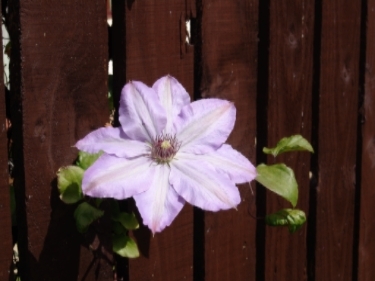
flowerfence

So what does the dreaded “fence” feel like? I’d like to first point out that, largely, what makes the fence painful is the belief that we should be off it. That being “on the fence”, feeling “maybe” instead of yes or no, means something is wrong.

When I’m genuinely on the fence (and not pretending to be there because I’m afraid of my yes or my no and what they might mean), there is a true sense of curiosity. Again, I feel it in my body. Curiosity shows up in my abdomen, chest, throat and jaw. It starts in my abdomen and moves upward — there’s a ticklish quality to it, a momentum that is born of wonder.

In fact, a good sign that I’m genuinely unsure is I hear myself saying “I wonder” and “what if?” a lot, in a musing, reverent way. I don’t mean “what if” here in the worrying, fearful sense. I mean it in the creative sense.

It’s like when I’m writing fiction, and I’m testing out story possibilities. What if she does this? And then he reacts by doing that? And then that causes this? It feels more like playing than the tense, cramped feeling that comes from analysis paralysis, from trying to “figure it all out and get it right.”

There is nothing wrong with being “on the fence”, unless we are perpetually there. In fact, when we are on the fence, it is a great opportunity to know ourselves intimately. It is autobiographical. No two people will be “on the fence” about the same situation in the same way.

I do a lot of “fence work” with my coaching clients because people often seek out a coach when they’re struggling with a big decision. Sometimes their truth is that they’ve already reached a “hell yes” or a “hell no” and they simply need to permission to see it and support in owning it.

And sometimes, they need support in embracing the beauty of their particular fence.

Very often, we can only step off the fence into the lush grass on the other side when we deeply get how the fence is serving us. It’s okay to be there for a while, as long as our being there is true for us. And if our truth is that we’re ready to jump off the fence — or shimmy down ever so gently — it’s okay to get support in doing that.

How do you know the difference between a true yes and a true no for yourself? How do they feel different than when you are genuinely “on the fence”? I’d love to hear your take on this!

Above images © Susinder | Dreamstime Stock Photos and © Steve Sharp | Dreamstime Stock Photos, respectively.

How distracting yourself can get you unstuck

colourtube

Sometimes we can find ourselves in a cycle that looks like this: We’re pushing and pushing to get something done, but it’s not working, no matter how hard we push.

Then we ask ourselves, “Why isn’t it working? What’s going wrong?”

Our minds start looking for what’s wrong and find that it’s all wrong. (If we look hard enough for something, we will definitely find it.) The project is wrong, the way we’re going about it is wrong, we are wrong. Our lives are wrong. Wrong! Where did it all go wrong?

We get discouraged with how wrong it all seems, and we think, “Well, maybe it’s my attitude. I just need to try harder.” So we push ourselves, and the whole cycle continues.

Western culture is in many ways a “push” culture, which values moving forward at all costs.

One thing that can result from too much pushing is a feeling of stuckness.

Ideally — when I’m really “on track” — I’ve noticed that I feel pulled toward what I want, not like I am pushing myself toward it.

This is not to undervalue “push” energy, as it’s certainly necessary sometimes (it’s just not a great way to live all the time).

A lot of what’s going on with pushing ourselves is that we’re pushing so hard we’re losing sight of why we’re doing something in the first place.

And that’s why — in addition to pulling back and gaining a broader perspective, which I wrote about in my last post — an important element to moving out of a feeling of stuckness can be shifting focus. Or, to put it another way, distracting yourself.

Yes — that means stepping away from what you’re trying (unsuccessfully) to do, and doing something else. Anything else. Resist the urge — for the moment — to try to “figure out” why things aren’t working, and just do something else.

This can work on the smaller scale or the larger scale.

On the small scale, it might look like calling it quits for the day with that chapter you’re wrestling with and attending to the email you’re feeling called to write to a friend.

On the large scale, it might look like putting the major project that’s feeling incredibly draining on hold for a month and immersing yourself in a “fun” project.

This happened for me years ago during grad school when I felt a lot of heaviness around my thesis material. At the end of a summer, when I had a brief break from course work, I found myself super-inspired by these little cat paintings I saw artists doing on a certain auction site at the time. And it occurred to me that — for fun — I could try to do a little cat painting of my own.

I did one late on a Friday night, painting into the wee hours, and it was so much fun I did another one, then listed them both on the site for very low prices. Just for the hell of it.

My sister called the next day — she was always checking on my listings back then, as we sold used clothing a lot — and said, “What are these paintings you have up? One has a bid on it!”

Yep, my little painting I’d done “just for fun” had a bid on it. Someone wanted to pay actual money for my little experiment.

This was the beginning of a period of a year or so where I made lots of little cat paintings and sold them. One ended up in a coffeehouse in Seattle. One ended up in the home of an octogenarian with six cats who lived in England. It was so much fun selling my little paintings and learning about my customers.

And what I discovered during this time was that part of the reason I’d gotten so stalled on my thesis material was that I’d lost touch with what had mattered to me about writing in the first place: it felt fun! I liked it!

I’d gotten locked into “serious grad student” mode and felt like my writing had to be big and important. I still struggled with those feelings (and sometimes do now), but doing my little paintings reminded me that there was much joy to be had from the small, the simple, the cute and the fun.

That thing I was truly seeking — connection with dear, kindred souls — was available to me by doing ordinary things with extraordinary care. (I wrapped my cat paintings in pretty tissue paper and tied them with ribbon and wrote personal notes to each of my customers. I loved responding to messages from my customers and hearing their stories about their cats.)

***

Anne Lamott tells a story in her book Traveling Mercies about her car breaking down when she and her son were on the way to visit a dying friend. When all was said and done, it turned out she wasn’t able to visit her friend until a few days later than she’d planned.

Somehow,  thanks to the “distraction” of the car situation and what it brought up for her, she was able to show up for her friend with more true presence. “I still did not know what was trying to distract me so it could get itself born,” she wrote, “but I felt happier than I had in a long time.”

Sometimes we need to distract ourselves so that we can get out of our own way.

I think this is what happened for me when I was drawn to making small, simple paintings of cats. I needed to get out of my own way.

Getting out of our own way in this sense is not the same thing as procrastination (though our culture — oh, our culture! — will try to convince us that it is, that there is nothing of value in ceasing to push.)

Challenge the culture. Allow your life to be a grand experiment that always leads you back to your core.

Need some support on your grand adventure? Through Feb. 29, my one-on-one coaching sessions and packages are at special prices, in honor of The Year of the Monkey. (Monkeys are a spirit animal for me — they are the guardians of fun and play, which my serious, driven side badly needs to stay connected with.) Find out more here

Above image is “Colour Tube” © Esra Paola Crugnale | Dreamstime Stock Photos

Are you pulling back enough to gain perspective? + special February coaching prices

eagle on beach

Scroll down to learn about my special coaching prices this month, in celebration of the Lunar New Year!

One thing about my many, many years of journal-keeping is that certain patterns — truths about the way I live my life, the behaviors I resort to when I’m under stress — show up with (sometimes frightening) regularity on my quickly-scrawled pages.

One of these truths about myself, which I don’t necessarily like but am coming to terms with, is that I have a tendency to keep moving things ahead even when they’re not working.

It makes me feel virtuous to check off my daily to-do list, to be there for others, to get things done that feel hard. And, I also truly love these things — when they feel deeply right.

But sometimes, I have a creeping sensation that something isn’t quite right, and, in the interest of getting my work done for the day, I don’t actually step back and ask: Is this work, you know, working? Is doing this stuff contributing to what I desire in the long run?

I had a conversation with a friend recently where I told her about this tendency of mine to keep hanging in there, to keep moving something ahead, even though it’s not necessarily working for me, even though I badly need to press the pause button.

And she said, “Wow, you know, I think of you in exactly the opposite way. You always remind me of how important it is to focus on what really matters and to take time out to be present.”

Ack. Apparently it’s true that we teach what we (desperately) need to learn.

The truth is, I’m a lot better at stepping back and focusing on the big picture than I used to be. In my younger years, I felt like I was constantly on fast-forward. I have no idea what I looked like to others, but I had a huge fear of stopping and looking around.

I became monumentally out of touch with my own feelings, and it was only an illness at twenty-five that really slapped me into the reality of what was true for me: I needed to stop pushing, to stop trying so hard to be there for others, and to allow myself to simply be. Not just once in a while, but as a regular practice.

But, it is always a process, and many years later I still get caught up in pushing myself forward when, in fact, what is required is a giant step back.

those icky patterns show up on the pages of my journal

those icky patterns show up on the pages of my journal

Obviously, moving things forward is vital, but the best way to do that is through what we coaches call inspired actionaction connected to what is in the best interests of our essential self — not simply action for the sake of it.

And this can be truly challenging when we live in a society that rewards us for taking lots of actions, for “just doing it.”

***

Last year, I made the painstaking decision to move into a smaller home. It’s a lot smaller. (I wrote about this journey here.)

It was a complicated situation, but a defining aspect of it was that I was expending a lot of physical, mental, and emotional energy trying to keep up a house that, in the long run, I just didn’t actually want to live in. In the final analysis, I had to admit I just didn’t care about the things that came with maintaining a house.

I would look around at friends and think, well, they do it. It’s worth it to them. And I’d wonder if there was something wrong with me that I wanted to go back to small apartment living, at my age.

But when I thought about moving into a small apartment, where upkeep would be minimal, where maintenance would be taken care of by someone else, where I could feel like each room and each object was well-used and appreciated, I felt all lit up inside. It was my truth, even if it wasn’t somebody else’s.

It took me a long time, though, to actually pull back from my daily existence enough to see this truth.

And it was care of the house, in part, that distracted me from the truth. Whenever I got everything else done, there was always snow to be shoveled, or leaves to be raked, or a flooded basement, or an attic fan that needed repairing. But isn’t this what you’re supposed to do? I’d think. Grow up and take care of a house?

***

Martha Beck, in her book Finding Your Own North Star, talks about the difference between “mouse vision” and “eagle vision”. Mouse vision takes care of the small details that help us get things done each day. Mouse vision is very important, because it is only through tiny, individual steps that we make our way to completing our “big things.”

Eagle vision, on the other hand, is about the big picture — it’s soaring above the landscape so we can get a sense of the whole scheme and notice what needs attending to, what needs to be let go of, and when we need to fly in a slightly (or dramatically) different direction.

It’s easy to get stuck in mouse vision. If you find yourself saying things like, “I can’t believe how the years are getting away from me,” it’s likely that mouse vision is a little too much at play in your life.

Something I’ve noticed while working on novel drafts (which I will get into more in a future post) is that it is really important to be able to flexibly switch between mouse vision and eagle vision in the creative process. Just like in my life, I’ve had a tendency to push my writing forward even when something nags at me, raising its little hand and saying, “Hey! Something’s not working here!”

It feels so virtuous to keep plugging along, to write more words, to check that off my to-do list! Who wants to pull back and look at the work as a whole? Do I get a gold star for doing that?

But it’s so necessary, in our lives as well as our creative work.

How do you know it’s time to pull back and embrace the big picture?

• You feel like you are drowning in the day to day. It feels like you’re just going from one thing to another, putting in the time.

• You feel disconnected from yourself, or your creative work.

• You find yourself getting really angry when you have to perform certain tasks. (When I was living in the house, there came a point where any time something broke — the dryer, the lock on the front door — I felt like I was ready to kill somebody. This kind of anger is a sure sign that something needs to change.)

• You start to get sick of hearing yourself complain about the same things, over and over.

The next step — as always! — is acceptance. This is where you are — and change is totally possible. What does a shift to a broader perspective reveal to you?

If you’re a little too entrenched in “mouse vision” and you’d like some support, I’m offering a package of three thirty-minute coaching sessions through Feb. 12 (this Friday). I don’t regularly offer thirty-minute sessions, so if this way of working with me appeals to you, I encourage you to check it out!

Also, through the end of this month, my 60-minute sessions and packages are at special prices in celebration of The Year of the Yang Fire Monkey! Find out more about this and my other coaching offerings here.

Eagle image © Cecilia Lim | Dreamstime Stock Photos

Welcoming the conscious pause

image

Conscious paws are always welcome 🍃

Somewhere on the continuum between torturous procrastination and frenetic “just so I feel like I’m doing something” action is a place of pausing. Of breathing. Of looking around, looking within, and inquiring: what do I really want here? What is it I truly need?

Or perhaps this place, which I call conscious pausing, is not on that continuum at all. Maybe it is actually off that continuum — the silent, sometimes-sacred space you step off the path to claim, like the big rock next to the river that runs along the highway.

I mention this place of conscious pausing because it took me four days to recognize that I was forgetting it was available to me. I returned from visiting my family for Christmas a week ago, and allowed myself a couple of days to recharge (which a younger me would have felt like a slacker for allowing myself, so, yay! Progress!).

But after those two days, I began to ping-pong between a feeling of severe procrastination (I should be doing something, but what? how?) and impulsive activity that felt pointless and disconnected.

(One sign that I, a Myers-Briggs INFP, am “in the grip” — read: under stress — is that I start taking urgent actions that actually make things worse. If you’re at all interested in personality type theory, it’s worth reading up on what your type looks like when it’s “in the grip.” You can start to recognize these behaviors in yourself and regroup.)

Once I noticed how I was acting, I realized my desire to “start the New Year off right” had caused me to fall back on old black-and-white thinking: “If you’re not doing productive things, you must be procrastinating. And if you’re procrastinating, you suck. And now 2016 sucks. Bah!” (Humbug.)

But the key, my friends, as always, is in noticing — a seemingly benign word with a ton of power.

Because once I noticed my swing from one end of that aforementioned spectrum to the other and back, I was able to consider the possibility that I had another choice. That, instead of beating myself up for procrastinating or jumping into frenetic doing, I could take that conscious pause and reconnect with what I truly wanted and needed.

***

Here are some questions I find helpful when I realize it’s time for a conscious pause.

(It’s good to ask them while placing awareness on your breath. I often find that writing the questions and my answers in my journal gives me a bit of detachment from myself so I can see what’s going on in me more clearly. But you can also speak them aloud, or have a friend read the questions to you.)

How exactly am I feeling right now? What emotions are coming up? (If you’re not sure, start here: are you more mad, sad, glad or scared?)

How does it feel in my body right now? (I have a headache, my chest is tight, my knees hurt.)

How do I want to feel right now? (excited, hopeful, peaceful, relaxed?)

How does my body feel when I’m in that place? (get specific here: my spine straightens, my pulse slows, I breathe more deeply.)

What thoughts am I having about the immediate future?

(Here are some of mine as examples: I can’t get it all done. I’m already behind. I won’t make the deadline. I can’t show up fully for my client.)

How can I change these thoughts to thoughts that feel better but also feel true? (When you work with your thoughts, you must believe your new thoughts — your essential self will not be fooled by hollow “positive affirmations”!)

Here’s how I changed my examples above:

I don’t have to get it all done, only the priority stuff. (I believed that.)

Exactly WHAT am I behind? A semi truck? (The frantic part of me didn’t have an answer for this; she just sort of laughed, nervously.)

If I absolutely can’t make the deadline, I can find a work-around. I’ll see it better when I’m in a place of peace.

I can offer my client my imperfect presence, my listening, my best for today. That is all I can ever do. It’s been enough in the past, so why wouldn’t it be enough now? (My frantic self rolled her eyes and scowled at me a bit here, but I could see her shoulders relaxing despite her best efforts to act intimidating.)

***

After you check in with these exercises, you’ll notice that what you’re wanting and needing will be all over your answers to the questions. (It’s amazing how easily and automatically we forget to ask ourselves what we want and need!)

It really helped that my cat climbed into my lap while I was checking in with myself. Is there anything more grounding than a warm feline?

By the way, you don’t have to answer all of these questions (you don’t HAVE to do anything!). You can start with the first one, and move on as it feels right. You may find relief after the first two.

Or, you can nix the questions altogether and simply focus on your breath and the fact that you are, indeed, choosing to consciously pause and stop the madness! What I love about going through these questions, though, is the clarity I come out with on the other side. Every time I see my behavior, my thinking, my feelings, with more clarity, it’s that much easier to navigate the stress when it arises the next time around.

Here’s to conscious pausing and a juicily creative 2016! How might you integrate the power of the conscious pause into your intentions and goals for the new year?