Permission to do it differently + last day to grab an Autumn Transition coaching session

coffeebeans

Scroll down to learn more about my Autumn Transition Coaching Sessions — the deadline to sign up is today!

Sometimes (often) I get really, really attached to the way I’ve always done something.

Like, when I was in my twenties, I wrote in coffeehouses a few times a week. It worked really well for me. I loved the hum of activity around me and the human company. I loved watching people walk by the window and the bottomless-cup-of-coffee served by a particular place that I went to most often.

But by my late twenties, the coffeehouse writer thing wasn’t working for me so well. I found that I was too prone to socializing when I wrote in a coffeehouse, and that the socializing felt exhausting rather than enlivening as it had when I was younger. I also found that the bottomless-cup-of-coffee wasn’t good for my body, but if it was available, I was likely to succumb to it.

For a while, I kept on trying to write in coffeehouses. But it just didn’t feel the same as it had. It just didn’t work. How could what had worked for such a long time — and helped me create a solid writing practice — no longer be helpful?

The answer is, I don’t know. My hunch is that my journey as a writer, as a person — as me! — changed. I no longer needed the particular brand of community and company and ritual that I got from the coffeehouse writing experience — I still needed to experience those things, but in new ways, and I craved a quieter, more solitary connection to my writing and myself.

A friend of mine who is a frequent blogger and who also has another job used to crank out a blog post on her lunch break three to four times a week. For a long time, this worked really well for her. She committed to doing it and showed up and did it.

And then, over time, it began to not work so well. She felt empty and distracted when she showed up to write. She wondered if perfectionism was getting the best of her and she was just becoming too picky about her topics. She wondered if she’d run out of material. She figured if she could just push herself a little bit harder, she could keep making it work.

Then one day we were talking and she said that she’d realized her days of cranking out three to four blog posts a week while at her other job were over. Like me with the writing-in-coffeehouses thing, she’d kept on trying to do what worked before, but it no longer did.

It seems it’s a human tendency to hang on to “what once worked.” We do it with rituals, and relationships, and jobs, and rituals within relationships and jobs.

And I’ve come to realize that the important question to ask, sometimes, is not why is it no longer working like it did before? but why am I trying so hard to make it work like it did before?

Because so often what we actually need is not to figure out how to keep doing it the way we once did, but permission to do it differently.

My hunch is that much of this boils down to identity. Our rituals and routines and the things we’re able to achieve regularly contribute to our feeling of who we are. And when we begin to perceive that they’re not feeling so good anymore, we wonder who we are without them.

Eventually, I gave myself permission to do my writing at home — even though I was afraid it would be boring and tedious and that that meant I was becoming boring and tedious (oh, the things I worried about in my twenties!). And I discovered that the truth was something far, far different.

And my friend has found that it feels a lot better to write one blog post a week (and that she is shifting to new subject matter, which feels both exciting AND like she’s not quite sure who the heck she is right now, and, as we like to remind each other, that’s totally okay).

If you find yourself attempting to do something the way you always have and it’s just not working, what if you simply gave yourself permission to do it differently? What if it was totally okay to let go of that old routine and do something new? I’d love to hear how this works for you, in the comments.

And if you’re in the U.S., I wish you a very happy Thanksgiving, with much to give thanks for.

Also: Today is the last day to grab one of my low-cost Autumn Transition Coaching Sessions. These thirty-minute sessions are only $39, and the deadline to sign up is midnight Pacific Time tonight. If you’re experiencing a lot of change in your life right now and feeling stuck, scared, or just plain confused, I’d love to help. Find out more here.

Above image © Johanna Goodyear | Dreamstime Stock Photos

The difference between “ready” and “comfortable”

gorgeous fall

Scroll down to find out about limited-time Autumn Transition Coaching Sessions. 

As I am settling into my new living space, I notice how satisfied I feel with this change. Being in this new place during the gorgeousness of fall, my favorite season, is lending a brisk beauty to this season of my life.

The other morning I was up with my cat at 4 a.m.  — he is a night prowler and shelf-climber, unfortunately (at least it’s unfortunate at that time of day). Even though it’s a drag to get up and monitor him at an insanely early hour, I often have insights at that time of day/night. (Isn’t 4 a.m. known as the witching hour? Hmm.)

The insight that came to me that morning was that, as with all the changes in my life that have felt most “right”, this move to a new home happened when I was ready for it, and not a moment before.

Now, what do I mean by “ready”?

There’s an idea out there in the world right now about “starting before you’re ready.” That if we wait to be “ready,” we’ll never begin.

I understand this concept, but my experience tells me something different. And I think it has to do with what is meant by “ready”.

I would say, “Start before you’re comfortable, but don’t start before you’re ready.”

For me, deep, true “readiness” has a feeling of acceptance attached to it.

With moving to this new home, for example, I wasn’t entirely happy about the change. For a long time after I began to perceive that it was going to be necessary for me to let go of my old home, I felt a lot of resistance to that idea.

About a year and a half before I made the move, I looked at apartments in the very building where I now live, and I had a feeling of wondering. Hmm, I wonder what it would be like to live here. I really like this street. I have a sense that I’d like to live here.

But: I was nowhere near ready to make a move at that point. My attachment to my old home was still so great that even thinking about a “real move” filled me with grief, exhaustion and overwhelm.

At that point, all I was ready for was wondering about where I might want to live next. The idea that I should be “more ready” to make a change than I actually was created lots of stress for me. (Funny how it’s always easier to see these things in retrospect.)

The shift for me came this past March or so, when I realized that even though things were still very much up in the air with my living situation and I was enduring frequent house showings, it felt right to simply be where I was. I stopped scrambling. I decided that despite the uncertainty of my situation, I was going to fully enjoy my home for as long as I had it.

And, from that place of full acceptance, I began to become truly, deeply ready to make a change. By June, my boyfriend and I had found our new home and we knew we would be moving in August.

But moving — despite feeling more truly ready for it — was not comfortable.

As I wrote previously, I had a ton of downsizing and letting go to do, on a number of levels. Aspects of that felt excruciating, not just from an emotional standpoint but from a logistical one.

And sometimes, in my new “streamlined” existence, I am still uncomfortable with the fact that I go looking for something that was part of my life for a long time and realize I donated it back in August. Or, now that my boyfriend and I do not have separate office rooms to go to, we sometimes feel on top of each other when we are trying to work. This change is not comfortable, even though I wanted it, I chose it.

pumpkintrio

Happy Halloween!

Another example: Back when I finished life coach training in 2011, a number of my fellow “cadets” began to go through the coaching certification process. My mind started in on a familiar loop: “Look at them! You’re falling behind. Hurry up and get certified!”

Luckily, my training had taught me to question my thoughts, and in doing that I realized that, deep in my bones, I was not ready to apply for certification. I wanted to do more coaching first. I wanted to “get” coaching at a deeper level before I went through the certification process so it would actually have meaning for me, rather than just feeling like a “should”.

This feeling came from a different place than the “never-quite-good-enough” thrust of perfectionism. It simply felt right to me to wait to get certified.

When I did go through the certification process, in November of 2011, I felt ready, but it was not comfortable. I still had all kinds of doubts and fears, but the way I knew I was ready was that I was not attached to the outcome. The process of certification was so “real” to me by this point that, even if I didn’t get certified, I knew what coaching meant to me, and I knew that I was a good coach. I’d walked coaching into my bones, and certification felt like a natural evolution of that process.

And, as it happened, certification went beautifully for me. But it wasn’t comfortable. I had all kinds of anxiety around it, but it was a different kind of anxiety than I would have had if I’d forced myself to go through the process six months earlier than I did, just as I would have had a different kind of discomfort around moving if I’d made myself do it a year earlier, just to end my discomfort!

(One of the most poignant things I’ve learned about humans since I became a coach is that, so often, in our hurry to end our discomfort, we create even more discomfort for ourselves. Then we look back and wonder what in the world we were thinking.)

What do you notice about the difference between the times you’ve felt “deeply ready” to make a change and the times you started too soon? Has being “ready” felt comfortable for you? I’d love to hear your experience.

Plus: In celebration of Halloween and the beauty of fall, I’ll be offering 30-minute Autumn Transition coaching sessions for just $39, now through November 25. If you find yourself in deep transition and not quite sure how to navigate your next step, I’d love to help. Find out more about Autumn Transition Coaching Sessions, here.

Above images © Jill Winski, 2015

Walking my talk about self-care + Happy Fall!

pumpkins15Maybe the hardest thing for me about going through a time of heightened activity (or, insanely heightened activity) is coming down from it all.

After the last couple of months of transitioning from my old home to the new one — and the accompanying “too much to do” feeling on a daily basis — things are starting to settle down just a bit.

And I’ve actually found myself at loose ends on certain days. My mind and body have gotten used to “too much to do.” It’s that “coming down from the adrenaline of momentum” feeling that I’ve written about before. The adrenaline that helps us to get through the period of heightened activity actually starts to feel normal to us.

This is where I can get into trouble if I don’t pay attention. Last week Saturday was the first day I really took an opportunity to fully catch my breath — and it felt wonderful. But the very next day, I noticed myself overscheduling and stuffing in activities here and there because, why not? I’ve gotten used to having too much on my plate.

And noticing this in myself clued me in to the fact that I’d fallen for it all over again — our culture’s glorification of “busy”.

Remember that saying, “If you need to get something done, give it to a busy person”? I heard that often from my parents and teachers when I was growing up, and again in college, and, heck, somebody just said it to me the other day.

And to a degree, being busy feels good and IS good, as long as we are occupied with things that are meaningful to us and notice our need to rest.

But there’s something insidious in the way we praise “busy”. We apologize for being “so busy”, and yet it also seems to give us some kind of quick validation. We’re busy, therefore we must be important, we must have value.

And: being super-busy also gives us a good reason to (finally) take a huge time-out and take care of ourselves.

But what if we didn’t need a “good” reason, or any reason at all? What if noticing our need to rest and then our need to be active and then our need to rest again, was simply part of our daily lives, part of our ongoing self-care? What if this kind of self-care was a must, a foundation for our lives, rather than something we have to hit a (sometimes very painful) wall to finally allow in?

For the past several months, I’ve been leading clients through my Stellar Self-Care program, which I created because I recognized that far too few of us truly anchor self-care into our lives at the foundational level. We wait until we’re in so much physical, mental or emotional pain that we simply can’t ignore the part of us that, ultimately, cannot be denied if we actually want to thrive and not just cling by a thread to survival.

And, here’s the thing I came to: I wasn’t walking my talk. I’d been seduced by the idea that I would practice better self-care after my move was over. When things calmed down. When things got less hectic. 

In these past few days, I’ve reminded myself that it’s okay to feel at loose ends as my body adjusts to living life in a less heightened way.

It’s okay to let go of activities that I’m tempted to “schedule in” but simply don’t feel necessary.

And it’s okay to do it all completely imperfectly as I discover how I want to live now (because now is not then!)

One thing I’ve learned while working with people in this new program is that we all have a tendency to turn self-care into “one more big to-do on the list.” And that’s exactly what I did when I starting telling myself I’d take better care of myself when the move was over. I already had such a giant to-do list I felt like I couldn’t possibly take on any more.

And I was right. I couldn’t.

But I was also wrong — because taking care of myself wasn’t about adding to the list; it was about leaning away from the list. About letting the list sit. If there was anything to “do”, it was simply to shift my relationship to the list. To trust that those things on the list would be done when they’d be done, rather than to hold my breath until I’d “tackled them.”

There’s nothing like “heightened times of activity” to trigger stress in us, and there’s nothing like stress to trigger our “fight, flight, freeze” reactions. Once we’re in fight, flight, freeze, we’re in survival mode and we try to “just get through it.”

If we can intervene before we get to that point, we absolutely should. And right now, as I’m writing this post, I’m noticing that part of me that is feeling like it’s pushed hard enough and is ready to stop. It’s saying “enough for today”.

Listening to that soft voice — right here, right now, not later, not when I’m sure this post is “good enough” — is key to me taking care of myself today. So I’m going to act on that urging. And stop. 🙂

I’d love to hear how YOU take care of yourself before getting to the “fight, flight, freeze” point. And you can learn more about my Stellar Self-Care program here.

Gorgeous gourds: confirmation that fall has arrived!

Gorgeous gourds: confirmation that fall has arrived!

Good stuff this week:

  • My good friend, artist, writer, and creativity consultant Dawn Herring, interviewed me about journaling for one of her “Creative Conversations”. I had a terrific time chatting with Dawn (she got me thinking and making connections between my journaling and the rest of my life that I don’t know if I’d have gotten to otherwise!).
  • I absolutely love this interview with Elizabeth Gilbert about creativity on Marie Forleo’s site. I particularly love what Elizabeth had to say about being a “trickster” when it comes to our creative work as opposed to a “martyr.”
  • Fall is here! The pictures accompanying this post are gourds I saw on one of my walks this week. I wish you the spaciousness to relish this gorgeous season as it sweeps in.

Images © Jill Winski, 2015

How moving is bringing up my stuff (literally)

sullivanshelfsitter

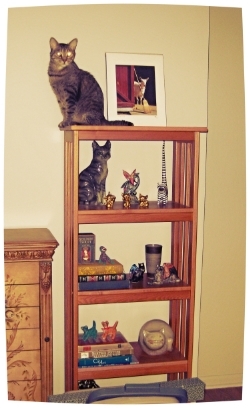
Sullivan claims his “right size” at the top of the hierarchy of our new home.

It’s been a month since my last post here, and for good reason: I moved to a new home two and a half weeks ago.

Well, sort of moved. I’m still somewhat in transition between the old place and the new — living in the new place, but going back regularly to the old to sort, organize, and get rid of before the place is officially sold. In other words: There’s a lot of letting go going on right now.

I lived in the house for ten years. When I first saw the second floor apartment (it was a two-flat), I had this inexplicable feeling of being home, and I knew I wanted to live there.

There are a number of complex reasons for my leaving the house, but let me just say that, over time, I have become the sort of “default” property manager.

And, as a friend of mine once wisely said, “houses are very greedy.” Especially old houses (this one was built in the 1880s). Although the house is in good shape for its age, its care, ultimately, has felt like too much for me to manage.

Still, I hung on until May, when some offers were made on the house and it became real to me that I really could not stay.

I am in a place in my life where I want to travel a bit more lightly in the physical world — and that means, less house and less stuff. But, as it’s becoming painfully clear, oh, do I have stuff!

***

When I moved into the house, I had been living in a teeny-tiny apartment, and I wanted to expand. I wanted to have people over for dinner.  I wanted to have get-togethers in the backyard. I wanted to have more room for beautiful things.

So when I moved my two-small-rooms-full of furniture and belongings over to the house (which had seven rooms), I could not begin to fill it up. And I kind of went hog-wild doing so. I had space! I was going to fill it with exactly what I wanted. I bought artwork — tons and tons of artwork — to cover my walls. I bought mirrors, and lamps, and ceramic cat statues, and, over time, lots of books and clothing as I became this new me who lived in this new space.

I was so in love with that house that I was determined, ten years ago, to live there for at least ten years. (Which, as it turns out, is what I did.)

But. It seems I have changed. Starting around five years ago or so, the house no longer fit me like a glove. It was almost imperceptible at first, the change — something just felt slightly off. It began to feel to me that there were too many rooms, rooms whose purpose was simply to house my stuff.

And those people who were supposed to come over for dinner and have barbecues in the backyard? Those things never really happened. The real me, it turns out, does not like having more than one or two people over at a time.

How could the house feel too big? After all, I was only living on the second floor of it, not even in the whole house! How could that be too big? I’d moved there in the first place because I wanted my life to expand. And plenty of my friends, and my parents, lived in much bigger spaces than this.

***

In the past few days I’ve been involved in two conversations about showing up in the world at our “right size.” Visionary types (and I do consider myself one) often encourage us “not to play small” and to “live a big life”. But is it really about being big, or about claiming our right size in the world?

And shouldn’t our living space support us in being our right size, having our “right effect”, in the world? Can our living spaces elegantly support us in living the lives we want to lead, the way we want to live them, rather than taking over our lives or defining us?

I guess what I am coming to is that the house, for all its aged charm and familiarity, grew over time to feel more like the house I thought I “should have” than the living space I actually wanted.

I know that I do not want to work hard to being able to pay for a living space that feels oddly “too big” and “too greedy” in the care it requires. I want to enjoy my work, and have a right-size-feeling living space that gives me the comfort and efficiency to do that. And somehow the word “cozy” applies here. It is important to me that my living space is cozy.

***

What this all means is that I have a lot of letting go to do. I’ve donated quite a lot of clothing, shoes, and household things over the past couple of months. And some of my beloved artwork will likely be given away, sold, or put into storage. (Only some: I’m hardly a minimalist and I can’t imagine my living space without artwork I adore surrounding me.)

This is hard. I had not realized how much I was identified with my stuff. How much I keep for sentimental reasons, how much I keep “just in case I need it some day”, how much I keep because it reminds me of a certain time in my life (even if I no longer particularly want or need to be reminded of that time).

And it’s not just about what I keep, but how hard I cling to what I keep.  There’s a part of me that says, I’m not going down without a fight! I will hold onto this Anthropologie sweater purchased in 2004 until my fingernails bleed! (And believe me, clothing is the easiest stuff for me to let go of.)

Even more than the stuff, I have been attached to the house itself. Its friendly oldness, its lovely crown mouldings, its creaky wood floors, its semi-treacherous winding staircases, its clutch of small rooms in unexpected places, its red back door with the cut-glass window.  Its retro 50s-diner-look kitchen, its bathroom with the green marbled tile from the 60s. Its arched walkways. The overhanging trees in the backyard, the across-the-street-neighbors’ dog we saw being walked several times a day, always with a white bandage on its hind leg. The house and its small swatch of neighborhood had character, and personality, and they met me where I was when I moved there.

***

It seems like every third person I know these days is reading The Life-Changing Magic of Tidying Up by Marie Kondo — I saw it referenced in two blog posts just today! Since I haven’t read it, I don’t know exactly what she talks about, but I have a sense that I am going through my own version of it right now.

I’ll write more on my (sometimes excruciating) letting go process in a future post. But for now, let me just say that, although it does not yet feel like home,  I am liking the new place (which I share with my dear boyfriend and Sullivan the Supercat — don’t tell him the vet says he’s a “senior”).

I'm a little grumpy that you've made me move ... but really, it already feels like home.

“I’m a little grumpy that you’ve made me move … but really, it already feels like home.”

One of the joys of moving in here has been the relative ease with which Sullivan has adjusted. He yowled his displeasure as we sat his carrier on the floor on the first day in the new place — but by day four, he was doing his usual intense shelf-climbing. (Sullivan is what cat behaviorist Jackson Galaxy calls a “tree dweller” — he’s most himself in high places.)

What about you? What have you noticed about how your living space and your “stuff” reflect who you are and what matters to you? I’d love to hear from you.

Allowing yourself to dream fully

hotairballoons

Sometimes, when we realize we want to make changes in our lives — to show up more fully, to get our creative work out into the world — we hit a kind of wall.

The wall is at once universal (we all experience it in some form) and ultra-personal (the wall we run into will be unique to us and our particular experiences, struggles and strengths).

If we were to give our voice to the wall, it might sound something like this:

“Wait — I notice that I need this in order to do what I want to do and be who I need to be — but am I allowed to have this? I’m not sure if my family will approve. People at work will think I’m weird if I do this.”

Or: “I’m afraid to even pause to think about what I really need in order to make this dream happen. Because I don’t really believe I can have it/get it/do what it takes to do it. It’s too painful to think about what I really want because what if I just can’t have it?”

Usually, though, the wall doesn’t talk. It just kind of hangs out there and we keep slamming into it (unless we take steps to look at it more deeply).

So what can happen for many of us is we don’t really allow ourselves to go there. We don’t dream fully — we don’t let ourselves imagine what we really want.

That’s why I want to wave a little flag here in support of giving yourself a safe space to fully dream — on a regular basis.

Now, here’s the thing (and it may seem like a paradox): In order to allow yourself to fully dream, to really give consideration to what you truly want, you also need to make it totally okay NOT to pursue those dreams. 

Here’s why: Too often, we come up with an amazing idea about where we want to go or what we want to do, and then we jump immediately to how we are going to make that idea happen.

Any idea that is truly amazing and really lights us up in the deepest part of our being is going to require lots of change in us if we want to bring it to fruition. And not just in us, but in those around us and the way we lives our lives in general.

To a part of us, this is really, really scary. And that part is going to shrink back in fear — and sometimes total paralysis — if we hit it over the head with too much change, too quickly. In fact, that part of us will actually prevent change — sometimes for many years — if we force change on it.

But: that part of us is not opposed to change. Change is absolutely natural and necessary and all parts of our being know this.

It’s just that that fearful part of us wants to ensure our survival in the physical world, and it seeks a status quo in which it knows what’s what. So if we don’t take it into account at all, it will pull out all the stops to halt change for us.

That’s why, or order to let ourselves fully dream, we need to create a space where we tell this fearful part of us: “We’re just dreaming here. We’re not going to do any of this today, or even tomorrow. And if we do decide to do any of this, we’re going to keep you fully informed about the process and you’re going to be taken care of, we promise. But for today, we are just playing.”

Sometimes, we don’t have to make any enormous changes in our physical, day-to-day world in order to bring our dreams into reality. But sometimes, we do. And we always need to change internally when we bring a dream into the real world.

If this feels so scary to you that you feel a huge wall go up as soon as you entertain the idea, you are especially in need of a safe space for dreaming fully. You can call this space a “no action, no decision zone.”

Here is what happens when you allow yourself to hang out with your dreams in the “no action, no decision zone” fully for a while: You start to see how it is actually safe to bring those dreams into reality (the ones you truly want, anyway).

You start to prepare yourself for the “how” it will all happen. That terrified part of you that only cares about you surviving as you are right now begins to feel just a little bit less resistant to the idea of newness. And it loosens its grip on staying the same. And it even offers you its wisdom (because it does have some) about the road ahead.

Do you notice resistance to allowing yourself to dream fully? If you do, what helps you open up to your true possibilities? I’d love to hear from you.

And, if you’re running into a wall of your own right now, I’d love to help! I have a couple of spaces open for new clients in my one-on-one programs. During the month of August, I will not be taking on new clients due to the fact that I am finally moving to a new home! So now is a good time to sign up if you’re so inclined. You can learn more about working together here.

Above image is “Hot Air Balloons Inflating” © Alptraum | Dreamstime Stock Photos

Radical self-care: when your “normal” has changed

palebutterflies

As I’ve been working with clients in my Stellar Self-Care program, I notice how the tendency for many of us is to keep going on “as usual” — even though our lives have changed.

Maybe a health issue (for us or a loved one) has come up, and we’re still expecting ourselves to function as though it hasn’t.

Maybe we’ve started a new job, or we’re in the process of moving, or we have a project or business that is gaining momentum.

Maybe we’ve been through a break-up, or someone close to us has passed away recently.

Or, maybe a mix of ALL of the above is happening at once.

Whether our circumstances inspire hope, excitement, or sadness, the fact is that when things are changing profoundly in our lives, or when they’ve changed suddenly and without warning, we are affected.

So it’s really interesting to notice this human tendency to stay the course, to keep showing up, to expect “the usual” of ourselves, even though things are anything but “usual.”

None of this is “bad” or “wrong.” It’s just not necessarily effective — or kind to ourselves.

I notice for myself that my tendency is to toss self-care out the window — exactly when I need it the most.

When I’m really stressed, I also get really self-indulgent. (Read my take on the difference between self-care and self-indulgence, here.)

I start to obsess. I tell myself it’s more productive to worry than to sleep. I grab the quick food rather than the nutritious food (or don’t eat at all because I’m “too nervous”). I forgo my daily walk on the grounds that “there’s too much to do”. I feel much less creative because I’m tied up in knots and I’m “pushing the river”. (I like to think of creativity as a river that is always flowing — we can move with it, against it, or jump to shore and return later.)

And: I am getting a lot better at letting go of these behaviors and replacing them with acts of care for myself.

Sometimes this looks like:

* Declaring my sleep time as a “worry-free zone”.

Letting myself know that — if I want to — I can worry all I want at 9 a.m., but between between 9 p.m. and 9 a.m. I’m going to step into the worry-free zone.

Better yet, if I’m going to insist on worrying at all (which a part of me will), I can declare one hour a day as my “worry hour” and make the rest of the day the worry-free zone. (I’m not quite there yet, but I like this idea very much. A friend tells me that when she started doing this, eventually an hour became too long to worry — she got bored with it and found she couldn’t spend longer than about five minutes worrying when she was forcing herself to do it!)

* Taking my walk even though I’m having a thought that says “There’s no time for this, there’s too much to do.”

This might mean reminding myself that, often, if I walk long enough and focus on my body moving and my breath flowing in and out, problems have a tendency to solve themselves. (That’s because I’m back in the river of creativity, and I’m moving with it, rather than pushing upstream. Walking is great for reconnecting to the river of creativity.)

* Putting off the non-essentials for later, or for “never.”

I mentioned in an earlier post that I had taken on a freelance project even though I’ve been going through a hectic time because I just couldn’t say no to the opportunity. When I really looked at everything on my plate, I realized that the project was a non-essential, and I would be fine with taking on such a project later, or even never. Other opportunities would surely arise, but I was, at the moment, at bandwidth.

* Getting (or hiring) help where I can.

A couple of weeks ago, the lawnmower broke, and I got angry. After thirty minutes of going on about my terrible luck (The lawnmower breaks just when I have so much to do!), I realized this was a chance to give myself the gift of time and one less thing on my to-do list: I discovered a local lawn care service that would mow the lawn regularly for a very reasonable rate. The owner came over and gave me an estimate the very next day.

(This is a recurring theme in my life over the past couple of years: when something breaks, there is a gift in it for me.)

The bottom line, though: it starts with acceptance of where I am, and who I am.

If you feel like you’re slamming into the same wall again and again, ask yourself this: What needs to be accepted? And then: How can I accept myself, here?

Somewhere in there lies what is true, for you. And from that truth you will discover not only what caring for yourself looks like, now, but also that giving yourself that care is essential to navigating the reality of your life not as it was, but as it is.

Do you notice yourself resisting change in your life? What acts of care can you give yourself when change feels overwhelming?

Image © Phillip Wheat | Dreamstime Stock Photos

When you’re overwhelmed, get specific

blurrySomething I’ve noticed while working with clients who are “overwhelmed” is that, often, we remain in overwhelm because we are not getting specific enough.

We’re not specific about what exactly it means when we say “I’m overwhelmed.”

In this way, overwhelm is kind of like a stifling blanket of vagueness. We keep spinning in it, saying things like, “I just want to stop being overwhelmed” or “I feel so overwhelmed I can’t move forward.”

That’s the trick (and sometimes the gift) of overwhelm — it keeps us in the dark about what’s really going on with us. It keeps us spinning, obsessing, fighting, or zoning out.

Sometimes it is effective, when we realize we’re overwhelmed, to cut right through the “overwhelm story” and ask ourselves how we want to feel. And then, when we know how we want to feel, we can ask ourselves what would help us feel that way.

Sometimes, though, it’s more helpful to actually pull apart the overwhelm — to look at it as a mass that is made up of a number of components, and get really specific about those components.

What we call “overwhelm” is, in many ways, an attempt to focus on too much at once. So if we pull apart the elements of it, we can start to see what it is made up of. We can start to remove focus from pieces of it, and focus only on what we choose to focus on.

For example, as I mentioned in my last post, I have a move on the horizon, but I don’t know exactly where or when I’ll be moving. I am dying for more clarity around this move — the uncertainty, on some days, feels like it’s driving me crazy!

What I noticed a few days ago is that even though I have this fairly giant thing on my horizon, which is requiring a certain amount of focus and energy (looking at finances, neighborhoods, apartments, storage possibilities), I’d been demanding of myself that I focus on other “big things” as well. And my attention had become scattered and paper-thin.

So yesterday, I let go of a freelance project I’d taken on because it seemed like a good opportunity.

What I found was that even though my mind couldn’t pass up the opportunity, it was actually a terrible time to bring in another thing to take energy and focus from me, especially when it was a thing that didn’t totally light me up.

When I let go of the project, I also felt the overwhelm whoosh out of my body. From this place of more lightness and peace, my move and the elements surrounding it feel so much more doable.

Here are a few ways to get specific about what’s really going on if you’re feeling overwhelmed:

* Instead of saying, “I’m overwhelmed,” say, “I’m sensing overwhelm within me.”

This will create separation between you and the feeling of overwhelm. (You are not the feeling!) Then see what comes up. What happens when you recognize that you are bigger than the feeling of overwhelm?

* Give yourself ten minutes to write down what you’re feeling overwhelmed about.

Do this stream-of-consciousness — don’t try to “get it right.” (And don’t go on for longer than ten minutes — set a timer if you must.)

Then, read over what you’ve written. Notice what jumps out at you. Is there something here that you’re giving a lot of attention to that doesn’t warrant it? Is there anything you wrote down that you can just drop? Does it truly all have equal priority? (My guess is no!)

It can help to consult your “future self” here. If you were to ask you-five-years-from-now which of these issues is important, what does “future you” have to say?

* Bring your focus to your body.

What does your body feel like right now, while you’re in this space of overwhelm? Is it tightness in your abdomen, a clenched jaw, a headache? Shallow breathing? As you breathe, notice what thoughts bubble up for you with these body sensations.

The thought I had was, “If I don’t do this project, I’ll regret it.” I asked myself if this thought was true. What felt more true was, “If I DO this project, I’ll regret it.” That felt more true because doing the project was adding to my to-do list during an already stressful time, rather than taking away stress by giving me an opportunity! And that made it easier to let go.

* Ask yourself if perfectionism plays a role in your overwhelm.

Frequently, the idea that we have to “do it all well” triggers overwhelm because on some level we know it’s not possible or worthwhile. This creates a conflict — part of our attention is on “doing it all well” and part of our attention is on that nagging knowledge that we can’t do it all well.

If you had permission to show up for all parts of your life with C+ rather than A+ effort, how would that change your feeling of overwhelm? Is it possible that showing up in and of itself is enough?

What helps you break down this thing we call “overwhelm”? I’d love to hear what works for you.

And, if you’re struggling with overwhelm on an ongoing basis, you may want to check out my Stellar Self-Care (for Sensitive Creatives) program. You can learn more about that, and my other offerings, here.

Image is “Railway Station Through Glass Brick,” © Bx3t | Dreamstime Stock Photos

The difference between self-care and self-indulgence

strongtreesI have to admit that I’ve been pretty on edge lately. At times I feel unsafe. The house I rent is up for sale, and I know I need to move soon.

Being in limbo mode with my living space brings up all my “stuff” around safety, feeling like I don’t have a true home base, and, well, strangers. Strangers coming through my home and seeing all my stuff, deciding if they’re interested in living here themselves.

It’s weird and, somehow, it makes me feel like a little kid. It brings up the part of me that wants to hide out.

And so, I’ve had to practice extra self-care in order to stay sane, to feel safe.

I’ve had to remind myself, it’s okay, you’re an adult, you can take care of yourself with these strangers who suddenly show up.

I’ve had to pause and ground myself, remind myself to breathe, more than usual.

What’s interesting is how, because I’m also extra-busy right now, another voice comes up a lot.

It’s a high-pitched voice that snaps at me, “What’s with all this self-care stuff? Self-care? Aren’t you being just a little self-indulgent? I mean, look at all you have to do! And you’re letting yourself sleep an hour later than usual?”

This voice is old. Years ago, I thought “self-care” meant taking bubble baths and sitting on a cushion drinking tea. Or spa treatments. Or buying expensive moisturizers.

Self-care can look like those things, but what I’ve come to realize over the past twenty years is that it goes much, much deeper.

What I’ve also come to realize is what self-care is not: it’s not self-indulgence. There’s a big difference, but I think many of us confuse these two terms, which are most definitely not interchangeable.

I’ve mentioned quite a few times on this blog that in my twenties I developed a chronic illness and ended up in the hospital. Then and only then was my cynical twenty-five-year-old too-hip-to-do-self-care self forced to recognize that I had to take better care of me.

That’s all self-care is, really. It’s acknowledging that without putting YOU at the center of your life, there ultimately is no life that feels like you.

Many of the clients I’ve worked with over these past several years have had a pattern in common: feeling bad about not showing up for their creative work in the world as fully as they’d like because they just can’t make it important enough to put themselves front and center in their own lives.

Or: They’re doing their creative work in the world, they’re getting it out there, but they’re so overwhelmed and overstimulated from both the work itself and their interactions with others that they’re totally depleted and aren’t sure they can go another step on their journey.

Self-care, in my book, is about recognizing that YOU are at the center of any creative journey you’re on. Both when you begin the journey, and during it.

And yet, so many of us have a judge-y inner voice like mine that insists that taking good care of ourselves might just actually be, you know, self-indulgence.

How is self-care different from self-indulgence?

For me, “self-care” is about noticing what I am needing — truly needing — in the physical, emotional, and spiritual realms, and making it important that I provide it for myself.

The focus of self-care is not doing, but noticing and acknowledging — and then doing, if necessary. (Often, practicing better self-care means practicing un-doing!)

It’s the noticing and acknowledging piece that we tend to lose sight of in our driven society. And often, when we do notice and acknowledge, we don’t allow ourselves to know what we know about what we need.

Self-indulgence, on the other hand, is fueling the part of us that doesn’t notice or acknowledge what we need. 

Self-indulgence is buying six more sweaters when we already have fifty and only wear ten (I’m raising my hand here!) — and the buying of the sweaters feels like an avoidance rather than a coming home.

It’s eating or checking Facebook or staying on the phone too long or having an extra glass of wine or pushing ourselves to work longer hours in order to avoid checking in with ourselves.

It may feel good or “righteous” or like we “deserve it” in the moment, but in the long run it’s actually continuing to do something that hurts when we know it hurts us.

Self-indulgence can also look like committing to something, or someone, and only giving it half our effort, or half our attention. It can look like always holding back just that little bit so we’re never fully present to our lives.

Now, I do want to emphasize that a little indulgence is not wrong, and sometimes it’s exactly what we need. (Particularly if we have a tendency toward perfectionism, we may need to “balance ourselves out” a little with some indulgence.)

The key is to be honest with yourself. When are you crossing the line from enjoyment to making yourself sick with enjoyment (I’m thinking about French silk pie here) simply because it’s hard to be present with yourself?

When are you crossing the line from doing an extra hour of work on the book you’re writing to feeling burned out but forcing yourself to continue? That, too, is self-indulgence. It’s starting to hurt, not help, and you’re rationalizing doing it anyway.

Self-indulgence always has a seed of avoiding ourselves in it; self-care always feels like coming home to ourselves. That’s how we know the difference.

And so, all this extra grounding myself and focusing on my breath and allowing myself to sleep more than usual? I know it’s self-care because it feels like coming home. Which reminds me that home is within me, wherever I happen to be. It’s a great reminder when my external living space is in flux.

What challenges you about practicing self-care, especially during times of a lot of stress when you need it the most? I’d love to hear from you.

And, I have a new program called Stellar Self-Care (for Sensitive Creatives). If you’re wanting to put YOU at the center of your life, or get back to it, I’d love to be that support for you. You can learn more about the program, here.

Image is “Sunset at Peace” © Shannan Thiel | Dreamstime Stock Photos

Making friends with creative transition

making friends with creative transitionRecently I spoke with a client who had just completed a massive project that took several years of her life to bring to fruition. It was a huge accomplishment for her to send her “baby” out into the world, and she was really happy about it.

Except that … she also wasn’t. She also felt lost and … sad?

How could this be? This was the time she’d been waiting for! In fact, at points during her journey she’d sworn the project would never be finished and couldn’t wait for it to leave her hands.

Because this was the first creative project of this scope that my client had seen from start to finish, she was unprepared for the letdown she felt when it was done. And it was making her really nervous that she wasn’t sure what her next project would be.

She didn’t even have any ideas. She kept trying to grab onto opportunities that came her way, but none of them felt right.

What my client was feeling was so, so normal.

When we imagine finishing something big, we often envision the elation that will come with the accomplishment but we don’t realize that there is a sense of loss in finishing, too.

We get thrown into “creative transition.”

Our tendency during these times is to rush ourselves through them because they feel so uncomfortable.

If we rush ourselves through, though, we miss out on the opportunity to become the new “us” that the transition time provides. That’s what transitions are, after all — bridges or tunnels from one version of ourselves to the next.

It’s kind of like when we end a relationship. Most of us have had that experience of breaking up with someone and then (oh, crap!) getting back together with them a week or a month later.

What happened there? We crawled back into our former lives, not quite ready to go through the “deep cocooning”  process we must embrace in order to emerge as that new “us.”

This is okay. As Robyn Posin says in one of her wonderful posts, we’re never fully anywhere until all of us arrives there. (I’m also reminded of an episode of Seinfeld where Jerry compares ending a relationship to knocking over a Coke machine. It has to rock back and forth a few times before the whole thing falls over.)

So what can we do to make times of creative transition easier? Here are a few suggestions.

* Allow yourself to come down from the trip.

Recognize that at the end of a long creative journey, we’re often functioning — to some extent — on adrenaline. This is especially true if we have a bunch of deadlines to meet or events to attend in order to complete our journey and we’re (understandably) tired. Adrenaline will kick in to help us make it through.

Remember how badly you wanted the semester to be over back in college, and you got all your papers in and exams taken, and then didn’t know what to do with yourself for a few days? That’s because you were still pumped with adrenaline and it was compelling you to do something, anything! When we come down from that heightened state (which, by the way, is not healthy for us to remain in), we will feel more centered and present and at choice.

* Allow yourself to feel sadness and loss.

There is nothing wrong with you if you feel a sense of loss and even grief after achieving a huge success. It is part of the natural process of moving from one phase of life to another. It’s normal to enter a “liminal state” at this time, what Martha Beck refers to as “Square One.” (Martha’s wonderful book Finding Your Own North Star explains “Square One” at length.)

* This is an excellent time to cultivate curiosity.

As the sadness and loss mix with your joy at your achievement and wash through you, what’s taking your interest? What do you notice about the change in yourself from the beginning of this journey to now? As you move through your daily life, what are you needing? Comfort? Connection with trusted friends?

Journaling about what you’re going through can be a great way to gain more awareness of your current needs, and the ways your inner compass is pointing you to your next step.

* It’s okay to go slow — in fact, it’s best to go slow — at this time.

When you allow yourself slowness as you enter creative transition, you really get a chance to experience who you’re becoming and what this transition is all about (though that may not be totally clear to you until you exit the transition phase!). This time is an amazing gift and you’ll never get it back in exactly the same form again. So how can you find ways to savor rather than hurry it?

You may need support in doing this. Our culture does not encourage savoring and slowness. Trust that support is out there in the form you need it!

What have you noticed about creative transitions for yourself? Has anything in particular helped to make them easier for you? I’d love to hear from you.

And: These are the last several days (through March 31) to purchase my package of four coaching sessions as I will have new offerings up on my site soon (I can’t wait to share them with you!). The package of four saves you $75 and is a great way to get ongoing support from me. Take a look here to learn more!

Image is “Tunnel Under Railroad” © Peterguess | Dreamstime Stock Photos

Making decisions from a place of peace

Making decisions from a place of peace

Something I often notice when I work with a coaching client is how urgent everything can feel when we are in a space where we have unmet needs.

The interesting thing about this urgency is that it can feel really true.

Sometimes, before we even consciously recognize it, we have acted on this feeling of urgency when — actually — the best course of action might have been, in this moment, no action.

One of the biggest push-backs I get from clients is when I suggest that if they are feeling frantic or highly anxious, they become peaceful before making whatever decision it is that they are sure they need to make.

Two things usually come up:

1) But I can’t get peaceful until I figure out what the heck I’m doing. I need to have my life sorted out first.

2) My needs are enormous and unless I take the “right” action to fulfill them, they will not be met. I am so tired of having these unmet needs. I need to do something about it, now!

I totally get both of these reactions. It can feel so frustrating and overwhelming to have a pile of unmet needs sitting there, unsure of how we will ever resolve any of it.

On top of the fact that the needs seem to be hanging there unmet, we can get really hard on ourselves for not meeting them immediately, or for having them in the first place. (The Buddha told a story where he referred to this as “the second arrow” — when something difficult happens, we in effect have “one arrow” in us, and our tendency is to “shoot another arrow into ourselves” by being hard and judgmental just when we most need to be compassionate.)

Here’s the thing: When we proceed from a place of panic, anxiety, or otherwise stirred-up feelings, we often end up making decisions that either do not actually need to be made right now (or at all), OR we make choices that only create more pain for us and have to backtrack and undo them.

So I like to share this Lao Tzu quote with clients (and sometimes they find this really annoying): “Muddy water, let stand, becomes clear.”

Clients usually say, but what do I do to get peaceful? How can I make the muddy water become clear, faster?

These questions make me laugh. They are so, so funny. Can you see why? (And I’ve asked the same questions myself, many many times, so I’m laughing from a place of compassion, for sure.)

Sometimes, it’s not about doing, and it’s not about making things happen, faster.

How can we tell? Because our doing has that frantic, anxious energy behind it. And, the biggest tip-off that we are doing in order to resist being with what is coming up for us: we don’t feel any better for having taken an action or made a decision.

Here are some better questions to ask ourselves:

What is so hard about staying with these uncomfortable feelings until they settle down a little and point me to clarity?

How can I make it easier to allow these feelings to be there, without trying to change them?

How might I support myself in being with the hard stuff that’s coming up for me right now?

Sometimes we might think, but how will I know that I’m ready to take a particular action or make a decision?

The answer is, you’ll know because you will find yourself in the middle of doing the action or making the decision.

When we’re in a place of acceptance, what truly needs to be done and decided arises naturally. We make the call to get the help we need. We withdraw the money from the bank. We comfort the friend who is hurting. We sleep because we’re tired.

This is all there ever is when we’re able to be with what’s actually true for us, right now: the next step presents itself, and we take it. (Or maybe what presents itself is that there is no action to be taken right now.)

But in order to be in our truth, in order to sense our true next step, we may need to allow our muddy water to clear. We may need to exercise some patience and be with whatever is coming up for us. And we can do that a few minutes, or seconds, at a time. We can break it down that much if we need to.

(Byron Katie says that we don’t make decisions — “decisions make us” when we have the necessary information to make them. Do you notice this for yourself?)

What have you learned about your decision-making process? What have your best decisions felt like for you? I’d love to hear.

And: I’m in the process of changing my coaching offerings and won’t be offering them in the current format for much longer. If you’d like to work with me in the current way, check out my offerings, here.

Image is “Water 4” © Chrisharvey | Dreamstime Stock Photos