
You only ever need to do one thing

christmasstar

Yesterday I was having one of those days where my mind spun with all that I was sure needed to be done. I sat at my kitchen table, staring out the window, trying frantically to access peace (as if “frantic” could ever be the way to peace).

There was so much I should be doing, surely, but it felt like there was so much that there was no point in starting — with such a huge to-do list, anything I did would only constitute a drop in the overflowing bucket of what must be done.

This is a familiar place I can go to when more than “the usual” is on my plate, and that’s the case for so many of us at the holidays. Even though I’ve made a conscious decision to do things more simply this year, I still travel for Christmas and, grrr — traveling? Not my favorite thing. I like being there, I just don’t like getting there.

As I backtracked and took a look at what I’d been thinking yesterday morning, I realized I was focused on the sheer hell that plane travel would surely be, and what a drag it is that every year I endure this, and how with everything going on in our world I have an extra layer of fear right now, and on and on.

And then I felt selfish and self-centered for not being able to be a “bigger person” and have gratitude that my parents are in good health and I have this opportunity to see them at the holidays.

This is a good example of what our minds tend to do (my mind is hardly unique in its patterns!). When we fixate on something we’ve decided will be unpleasant, reinforce the expected unpleasantness with fearful thoughts, and then judge ourselves for having the thoughts in the first place, we get into a vicious loop.

When we’re operating from that loop, it looks like only eliminating the circumstance we’re convinced is making us unhappy will restore our sanity — or, only making the exact “right choices” within that circumstance will keep us safe, secure, on steady or virtuous ground.

If feeling good is dependent on either eliminating circumstances or choosing the “correct” ones, we’re on a slippery slope. So much is out of our complete control, even in areas where we do have a good amount of legitimate power over what happens.

So when we approach our lives this way, it’s kind of like we’re either focused on the finish line, when the race will be over and (if we do it right) we’ll have won, or we’re looking for a way to bow out of the race altogether. But I don’t want to run! we think. Why does there have to be this stupid race?

As I sat obsessing about the “right way” to handle my commitments, I looked over at my boyfriend, who was sitting in a chair in the living room laughing heartily at something on TV.

How simple it is for him, I thought. He doesn’t analyze everything the way I do. He just does what needs to be done and doesn’t make a big thing out of it. (He would tell you this isn’t exactly true, but it was what I thought in the moment.)

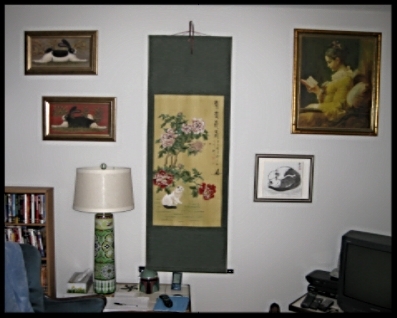
And then I noticed the mostly blank wall behind him. Since we moved in August, I’d been meaning to hang pictures on that wall, but I kept telling myself it wasn’t important enough to take precedence over everything else I needed to do.

But, I realized, I wanted to hang those pictures. Of everything I could have been doing in that moment, hanging those pictures felt like something I wanted to do. And, looking at the mostly empty wall, I realized that hanging the pictures — only that — was all I was called to do in that moment.

Just that one thing.

Back in August, during that last chaotic week before I moved to my new home, my friend Mary Montanye asked me via email how the moving preparations were going, and I told her I was mega-overwhelmed. She responded that when she was in the process of moving, she’d found it helpful to “just take the next indicated step.”

Those words spurred me on like you wouldn’t believe (thank you, Mary!). And yesterday, hanging the pictures and admiring them afterward, noticing how much more it feels like home in the living room now that the pictures are up, my mind began to quiet itself.
pictureshung

Pictures are up!

I was reminded that all I ever need to do is one thing. No matter how big the project, how sprawling the to-do list, I only ever need to do one thing.

And here’s the trick: Only when I am in the process of doing that one thing am I able to see clearly that it is being engaged with the process that I crave, not getting to the finish line or eliminating the task.

When I am caught up in thinking about all that needs to be done, and not actually doing the one thing that presents itself, I am disconnected from the rewards of the process of doing. I believe that the only reward comes from “having done it”.

This is why when I hear people say things like, “I hate writing, but I love having written,” something in me cries, but that’s no way to live! If we can’t find ways to make the process rewarding, we’re forever focused on the finish line, and therefore missing most of our lives.

And the process looks like this: one thing, one thing, one thing. (And yes, sometimes our “one thing” CAN be eliminating, or rescheduling, something on our to-do list! The key is in taking the action, rather than obsessing over it.)

I’m curious about how this works for you, and particularly about how you might apply “just one thing” to anything you have planned for the holidays.

And if, like me, you’re an introvert who’s needing a little more comfort and simplicity at this time of year, you might want to check out this post that I wrote last year at holiday time.

Top image © Jessie Eldora Robertson | Dreamstime Stock Photos

Bringing the joy back to your creative work

paintedheartRecently, a writer friend and I had a great conversation about what to do during those periods when you feel like the joy has simply evaporated from your creative work (or your life!). The talk got me pondering.

I love a broad definition of creativity: I believe it is, simply, the life force moving through us. So when we’re not feeling joy, something is going on with the flow of that life force.

Consider the following three things if you’re wondering where your “creative joy” went:

* Structure: do you need more or less?

As with everything, as we change and our lives change, so does our need for structure. Back when I worked at a job that required me to be in an office from 9 to 5, I felt that my life was too heavily structured. I didn’t have the amount of “meandering, puttering time” that fed my creativity. However: when I quit that job and had more free time, I quickly found that I needed to create more structure in my life or I felt sluggish and unfocused.

Both feeling overly structured and “understructured” can squeeze the joy from our creative work. (As I was reminded last weekend while watching the movie Next Stop Wonderland, that quote from Emerson is NOT “consistency is the hobgoblin of little minds” but “a FOOLISH consistency is the hobgoblin of little minds.”)

Consistency in and of itself can provide the daily structure we need to show up for our creative work — but we need to be tapped in to what kind of structure and how much we truly need (or we can get into that foolish consistency territory!). There is no question that our souls crave those periods of open, meandering, wandering time. If you haven’t had one of these for a while, see how you can go about scheduling one and notice whether you see your joy resurfacing.

(I went into more depth on the topic of structure here.)

* Support: do you need more, or different?

Support for our creative work is so important — and/but it must be the kind of support that works for us, not for somebody else. If you feel like the joy is leaking out of your creative process, take a look at the support you’ve built around it. Is there too little? Is there any at all?

Or, are you surrounded by voices that encourage you in ways that don’t quite feel like the kind of encouragement you actually crave? Are you calling something “support” that actually isn’t? (For example, does the writing group you joined offer feedback in a way that doesn’t work for you? Can you ask them for what you need and move on if you’re not able to get it?)

Or, are you suffocating in information masquerading as support? I’ve become very picky about what I read online. So often, less is more, and in the end, it’s myself I need to consult, not “the experts.”

(I delved more deeply into the topic of support here and here.)

* Sovereignty: do you have enough? Do your boundaries need strengthening?

Sovereignty means that you are the ruler of your own kingdom.  In other words, you decide what comes into your life and what stays out, through creating boundaries around your creating.

Many times when I’ve felt I’ve “lost my joy”, when I’ve looked a little deeper (or perhaps had a friend, coach, or other compassionate witness point out the obvious to me), what’s really happened is I’ve lost my boundaries. I’ve allowed the desires and needs of others to encroach on my own to the point that I’ve felt angry and resentful — which is pretty much the opposite of joy!

Or, I may be eroding my own boundaries by being mean to myself (here it can be vital to look at my thoughts and how they’re influencing the way I feel) or getting out of whack in the realms of Structure and Support. (See how it’s all connected?)

Karla McLaren says in her wonderful books that when we feel anger, the questions we need to ask are “What needs to be protected?” and “What needs to be restored?” Very often, the answer is boundaries. We need to reclaim our crowns as rulers of our creative kingdoms (or use whatever metaphor works for you there!).

(I wrote more on the topic of setting boundaries around your creativity here and here.)

Reclaiming joy is a huge topic, but just taking a look at one (or all three) of these areas of your life can be a great jumping-off place.

How do you bring the joy back into your creating when it’s slipped through the cracks? I’d love to hear.

And by the way, if you’re needing more structure and support for your writing, you might want to check out The Writer’s Circle (where I am both a coach and a longtime participant!). Registration for our next session ends July 16.

Above image © Egidijus Mika | Dreamstime Stock Photos

The difference between self-care and self-indulgence

strongtreesI have to admit that I’ve been pretty on edge lately. At times I feel unsafe. The house I rent is up for sale, and I know I need to move soon.

Being in limbo mode with my living space brings up all my “stuff” around safety, feeling like I don’t have a true home base, and, well, strangers. Strangers coming through my home and seeing all my stuff, deciding if they’re interested in living here themselves.

It’s weird and, somehow, it makes me feel like a little kid. It brings up the part of me that wants to hide out.

And so, I’ve had to practice extra self-care in order to stay sane, to feel safe.

I’ve had to remind myself, it’s okay, you’re an adult, you can take care of yourself with these strangers who suddenly show up.

I’ve had to pause and ground myself, remind myself to breathe, more than usual.

What’s interesting is how, because I’m also extra-busy right now, another voice comes up a lot.

It’s a high-pitched voice that snaps at me, “What’s with all this self-care stuff? Self-care? Aren’t you being just a little self-indulgent? I mean, look at all you have to do! And you’re letting yourself sleep an hour later than usual?”

This voice is old. Years ago, I thought “self-care” meant taking bubble baths and sitting on a cushion drinking tea. Or spa treatments. Or buying expensive moisturizers.

Self-care can look like those things, but what I’ve come to realize over the past twenty years is that it goes much, much deeper.

What I’ve also come to realize is what self-care is not: it’s not self-indulgence. There’s a big difference, but I think many of us confuse these two terms, which are most definitely not interchangeable.

I’ve mentioned quite a few times on this blog that in my twenties I developed a chronic illness and ended up in the hospital. Then and only then was my cynical twenty-five-year-old too-hip-to-do-self-care self forced to recognize that I had to take better care of me.

That’s all self-care is, really. It’s acknowledging that without putting YOU at the center of your life, there ultimately is no life that feels like you.

Many of the clients I’ve worked with over these past several years have had a pattern in common: feeling bad about not showing up for their creative work in the world as fully as they’d like because they just can’t make it important enough to put themselves front and center in their own lives.

Or: They’re doing their creative work in the world, they’re getting it out there, but they’re so overwhelmed and overstimulated from both the work itself and their interactions with others that they’re totally depleted and aren’t sure they can go another step on their journey.

Self-care, in my book, is about recognizing that YOU are at the center of any creative journey you’re on. Both when you begin the journey, and during it.

And yet, so many of us have a judge-y inner voice like mine that insists that taking good care of ourselves might just actually be, you know, self-indulgence.

How is self-care different from self-indulgence?

For me, “self-care” is about noticing what I am needing — truly needing — in the physical, emotional, and spiritual realms, and making it important that I provide it for myself.

The focus of self-care is not doing, but noticing and acknowledging — and then doing, if necessary. (Often, practicing better self-care means practicing un-doing!)

It’s the noticing and acknowledging piece that we tend to lose sight of in our driven society. And often, when we do notice and acknowledge, we don’t allow ourselves to know what we know about what we need.

Self-indulgence, on the other hand, is fueling the part of us that doesn’t notice or acknowledge what we need. 

Self-indulgence is buying six more sweaters when we already have fifty and only wear ten (I’m raising my hand here!) — and the buying of the sweaters feels like an avoidance rather than a coming home.

It’s eating or checking Facebook or staying on the phone too long or having an extra glass of wine or pushing ourselves to work longer hours in order to avoid checking in with ourselves.

It may feel good or “righteous” or like we “deserve it” in the moment, but in the long run it’s actually continuing to do something that hurts when we know it hurts us.

Self-indulgence can also look like committing to something, or someone, and only giving it half our effort, or half our attention. It can look like always holding back just that little bit so we’re never fully present to our lives.

Now, I do want to emphasize that a little indulgence is not wrong, and sometimes it’s exactly what we need. (Particularly if we have a tendency toward perfectionism, we may need to “balance ourselves out” a little with some indulgence.)

The key is to be honest with yourself. When are you crossing the line from enjoyment to making yourself sick with enjoyment (I’m thinking about French silk pie here) simply because it’s hard to be present with yourself?

When are you crossing the line from doing an extra hour of work on the book you’re writing to feeling burned out but forcing yourself to continue? That, too, is self-indulgence. It’s starting to hurt, not help, and you’re rationalizing doing it anyway.

Self-indulgence always has a seed of avoiding ourselves in it; self-care always feels like coming home to ourselves. That’s how we know the difference.

And so, all this extra grounding myself and focusing on my breath and allowing myself to sleep more than usual? I know it’s self-care because it feels like coming home. Which reminds me that home is within me, wherever I happen to be. It’s a great reminder when my external living space is in flux.

What challenges you about practicing self-care, especially during times of a lot of stress when you need it the most? I’d love to hear from you.

And, I have a new program called Stellar Self-Care (for Sensitive Creatives). If you’re wanting to put YOU at the center of your life, or get back to it, I’d love to be that support for you. You can learn more about the program, here.

Image is “Sunset at Peace” © Shannan Thiel | Dreamstime Stock Photos

Understanding the message of fear + new coaching programs!

shimmeryweb

When we try something new, or sense that change is on the horizon, or when we’re in a murky transition period that seems to have no end, it’s not unusual to feel varying amounts of fear.

Sometimes, though, the amount of fear we experience, well, scares us. (I’m reminded of the title of a song by Bauhaus: “In Fear of Fear.” That’s how it is sometimes!)

So I like to look at fear in two different ways (there are probably infinite flavors of fear, but this is a general distinction that is often helpful when fear’s got us confused or shrinking).

One kind of fear is what is sometimes referred to as “rollercoaster” fear.

You’ve got butterflies in your stomach, and your body is braced for an intense experience — but there’s a definite thread of excitement there. You want to go where the rollercoaster is taking you, even though sometimes it causes your stomach to drop to your feet or your heart to spring to your throat.

The other kind of fear feels different. You’re expecting an intense experience, but instead of butterflies in your stomach, you feel cement.

This fear weighs you down; it feels impossibly heavy; you don’t anticipate the rollercoaster, but even if you did you wouldn’t have the lightness of step to get on. This fear is entangled with a palpable sense of dread, and sometimes a feeling of “ick” or revulsion. You don’t want to go where it’s taking you.

We can become confused when we don’t take time to make a distinction between these types of fear.

How many movies have you seen where a character is about to get married, and confides to her best friend that “something doesn’t feel right,” and the ever-helpful friend says, “Oh, you just have cold feet. It’s normal to feel that way before taking such a big step.” And either the bride turns and runs back up the aisle and out of the church in the middle of the ceremony, or she goes ahead with the marriage and it’s a disaster.

This is a good example of that second type of fear, which can be an indication that something isn’t right for you on the road you’re about to take.

Now, here’s the tricky thing: It can also be an indication that something isn’t right in the way you’re thinking about the road you’re about to take.

So, it’s not necessarily as clear-cut as, “Oh, you’re experiencing a side of dread with your fear? That means you definitely shouldn’t get married!”

What fear combined with dread actually warrants is further inquiry into what is going on for you.

It could be that you don’t want to marry this person — ever. He’s wrong for you and that’s the awful truth.

But it could also be that you love this person deeply — but you don’t want to marry him.

Or, it could be that you love this person AND you want to get married — but not until you’ve gotten in contact with your estranged dad, because your heart sinks at the thought of ever being married without your dad in attendance.

We always have a good reason for feeling the way we feel (even if the reason doesn’t seem valid to our “logical mind” or our inner critic). When we hit on that good reason, we usually feel true relief, sometimes accompanied sadness. If your fear feels heavy or “icky”, this is a sign to stop and investigate before moving forward.

If your fear feels like you’re about to get on a rollercoaster (and rollercoasters thrill you rather than making you want to throw up), this is a good sign that you’re in for a wild ride and your essential self is up for it.

(It’s worth noting, though, that if, like me, you are highly sensitive, “good fear” can feel overstimulating, so make sure you have solid support and self-care as you embark on your journey.)

Speaking of support, I have a two new one-on-one coaching programs I’m excited to share with you (and yes, I do feel some of that “rollercoaster fear” in putting these programs out into the world!). There will be more to come on these programs soon, but for now, you can hop on over and learn about Light Up Your Creative Self and Stellar Self-Care Foundations, here.

What do you notice about the different “flavors” of fear, for you? How do you deal with them? I’d love to hear from you.

Above image is “Necklace” © Mihail Orlov | Dreamstime Stock Photos

Making friends with creative transition

making friends with creative transitionRecently I spoke with a client who had just completed a massive project that took several years of her life to bring to fruition. It was a huge accomplishment for her to send her “baby” out into the world, and she was really happy about it.

Except that … she also wasn’t. She also felt lost and … sad?

How could this be? This was the time she’d been waiting for! In fact, at points during her journey she’d sworn the project would never be finished and couldn’t wait for it to leave her hands.

Because this was the first creative project of this scope that my client had seen from start to finish, she was unprepared for the letdown she felt when it was done. And it was making her really nervous that she wasn’t sure what her next project would be.

She didn’t even have any ideas. She kept trying to grab onto opportunities that came her way, but none of them felt right.

What my client was feeling was so, so normal.

When we imagine finishing something big, we often envision the elation that will come with the accomplishment but we don’t realize that there is a sense of loss in finishing, too.

We get thrown into “creative transition.”

Our tendency during these times is to rush ourselves through them because they feel so uncomfortable.

If we rush ourselves through, though, we miss out on the opportunity to become the new “us” that the transition time provides. That’s what transitions are, after all — bridges or tunnels from one version of ourselves to the next.

It’s kind of like when we end a relationship. Most of us have had that experience of breaking up with someone and then (oh, crap!) getting back together with them a week or a month later.

What happened there? We crawled back into our former lives, not quite ready to go through the “deep cocooning”  process we must embrace in order to emerge as that new “us.”

This is okay. As Robyn Posin says in one of her wonderful posts, we’re never fully anywhere until all of us arrives there. (I’m also reminded of an episode of Seinfeld where Jerry compares ending a relationship to knocking over a Coke machine. It has to rock back and forth a few times before the whole thing falls over.)

So what can we do to make times of creative transition easier? Here are a few suggestions.

* Allow yourself to come down from the trip.

Recognize that at the end of a long creative journey, we’re often functioning — to some extent — on adrenaline. This is especially true if we have a bunch of deadlines to meet or events to attend in order to complete our journey and we’re (understandably) tired. Adrenaline will kick in to help us make it through.

Remember how badly you wanted the semester to be over back in college, and you got all your papers in and exams taken, and then didn’t know what to do with yourself for a few days? That’s because you were still pumped with adrenaline and it was compelling you to do something, anything! When we come down from that heightened state (which, by the way, is not healthy for us to remain in), we will feel more centered and present and at choice.

* Allow yourself to feel sadness and loss.

There is nothing wrong with you if you feel a sense of loss and even grief after achieving a huge success. It is part of the natural process of moving from one phase of life to another. It’s normal to enter a “liminal state” at this time, what Martha Beck refers to as “Square One.” (Martha’s wonderful book Finding Your Own North Star explains “Square One” at length.)

* This is an excellent time to cultivate curiosity.

As the sadness and loss mix with your joy at your achievement and wash through you, what’s taking your interest? What do you notice about the change in yourself from the beginning of this journey to now? As you move through your daily life, what are you needing? Comfort? Connection with trusted friends?

Journaling about what you’re going through can be a great way to gain more awareness of your current needs, and the ways your inner compass is pointing you to your next step.

* It’s okay to go slow — in fact, it’s best to go slow — at this time.

When you allow yourself slowness as you enter creative transition, you really get a chance to experience who you’re becoming and what this transition is all about (though that may not be totally clear to you until you exit the transition phase!). This time is an amazing gift and you’ll never get it back in exactly the same form again. So how can you find ways to savor rather than hurry it?

You may need support in doing this. Our culture does not encourage savoring and slowness. Trust that support is out there in the form you need it!

What have you noticed about creative transitions for yourself? Has anything in particular helped to make them easier for you? I’d love to hear from you.

And: These are the last several days (through March 31) to purchase my package of four coaching sessions as I will have new offerings up on my site soon (I can’t wait to share them with you!). The package of four saves you $75 and is a great way to get ongoing support from me. Take a look here to learn more!

Image is “Tunnel Under Railroad” © Peterguess | Dreamstime Stock Photos

Slowing down to speed up: embracing gentle on Valentine’s Day

Slowing down to speed up

I gave myself a Valentine’s gift today: the gift of sleeping in. I slept until 9:30 (though not without the usual 4 a.m. wake-up call from kitty!).

This was a conscious choice — I decided yesterday evening that I would allow myself to sleep in this morning, since I had nothing on my schedule early.

And there’s something about consciously choosing that makes a real difference. It was a much different feeling than, “Damn, I slept late! Now I’m already behind!” You can feel the difference, right?

I woke up having already honored myself (with extra sleep) the way I’d planned to. And I feel really happy that I actually put “allow myself to sleep in” on my schedule for the day. I made it that important.

As I mentioned a couple of posts ago, I entered 2015 with a feeling of burnout. And little by little over the weeks, I’ve been feeling myself move out of it, in teeny, tiny increments.

Small glimmers of new energy have arrived; I’ve been working with a wonderful mentor (Yollana Shore of Heart of Business) to expand into new directions with my coaching work.

Sometimes almost imperceptibly, I can feel myself moving forward in small but important ways.

But here’s the thing: When I start putting pressure on myself to move more quickly, I can feel myself shrinking back.

This has been a longstanding pattern with me — wanting myself to move more quickly than the whole of me can actually capably move.

I’ve learned something over the years that has been reinforced by my work with my coaching clients. Many of us have a “visionary” part of our selves that moves very quickly and can often manifest things in the physical world with a lot of speed.

But this visionary aspect of us is only one aspect. There are other parts of us, too, which may need to move at a different pace.

I learned this bigtime when I was in my mid twenties. I bottomed out on my inner visionary’s need for speed.

It wanted to move so quickly that it didn’t take the “slower” parts of me into account: the child in me who feels vulnerable and needs a safe space (and, as Julia Cameron points out in The Artist’s Way, the “inner child” is very much connected to the part of us that creates); and my (highly sensitive) physical body which can become overstimulated by too much activity and movement and needs slowness and quiet to recharge itself.

When I bottomed out, I developed a chronic illness which eventually put a halt to my ability to hold a job and to create at all. For much of my twenty-fifth year, I was too ill to function “normally”. My “new normal” was lying in bed or dragging myself down the hall to use the bathroom. I eventually ended up in the hospital, dehydrated and being fed through a tube.

When I came out of the hospital, the realization crept in over time that I had to learn to take care of the part of me that needed to move slowly.

I had to learn to accept — in fact, to love — the part of me that needed to move at its own pace (which to the visionary part of myself sometimes seems excruciatingly glacial).

The fact is, we are all touched by a constellation of components — heart, soul, physical body, genetics, our family history and any trauma from “back then” that may still get triggered from time to time, our changing needs and selves, our current and past relationships and the ways they affect us and we affect them, and the culture and environment we live in. Although we in Western culture are often encouraged to be “independent”, we are, without exception, interdependent.

And this means that, sometimes, in acknowledging the needs of all parts of us, we move more slowly than we’d like.

A while back I gave a presentation and after it a man in the audience came up and remarked on how gentle I was in answering questions from the audience. Yes, I am gentle when I sense struggle. But I’ve had to learn to be gentle. I learned it because it was necessary for me to be gentle with myself in order to grow.

I found during my illness all those years ago that the harder I was on myself, the more I demanded of myself that I get well quickly, the sicker I felt. I finally had to accept that I might stay sick forever, and I had to learn to be okay with that. Only gentleness — treating myself with kindness and softness, even though it felt foreign to me — allowed me to rest fully enough to get well.

I think, many years later, this learning is circling back around to me as I’m navigating the current transition in my life. And I’ve seen it in various forms with my coaching clients, too. The more I notice myself putting pressure on myself to move quickly, the more imperative it is that I allow myself to slow down.

This is especially true when we are going through difficult transition periods. We want to be out of them quickly because they are so uncomfortable, but the irony is that the more we try to rush them along, the longer they last!

So: I look around at my life right now and I notice that I am not sick. I notice all the ways I am better at taking care of myself than I was at twenty-five. I notice that I no longer hold my breath and leap in order to ignore the fear that comes with transitions. I notice I am more able to be present with what is coming up for me.

I notice that it is Valentine’s Day and I am in a loving relationship — and while I do have a significant other I love very much, that is not the relationship I’m referring to here. I am talking about me. My loving relationship with me. It’s been a long road and I look forward to where it leads next.

Wishing you a Valentine’s Day filled with love, whether you are spending it with yourself or with someone else. (And I love Robyn Posin’s article here, on “going only as fast as the slowest part of you feels safe to go”. Her site is wonderful.)

What do you notice about navigating transitions? What helps you move at the speed that feels right to all of you?

And: In the coming weeks, I will be making some changes to my coaching offerings. If you’d like to work with me in the current way, you can take a look at my offerings here.

Above image is “Valentine Ribbon” © Radu Razvan Gheorghe | Dreamstime Stock Photos

Your self-care bottom line

Your self-care bottom line

The brutal winter months always remind me of the importance of walking as a way of staying connected to myself. Mostly because, when the weather is really awful, I can’t get out for a very long walk, and sometimes I can’t get out at all because the sidewalks are simply too treacherous.

Walking is one of those “bottom line” activities that help me feel actively connected to myself. It’s about moving my body, it’s about watching my mind — detaching from it — instead of buying into everything it tells me, it’s about connecting with the people and animals I see on my walks (even if this is only to smile and nod “hello”).

When I don’t get a lot of walking in, I start feeling deprived and stagnant.

Walking is one of the “tent poles” in my daily self-care. Occasionally I’ll run into someone from my neighborhood who says, “I see you walking all over the place!” People have been telling me this for years and years. (And that’s kind of funny, because when I’m out walking, I feel invisible — I feel like “I” disappear and my focus is on my breath, on the world around me, on the next step on the pavement. Apparently I’m pretty visible when I’m feeling invisible — but that’s a topic for another post!)

Another tent pole in my self-care routine is journaling. About five days a week, I need to journal to connect with myself. It’s rare that I miss more than a couple of days in a row of journaling. I have so many filled notebooks I couldn’t even begin to count them, and it’s fairly rare that I actually reread old ones (though it can be extremely beneficial when I do).

Sometimes people ask me how I “make myself” do all this journaling, and I tell them I’ve never once had to “make myself” journal. It’s like the walking — I crave it, because it’s my process of connecting with myself, knowing myself better, and using that knowledge to forge my path in the world. And it goes beyond myself as well — just like with walking, when I commit to doing it, I feel like I’m more connected to the universe, the collective consciousness, the whole of everything.

Sleep — good sleep — is another self-care tent pole, and a truly foundational one. When I struggle to get good sleep (as I have been this week), everything’s a little (or a lot) harder. And I put eating well — in a balanced way that doesn’t overwhelm my system — and staying hydrated in there with the sleep tent pole.

The fourth tent pole for me is “do-nothing time.” This doesn’t necessarily mean that I’m actually doing nothing during this time. It means that I set aside some time every day where my intention is not to do but to be. The truth is, I might be puttering around the house, playing with my cat, or browsing Etsy during this “do-nothing” time. The important thing is that I’m not trying or striving or figuring things out during this time. The intention is presence.

I can reach this “being” place while walking or journaling, too — the difference for me is in the intention of simply being (which is different than the intention of moving my body or connecting with myself). I need to make sure I factor it in daily, even if it’s only fifteen or twenty minutes of “being” time.

So, my self-care tent is up, and there’s a lantern in it. That lantern is quality connection with — and support from — others. The reason I say “quality” connection is because I notice that if I don’t make a point of connecting with people I care about on a level deeper than jumping in and out of Facebook, it doesn’t necessarily happen. And during the weeks I have more depth of connection with loved ones — whatever form it may take, online or “real world” — I feel a LOT better, a lot more nourished and supported, and more able to pass on true support to others.

When I’m feeling drained, at loose ends, or like my life is insanely complicated, it really helps to check and see if one of my “tent poles” and/or my lantern have been consistently absent for a while. My self-care bottom line keeps me sane and reminds me that the only true power I have resides in the present moment, not in the past or the future.

What is your self-care bottom line? What are your absolute musts for taking good care of yourself and staying connected to yourself, on a daily basis? What do you notice about your overall sense of well-being when you practice solid daily self-care versus when you don’t practice it?

Image is “Vintage Raining Shoes1” © Pierrette Guertin | Dreamstime Stock Photos

On opportunities and trust

squirrel

This past week, I almost signed up for a course that sounded really good to me. In fact, it sounded awesome and perfect. I know the creator of the course is amazing, and I’ve been wanting support in the area of the course material, and the pricing was just right.

It seemed like a no-brainer, but when it came to signing up, I was on the fence.

The deadline loomed and I couldn’t make up my mind. A part of me was convinced that if I didn’t take this course I’d regret it. And yet I couldn’t get myself to press the sign-up button.

I became really curious about what was going on for me here. I noticed that my mind was telling me it sounded great and it might be just what I needed and it was so inexpensive how could I not take it?

But when I dropped down from my mind, into my body, the idea of participating in the course felt heavy, even exhausting. It felt unnecessary. You don’t need it, my body said.

My mind started chattering, but … but … it has all these things you’ve been saying you need! It’s a chance for more learning, more connection, more growth! And it’s affordable! What’s wrong with you that you’re not signing up? The deadline, the deadline …

I dropped down into my body again, and got this message: We have enough learning, enough connection, enough growth for now. For right now, we have enough. Nothing more is needed.

I sat with this and I began to feel how supported I already am — even though my mind often tells me that I need “more support.”

As the deadline came and went, my mind did a wild, frantic dance. How can you pass up this opportunity? You must be mad. Mad, I tell you! You are going to regret this, bigtime!

The saner, quieter part of me sat and mused about all the noise my mind was making.

I saw my mind’s belief that the “right” opportunity only comes once, and that if I don’t grab it, I will be filled with regret. Forever.

I saw my mind’s belief that the “right” opportunity could totally transform my life. Forever.

I saw my mind’s belief that I need more of what I already have. Learning, connection, growth. Even if, at the moment, I feel “full.”

Then I thought about how the “true right” opportunities for me have usually had an organic feel to them. Like there was no decision to be made; the decision was making me, as Byron Katie might say.

When I am heavily on the fence, when there’s a forcing quality to a decision, usually the timing is not right — or perhaps I do not yet have enough information about the opportunity. Or, maybe, I just don’t need or want it.

Sometimes, it is difficult for me to say “I don’t want that.” And maybe even more difficult to say, “I don’t need it.”

But … what if I want it later? What if I need it later, and I don’t have it?

This comes up for me a lot when I decide to donate clothing or other things (which I’ve been doing a lot of this year). I’m convinced if I let something go, I’ll later regret that choice, or I’ll suddenly really need it and be without it.

What if that were to happen? What if I decide to let go of something and later realize I want it or need it? What then?

Can I tolerate the feeling of wanting? Of needing? Can I find alternative ways to meet that particular want or need?

(What more typically happens, at least with letting go of material things, is that I let go and never think of them again. This is not always so for other, more complex types of letting go.)

As for the course I decided not to take, my body is still fine with my decision, whereas from time to time over the past several days my mind has had a little fit — you should have signed up! What might you be missing out on?

The truth is, right now I don’t know exactly why my intuition (body wisdom) guided me away from this particular course. I may discover why later (maybe another opportunity that feels like a true YES will present itself). But, as I’ve written about before, intuition doesn’t always give us a reason. It simply knows. It’s trusting it that’s the tricky part.

And there’s something here, for me, about trusting that my needs will be met — sometimes, often, not in the exact way I think they will be, but they will be met. How many times do I consume more than I need because I am afraid that at some future point I will be deprived of what I need?

I think about the squirrels I see out and about all the time now, burying sustenance in the ground for the cold winter months. I’ve read that squirrels often forget where they bury things. I am like this, too, stocking up on things just in case and then forgetting.

What do you notice about trusting in your intuitive sense of what is enough for you? Is it difficult for you, too? I’d love it if you’d share, in the comments.

Image is “Squirrel with Peanut” © Kathy Davis | Dreamstime Stock Photos

“I wrote to honor myself” ~ A conversation with memoirist Mary Montanye

MaryMontanye-w-credit-222x300

Mary Montanye is the author of the memoir Above Tree Line, which I had the joy of reading recently. To quote her website, it’s “the story of one woman’s spiral downward into physical and mental breakdown and her return to wholeness by courageously, and some would say recklessly, following her intuition.”

Mary and I got on the phone to talk about her experience of writing and publishing the memoir, and how she found support for the process of bringing it into the world. Mary is one of my fellow coaches in The Writer’s Circle, and she’s become one of my favorite people, too. I’m so pleased she took the time to talk with me, and my hope is that creators who are struggling to share their work with the world — or even to begin the process of creating — will gain courage and comfort from Mary’s writing journey.

You can learn more about Mary’s memoir (and read her terrific blog posts!) at her website, here.

Read highlights from our conversation below, or find the link to listen to our whole conversation at the bottom of the post (please note this more of a casual conversation, not a “formal” interview!).

* * *

Jill: I imagine some parts of this were much harder to write than others, emotionally.

Mary: Yeah, they were. And there were two things about that: Whenever I was getting close to writing something that I knew was gonna be really, really difficult, there were two things I did: One is, I reminded myself that all I had to do was write it. I didn’t have to share it; I didn’t have to publish it. There were many other reasons I was writing it. One is, I was learning how to write. Two, I was learning about me. I was honoring me.

That’s another thing, I think that many times writers have, somewhere in their childhood, been shut down. “Oh, we don’t want to hear about that,” or whatever. So, by me putting it down, I was honoring myself, and my voice, and my experiences, and my life.

So I told myself that, even if I choose not to publish this down the line somewhere, I still benefit. And when I did that, it made the writing of the hard stuff doable, and it also made it possible for me to be as honest as possible.

… And second of all, I told myself that even if I did choose to publish it somewhere down the line, I could remove anything that I didn’t want to have in there. If it was really too tough, if I was too afraid to have it out there, I would just remove it from the book.

And it ended up that I didn’t remove anything from the book. I mean, of course I tightened it … But it works to just let yourself do it, just write whatever. And then tighten, or delete.

Jill: So it sounds like there was a lot of permission to write it and not have to publish it, and then there was also permission to not have to put in those more difficult parts – that you could cut those out if you wanted to.

Mary: Yeah. I just had to constantly remind myself that, I have control over this. Just because I write it down doesn’t mean that I have to publish it. And it ended up that I did publish it, and actually, a lot of the fears that I had about that never came true: that other people would hate me, or judge me, or not want me in their life, or be hurt.

… I think you have to just bite off small pieces as you go along, and not think of it as some great big huge thing that’s gonna change the rest of your life, because that would be paralyzing. At least for me. But when I did it bits and pieces at a time, every piece that I did was beneficial.

And that even included the publishing. I mean, I’ve had people, especially younger women, that I never thought would even read it, say how much it has meant to them, and why. And that’s made it all worthwhile. This is why it was meant to be out there. And I can take fear.

Jill: So basically, then, it sounds like you were writing this for yourself. So would you say that if you had any audience in mind, it was just yourself? Kind of your own listening ear?

Mary: Yeah. Well, I also had a reader in that Mary [Allen, writer and writing teacher] was reading. She wasn’t changing things so much as she was just saying, “Tell me more about this. This is really interesting, could you write more here?”… So I had her as a reader, but she was a very loving, supportive, gentle reader. And in fact, having one person like that is really helpful in that she normalized some of this for me. Like, I was feeling so awful about myself, even this many years later, for doing some of the things that I did, and she would go, “Well, that’s really not all that bad.” And that sort of helped, too.

So I’m not saying never have a reader and just put it out there before you’ve ever had a reader, or never have a reader in mind. [But] have the perfect reader in mind: like, for a memoir, the most wonderfully accepting, gentle person that you could possibly imagine, who really wants to sit down and hear about your life, and not judge you for it. Because if you think about just a general “other” out there, like some big massive social media kind of other, it would be terrifying. I don’t know how anybody could write an honest memoir like that.

***

Jill: Another point that I wanted to bring up is self-care around this process of writing something that brings up so much stuff for us. That is bound to be emotionally taxing. And physically exhausting too, probably.

Mary: Yeah. Everything. Sometimes I’d just feel like all I wanted to do was go to bed. So I got to the point where I just let myself go to bed. You know, it’s okay. Or take time off, too. Take a week off. Or write something easier, write a little bit of history of the area, or something that isn’t like one trauma after another.

Jill: That makes a lot of sense. I think that as writers we can get into a mentally of, I’ve gotta sit there and I’ve gotta push through, especially maybe if we have some resistance coming up for us around a particular thing. And it sounds like you were very aware of your own exhaustion, and you must have had a lot of trust in your process in order to give yourself breaks when you needed it.

Mary: Well, I got it [trust]. I don’t think I had it right off the bat. But as time went on and I did it, I’d say, oh yeah, I’m noticing every time I write some really hard scene, that I don’t want to do anything but go to bed. Well, maybe it would be a good idea to just go to bed. It was through the process that I learned about me and what I needed, and what I could do and what I couldn’t. And that there was only a certain length of time I could write every day. About an hour, for this book, was it. When I got into editing, I could spend a lot more time, but the actual writing was not more than probably about an hour a day.

***

Jill: What would you say to people who have a story – or not even just a story but some piece of creative work, something they want to share with the world, but they’re feeling stuck or scared around that? Let’s say it’s a dream right now. It’s in sort of baby dream phase and nobody else knows about it, it’s just something they really feel strongly about but they haven’t taken any action to create it. What would be the first thing you would tell them?

Mary: Well, I would tell them first that, if they’re feeling this pull, this little dream, this tug, whatever you want to call it, that that’s your intuition saying that you need to do it. You don’t know why you need to do it, but there’s a tug there, there’s that intuition. I think we tend to ignore our intuition, and I’m somebody who doesn’t ignore her intuition most of the time.

And most of the time, or 99.9 percent of the time, I find out why it was important that I didn’t ignore it. It may not be what you think – it may not BE about publishing it in the world. It may be you’ll help one person. It may be that you will learn something about yourself that you need to learn. But whatever it is, the very first thing I would say is don’t ignore, don’t minimize the fact that we have that tug to do it. That would be my first.

And then my second would be to just begin. Don’t think very far in advance, and set aside some alone time where you won’t be bothered. And make it, like we say in the Writer’s Circle, make it sacred. And just begin. Simple. Twenty minutes, five minutes, ten minutes. And then just do something else the next day, and the next day. And just see where it goes. Because we can’t figure out in our head what the reason is. We can’t figure out the reason, we can’t figure out the end result. We can only figure that out by the actual doing of it.

So those would be my two main things. Don’t ignore, and then begin.

***

Check out the recording to hear more about Mary’s take on: being a writer who’s an introvert and a highly sensitive person; how Mary “discovered” she was writing a memoir; Mary’s process of sharing the draft of the book with people close to her; her publishing and marketing experience; and more!


Setting boundaries around your creative space: Part two

fence2

In Part One of this post, I wrote about how important it is to honor the transitions between our “creative space” and our time interacting with others. It’s recognizing those transitions (even if they happen very quickly) that allows us to set boundaries that support our creativity.

(And when I talk about creative space, I mean not only the period of time in which we are actually tangibly creating, but also our solitary reflecting/processing/being time — which is vital for so many of us.)

It can be difficult enough to honor our own commitment to show up for creating regularly, whether that’s journaling, painting, working on our business or writing a book. But what about when those around us don’t support us in our regular habit of creating?

This can be a truly frustrating place to be.

In Part One, I wrote about how when I was a child I had a deep need to go off by myself and write, draw, or simply daydream.

What I didn’t say in that post was that my family and friends were not always terribly thrilled with my doing this.

At a certain point, the people around me began encouraging me not to be so “introverted”, and before I knew it my life became a flurry of activity and achievement with hardly any solitary “being” time. In fact, it wasn’t until I was out of college that I actually — slowly — began to recognize my need for solitude and to — slowly — give it to myself.

And that took a certain amount of courage, in a culture that worships “busy” and “tangible goals.”

In fact, I remember frequenting a cafe when I was twenty-three and working at a bookstore. When I was done with work, I’d stop at the cafe, have a coffee, and do Natalie Goldberg‘s “writing practice” (I was a huge fan of Natalie’s books at the time and still am).

After I’d done this for a while, the owner of the cafe came up to me one day and said, “I see you here almost every day, writing. Are you writing a book?”

“No,” I said, “I’m doing something called ‘writing practice’.” I explained to him Natalie’s concept of writing as a daily practice, as a way of grounding and connecting with ourselves.

The cafe owner shook his head and let out a deep sigh. “This is no good,” he said. “You won’t get anywhere doing that.”

I could see the sincerity in his eyes and I honestly think he was trying to be helpful. But I never went back to that cafe. I felt stupid writing there after that.

And I didn’t even know the guy! When it’s our family or friends who don’t support our creative practice, that can really sting.

So what to do if those around us aren’t supportive, or even blatantly disrespect, our need for creative space?

This isn’t an easy one, but here are a few things that may help:

1) Reaffirm on a daily basis WHY it is important for you to have this time and space to yourself. When you’re regularly connected to why you’re doing it — at a deep level — it matters much less if others “get it” and support it.

2) In keeping with point #1, remember that others act as a mirror for our beliefs.

Part of the reason I was so bothered by the cafe owner’s statement all those years ago was because I had not yet owned the importance of my writing for ME. I wasn’t yet sure that I wasn’t doing something pointless by showing up to the cafe to write, so his words easily shook my not-yet-sound foundation.

Today, if someone were to say that to me, I’d probably be curious about his belief, but it wouldn’t throw me off balance (though I’d choose to be around more supportive energy). I’ve bitten down on the root of my need to write regularly so deeply that it doesn’t matter to me if a stranger questions what I’m doing.

3) Know that your commitment to your creative process may trigger those who want to do the same but just aren’t there yet. It may also shift your relationship with loved ones a little (or a lot). Remember you can always reassure them that this time is for you and that it will actually contribute to you having a better relationship with them. And let them know that it’s totally okay for them to establish their own creative practice, in their own way — you’ll support them in it, too.

4) Get clear on what kind of support you need. Sometimes our loved ones don’t know HOW to support us. It’s okay to tell them what feels supportive and what doesn’t.

5) Take note of the people in your life who DO support you in creating and seek out more of that support, whether that’s in person or online (preferably both as we can use true support in BOTH worlds!).

6) Be willing to let go of your need to be nice. I used to think I had to let go of certain relationships in order to feel more supported in my creative practice (and occasionally that’s been true). But I came to see that, more often, what I truly needed to let go of was my desire to be “nice” and constantly available for those relationships in ways that interfered with carving out my own creative space.

What do you have to add? How do you set boundaries around your creative practice when others aren’t supportive? I’d love to know.

Image is “Fence at Dusk” © Kurt | Dreamstime Stock Photos