On discomfort, sadness, and creativity

reflections

I recently reconnected with a teacher of mine, and, as I shared a frustrating experience with him, he reminded me of the importance of being able to tolerate discomfort.

Even thinking about “tolerating discomfort” makes me … uncomfortable. But I was so grateful for his reminder.

I wrote about allowing discomfort quite a while ago, and it’s a theme I revisit periodically. Because I forget: my mind gets busy trying to make things the way I think they should be SO THAT I am not experiencing discomfort.

But: what if the very discomfort I’m experiencing is exactly what I need to experience in order to grow into the place, the self, the life, I desire?

I am not saying that we should tolerate negativity or abuse or situations we can readily change by willingly acting on our desire to change them.

But sometimes there are situations we cannot readily change — they are not so clear-cut, and there may actually be nothing for us to “do” at this very moment. This is an uncomfortable place to be. It is the space of ambiguity, the (sometimes vast) gray area of uncertainty. Most of us will go to great lengths to not be here.

When I am feeling particularly crabby or “off” or I catch myself slamming into a wall again and again trying to make something happen, there’s a good chance that my mind is actively avoiding discomfort by trying to “move the furniture.”

(“Moving the furniture” is my metaphor for those times in life when there is really no clear action to take, but because fear has a hold on me, I try to do something — anything — in order to feel more control. In other words, the room may be perfectly fine and functional, for now, but I am moving the furniture here and there anyway, trying to predict how I’ll want it next month or next year.)

Something I’ve learned in these past few years of working with some very dear clients is that, frequently, when someone says “I’m stuck”, what’s really going on is an unwillingness to tolerate discomfort.

In an emotional sense, the feeling of stuckness is very real, because the unwillingness to allow the discomfort to be there creates a contraction in the body. It’s like rigidly setting your jaw or tensing your abdomen. There’s no flow.

What happens when we give space to discomfort? What happens when we are not frantically searching for the “right option” or course of action so we can get rid of it, but we simply allow it to be there? Just breathe into it, even for ten seconds or so?

I notice that, often, what is underlying my own discomfort is sadness. Just pure sadness.

This does not make me a “sad person”. Sadness, as Karla McLaren says in her book The Language of Emotions, is “the watery emotion.” It is about letting go and moving on.

We may feel a hint of sadness even about small “letting-go’s”, like finishing a book we’ve dearly loved reading, or donating some clothing we no longer want. And let’s face it, there’s not a lot of space for sadness in Western culture.

But these small sadnesses are part and parcel to letting go, moving on, sorting through what needs to be processed and integrated so we can allow movement and flow into our bodies and our lives.

Speaking of flow, I am experimenting with allowing tears more in my daily life. Obviously, not all situations are appropriate or safe for the expression of tears, but sometimes, tears are a totally good thing when I might normally stifle them, and I’m finding the expression allows people to feel closer to me and creates more real connection.

(I don’t mean I’m going around bawling. I’m just allowing the tears to come forth rather than forcing them back. Like, after I saw Hello, My Name is Doris last week, I let myself be all teary and emotional coming out of the theater, because I loved the character of Doris. In the bathroom, I looked over at the woman at the sinks next to me and saw that she, too, was wiping her eyes, and we shared this lovely, appreciative smile.)

***

Creativity is, at its most essential, the life force moving through us. If we are not allowing discomfort, if we are pushing it down and analyzing or strategizing in order to avoid it, there will be a deadness to anything we attempt to create.

You’ve probably felt it when something you’ve created is a little too “sterile” or “perfect”, with not enough feeling, not enough oomph!, not enough flow. Any chance you were trying to avoid discomfort in some way there? I know I’ve done this in my writing many times.

What do you notice about allowing space for discomfort in your life? What happens if you try it for ten seconds? I’d love to hear your experience.

Do you need support in making your creative work a priority in your life, in a way that works for YOU (not the way you think you should do it!)? I’d love to help. Find out more, here.

Above image © Gjs | Dreamstime Stock Photos

When “good enough” is plenty

coffeegrounds

My favorite morning ritual is to go for a walk and get coffee and then walk home. There is something about starting my day this way that just helps. Since I work from home, my “walk for coffee” is a transitional element — it smooths that space between waking and working.

But: the coffee at the places within walking distance just doesn’t really do it for me. Oh, there are many. Major chains, smaller independent places. But something is lacking in the taste of the coffee. It’s either too strong or too weak or it’s not quite the right flavor. Blah!

A few months ago I became obsessed with finding coffee that I could love. I was tired of paying for coffee I wasn’t thrilled with. I convinced myself that if I had better-tasting coffee to start my day, the day would go better. Like, way better.

So I decided to try just making my coffee at home. I did lengthy searches, read copious reviews, and found some fancy new flavors. And I was able to create the coffee I wanted, for the most part. And I felt satisfied. Sort of.

But: the walk. It was missing! And my morning walk is huge for me. It jump-starts my day. It connects me with the creative impulse, with birds, with squirrels and trees. It gets my body moving.

So: I decided I’d make my coffee at home, and then take it with me on my walk.

But: this didn’t work either.

Because: I like going into a coffee place and having that simple interaction with people. There is something about going into a place, talking to people a bit — just a bit, not too much — holding the door, that simple exchange — staring at the bulletin boards, smelling the coffee smells — I like all that. It connects me with the world. I need it.

So, I sat with this coffee conundrum, marveling that this seemingly small thing — really good coffee — had started to take up so very much space in my daily life.

And, eventually, I realized this: the perfect coffee just didn’t really matter that much.

Yes, it would be nice to have the coffee of my dreams on a daily basis, but it was the entirety of the experience I truly needed — walk/coffee/nature/people — and not really the coffee itself. Coffee was only one piece of a bigger thing — my foundational morning ritual.

I also realized something else: In preoccupying myself with my search for the perfect coffee, I was less available — even if only slightly — to the parts of my life that are more important to me. To the parts of my life where, perhaps, I need to take more risks and dial up my commitment. Or simply experience more presence, more of the “enough” of the here and now.

And so, I decided to let it go.

And you know what? Since I let it go, I am totally fine with my coffee, wherever I get it.

Sure, I will probably stumble on amazing coffee somewhere I don’t usually go, that is not near where I live (like the coffee they served at the Indian restaurant that went out of business!), and I will wish I could replicate that taste somehow.

But while fulfilling my desire for the perfect coffee would be nice, it’s not essential.

When it comes down to it, I’m okay with coffee that is good enough.

***

The coffee example is a simple one, but I see a version of this a lot with my clients, who sometimes feel like they need to hit upon the perfect product, or class, or book, or coach (or, in some cases, life path!) in order to feel like they’re really on their way.

While it is important in certain cases to find a great fit, sometimes it’s okay for the fit to be “good enough.”

(If we’ve struggled with perfectionism, and its shady sister, procrastination, we may use a tendency to hold out for the “perfect fit” as a way of keeping ourselves from showing up in ways that scare us. Check out the categories on the right to find my previous posts on perfectionism. )

Pouring energy into these non-essential areas may seem like a small thing, but it’s actually a huge drain on our creative energy to search for perfect when we already have enough.

And even when we are dealing with an area that is truly essential, like a central relationship or the pursuit of our soul’s work, the “search for perfect” can serve as an exquisite distraction from what is already available to us.

Do you see areas like this in your life,  where you’re looking for perfect when “good enough” would suffice? I’d love to hear how you experience this.

Need some support in making your creative work a priority in your life? I’d love to help. Click here to see if we might be a good fit. 

Above image © Dana Rothstein | Dreamstime Stock Photos

When the ideal meets the real

idealreal

One thing getting into my forties has shown me is that a lot of the “ideals” of my twenties and thirties haven’t truly meshed with “the real”.

Now, when I say “the real” here, I’m not necessarily talking about “the real world” — not exactly. I’m talking about what is, when it comes down to it, real and true for me for the whole of who I am.

It’s easy for me to hang out in the land of the ideal. I remember one time, in my twenties, I was explaining to my therapist how disappointed I was in someone I was dating. She nodded and smiled and said, “As usual, your standards are very high.”

She didn’t say it with judgment at all, but with love — in fact, because I felt very accepted by her, I took it as a compliment. (She managed to say this when she could finally get a word in — at least once a session she would have to hold up her hand and say, “Jill, excuse me, may I say something?” Introvert that I am, when I am feeling safe, I can talk and talk and talk.)

I did have high standards — but I think it’s more accurate to say I had certain ideals that I was absolutely certain I needed to live by. And, as life plays out, as we live it, sometimes those ideals crash upon the shores of the real.

It’s not that the ideals are ridiculous or naive (as certain adults used to tell me about my “big dreams” when I was a teenager). It’s not even that the ideals are unattainable (sometimes ideals are very possible for us, especially when they are in keeping with our essential selves).

It’s more that reality provides constraints for our ideals to push up against.  And that who we think we are when we connect to certain ideals may not be who we truly are — or maybe it is, but we change, and our old ideals start to feel more punishing than inspiring.

And this is not a bad thing (though tell that to my twenty-five-year-old self!). In fact, creativity often thrives within constraints. (Why do we need to be creative if there’s nothing to work out, nothing to understand, nothing to make better or see more clearly?!)

When the ideal meets the real, that is when we get to know who we truly are.

I wrote several years ago about my early dream of being an actress, and how I discovered over time that the life of an actor was really not the life I wanted. If I hadn’t given it a shot, though, I never would have understood why.

The reality of me is that I’m much more a writer than an actor. And, as I’ve brought my “ideals around being a writer” into reality, I’ve also learned a lot about what kind of writer I am, and what kind I’m not. I’ve learned a lot about what writing means to me, and what it doesn’t. (In other words, I’m more than a writer. “Writer” is one aspect of me, and writing is a tool through which I express the whole of me. And I’m still learning here.)

***

Spiritual teacher Adyashanti has said that you can have all the ideals you want, but it’s your life experience — your daily reality — that shows you what is true for you.

I had to confront this in my relationships for a lot of years. Although I said I wanted to be with a partner who was fully there for me, the people I allowed into my life back then weren’t really partners at all — they were never truly available to me.

Reality for me clashed with my ideal — what was true for me, I came to see, was that I didn’t really want a partner who was actually there — I wanted the idea of a partner.

It took a lot of peeling back the layers of my ideal for me to comes to terms with what was real — and true — for me. (It’s extremely common in the work I do with clients for them to test out an ideal and discover that they liked the idea of it, but the reality of it is not necessarily a good fit for who they truly are. This is wonderful news: now they get to see what it was in the essence of that ideal that they wanted. Very often, it is the essence we crave, not the actual thing itself.)

If you find your reality pushing up against an ideal, ask yourself:

• What is it about this ideal that inspires me, that moves me? Is there a way I can have the essence of this in my life without needing particular external circumstances?

• Does this ideal even fit me — the real me — anymore?

• Do I simply need more support in order to really live this ideal in my daily life?

What do you notice about how your ideals mesh with reality in your own life? I’d love to hear how this works (or doesn’t!) for you.

This is tough stuff. If you’re in this space and needing support, check out my options for one-on-one coaching and see if you think we might be a good fit. I’d love to help.

Above image is “Clouds Floating Along” © Marilyn Barbone | Dreamstime Stock Photos

Squirrel wisdom (or, the power of a good question)

squirrelfoodA couple of weeks ago, I was sitting at my kitchen table with my journal, and I paused to stare out the window. It was cold out, bitterly cold, and I watched a squirrel make her way up a telephone pole across the parking lot with a frozen piece of hamburger bun.

When the squirrel had made it almost to the top of the pole, just inches from the wire she wanted to access in order to make it across to the tree branches many yards away, she dropped the bread. I watched it plummet — its trajectory was swift, and it bounced twice on the pavement.

On realizing she had dropped the bread, the squirrel immediately — and I mean immediately — turned around and started down the pole to retrieve it. It took her a while; eventually, she got to the pavement, located the bread (which was about twice the size of her head), put it in her mouth and headed back up the pole.

The squirrel had very little — if any — reaction to her loss of the bread. She simply noticed it had fallen and recalculated.

But here was my reaction, from the kitchen window: Oh my God! All that work and she drops it! Poor squirrel! What a hard life she has in the winter! It’s not fair! All that work just to get a scrap of bread! What if she drops it again? What then? Why is life so hard?

I watched as the squirrel made it up the pole a second time, this time without dropping the bread. She balanced with it on the wire and managed to reach the tree branches, at which point I stopped observing her because I couldn’t bear to see her drop it a second time. If she did, that would mean … what?

I was making the squirrel’s dropping the bread, or potentially dropping the bread, mean all sorts of things. Bad, sad, things.

But the squirrel wasn’t making it mean anything. She was just going on with life, not shaking her little squirrel fist at the heavens and saying, Woe is me! What a pitiful squirrel life I lead, dropping bread left and right! How will I ever eat? I am so incompetent and life is unfair to me!

What are you making it mean? is one of my favorite questions ever. I learned to employ this question during my life coach training back in 2010, and once I learned it I didn’t know how I’d lived without it. It’s probably one of my favorite questions to use with my clients, too.

Our thinking is often automatic. It bypasses our conscious awareness and, before we know it, we’re off into all kinds of stories.

Notice what I did when the squirrel dropped the bread? My mind just went there. It applied all my human concerns to the squirrel and her squirrel-ness. It took maybe three seconds — if that — for my mind to go from noting that the squirrel had dropped the bread to asking an unanswerable question: “Why is life so hard?”

It’s worth it — so worth it — to slow down and observe our thinking. We can’t stop our minds from spewing out thoughts — some research shows that we think thousands of thoughts per day — but we can step back and notice how what we’re thinking is affecting us.

Sometimes (often!) I respond to myself the way I did to the squirrel. Something doesn’t turn out the way I wanted it to, or it’s harder than I thought it would be, and my mind is off and running — I shouldn’t have tried, what’s the point, that was so hard there’s no way I can do it again, why is life so unfair? 

It’s not bad, or wrong, that I have these thoughts. It’s what minds do. The not-so-great thing is when I believe them and take action (or not) accordingly.

When the “bad thing” happens, when I drop my proverbial bread, this is where What are you making it mean? can be a really helpful question to pose to myself. (Notice the difference in feel between this question and a profoundly unhelpful question like “why is life so unfair?”)

Humans are not squirrels, and not meant to be, but I’d like to become a little more like the squirrel. A little more undaunted, a little less self-pitying, a little less thwarted by inevitabilities that have absolutely nothing to do with me. Life is unfair (okay, I guess you can argue that thought, if you want to!). But the squirrel in her squirrel-ness reminds me that what I do with that fact is up to me.

(Two of my favorite resources for noticing and working with my thoughts are Byron Katie’s The Work, and Brooke Castillo’s Self-Coaching 101.)

What are you making it mean? I’d love to hear what you notice about how your reactions shape your world. (Noticing is always the first step!)

Need some support in bringing your creative work into the world? Check out the ways we can work together, here.

Above image is “Squirrel Food” © David James | Dreamstime Stock Photos

How distracting yourself can get you unstuck

colourtube

Sometimes we can find ourselves in a cycle that looks like this: We’re pushing and pushing to get something done, but it’s not working, no matter how hard we push.

Then we ask ourselves, “Why isn’t it working? What’s going wrong?”

Our minds start looking for what’s wrong and find that it’s all wrong. (If we look hard enough for something, we will definitely find it.) The project is wrong, the way we’re going about it is wrong, we are wrong. Our lives are wrong. Wrong! Where did it all go wrong?

We get discouraged with how wrong it all seems, and we think, “Well, maybe it’s my attitude. I just need to try harder.” So we push ourselves, and the whole cycle continues.

Western culture is in many ways a “push” culture, which values moving forward at all costs.

One thing that can result from too much pushing is a feeling of stuckness.

Ideally — when I’m really “on track” — I’ve noticed that I feel pulled toward what I want, not like I am pushing myself toward it.

This is not to undervalue “push” energy, as it’s certainly necessary sometimes (it’s just not a great way to live all the time).

A lot of what’s going on with pushing ourselves is that we’re pushing so hard we’re losing sight of why we’re doing something in the first place.

And that’s why — in addition to pulling back and gaining a broader perspective, which I wrote about in my last post — an important element to moving out of a feeling of stuckness can be shifting focus. Or, to put it another way, distracting yourself.

Yes — that means stepping away from what you’re trying (unsuccessfully) to do, and doing something else. Anything else. Resist the urge — for the moment — to try to “figure out” why things aren’t working, and just do something else.

This can work on the smaller scale or the larger scale.

On the small scale, it might look like calling it quits for the day with that chapter you’re wrestling with and attending to the email you’re feeling called to write to a friend.

On the large scale, it might look like putting the major project that’s feeling incredibly draining on hold for a month and immersing yourself in a “fun” project.

This happened for me years ago during grad school when I felt a lot of heaviness around my thesis material. At the end of a summer, when I had a brief break from course work, I found myself super-inspired by these little cat paintings I saw artists doing on a certain auction site at the time. And it occurred to me that — for fun — I could try to do a little cat painting of my own.

I did one late on a Friday night, painting into the wee hours, and it was so much fun I did another one, then listed them both on the site for very low prices. Just for the hell of it.

My sister called the next day — she was always checking on my listings back then, as we sold used clothing a lot — and said, “What are these paintings you have up? One has a bid on it!”

Yep, my little painting I’d done “just for fun” had a bid on it. Someone wanted to pay actual money for my little experiment.

This was the beginning of a period of a year or so where I made lots of little cat paintings and sold them. One ended up in a coffeehouse in Seattle. One ended up in the home of an octogenarian with six cats who lived in England. It was so much fun selling my little paintings and learning about my customers.

And what I discovered during this time was that part of the reason I’d gotten so stalled on my thesis material was that I’d lost touch with what had mattered to me about writing in the first place: it felt fun! I liked it!

I’d gotten locked into “serious grad student” mode and felt like my writing had to be big and important. I still struggled with those feelings (and sometimes do now), but doing my little paintings reminded me that there was much joy to be had from the small, the simple, the cute and the fun.

That thing I was truly seeking — connection with dear, kindred souls — was available to me by doing ordinary things with extraordinary care. (I wrapped my cat paintings in pretty tissue paper and tied them with ribbon and wrote personal notes to each of my customers. I loved responding to messages from my customers and hearing their stories about their cats.)

***

Anne Lamott tells a story in her book Traveling Mercies about her car breaking down when she and her son were on the way to visit a dying friend. When all was said and done, it turned out she wasn’t able to visit her friend until a few days later than she’d planned.

Somehow,  thanks to the “distraction” of the car situation and what it brought up for her, she was able to show up for her friend with more true presence. “I still did not know what was trying to distract me so it could get itself born,” she wrote, “but I felt happier than I had in a long time.”

Sometimes we need to distract ourselves so that we can get out of our own way.

I think this is what happened for me when I was drawn to making small, simple paintings of cats. I needed to get out of my own way.

Getting out of our own way in this sense is not the same thing as procrastination (though our culture — oh, our culture! — will try to convince us that it is, that there is nothing of value in ceasing to push.)

Challenge the culture. Allow your life to be a grand experiment that always leads you back to your core.

Need some support on your grand adventure? Through Feb. 29, my one-on-one coaching sessions and packages are at special prices, in honor of The Year of the Monkey. (Monkeys are a spirit animal for me — they are the guardians of fun and play, which my serious, driven side badly needs to stay connected with.) Find out more here

Above image is “Colour Tube” © Esra Paola Crugnale | Dreamstime Stock Photos

Are you pulling back enough to gain perspective? + special February coaching prices

eagle on beach

Scroll down to learn about my special coaching prices this month, in celebration of the Lunar New Year!

One thing about my many, many years of journal-keeping is that certain patterns — truths about the way I live my life, the behaviors I resort to when I’m under stress — show up with (sometimes frightening) regularity on my quickly-scrawled pages.

One of these truths about myself, which I don’t necessarily like but am coming to terms with, is that I have a tendency to keep moving things ahead even when they’re not working.

It makes me feel virtuous to check off my daily to-do list, to be there for others, to get things done that feel hard. And, I also truly love these things — when they feel deeply right.

But sometimes, I have a creeping sensation that something isn’t quite right, and, in the interest of getting my work done for the day, I don’t actually step back and ask: Is this work, you know, working? Is doing this stuff contributing to what I desire in the long run?

I had a conversation with a friend recently where I told her about this tendency of mine to keep hanging in there, to keep moving something ahead, even though it’s not necessarily working for me, even though I badly need to press the pause button.

And she said, “Wow, you know, I think of you in exactly the opposite way. You always remind me of how important it is to focus on what really matters and to take time out to be present.”

Ack. Apparently it’s true that we teach what we (desperately) need to learn.

The truth is, I’m a lot better at stepping back and focusing on the big picture than I used to be. In my younger years, I felt like I was constantly on fast-forward. I have no idea what I looked like to others, but I had a huge fear of stopping and looking around.

I became monumentally out of touch with my own feelings, and it was only an illness at twenty-five that really slapped me into the reality of what was true for me: I needed to stop pushing, to stop trying so hard to be there for others, and to allow myself to simply be. Not just once in a while, but as a regular practice.

But, it is always a process, and many years later I still get caught up in pushing myself forward when, in fact, what is required is a giant step back.

those icky patterns show up on the pages of my journal

those icky patterns show up on the pages of my journal

Obviously, moving things forward is vital, but the best way to do that is through what we coaches call inspired actionaction connected to what is in the best interests of our essential self — not simply action for the sake of it.

And this can be truly challenging when we live in a society that rewards us for taking lots of actions, for “just doing it.”

***

Last year, I made the painstaking decision to move into a smaller home. It’s a lot smaller. (I wrote about this journey here.)

It was a complicated situation, but a defining aspect of it was that I was expending a lot of physical, mental, and emotional energy trying to keep up a house that, in the long run, I just didn’t actually want to live in. In the final analysis, I had to admit I just didn’t care about the things that came with maintaining a house.

I would look around at friends and think, well, they do it. It’s worth it to them. And I’d wonder if there was something wrong with me that I wanted to go back to small apartment living, at my age.

But when I thought about moving into a small apartment, where upkeep would be minimal, where maintenance would be taken care of by someone else, where I could feel like each room and each object was well-used and appreciated, I felt all lit up inside. It was my truth, even if it wasn’t somebody else’s.

It took me a long time, though, to actually pull back from my daily existence enough to see this truth.

And it was care of the house, in part, that distracted me from the truth. Whenever I got everything else done, there was always snow to be shoveled, or leaves to be raked, or a flooded basement, or an attic fan that needed repairing. But isn’t this what you’re supposed to do? I’d think. Grow up and take care of a house?

***

Martha Beck, in her book Finding Your Own North Star, talks about the difference between “mouse vision” and “eagle vision”. Mouse vision takes care of the small details that help us get things done each day. Mouse vision is very important, because it is only through tiny, individual steps that we make our way to completing our “big things.”

Eagle vision, on the other hand, is about the big picture — it’s soaring above the landscape so we can get a sense of the whole scheme and notice what needs attending to, what needs to be let go of, and when we need to fly in a slightly (or dramatically) different direction.

It’s easy to get stuck in mouse vision. If you find yourself saying things like, “I can’t believe how the years are getting away from me,” it’s likely that mouse vision is a little too much at play in your life.

Something I’ve noticed while working on novel drafts (which I will get into more in a future post) is that it is really important to be able to flexibly switch between mouse vision and eagle vision in the creative process. Just like in my life, I’ve had a tendency to push my writing forward even when something nags at me, raising its little hand and saying, “Hey! Something’s not working here!”

It feels so virtuous to keep plugging along, to write more words, to check that off my to-do list! Who wants to pull back and look at the work as a whole? Do I get a gold star for doing that?

But it’s so necessary, in our lives as well as our creative work.

How do you know it’s time to pull back and embrace the big picture?

• You feel like you are drowning in the day to day. It feels like you’re just going from one thing to another, putting in the time.

• You feel disconnected from yourself, or your creative work.

• You find yourself getting really angry when you have to perform certain tasks. (When I was living in the house, there came a point where any time something broke — the dryer, the lock on the front door — I felt like I was ready to kill somebody. This kind of anger is a sure sign that something needs to change.)

• You start to get sick of hearing yourself complain about the same things, over and over.

The next step — as always! — is acceptance. This is where you are — and change is totally possible. What does a shift to a broader perspective reveal to you?

If you’re a little too entrenched in “mouse vision” and you’d like some support, I’m offering a package of three thirty-minute coaching sessions through Feb. 12 (this Friday). I don’t regularly offer thirty-minute sessions, so if this way of working with me appeals to you, I encourage you to check it out!

Also, through the end of this month, my 60-minute sessions and packages are at special prices in celebration of The Year of the Yang Fire Monkey! Find out more about this and my other coaching offerings here.

Eagle image © Cecilia Lim | Dreamstime Stock Photos

Permission to do it differently + last day to grab an Autumn Transition coaching session

coffeebeans

Scroll down to learn more about my Autumn Transition Coaching Sessions — the deadline to sign up is today!

Sometimes (often) I get really, really attached to the way I’ve always done something.

Like, when I was in my twenties, I wrote in coffeehouses a few times a week. It worked really well for me. I loved the hum of activity around me and the human company. I loved watching people walk by the window and the bottomless-cup-of-coffee served by a particular place that I went to most often.

But by my late twenties, the coffeehouse writer thing wasn’t working for me so well. I found that I was too prone to socializing when I wrote in a coffeehouse, and that the socializing felt exhausting rather than enlivening as it had when I was younger. I also found that the bottomless-cup-of-coffee wasn’t good for my body, but if it was available, I was likely to succumb to it.

For a while, I kept on trying to write in coffeehouses. But it just didn’t feel the same as it had. It just didn’t work. How could what had worked for such a long time — and helped me create a solid writing practice — no longer be helpful?

The answer is, I don’t know. My hunch is that my journey as a writer, as a person — as me! — changed. I no longer needed the particular brand of community and company and ritual that I got from the coffeehouse writing experience — I still needed to experience those things, but in new ways, and I craved a quieter, more solitary connection to my writing and myself.

A friend of mine who is a frequent blogger and who also has another job used to crank out a blog post on her lunch break three to four times a week. For a long time, this worked really well for her. She committed to doing it and showed up and did it.

And then, over time, it began to not work so well. She felt empty and distracted when she showed up to write. She wondered if perfectionism was getting the best of her and she was just becoming too picky about her topics. She wondered if she’d run out of material. She figured if she could just push herself a little bit harder, she could keep making it work.

Then one day we were talking and she said that she’d realized her days of cranking out three to four blog posts a week while at her other job were over. Like me with the writing-in-coffeehouses thing, she’d kept on trying to do what worked before, but it no longer did.

It seems it’s a human tendency to hang on to “what once worked.” We do it with rituals, and relationships, and jobs, and rituals within relationships and jobs.

And I’ve come to realize that the important question to ask, sometimes, is not why is it no longer working like it did before? but why am I trying so hard to make it work like it did before?

Because so often what we actually need is not to figure out how to keep doing it the way we once did, but permission to do it differently.

My hunch is that much of this boils down to identity. Our rituals and routines and the things we’re able to achieve regularly contribute to our feeling of who we are. And when we begin to perceive that they’re not feeling so good anymore, we wonder who we are without them.

Eventually, I gave myself permission to do my writing at home — even though I was afraid it would be boring and tedious and that that meant I was becoming boring and tedious (oh, the things I worried about in my twenties!). And I discovered that the truth was something far, far different.

And my friend has found that it feels a lot better to write one blog post a week (and that she is shifting to new subject matter, which feels both exciting AND like she’s not quite sure who the heck she is right now, and, as we like to remind each other, that’s totally okay).

If you find yourself attempting to do something the way you always have and it’s just not working, what if you simply gave yourself permission to do it differently? What if it was totally okay to let go of that old routine and do something new? I’d love to hear how this works for you, in the comments.

And if you’re in the U.S., I wish you a very happy Thanksgiving, with much to give thanks for.

Also: Today is the last day to grab one of my low-cost Autumn Transition Coaching Sessions. These thirty-minute sessions are only $39, and the deadline to sign up is midnight Pacific Time tonight. If you’re experiencing a lot of change in your life right now and feeling stuck, scared, or just plain confused, I’d love to help. Find out more here.

Above image © Johanna Goodyear | Dreamstime Stock Photos

The difference between “ready” and “comfortable”

gorgeous fall

Scroll down to find out about limited-time Autumn Transition Coaching Sessions. 

As I am settling into my new living space, I notice how satisfied I feel with this change. Being in this new place during the gorgeousness of fall, my favorite season, is lending a brisk beauty to this season of my life.

The other morning I was up with my cat at 4 a.m.  — he is a night prowler and shelf-climber, unfortunately (at least it’s unfortunate at that time of day). Even though it’s a drag to get up and monitor him at an insanely early hour, I often have insights at that time of day/night. (Isn’t 4 a.m. known as the witching hour? Hmm.)

The insight that came to me that morning was that, as with all the changes in my life that have felt most “right”, this move to a new home happened when I was ready for it, and not a moment before.

Now, what do I mean by “ready”?

There’s an idea out there in the world right now about “starting before you’re ready.” That if we wait to be “ready,” we’ll never begin.

I understand this concept, but my experience tells me something different. And I think it has to do with what is meant by “ready”.

I would say, “Start before you’re comfortable, but don’t start before you’re ready.”

For me, deep, true “readiness” has a feeling of acceptance attached to it.

With moving to this new home, for example, I wasn’t entirely happy about the change. For a long time after I began to perceive that it was going to be necessary for me to let go of my old home, I felt a lot of resistance to that idea.

About a year and a half before I made the move, I looked at apartments in the very building where I now live, and I had a feeling of wondering. Hmm, I wonder what it would be like to live here. I really like this street. I have a sense that I’d like to live here.

But: I was nowhere near ready to make a move at that point. My attachment to my old home was still so great that even thinking about a “real move” filled me with grief, exhaustion and overwhelm.

At that point, all I was ready for was wondering about where I might want to live next. The idea that I should be “more ready” to make a change than I actually was created lots of stress for me. (Funny how it’s always easier to see these things in retrospect.)

The shift for me came this past March or so, when I realized that even though things were still very much up in the air with my living situation and I was enduring frequent house showings, it felt right to simply be where I was. I stopped scrambling. I decided that despite the uncertainty of my situation, I was going to fully enjoy my home for as long as I had it.

And, from that place of full acceptance, I began to become truly, deeply ready to make a change. By June, my boyfriend and I had found our new home and we knew we would be moving in August.

But moving — despite feeling more truly ready for it — was not comfortable.

As I wrote previously, I had a ton of downsizing and letting go to do, on a number of levels. Aspects of that felt excruciating, not just from an emotional standpoint but from a logistical one.

And sometimes, in my new “streamlined” existence, I am still uncomfortable with the fact that I go looking for something that was part of my life for a long time and realize I donated it back in August. Or, now that my boyfriend and I do not have separate office rooms to go to, we sometimes feel on top of each other when we are trying to work. This change is not comfortable, even though I wanted it, I chose it.

pumpkintrio

Happy Halloween!

Another example: Back when I finished life coach training in 2011, a number of my fellow “cadets” began to go through the coaching certification process. My mind started in on a familiar loop: “Look at them! You’re falling behind. Hurry up and get certified!”

Luckily, my training had taught me to question my thoughts, and in doing that I realized that, deep in my bones, I was not ready to apply for certification. I wanted to do more coaching first. I wanted to “get” coaching at a deeper level before I went through the certification process so it would actually have meaning for me, rather than just feeling like a “should”.

This feeling came from a different place than the “never-quite-good-enough” thrust of perfectionism. It simply felt right to me to wait to get certified.

When I did go through the certification process, in November of 2011, I felt ready, but it was not comfortable. I still had all kinds of doubts and fears, but the way I knew I was ready was that I was not attached to the outcome. The process of certification was so “real” to me by this point that, even if I didn’t get certified, I knew what coaching meant to me, and I knew that I was a good coach. I’d walked coaching into my bones, and certification felt like a natural evolution of that process.

And, as it happened, certification went beautifully for me. But it wasn’t comfortable. I had all kinds of anxiety around it, but it was a different kind of anxiety than I would have had if I’d forced myself to go through the process six months earlier than I did, just as I would have had a different kind of discomfort around moving if I’d made myself do it a year earlier, just to end my discomfort!

(One of the most poignant things I’ve learned about humans since I became a coach is that, so often, in our hurry to end our discomfort, we create even more discomfort for ourselves. Then we look back and wonder what in the world we were thinking.)

What do you notice about the difference between the times you’ve felt “deeply ready” to make a change and the times you started too soon? Has being “ready” felt comfortable for you? I’d love to hear your experience.

Plus: In celebration of Halloween and the beauty of fall, I’ll be offering 30-minute Autumn Transition coaching sessions for just $39, now through November 25. If you find yourself in deep transition and not quite sure how to navigate your next step, I’d love to help. Find out more about Autumn Transition Coaching Sessions, here.

Above images © Jill Winski, 2015

How moving is bringing up my stuff (literally)

sullivanshelfsitter

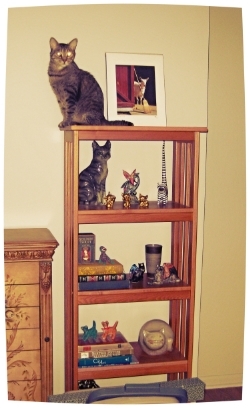
Sullivan claims his “right size” at the top of the hierarchy of our new home.

It’s been a month since my last post here, and for good reason: I moved to a new home two and a half weeks ago.

Well, sort of moved. I’m still somewhat in transition between the old place and the new — living in the new place, but going back regularly to the old to sort, organize, and get rid of before the place is officially sold. In other words: There’s a lot of letting go going on right now.

I lived in the house for ten years. When I first saw the second floor apartment (it was a two-flat), I had this inexplicable feeling of being home, and I knew I wanted to live there.

There are a number of complex reasons for my leaving the house, but let me just say that, over time, I have become the sort of “default” property manager.

And, as a friend of mine once wisely said, “houses are very greedy.” Especially old houses (this one was built in the 1880s). Although the house is in good shape for its age, its care, ultimately, has felt like too much for me to manage.

Still, I hung on until May, when some offers were made on the house and it became real to me that I really could not stay.

I am in a place in my life where I want to travel a bit more lightly in the physical world — and that means, less house and less stuff. But, as it’s becoming painfully clear, oh, do I have stuff!

***

When I moved into the house, I had been living in a teeny-tiny apartment, and I wanted to expand. I wanted to have people over for dinner.  I wanted to have get-togethers in the backyard. I wanted to have more room for beautiful things.

So when I moved my two-small-rooms-full of furniture and belongings over to the house (which had seven rooms), I could not begin to fill it up. And I kind of went hog-wild doing so. I had space! I was going to fill it with exactly what I wanted. I bought artwork — tons and tons of artwork — to cover my walls. I bought mirrors, and lamps, and ceramic cat statues, and, over time, lots of books and clothing as I became this new me who lived in this new space.

I was so in love with that house that I was determined, ten years ago, to live there for at least ten years. (Which, as it turns out, is what I did.)

But. It seems I have changed. Starting around five years ago or so, the house no longer fit me like a glove. It was almost imperceptible at first, the change — something just felt slightly off. It began to feel to me that there were too many rooms, rooms whose purpose was simply to house my stuff.

And those people who were supposed to come over for dinner and have barbecues in the backyard? Those things never really happened. The real me, it turns out, does not like having more than one or two people over at a time.

How could the house feel too big? After all, I was only living on the second floor of it, not even in the whole house! How could that be too big? I’d moved there in the first place because I wanted my life to expand. And plenty of my friends, and my parents, lived in much bigger spaces than this.

***

In the past few days I’ve been involved in two conversations about showing up in the world at our “right size.” Visionary types (and I do consider myself one) often encourage us “not to play small” and to “live a big life”. But is it really about being big, or about claiming our right size in the world?

And shouldn’t our living space support us in being our right size, having our “right effect”, in the world? Can our living spaces elegantly support us in living the lives we want to lead, the way we want to live them, rather than taking over our lives or defining us?

I guess what I am coming to is that the house, for all its aged charm and familiarity, grew over time to feel more like the house I thought I “should have” than the living space I actually wanted.

I know that I do not want to work hard to being able to pay for a living space that feels oddly “too big” and “too greedy” in the care it requires. I want to enjoy my work, and have a right-size-feeling living space that gives me the comfort and efficiency to do that. And somehow the word “cozy” applies here. It is important to me that my living space is cozy.

***

What this all means is that I have a lot of letting go to do. I’ve donated quite a lot of clothing, shoes, and household things over the past couple of months. And some of my beloved artwork will likely be given away, sold, or put into storage. (Only some: I’m hardly a minimalist and I can’t imagine my living space without artwork I adore surrounding me.)

This is hard. I had not realized how much I was identified with my stuff. How much I keep for sentimental reasons, how much I keep “just in case I need it some day”, how much I keep because it reminds me of a certain time in my life (even if I no longer particularly want or need to be reminded of that time).

And it’s not just about what I keep, but how hard I cling to what I keep.  There’s a part of me that says, I’m not going down without a fight! I will hold onto this Anthropologie sweater purchased in 2004 until my fingernails bleed! (And believe me, clothing is the easiest stuff for me to let go of.)

Even more than the stuff, I have been attached to the house itself. Its friendly oldness, its lovely crown mouldings, its creaky wood floors, its semi-treacherous winding staircases, its clutch of small rooms in unexpected places, its red back door with the cut-glass window.  Its retro 50s-diner-look kitchen, its bathroom with the green marbled tile from the 60s. Its arched walkways. The overhanging trees in the backyard, the across-the-street-neighbors’ dog we saw being walked several times a day, always with a white bandage on its hind leg. The house and its small swatch of neighborhood had character, and personality, and they met me where I was when I moved there.

***

It seems like every third person I know these days is reading The Life-Changing Magic of Tidying Up by Marie Kondo — I saw it referenced in two blog posts just today! Since I haven’t read it, I don’t know exactly what she talks about, but I have a sense that I am going through my own version of it right now.

I’ll write more on my (sometimes excruciating) letting go process in a future post. But for now, let me just say that, although it does not yet feel like home,  I am liking the new place (which I share with my dear boyfriend and Sullivan the Supercat — don’t tell him the vet says he’s a “senior”).

I'm a little grumpy that you've made me move ... but really, it already feels like home.

“I’m a little grumpy that you’ve made me move … but really, it already feels like home.”

One of the joys of moving in here has been the relative ease with which Sullivan has adjusted. He yowled his displeasure as we sat his carrier on the floor on the first day in the new place — but by day four, he was doing his usual intense shelf-climbing. (Sullivan is what cat behaviorist Jackson Galaxy calls a “tree dweller” — he’s most himself in high places.)

What about you? What have you noticed about how your living space and your “stuff” reflect who you are and what matters to you? I’d love to hear from you.

Radical self-care: when your “normal” has changed

palebutterflies

As I’ve been working with clients in my Stellar Self-Care program, I notice how the tendency for many of us is to keep going on “as usual” — even though our lives have changed.

Maybe a health issue (for us or a loved one) has come up, and we’re still expecting ourselves to function as though it hasn’t.

Maybe we’ve started a new job, or we’re in the process of moving, or we have a project or business that is gaining momentum.

Maybe we’ve been through a break-up, or someone close to us has passed away recently.

Or, maybe a mix of ALL of the above is happening at once.

Whether our circumstances inspire hope, excitement, or sadness, the fact is that when things are changing profoundly in our lives, or when they’ve changed suddenly and without warning, we are affected.

So it’s really interesting to notice this human tendency to stay the course, to keep showing up, to expect “the usual” of ourselves, even though things are anything but “usual.”

None of this is “bad” or “wrong.” It’s just not necessarily effective — or kind to ourselves.

I notice for myself that my tendency is to toss self-care out the window — exactly when I need it the most.

When I’m really stressed, I also get really self-indulgent. (Read my take on the difference between self-care and self-indulgence, here.)

I start to obsess. I tell myself it’s more productive to worry than to sleep. I grab the quick food rather than the nutritious food (or don’t eat at all because I’m “too nervous”). I forgo my daily walk on the grounds that “there’s too much to do”. I feel much less creative because I’m tied up in knots and I’m “pushing the river”. (I like to think of creativity as a river that is always flowing — we can move with it, against it, or jump to shore and return later.)

And: I am getting a lot better at letting go of these behaviors and replacing them with acts of care for myself.

Sometimes this looks like:

* Declaring my sleep time as a “worry-free zone”.

Letting myself know that — if I want to — I can worry all I want at 9 a.m., but between between 9 p.m. and 9 a.m. I’m going to step into the worry-free zone.

Better yet, if I’m going to insist on worrying at all (which a part of me will), I can declare one hour a day as my “worry hour” and make the rest of the day the worry-free zone. (I’m not quite there yet, but I like this idea very much. A friend tells me that when she started doing this, eventually an hour became too long to worry — she got bored with it and found she couldn’t spend longer than about five minutes worrying when she was forcing herself to do it!)

* Taking my walk even though I’m having a thought that says “There’s no time for this, there’s too much to do.”

This might mean reminding myself that, often, if I walk long enough and focus on my body moving and my breath flowing in and out, problems have a tendency to solve themselves. (That’s because I’m back in the river of creativity, and I’m moving with it, rather than pushing upstream. Walking is great for reconnecting to the river of creativity.)

* Putting off the non-essentials for later, or for “never.”

I mentioned in an earlier post that I had taken on a freelance project even though I’ve been going through a hectic time because I just couldn’t say no to the opportunity. When I really looked at everything on my plate, I realized that the project was a non-essential, and I would be fine with taking on such a project later, or even never. Other opportunities would surely arise, but I was, at the moment, at bandwidth.

* Getting (or hiring) help where I can.

A couple of weeks ago, the lawnmower broke, and I got angry. After thirty minutes of going on about my terrible luck (The lawnmower breaks just when I have so much to do!), I realized this was a chance to give myself the gift of time and one less thing on my to-do list: I discovered a local lawn care service that would mow the lawn regularly for a very reasonable rate. The owner came over and gave me an estimate the very next day.

(This is a recurring theme in my life over the past couple of years: when something breaks, there is a gift in it for me.)

The bottom line, though: it starts with acceptance of where I am, and who I am.

If you feel like you’re slamming into the same wall again and again, ask yourself this: What needs to be accepted? And then: How can I accept myself, here?

Somewhere in there lies what is true, for you. And from that truth you will discover not only what caring for yourself looks like, now, but also that giving yourself that care is essential to navigating the reality of your life not as it was, but as it is.

Do you notice yourself resisting change in your life? What acts of care can you give yourself when change feels overwhelming?

Image © Phillip Wheat | Dreamstime Stock Photos