Bringing the joy back to your creative work

paintedheartRecently, a writer friend and I had a great conversation about what to do during those periods when you feel like the joy has simply evaporated from your creative work (or your life!). The talk got me pondering.

I love a broad definition of creativity: I believe it is, simply, the life force moving through us. So when we’re not feeling joy, something is going on with the flow of that life force.

Consider the following three things if you’re wondering where your “creative joy” went:

* Structure: do you need more or less?

As with everything, as we change and our lives change, so does our need for structure. Back when I worked at a job that required me to be in an office from 9 to 5, I felt that my life was too heavily structured. I didn’t have the amount of “meandering, puttering time” that fed my creativity. However: when I quit that job and had more free time, I quickly found that I needed to create more structure in my life or I felt sluggish and unfocused.

Both feeling overly structured and “understructured” can squeeze the joy from our creative work. (As I was reminded last weekend while watching the movie Next Stop Wonderland, that quote from Emerson is NOT “consistency is the hobgoblin of little minds” but “a FOOLISH consistency is the hobgoblin of little minds.”)

Consistency in and of itself can provide the daily structure we need to show up for our creative work — but we need to be tapped in to what kind of structure and how much we truly need (or we can get into that foolish consistency territory!). There is no question that our souls crave those periods of open, meandering, wandering time. If you haven’t had one of these for a while, see how you can go about scheduling one and notice whether you see your joy resurfacing.

(I went into more depth on the topic of structure here.)

* Support: do you need more, or different?

Support for our creative work is so important — and/but it must be the kind of support that works for us, not for somebody else. If you feel like the joy is leaking out of your creative process, take a look at the support you’ve built around it. Is there too little? Is there any at all?

Or, are you surrounded by voices that encourage you in ways that don’t quite feel like the kind of encouragement you actually crave? Are you calling something “support” that actually isn’t? (For example, does the writing group you joined offer feedback in a way that doesn’t work for you? Can you ask them for what you need and move on if you’re not able to get it?)

Or, are you suffocating in information masquerading as support? I’ve become very picky about what I read online. So often, less is more, and in the end, it’s myself I need to consult, not “the experts.”

(I delved more deeply into the topic of support here and here.)

* Sovereignty: do you have enough? Do your boundaries need strengthening?

Sovereignty means that you are the ruler of your own kingdom.  In other words, you decide what comes into your life and what stays out, through creating boundaries around your creating.

Many times when I’ve felt I’ve “lost my joy”, when I’ve looked a little deeper (or perhaps had a friend, coach, or other compassionate witness point out the obvious to me), what’s really happened is I’ve lost my boundaries. I’ve allowed the desires and needs of others to encroach on my own to the point that I’ve felt angry and resentful — which is pretty much the opposite of joy!

Or, I may be eroding my own boundaries by being mean to myself (here it can be vital to look at my thoughts and how they’re influencing the way I feel) or getting out of whack in the realms of Structure and Support. (See how it’s all connected?)

Karla McLaren says in her wonderful books that when we feel anger, the questions we need to ask are “What needs to be protected?” and “What needs to be restored?” Very often, the answer is boundaries. We need to reclaim our crowns as rulers of our creative kingdoms (or use whatever metaphor works for you there!).

(I wrote more on the topic of setting boundaries around your creativity here and here.)

Reclaiming joy is a huge topic, but just taking a look at one (or all three) of these areas of your life can be a great jumping-off place.

How do you bring the joy back into your creating when it’s slipped through the cracks? I’d love to hear.

And by the way, if you’re needing more structure and support for your writing, you might want to check out The Writer’s Circle (where I am both a coach and a longtime participant!). Registration for our next session ends July 16.

Above image © Egidijus Mika | Dreamstime Stock Photos
Hearing my voice in a noisy world

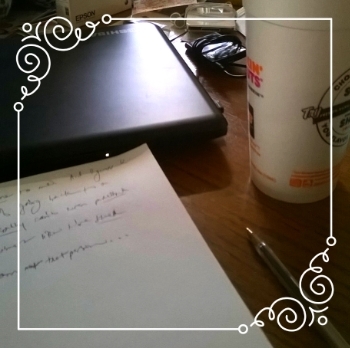
my daily journaling station

my daily journaling station

I grew up in a chaotic and noisy home. I’m not sure why it was this way — we were (and are) a loving family, and our propensity is more toward the introvert side of the personality type spectrum. But with three kids, two dogs (and an assortment of other animals), and two working parents for most of my childhood, privacy and peace were hard to come by.

The only way I knew to get true quiet was to stay home sick from school. Then everyone else would be gone (except the dogs) and I could absorb the quiet of the house, the ticking of clocks, watch how the sunlight moved across the floor as morning drifted into afternoon.

I craved quiet, solitary time as a kid. I wanted to be able to hear myself think. But home was loud and school was loud and my friends seemed loud.

Seventh grade was different because my family moved to Hawaii for the year, something I resisted, kicking and screaming. People said, “You must be crazy not to want to go to Hawaii!”

But to my twelve-year-old self who craved fitting in and stability more than anything else, a move to a faraway place for just one year would be one more thing that made me different, one more thing that told my peer group, “She isn’t like us. She doesn’t fit.”

A life-altering thing came out of our year in Hawaii, however. My English teacher handed out black-and-white composition books and required us to keep journals.

I knew I liked to write, and prior to this, I had dabbled in journaling, but it was more of the “this is what I did today” variety. My teacher encouraged us to really get our thoughts on the page. What was important to us? What did we think about the books we read in class? What scared us? What filled us with joy?

I was hooked. I used all the pages in the first composition book and my words spilled over onto the cardboard back cover.

Finally, I could hear my own voice. I could read my own thoughts on the pages of the composition book. And my teacher validated it all — keeping a journal was a good thing. A healthy thing. It would help me know myself.

In all honesty, I don’t think I fully internalized what my teacher said at the time. This is probably adult me looking back and superimposing herself onto twelve-year-old me. But what I do know for sure is that I was hungry to keep a journal. It became a home for me, the only true safe space I could think of at the time.

Later, in my early twenties, I took frequent trips to New York City, and I remember sitting in the airport one day, my notebook spread out on my lap. I realized I felt at home in O’Hare Airport, waiting for my flight, despite the swirl of activity and noise around me. I wrote in my notebook that day, “As long as I can write in my journal, I can be at home anywhere. My journal is the only home I need.”

I smile a little at my early-twenty-something self now, because I am far less nomadic in spirit than I was then. Now, I like a home base that goes beyond my journal (I am a true homebody at heart despite my love of discovering new places).

But I am still in touch with the “me” who believed that, armed with my journal, I could feel safe enough to take on the world.

Decades after discovering the mysteries and joys of the depths of the black-and-white composition book in a classroom of girls in black-and-white uniforms at St. Andrew’s Priory School in Honolulu, I still meet with my journal at my dining room table every day. (Except now it’s a sketch book with wide, blank pages, so I can draw pictures next to my thoughts, too.)

And every time I put my pen on that page, I’m cutting through the chaos of not just the world, but my mind. I’m safe, and I’m home, and I know who I am, once again.

If you, too, keep a journal, what is the greatest benefit of journaling for you? I’d love to hear from you.

This post is my contribution to the Five-Year Anniversary Celebration of  #JournalChat Live. I’ve been proud to be a guest on #JournalChat Live several times. You can learn more about #JournalChat Live, including how to join the Facebook group, here.

When you’re overwhelmed, get specific

blurrySomething I’ve noticed while working with clients who are “overwhelmed” is that, often, we remain in overwhelm because we are not getting specific enough.

We’re not specific about what exactly it means when we say “I’m overwhelmed.”

In this way, overwhelm is kind of like a stifling blanket of vagueness. We keep spinning in it, saying things like, “I just want to stop being overwhelmed” or “I feel so overwhelmed I can’t move forward.”

That’s the trick (and sometimes the gift) of overwhelm — it keeps us in the dark about what’s really going on with us. It keeps us spinning, obsessing, fighting, or zoning out.

Sometimes it is effective, when we realize we’re overwhelmed, to cut right through the “overwhelm story” and ask ourselves how we want to feel. And then, when we know how we want to feel, we can ask ourselves what would help us feel that way.

Sometimes, though, it’s more helpful to actually pull apart the overwhelm — to look at it as a mass that is made up of a number of components, and get really specific about those components.

What we call “overwhelm” is, in many ways, an attempt to focus on too much at once. So if we pull apart the elements of it, we can start to see what it is made up of. We can start to remove focus from pieces of it, and focus only on what we choose to focus on.

For example, as I mentioned in my last post, I have a move on the horizon, but I don’t know exactly where or when I’ll be moving. I am dying for more clarity around this move — the uncertainty, on some days, feels like it’s driving me crazy!

What I noticed a few days ago is that even though I have this fairly giant thing on my horizon, which is requiring a certain amount of focus and energy (looking at finances, neighborhoods, apartments, storage possibilities), I’d been demanding of myself that I focus on other “big things” as well. And my attention had become scattered and paper-thin.

So yesterday, I let go of a freelance project I’d taken on because it seemed like a good opportunity.

What I found was that even though my mind couldn’t pass up the opportunity, it was actually a terrible time to bring in another thing to take energy and focus from me, especially when it was a thing that didn’t totally light me up.

When I let go of the project, I also felt the overwhelm whoosh out of my body. From this place of more lightness and peace, my move and the elements surrounding it feel so much more doable.

Here are a few ways to get specific about what’s really going on if you’re feeling overwhelmed:

* Instead of saying, “I’m overwhelmed,” say, “I’m sensing overwhelm within me.”

This will create separation between you and the feeling of overwhelm. (You are not the feeling!) Then see what comes up. What happens when you recognize that you are bigger than the feeling of overwhelm?

* Give yourself ten minutes to write down what you’re feeling overwhelmed about.

Do this stream-of-consciousness — don’t try to “get it right.” (And don’t go on for longer than ten minutes — set a timer if you must.)

Then, read over what you’ve written. Notice what jumps out at you. Is there something here that you’re giving a lot of attention to that doesn’t warrant it? Is there anything you wrote down that you can just drop? Does it truly all have equal priority? (My guess is no!)

It can help to consult your “future self” here. If you were to ask you-five-years-from-now which of these issues is important, what does “future you” have to say?

* Bring your focus to your body.

What does your body feel like right now, while you’re in this space of overwhelm? Is it tightness in your abdomen, a clenched jaw, a headache? Shallow breathing? As you breathe, notice what thoughts bubble up for you with these body sensations.

The thought I had was, “If I don’t do this project, I’ll regret it.” I asked myself if this thought was true. What felt more true was, “If I DO this project, I’ll regret it.” That felt more true because doing the project was adding to my to-do list during an already stressful time, rather than taking away stress by giving me an opportunity! And that made it easier to let go.

* Ask yourself if perfectionism plays a role in your overwhelm.

Frequently, the idea that we have to “do it all well” triggers overwhelm because on some level we know it’s not possible or worthwhile. This creates a conflict — part of our attention is on “doing it all well” and part of our attention is on that nagging knowledge that we can’t do it all well.

If you had permission to show up for all parts of your life with C+ rather than A+ effort, how would that change your feeling of overwhelm? Is it possible that showing up in and of itself is enough?

What helps you break down this thing we call “overwhelm”? I’d love to hear what works for you.

And, if you’re struggling with overwhelm on an ongoing basis, you may want to check out my Stellar Self-Care (for Sensitive Creatives) program. You can learn more about that, and my other offerings, here.

Image is “Railway Station Through Glass Brick,” © Bx3t | Dreamstime Stock Photos

Slowing down to speed up: embracing gentle on Valentine’s Day

Slowing down to speed up

I gave myself a Valentine’s gift today: the gift of sleeping in. I slept until 9:30 (though not without the usual 4 a.m. wake-up call from kitty!).

This was a conscious choice — I decided yesterday evening that I would allow myself to sleep in this morning, since I had nothing on my schedule early.

And there’s something about consciously choosing that makes a real difference. It was a much different feeling than, “Damn, I slept late! Now I’m already behind!” You can feel the difference, right?

I woke up having already honored myself (with extra sleep) the way I’d planned to. And I feel really happy that I actually put “allow myself to sleep in” on my schedule for the day. I made it that important.

As I mentioned a couple of posts ago, I entered 2015 with a feeling of burnout. And little by little over the weeks, I’ve been feeling myself move out of it, in teeny, tiny increments.

Small glimmers of new energy have arrived; I’ve been working with a wonderful mentor (Yollana Shore of Heart of Business) to expand into new directions with my coaching work.

Sometimes almost imperceptibly, I can feel myself moving forward in small but important ways.

But here’s the thing: When I start putting pressure on myself to move more quickly, I can feel myself shrinking back.

This has been a longstanding pattern with me — wanting myself to move more quickly than the whole of me can actually capably move.

I’ve learned something over the years that has been reinforced by my work with my coaching clients. Many of us have a “visionary” part of our selves that moves very quickly and can often manifest things in the physical world with a lot of speed.

But this visionary aspect of us is only one aspect. There are other parts of us, too, which may need to move at a different pace.

I learned this bigtime when I was in my mid twenties. I bottomed out on my inner visionary’s need for speed.

It wanted to move so quickly that it didn’t take the “slower” parts of me into account: the child in me who feels vulnerable and needs a safe space (and, as Julia Cameron points out in The Artist’s Way, the “inner child” is very much connected to the part of us that creates); and my (highly sensitive) physical body which can become overstimulated by too much activity and movement and needs slowness and quiet to recharge itself.

When I bottomed out, I developed a chronic illness which eventually put a halt to my ability to hold a job and to create at all. For much of my twenty-fifth year, I was too ill to function “normally”. My “new normal” was lying in bed or dragging myself down the hall to use the bathroom. I eventually ended up in the hospital, dehydrated and being fed through a tube.

When I came out of the hospital, the realization crept in over time that I had to learn to take care of the part of me that needed to move slowly.

I had to learn to accept — in fact, to love — the part of me that needed to move at its own pace (which to the visionary part of myself sometimes seems excruciatingly glacial).

The fact is, we are all touched by a constellation of components — heart, soul, physical body, genetics, our family history and any trauma from “back then” that may still get triggered from time to time, our changing needs and selves, our current and past relationships and the ways they affect us and we affect them, and the culture and environment we live in. Although we in Western culture are often encouraged to be “independent”, we are, without exception, interdependent.

And this means that, sometimes, in acknowledging the needs of all parts of us, we move more slowly than we’d like.

A while back I gave a presentation and after it a man in the audience came up and remarked on how gentle I was in answering questions from the audience. Yes, I am gentle when I sense struggle. But I’ve had to learn to be gentle. I learned it because it was necessary for me to be gentle with myself in order to grow.

I found during my illness all those years ago that the harder I was on myself, the more I demanded of myself that I get well quickly, the sicker I felt. I finally had to accept that I might stay sick forever, and I had to learn to be okay with that. Only gentleness — treating myself with kindness and softness, even though it felt foreign to me — allowed me to rest fully enough to get well.

I think, many years later, this learning is circling back around to me as I’m navigating the current transition in my life. And I’ve seen it in various forms with my coaching clients, too. The more I notice myself putting pressure on myself to move quickly, the more imperative it is that I allow myself to slow down.

This is especially true when we are going through difficult transition periods. We want to be out of them quickly because they are so uncomfortable, but the irony is that the more we try to rush them along, the longer they last!

So: I look around at my life right now and I notice that I am not sick. I notice all the ways I am better at taking care of myself than I was at twenty-five. I notice that I no longer hold my breath and leap in order to ignore the fear that comes with transitions. I notice I am more able to be present with what is coming up for me.

I notice that it is Valentine’s Day and I am in a loving relationship — and while I do have a significant other I love very much, that is not the relationship I’m referring to here. I am talking about me. My loving relationship with me. It’s been a long road and I look forward to where it leads next.

Wishing you a Valentine’s Day filled with love, whether you are spending it with yourself or with someone else. (And I love Robyn Posin’s article here, on “going only as fast as the slowest part of you feels safe to go”. Her site is wonderful.)

What do you notice about navigating transitions? What helps you move at the speed that feels right to all of you?

And: In the coming weeks, I will be making some changes to my coaching offerings. If you’d like to work with me in the current way, you can take a look at my offerings here.

Above image is “Valentine Ribbon” © Radu Razvan Gheorghe | Dreamstime Stock Photos

Your self-care bottom line

Your self-care bottom line

The brutal winter months always remind me of the importance of walking as a way of staying connected to myself. Mostly because, when the weather is really awful, I can’t get out for a very long walk, and sometimes I can’t get out at all because the sidewalks are simply too treacherous.

Walking is one of those “bottom line” activities that help me feel actively connected to myself. It’s about moving my body, it’s about watching my mind — detaching from it — instead of buying into everything it tells me, it’s about connecting with the people and animals I see on my walks (even if this is only to smile and nod “hello”).

When I don’t get a lot of walking in, I start feeling deprived and stagnant.

Walking is one of the “tent poles” in my daily self-care. Occasionally I’ll run into someone from my neighborhood who says, “I see you walking all over the place!” People have been telling me this for years and years. (And that’s kind of funny, because when I’m out walking, I feel invisible — I feel like “I” disappear and my focus is on my breath, on the world around me, on the next step on the pavement. Apparently I’m pretty visible when I’m feeling invisible — but that’s a topic for another post!)

Another tent pole in my self-care routine is journaling. About five days a week, I need to journal to connect with myself. It’s rare that I miss more than a couple of days in a row of journaling. I have so many filled notebooks I couldn’t even begin to count them, and it’s fairly rare that I actually reread old ones (though it can be extremely beneficial when I do).

Sometimes people ask me how I “make myself” do all this journaling, and I tell them I’ve never once had to “make myself” journal. It’s like the walking — I crave it, because it’s my process of connecting with myself, knowing myself better, and using that knowledge to forge my path in the world. And it goes beyond myself as well — just like with walking, when I commit to doing it, I feel like I’m more connected to the universe, the collective consciousness, the whole of everything.

Sleep — good sleep — is another self-care tent pole, and a truly foundational one. When I struggle to get good sleep (as I have been this week), everything’s a little (or a lot) harder. And I put eating well — in a balanced way that doesn’t overwhelm my system — and staying hydrated in there with the sleep tent pole.

The fourth tent pole for me is “do-nothing time.” This doesn’t necessarily mean that I’m actually doing nothing during this time. It means that I set aside some time every day where my intention is not to do but to be. The truth is, I might be puttering around the house, playing with my cat, or browsing Etsy during this “do-nothing” time. The important thing is that I’m not trying or striving or figuring things out during this time. The intention is presence.

I can reach this “being” place while walking or journaling, too — the difference for me is in the intention of simply being (which is different than the intention of moving my body or connecting with myself). I need to make sure I factor it in daily, even if it’s only fifteen or twenty minutes of “being” time.

So, my self-care tent is up, and there’s a lantern in it. That lantern is quality connection with — and support from — others. The reason I say “quality” connection is because I notice that if I don’t make a point of connecting with people I care about on a level deeper than jumping in and out of Facebook, it doesn’t necessarily happen. And during the weeks I have more depth of connection with loved ones — whatever form it may take, online or “real world” — I feel a LOT better, a lot more nourished and supported, and more able to pass on true support to others.

When I’m feeling drained, at loose ends, or like my life is insanely complicated, it really helps to check and see if one of my “tent poles” and/or my lantern have been consistently absent for a while. My self-care bottom line keeps me sane and reminds me that the only true power I have resides in the present moment, not in the past or the future.

What is your self-care bottom line? What are your absolute musts for taking good care of yourself and staying connected to yourself, on a daily basis? What do you notice about your overall sense of well-being when you practice solid daily self-care versus when you don’t practice it?

Image is “Vintage Raining Shoes1” © Pierrette Guertin | Dreamstime Stock Photos

Momentum is not always obvious

frozenwaterfall

A friend and I had a conversation the other day about those times in life when we feel like we just can’t get any momentum going, and it got me thinking.

It can be painful to feel like we’re not moving forward. Part of this is due to external stuff (we live in a world that has little tolerance for the idea of “standing still”) and part of it is due to our innate desire to grow and become more of who we are.

If I look back over my life and pinpoint the periods of a lot of “obvious” momentum, it becomes clear that they were almost always preceded by a time (sometimes a long one) where I swore I was stagnating and that nothing would ever change.

Why is this?

In my experience, it’s because the part of us that has outgrown where we are is the one who is experiencing “where we are” as stagnant.

But: there’s another part of us, the slower part that isn’t quite ready to let go, that is NOT experiencing “where we are” as stagnant at all. This part of us is still receiving benefits, comfort, nourishment, even joy, from being exactly where we are.

When I look back on my life from the standpoint of “who I am now”, the “me” I am now sees the periods of my life that preceded a lot of change as stagnant.

But, when I actually was LIVING those periods, a part of me was okay with them. A part of me needed them to be exactly as they were. And until that part of me was ready to let go, they weren’t truly “stagnant” periods to ALL of me.

Maybe the truth is that when we feel a lack of momentum, and think we are “stagnating,” what’s really going on is we’re feeling an increasing sense of incongruence.  Who we are becoming is feeling incongruent with who we have been, but we are still ALSO who we have been.

I’ve found that it’s not helpful to rush along the part of me that needs to be exactly where it is for a while longer. When I do that, it holds on tighter out of fear and a kind of rebellion.

What’s more helpful is to reassure the part of me that wants to gallop ahead that it WILL have its day, and that, in fact it IS moving forward as we speak, and that’s why the divide between it and the part of me that wants to stay put is becoming more and more painful.

The pain is a good thing! The pain of incongruence is a sign of momentum, rather than evidence that there is NO momentum.

If you find yourself thinking that momentum has to look a certain way, play around with rethinking it. Are there signs of momentum in your life that may not be obvious or tangible? Does the fact that something is not obvious or tangible mean it isn’t real?

Nature is always a good role model for us here. During the winter, growth does not stop altogether. Growth goes into a different phase. Trees do not die; they sprout new buds in the spring. Some animals go into hibernation, conserving energy for their eventual reemergence. The fact that they’re inactive during this period does not mean they are dead!

Before you assume you have “no momentum,” look for ways that momentum may be showing up in your life that are not totally obvious. And check for signs that you may be in the middle of your personal “winter,” where growth is occurring in oh-so-subtle ways, deep beneath the surface.

Trust is helpful here. Trust and momentum make good partners.

What do you notice about what momentum looks like for you? What do you do when you feel your momentum is “lost”? I’d love to hear how this works for you, in the comments.

 Image is “Iced Waterfall” © Patricia Cale | Dreamstime Stock Photos

Shaking up your creative habit

tablewithview

While it’s vital to have a regular habit of creating, I’ve been reminded over the past couple of weeks that it’s important that I don’t become too routine about my creative routine.

I write approximately six days a week (and although I usually take Sundays “off”, I almost always do morning pages on Sundays anyway because they’re kind of a compulsion for me).

My typical routine has been to get up, take a shower, walk down the street to get coffee, then come back home and write at my dining room table.

But lately, this habit has begun to feel really mundane to me. Like the habit itself is encroaching on the writing and causing it to feel less fresh.

So I’ve started shaking it up a little.

I’ve written stretched out on the floor on my stomach, propped up on my elbows, notebook spread before me (my cat, intrigued by my unusual writing stance, took this opportunity to jump on my back and give me a kitty massage).

I’ve written sitting on a bench at a nearby park, to the sounds of kids playing around me.

I pulled out my journal and jotted down some images that were coming to me while waiting in the car for my boyfriend to come out of the drugstore.

I’ve gone to the library and savored the intense quiet and the smell of the pages of old books.

I sat cross-legged in the backyard, notebook balanced in my lap, the boughs of trees overhead creating a sheltering dome, writing to the sounds of sparrows, robins and squirrels fighting over the bounty the mulberry tree provides for them.

What has this done for my writing? For me?

It’s reminded me that I am a physical being with a connection to the earth. That a lot of wisdom resides in my body, and that when I sit for long periods of time at a computer, I can get wildly out of touch with that fact. When my posture is rigid, my jaw clenched, I feel very serious. And the writing I’m most connected to does not usually come from a place of “serious.” I can afford to dial back the “serious,” and dial up the play, the curiosity, the sense of discovery.

It’s reminded me of the importance of place in what I am creating. When I wrote in Ohio, in France, in Guatemala, the backdrop of the place had an effect on me, the writer, even if what I was writing had nothing to do with the place I was in at the moment. When I write in the backyard with my butt planted on the ground, I can’t help but feel connected to the rustling of the leaves, the heat of the sun on my skin, and let that sense of place seep into my writing.

It’s reminded me that, sometimes, we need change for the sake of change. For the sheer purpose of not becoming too stagnant. And that, while there is a lot of change in our lives that in not within our control, there is much that is. There were so many choices available to me about where, and how, to approach my daily writing, just within the few blocks from my home.

There are far more possibilities than we think available to us in any given moment. But we tend not to see them.

What have you done to shake up your creative habit? What possibilities might be right in front of you, if you allowed them to reveal themselves?

And: I have two spaces for one-on-one coaching opening up in September. Are you feeling stuck on a project that’s important to you, or having trouble getting started? I may be able to help. Learn more, here.

Image is “Table with a View” © Scott Patterson | Dreamstime Stock Photos

A two-step journaling process (for when you’re feeling stuck or scared)

“My writer self is braver than the rest of me.” — Natalie Goldberg

On one of our recent group calls, a fellow participant in Jenna Avery’s Writer’s Circle asked me how I use journaling when I’m feeling stuck on my fiction writing. I thought I’d share my process, in case others might benefit from it.

My journal is one of the safest spaces I know.

And I’m someone who’s struggled a lot with safety. (I remember when I was an undergraduate, a teacher had us do an exercise that started with the sentence “Imagine you’re in a safe space.” At that time, I literally could not think of a safe space, so I couldn’t go on with the exercise.)

Safety is important. We’re often told to “take creative risks” and “really put ourselves out there,” but we’re doing ourselves a disservice if we pretend that isn’t scary, if we pretend that we feel safe, when in fact we do not. Nothing creates a feeling of stuckness like pretending we feel differently than we actually do.

So, a lot of the time, when I’m feeling stuck or scared as I’m trying to write, it’s because I’m not feeling safe.

Safe to what?

Safe to explore. Safe to write the worst crap imaginable. Safe to share only what I’m ready to share. Safe to be with the discomfort of whatever’s coming up for me. Safe to write that thing that brings up the pain of the past.

So getting away from my document on the computer (which can feel so oddly “formal”) and going to my journaling notebook is STEP ONE of creating safety. I think of the journal as a room, a room where there’s only me (and anyone else with whom I feel completely safe).

From this point on (STEP TWO), I ask myself questions on the page.

Any of the following questions are good jumping-off points.

* What do I really want to say that I’m not allowing myself to say?

* What’s the worst thing that can happen if I write the thing I’m afraid to write?

* Why don’t I want to write this thing?

* What’s the worst thing that can happen if I make a wrong turn?

* Do I actually need to step away from the story right now? (If the answer is yes, follow this one up with “How can I make that feel okay?”)

* Where is the tension (fear, stress, sadness) located in my body right now? If that tension had a voice, what would it say?

* What does this particular feeling of stuckness remind me of?

* If I had a guarantee that no one but me would ever read this writing, what would I write now? (This one can really point us to where we are censoring ourselves.)

* Am I truly ready to write this story? Why or why not?

* If I honestly don’t know where to go with the story right now, how might I open myself up to all the possibilities?

Take one of these questions, and run with it. Don’t deliberate too much over which question to choose — they’re all designed to create movement, which is what we need when we’re feeling stuck. Go with one of the questions and keep writing until you feel ready to stop. Often, new questions arise for me while I’m writing, and I ponder those, too, on the page.

A page from my journal: answering the questions, + doodling

A page from my journal: answering the questions, + doodling

This process does not have to take a lot of time — I often do it in ten minutes or so. The idea here is not to find the perfect answer to the question (there isn’t one). The idea is to dig beneath your surface “stuckness” and generate a new perspective. “Feeling stuck” is nothing more than believing something about your writing or yourself that is not helpful.

You can probably come up with other, better questions. Make a master list of them and have it on hand for times when you’re sitting in front of the computer and the sweat on your forehead feels like blood. We don’t have to make the act of writing so dramatic (put that drama on the page!).

(By the way, you can transfer this process to any art form, or anything at all that you’re feeling stuck on.)

What do you do when you’re feeling stuck on your writing, artwork, or any other creative project? Please share in the comments!

On that note, Aug. 15 is the last day I’ll be offering my Free Mini Unsticky Sessions! (I’ll be offering them for a low cost, in a slightly different format, after Aug. 15.) Want to grab one? Check them out, here.

And: This Thursday, Aug. 8, is the last day to register for the next session of Jenna Avery’s Writer’s Circle. I’ve been a member of this group for going on two years now (I’m also one of the coaches) and it’s been an amazing source of support for me. Interested? Read more, here.