Curiosity … and decluttering!

cat in grass

I’ve been focused on two concepts for the past several weeks and today as I did my morning pages, I found myself writing about what a difference this focus has made.

The first:

Curiosity, not judgment.

I’ve had a longstanding, automatic habit of feeling discomfort or dissatisfaction about some area of my life and immediately jumping to judging myself for feeling that way. Then my mind dives into the past and starts finding evidence for all the ways I’ve made poor choices to get me to where I am today. So not helpful.

Over the past several years (particularly since going through coach training with Martha Beck), I’ve learned more and more how just getting really curious about what’s going on for me is WAY more effective than judging it.

When I judge myself (or some part of my life), I create a war. The judging voice says, “How could you have created this situation? What were you thinking?” And another part of me shouts back, “Hey! Stop judging me! I hate you!

Curiosity shifts that. Curiosity is neutral. Actually — curiosity is playful.

I love the curiosity my cat exhibits on a daily basis. It’s so much a part of him. He’s curious about his surroundings, checking them out literally every day as though they are completely new to him, even though he never leaves the same 900 or so square feet. Hey, what’s in this corner over here? Holy field mouse, it’s a dust bunny! How did this get here? How fun is this? I’m playing with it, now!

I like to take that kind of playful curiosity and apply it to the places I’m feeling stuck. Hmm … what’s going on here? What’s really going on here? Is this situation really like that one ten years ago? Or am I actually a different person than I was then, who has a larger range of choices? Hmm …

And so on. Curiosity takes the charge out of judgment and allows me to breathe, reframe, and see all my options.

The second thing I’m focused on lately is decluttering.

I have a deep, deep fear of loss of any kind. And I tend to get attached to objects, very attached. So for the past few weeks, I’ve committed to putting a bag of stuff together to donate every Sunday. I drop it into a donation box on my way to the grocery on Sunday mornings.

This has felt so good. I started small with this — one or two items — and it felt so amazing to let go of things that I’ve worked my way up to lots and lots of stuff.

My only rule has been that if I’m really hesitant to let go of something, I’m not yet ready to let go of it.

Frequently, what I’m not ready to let go of one week, I’m ready to let go of the next week. Fascinating, right? I can let go more quickly by not forcing myself to let go. Good to know!

And that’s it for today. Hope you’re having a beautiful weekend full of curiosity and play.

Speaking of which, I have a guest blog post on Jenna Avery’s wonderful site this week, about how I’m learning to finish my novel drafts, after years of getting stuck, and how awareness and curiosity figured into that process.  If you struggle to finish any project, I hope you’ll head over and take a look!

Image is “Cat in Grass” © Genarosilva | Dreamstime Stock Photos

What would make it easier?

Drop of water

Several months ago, I led a small group of my clients through a support session to help them with fears that were coming up around their creative projects. They were all nearing the finish line and feeling a lot of resistance to completing, so I thought, maybe we could all support each other in this.

Something we noticed during our session was that we all had a tendency to complicate things to the point that we felt utterly paralyzed about how to move forward. The closer we got to finishing, the more questions about what might happen when we brought our projects into the “real world” came up.

A lot of the stuckness, we found, was based on fears of what might — or might not — happen in the future, if we actually did finish the projects. What if we put them out into the world and no one noticed? What if we put them out there and offended someone close to us with our content? What if we put them out there and got criticized or booed?

All of these things, of course, are distinct possibilities when we put our work out into the world. Focusing on these possibilities can also be effective ways to distract ourselves from actually finishing our work so it can BE out there.

So we came up with this question to ask ourselves when analysis paralysis set in: What would make it easier? What would make it easier, right now?

Just asking this question, we noticed, created a feeling of relief (which good questions usually do — and most of us are not in the habit of asking ourselves good questions!).

We brainstormed a list of possibilities this question generated, and here are some of the things we came up with:

* I could, just for today, commit to staying in the present moment with my work.

* I could stay in my own business. (This comes from Byron Katie’s “three kinds of business” — my business, your business, and God’s business [you might also call this the universe’s business or simply “reality”]. As I’ve written here before, much of the time I feel stress it’s because I’m in someone else’s business. That includes worrying about how my creative work will affect others in the future. There’s a place for this concern, but it’s not while we’re creating the work.)

* I could go to bed earlier and wake up earlier.

* I could check in with someone who helps me gain perspective when I’m stuck.

* I could drink more water. (This might sound silly and completely unrelated, but truly, dehydration can cause us to feel stuck, because water helps our physical systems move and flow. And, particularly if your system is highly sensitive, you may be susceptible to the effects of dehydration.)

* I could take more walks. (Sitting at a desk, especially if you use a computer to do your creative work, can cause you to feel sluggish and static. Moving your body shakes things up and help you shift perspective.)

* I could employ tunnel vision (in a good sense). Think of a racehorse who has blinders on so he is not distracted by what’s on either side of him — he’s only focused on the immediate few yards ahead.

* I could shift my work time to earlier (or later) in the day.

* I could work in a warmer (or cooler) room.

* I could take more frequent breaks when I work.

* I could aim for a B- rather than an A+ (this one is especially important for perfectionists, which most of my clients are). If it didn’t have to match your perfect vision, how much freer would you be to finish? Think about your favorite books, movies, music, artwork. Are they perfect, or are they inspired? There’s a big difference.

* I could, just for today, let go of the idea that I can please everyone with my work.

* I could, just for today, let go of the idea that I can please everyone in my existing audience with my new work.

These are only a few examples of what we came up with. But notice how simple most of them are. Sometimes there’s one small tweak we can make that really helps. And we noticed that the phrase “just for today” was especially helpful.

It’s very human to make things much more complicated than they are. Usually, when I find myself in the land of analysis paralysis, it simply means that I’m scared and I need some support. Notice if this might be the case for you.

What might make your current project easier — particularly if you’re getting close to finishing? I’d love to hear, in the comments.

And: If you’re stuck near the finish line and need some support in completing a large project, I’ll be forming another small, low-cost support group soon. Feel free to contact me if you’d like to be put on the list to learn more.

Image © zaliha yussof | Dreamstime Stock Photos

Invisible progress

spiral

My friend Julia Roberts, an awesome creativity coach, posted on Facebook a couple of weeks ago that she “made lots of invisible progress today.”

I loved her term “invisible progress,” and told her so. Julia elaborated: “I think of pregnancy. It buoys us to know that even on the most uneventful day, we baked the baby a bit that day. We’ve already had a hand in altering the universe. Most days have more progress than we know.”

To that I say, YES! And I wanted to muse a little on the concept of invisible progress today.

Years ago, when I was a chronic overachiever, perfectionist, and dieter, I read these words by Geneen Roth: “Sometimes doing it looks like not doing it.”

What? I thought. How can that be? We’re either doing something, making tangible progress on it that we can see, or we’re not doing it, not making progress, and, therefore, falling behind.

And yet, even as my logical, rational mind rejected this idea, when I read the words, something resonated for me, deep in my abdomen. It felt true.

I realized (I was about twenty-two at the time) that I could live the rest of my life only believing in what I saw, or I could live my life trusting that sometimes things were happening beneath the surface, even if I couldn’t see them in the physical world (yet).

Trusting in invisible progress means recognizing that we need to balance our doing with being. While “perfect balance” between doing and being is not possible, we can acknowledge that we do need both in our lives. Most of us are better at one than the other. And some of us have trouble transitioning between the two (me!).

For me, invisible progress often happens when I am in a “being” state. For example, when I’m out walking, I sometimes get ideas for my next blog post or the next scene in my novel, or a completely unexpected solution to some problem I’ve been struggling with pops into my head. I’m not consciously “trying” to come up with ideas; in fact, they come because I’m letting my subconscious chew on things while I’m focused on my walk.

Invisible progress can also happen when we’re being distracted from what we intend to do. This week, I had to take my cat to the vet, something that seriously freaks me out. Both the stress and the actual act of going to the vet took a big chunk out of the day and I had to let some things go.

While I was at the vet, though, the vulnerable feeling that came over me actually ended up being precisely the feeling I’d been trying to get in touch with as I wrote the short story I’m working on. Even though I wasn’t able to put in much actual work in on the short story that day, the vet visit — the act of living life! — gave me exactly what I needed. I was able to return to my story and give that vulnerability to my character, which was exactly what the story needed in order to move forward.

And sometimes, as Julia pointed out so eloquently above, invisible progress is like gestation. Something is growing in us, but it’s not yet ready to burst forth into the world.

We may not even have words to describe it yet (fifteen years ago, I couldn’t have told you I was going to become a life coach one day — I didn’t even know then what a life coach was). We can try to push it and hurry it up, but ultimately, whether we’re growing a baby or a book, it will be born when it’s ready to be born and not one second before.

There are also days where we don’t notice our progress because it has become second-nature to us. Maybe we did something and did it well but since we’re so used to doing it, we don’t “count” it as progress or even think of it that way. It’s worth taking time to notice our accomplishments, maybe particularly the ones we tend to discount.

And, Melody Beattie has written that on some days, we need to congratulate ourselves for what we didn’t do. This, too, is “invisible progress.” I remember when I was having a particularly crappy day a few years ago and at the end of it I realized that, well, despite everything, I didn’t call my ex-boyfriend back even though he was trying to get in touch with me again, and I didn’t eat a box of Twinkies even though hearing from him really made me want to. And that a few years earlier I totally would have called him back and I totally would have eaten the Twinkies afterwards. Invisible progress for the win!

What does the idea of “invisible progress” mean to you? I’d love it if you’d share.

Also: I’ll be raising my coaching rates slightly in one week. If you’ve been thinking of working with me but haven’t gotten around to it, now’s a good time to get in on my current rates!

Image is “Spiral Diagonal” © David Coleman | Dreamstime Stock Photos

Saturday Gratitude #6

rainbowsprinkles

Time for another Saturday Gratitude post.

So much to choose from this week — and I feel blessed to be able to say that.

1) So it was my birthday this past week.

And I’m not a big celebrator of my birthday. I never have expectations for it or anything. But something about this birthday felt extra-special, extra-celebratory. The day unfolded in such a lovely way — I spent it with some of my favorite people (and cats!) — and I felt so loved and appreciated.

And the funny thing was, I had decided to give myself the gift of a day away from the internet. And that felt so peaceful, so replenishing, so grounding. I needed it. But then, when I did return to the internet, there were all these lovely birthday wishes on Facebook, and some emails from good friends.

And I was reminded that so much love flows through the internet, too. I just need to balance my internet time with my “in the physical world” time, or I start feeling like a strange, cramped, distorted version of myself.

2) While writing and revising a short story this week, I made some discoveries about why fiction writing has felt extra-hard for me lately.

Interestingly, I had to step away from my main project (a novel) in order to make these discoveries. The short story actually served as a metaphor for the struggle of the novel — but it was easier to see and grasp because a short story is a less vast and unwieldy thing than a novel (for me, anyway. I certainly don’t mean to say that writing a short story is not hard or confusing.). Metaphor! It can make things so much more clear. (More on this is a future post.)

3) Finally taking action on something I’d been on the fence about for a long time.

And then the noticing that what unfolded after I took action was not nearly as scary or overwhelming as I’d feared. And that I can create safety for myself along the way, with each step of the continued unfolding. In other words, I have more control than I think I do. Good to know!

I’d love it if you’d play along with me, if that feels good to you. What are you grateful for this week? What comes up for you? Feel free to do this silently, on your own, too, if you don’t want to share. But either way, do notice how focusing on the good stuff creates more of it. It’s true!

Image is “Rainbow Sprinkles” © Cyrus Cornell | Dreamstime Stock Photos

Creating during the rough times

twinflowers

A reader wrote me with this question recently (and gave me permission to share it here):

Lately I have a number of unexpected stresses in my life that have descended on me all at once. Almost every day I reach a point of overwhelm where I just have to do the minimum and then rest. My work on my novel has gone out the window. It feels like I spend every day just keeping up and managing my emotions, and have no energy left for anything creative. I keep trying harder to “do the work” and it’s just not happening. Any words of wisdom for me?

Oh! Creating during the rough times. What a challenge it is to get hit with a lot of “life stuff” and try to keep on keepin’ on as we have been.

In answering this question, I want to look at it from two different angles.

The first has to do with embracing reality.

When life throws a lot at us — whether that change is external or internal, or both — things are not as they were before. Pretty obvious, right? But let me repeat: life has changed.

I really want to underline this, because what I see again and again (and I see it in myself for sure) is that when our lives change radically — or sometimes even when we are afraid that they could change radically in the near future — we have a tendency to go into denial for a while.

Sometimes this looks like freezing and not doing anything. Often, though, it looks like trying to keep on exactly as we have been — even though things are not as they have been.

Which is perfectly normal. But — after a point — not totally helpful.

What embracing reality means from the standpoint of doing our creative work is that when things change, it’s pretty much a given that we won’t be able to approach it exactly as we have been.

If we are suddenly taking care of a sick child (or parent), that is taking up time. If we have to take on a full-time job when previously we worked part-time, that is taking up time. We literally don’t have as many hours in the day available for our creative work: it’s a fact.

Another aspect of embracing reality is who we are.

How do you tend to handle a lot of sudden change, especially certain types of change? How emotional and sensitive do you tend to be? Some of these things are innate in us: we’re not going to change them — even if we want to — beyond a certain point.

I value the fact that I have a very emotional nature (I’m a Myers-Briggs “feeling type,” for sure) and I’m also highly sensitive.

But this means that, for example, when I lost two loved ones in the same week several years ago, it rocked me to my core and I could not “just keep on.” I remember people suggested to me at the time that my grief could be good for my creative work, and that I could “write through the pain.”

That felt wrong in every fiber of my being. I didn’t want to create at that time. I wanted to grieve. Things had changed, and I needed to ask myself if there was value in forcing myself to continue writing during that time.

For me, there wasn’t. For someone else, there certainly may have been. But we need to take ALL of us into account during the difficult times — not just the part that wants to create and keep momentum with creative work. If it feels right to scale back, we need to give ourselves permission to do that.

The other angle I want to take here has to do with our emotions themselves and the way we approach them.

If, like my reader (and me!), you tend to be “emotionally intense,” the way you approach your emotions in and of itself can create more stress for you during the hard times — or not.

When a lot was going “wrong,” I used to say things like, “This sucks! I am so overwhelmed!”

Venting is a good thing sometimes. But it’s also important to look at what we say when we vent.

Here’s why: When I say “I’m overwhelmed,” I’m fusing my identity with the emotion. And, even if I value how deeply and intensely emotional I can be, my emotions are not me. They are simply energies moving through me.

Probably one of the things I say most frequently to a client when they share how they’re feeling about something is “Good to notice.” That’s because noticing is pure gold. We can’t change a thing if we don’t first have awareness of it.

And, at the bottom of it all, “who we are” is simply that awareness — not what we’re doing, what’s happening to us, the emotions we’re having or how we’re reacting.

So, now, when I catch myself saying “I’m overwhelmed,” I say instead, “I’m noticing that I’m overwhelmed” or “I’m noticing a feeling of overwhelm within me.”

Do you see how this immediately creates a space between you and the feeling?

From this space, you are both the person experiencing the emotion and the observer of that emotion, how it feels in your body, the way you are reacting to it, the thoughts you are thinking around it. And from that space, you are not rocked and thrown by your emotions; you are not fused with them; you are simply experiencing them.

So, during the difficult times, here are two places to start. I’d love to know if anything here resonates for you, or if you have other suggestions, in the comments.

And: If you’re in a rough patch right now and you need a shift, my awesome friend Dawn Herring, founder of Refresh with Dawn Herring and #JournalChat Live on Twitter, will be offering a Refresh Intensive e-course, starting April 3 (the deadline to sign up is April 1). And it’s only $21! Want to learn more? Find out, here.

Image is “Out of the Darkness” © Emi Pascuzzo | Dreamstime Stock Photos

Three ways you can feel more creative — right now

1c0f7770-4689-4e06-9a87-405ae800c500_zpsb1a48ada

When people tell me they’re “not creative,” I know they are lying. The truth is, we are profoundly creative — it’s our natural state. We don’t need to “work” at being creative. And I think most of us know that when we’re in a truly creative space, it feels like play, not work.

What we do need to work at is sustaining solid habits that support our creativity (which often isn’t easy). We need to commit to making regular time and space for our creativity to take center stage.

Believing we need to work at being creative is a good way to get stuck. We can’t “lose” our creativity. We can only lose touch with its flow.

But sure, we don’t always feel creative. And that’s okay. While I don’t believe we should force the flow, I do believe there are things we can do to welcome its return, to summon it back to us.

1) Get rid of things that feel unsupportive to you.

These can be small things — I’m not necessarily talking about ending a relationship or quitting a job here (though you may make those choices at some point!). I’m talking about things that consistently drag you down, in small, nagging ways.

For me, recently, that meant unsubscribing to a couple of popular blogs, one for writers and one for entrepreneurs. I’d been telling myself that the authors “knew what they were talking about,” and I needed their information — but I felt slightly depressed every time I read one of their posts. I finally realized that their messages of “This is what you must do to be successful” didn’t apply to me, because I don’t define success the way they do.

We’re all hit with so much information in a given day, it’s vital to get rid of any that doesn’t feel supportive to us.

2) Make your workspace appealing to you.

Whether you write, paint, or bake amazing things, having an uncluttered workspace that you love can make a huge difference.

I am hardly a minimalist when it comes to decorating — I actually feel good having a certain amount of “friendly clutter” in my home; it’s part of how I relate to my environment. But yesterday I took some time to clear piles off the table I work on, to dust its surface, to put away some coats and scarves that were thrown over a chair. And it’s like I’ve been given a fresh slate when I sit down to write. My mind feels clearer — I can even see the characters I’m writing about more clearly.

Decluttering also shifts energy and signals that we are willing to let go. This willingness is crucial to creating, which is a process of birth and death, building up and eventually letting go of — or even destroying — what we’ve built.

3) Briefly revisit what you love.

You can do this immediately. I have a framed Jaws poster in my office, and I only have to glance over at it to be reminded of why it’s one of my favorite movies of all time (characters! editing! Quint’s Indianapolis speech!).

Or, a couple of nights ago I made a Pinterest board dedicated to Beatrix Potter. That woman was an amazing artist and writer, and when I look at one of her pictures — and her accompanying words — I am instantly reconnected with some of my deepest loves: animals, stories, and dark humor. (Yes, Beatrix Potter’s books are full of dark humor. Only in “The Tale of Samuel Whiskers” can you find two mice trying to make a kitten into a pudding).

None of this has to take very long. And for days when you’re feeling overworked and profoundly uncreative, a few minutes of presence can be priceless.

What helps you reconnect with your creativity on a moment’s notice? I’d love to hear, in the comments.

Writers: Tomorrow, Feb. 27, is the last day to register for the next session of The Writer’s Circle. This group offers terrific support for writers who are struggling to finish a project or build a daily writing habit. Find out more, here!

Image is “Colorful Bubbles” © Judy Ben Joud | Dreamstime Stock Photos

Saturday Gratitude #2

After I wrote my first Saturday Gratitude post last week, I noticed how my attention shifted ever so slightly over the following days from what I was lacking to what is here already. And it’s funny how much more clear my choices and focus become when I am not in that panicky, lack-filled place.

It’s also so interesting to notice that, often, I don’t need nearly as much as I think I do. My needs only seem enormous when I am in that place of lack, and assuming that it is reality.

Then yesterday I happened to run across a Martha Beck piece on Oprah’s website where Martha mentioned that research shows that it is impossible to experience appreciation and fear at the same time. Yes! I noticed that so often this week.

So here is my Saturday Gratitude list for today — three things I am grateful for as this week draws to a close. We’ll see how today’s focus on gratitude shapes the coming week! And I’d love it if you’d join me in my experiment, if that feels good to you!

1) Writing in warmth. After last week’s computer crash, I finally have a new computer up and running, and because it’s a laptop, I can write anywhere in the house instead of sitting in my rather-cold office, which, truth be told, I had been feeling less and less inclined to do. This is kind of perfect, I realize, because I have been needing to approach my writing with warmer energy — more safety, more permission, more “it’s okay to be exactly where you are with this writing. It’s okay to let it be what it is, nothing more, nothing less.”

2) Recognizing when it was time for me to get offline, particularly off Facebook, and following up on that awareness by — getting offline! And how incredibly grounding and replenishing that turned out to be. As wonderful as the online world can be, as I stayed unplugged for a good while yesterday, I felt the remembrance that there is so much here, in the physical world, and in my own inner world. And it is good, and rich, and nourishing. With nothing else added.

3) Noticing old patterns coming up for me, and then noticing the thought that I shouldn’t be still doing this! Not after all these years. And then (here’s the part I’m truly grateful for), recognizing that, yes, the patterns are still here, but the way I interact with them, the way I deal with them, is much, much different than it was ten years ago. Or even five. And that, to me, is some kind of miracle.

Want to share yours? What are you grateful for this week?

Saturday Gratitude

In keeping with my intention to create new, supportive rituals this year — both in my life and here on this blog — this is my first Saturday Gratitude post.

I’ve been noticing the connection in my life between gratitude and creativity, and here’s what I’m discovering: creativity does not flow from a place of lack. And when I have a “not-enough” mentality, I end up putting a ton of pressure on my creativity to make me feel better, make me money!, make me feel successful.

But (as I’ll talk about in my next post), we are in relationship to our creativity. Imagine putting pressure on a person to make you feel better, make you money, make you feel successful. My hunch is that person (if they had a decent amount of self-respect) would run from you pretty quickly.

The same goes for creativity. It loves us when we express gratitude for it, but tends to hide from us when we pressure it.

So every Saturday, I’ll be winding down my week with a focus on three things I’m grateful for. And I’d love it if you’d join in, if that feels good to you!

Here’s this week’s list:

* My computer died this week, and I managed not to completely freak out. (And I’d backed up my work — something I haven’t always done in the past.) AND, money flowed in from an unexpected source to partly cover the cost of a new computer.

* My 13-year-old cat is in wonderful health. In fact, my boyfriend and I refer to him as “the kitten” due to his youthful acrobatic abilities.

* Here in Chicago, we have beautiful, gentle, snow-globe-quality snow in the air this morning. I didn’t think I could stomach more snow, let alone be grateful for it, but I have to say, it’s just so pretty. So I’m grateful not just for beauty in the world, but for my capacity to see it and appreciate it. That capacity is a renewable resource, for all of us.

What’s on your Saturday Gratitude list this week? I’d love it if you’d share. And most importantly, notice how you feel after you make your list.

When you feel like you’re not doing enough

sleepydog

Last week I had an awful moment one day where I felt like I was sitting squarely in that valley-wide gap between where I am and where I want to be.

I felt despair.

In that moment, I could not see clearly how I was going to get from here to there. It just did not feel possible.

When I feel this way, my initial impulse is usually to push myself really hard to do more.

Which doesn’t work very well. Not when my “doing” is coming from a place of despair. I can do more from that place, and only see mounting evidence for how very much there is to be done.

The other thing that happens when I approach doing from a place of fear is that everything seems to have equal priority. There might be twenty things on my list and they all rise up at once, calling out to be done yesterday.

And this isn’t true. They do not all need to be done now, and some of them probably don’t need to be done at all.

The good thing about despair is that there is not a lot of energy in it. So, in that space, instead of making to-do lists or scheming about all the steps I needed to take to get “there”, I sat down. (Notice if a feeling of despair sometimes follows an unmet need to ease up on yourself. It often does for me.)

From the blue chair in my living room, I began to focus on the blowing snow outside, the newly de-cluttered room, my cat’s snore. I picked up my journal and began to write not about what was bothering me, but about what I was noticing in my surroundings. (This is what Natalie Goldberg calls “writing practice”.)

And within a few minutes, I came solidly back to the present moment — in which, truth be told, I had everything I needed. Nothing was lacking.

I still had that feeling of wanting to grow, expand, move into newness and openness to change.

But it was coming, now, from a space of desire, of welcome, and not from that space of “I need to be there in order to be happy.”

It was coming from a space of “I am already enough — and wouldn’t that, too, be wonderful?”

Subtle shift; huge difference.

And from that space, my true priorities rose up before me. And there were only a couple, and they felt light. Not twenty equally heavy things.

So often, when I think I should be doing more, it’s because I believe doing more is going to get me something I don’t already have. In an external sense, this can certainly be true. And it’s important to honor that — I do need to take certain actions in order to get things done.

But what I sometimes forget is that nothing I accomplish “out there” can give me something that can only be generated internally. When I pursue something “out there” from a space of grasping, I only see evidence for how graspy I am and how much more I need.

The idea here is not to try “not” to be graspy; it’s not to stop pursuing what I want. The idea is to notice the back and forth between wanting and having, doing and being, between what it means to feel empty and what it means to feel satisfied. And to notice what “doing more” can help me achieve, and what it absolutely can’t.

Something to try:

For the next week, notice what happens when you have the thought “I’m not doing enough.”

How does it feel? Does it feel deeply true? Does it motivate clear action? If so, terrific! If it feels icky or stressful or — like me — you find yourself in despair when you have this thought, notice what happens if you slow down rather than speed up. See how you can return to the present moment. And when you’re there, notice the true priorities that make themselves known to you.

Hatched into the World …

This year, I want to start a ritual of pointing you to gifted writers, artists, and other creators — people who are putting healing, nourishing, and amazing things out into the world.

My friend Terri Fedonczak writes beautifully on parenting from a place of joy and abundance (rather than lack) in her new book  “Field Guide to Plugged-In Parenting … Even if You Were Raised by Wolves.” (I love that title.) I had the pleasure of looking in a bit on Terri’s daily process of writing this book as she participated with me in Jenna Avery’s Writer’s Circle. And although I’m not a parent myself, this is a topic close to my heart, as I believe we’re all in the process of parenting ourselves, throughout our lives. Terri’s also the CEO of Girl Power for Good, LLC. You can check out Terri’s amazing work in the world at her website (which is beautiful, by the way), here.

Image is “Sleepy Dog”, © Mihai Dragomirescu | Dreamstime Stock Photos

A journaling experiment for the New Year

littledeer2

I’m staring out my window taking in the snow-globe-soft snow that’s falling in the street light, thinking about what I’d like to share as this New Year begins.

And what I most want is to help you trigger some discoveries for yourself this year.

I’ve never been much on resolutions, but I do love open-ended intentions, or simply focusing on things that hold mysterious and positive questioning for me.

So here’s a little experiment I tried in my journal yesterday, and I thought I’d share it with you — if it feels good, see if it sparks anything for you as you move into 2014.

Step one:

Look around the room you’re in right now, or out your window if you’re near one. Choose three objects that light you up, that resonate for you in some way. Not necessarily the objects that you “like” the most, or are the most beautiful, but the ones that speak to you or call to you or trigger something in you that feels good.

Step two:

For each object, write down three adjectives that describe the object. (Hint: it helps if the adjectives work on two different levels — i.e., “solid” as opposed to “brown”.) Quick, off the top of your head — don’t think too hard about this! Do this for each object, one right after the other.

Step three:

Look through your list of adjectives — you should have nine words total. Pick the three from this list that resonate for you the most. Again, don’t think too long about this — pick the ones that jump out at you, quick!

Step four:

Take your list of three adjectives and look at it for a few moments. Now you can slow down a bit and get reflective. These words represent qualities that mean something to you, qualities you may want to bring into your life in 2014. 

Take out a fresh piece of paper and write each of these words across the top of the page. Now, draw an arrow from each word down the page and come up with at least one way you’d like to bring each of these qualities into your life this year.

Let your intuitive self take over here — allow yourself to make unexpected connections.

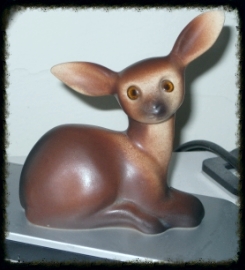
For example, one of my objects was the ceramic deer pictured above. It sits on my desk beneath my computer screen. The words I got from it were wide-eyed, healed (it has a broken ear that I’ve glued back on) and plump.

I like all of those words, but “plump” jumped out at me as the important one, so it went on my final list.

My logical mind thought, plump? Really? But intuitively, I know that plump, for me, represents robustness, stability, exuberance. How can I bring more of this “plumpness” into my life this year?

The first thing that popped into my head was “play around with more physical exercise.” So I wrote that down. (Ah, a clue! Any new form of exercise I try out needs to feel like play. And isn’t it funny how the idea of bringing MORE “plumpness” into my life — not less — led to me to exercise?)

Actually, I love “wide-eyed”, too. I want to face this year with even more curiosity, beginner’s mind, and freshness. How can I bring this wide-eyed quality into my life this year? The first thing that comes to mind is “Slow down and listen even more closely when people share with you.” Yes. That feels right.

If you give this a try, I’d love to hear how it went for you, in the comments.

Wishing you a beautiful start to your 2014! Whether we connected here on my blog or we worked together or we’re only “meeting” now for the first time, I’m truly grateful you’re a part of my experience as the New Year begins.