Squirrel wisdom (or, the power of a good question)

squirrelfoodA couple of weeks ago, I was sitting at my kitchen table with my journal, and I paused to stare out the window. It was cold out, bitterly cold, and I watched a squirrel make her way up a telephone pole across the parking lot with a frozen piece of hamburger bun.

When the squirrel had made it almost to the top of the pole, just inches from the wire she wanted to access in order to make it across to the tree branches many yards away, she dropped the bread. I watched it plummet — its trajectory was swift, and it bounced twice on the pavement.

On realizing she had dropped the bread, the squirrel immediately — and I mean immediately — turned around and started down the pole to retrieve it. It took her a while; eventually, she got to the pavement, located the bread (which was about twice the size of her head), put it in her mouth and headed back up the pole.

The squirrel had very little — if any — reaction to her loss of the bread. She simply noticed it had fallen and recalculated.

But here was my reaction, from the kitchen window: Oh my God! All that work and she drops it! Poor squirrel! What a hard life she has in the winter! It’s not fair! All that work just to get a scrap of bread! What if she drops it again? What then? Why is life so hard?

I watched as the squirrel made it up the pole a second time, this time without dropping the bread. She balanced with it on the wire and managed to reach the tree branches, at which point I stopped observing her because I couldn’t bear to see her drop it a second time. If she did, that would mean … what?

I was making the squirrel’s dropping the bread, or potentially dropping the bread, mean all sorts of things. Bad, sad, things.

But the squirrel wasn’t making it mean anything. She was just going on with life, not shaking her little squirrel fist at the heavens and saying, Woe is me! What a pitiful squirrel life I lead, dropping bread left and right! How will I ever eat? I am so incompetent and life is unfair to me!

What are you making it mean? is one of my favorite questions ever. I learned to employ this question during my life coach training back in 2010, and once I learned it I didn’t know how I’d lived without it. It’s probably one of my favorite questions to use with my clients, too.

Our thinking is often automatic. It bypasses our conscious awareness and, before we know it, we’re off into all kinds of stories.

Notice what I did when the squirrel dropped the bread? My mind just went there. It applied all my human concerns to the squirrel and her squirrel-ness. It took maybe three seconds — if that — for my mind to go from noting that the squirrel had dropped the bread to asking an unanswerable question: “Why is life so hard?”

It’s worth it — so worth it — to slow down and observe our thinking. We can’t stop our minds from spewing out thoughts — some research shows that we think thousands of thoughts per day — but we can step back and notice how what we’re thinking is affecting us.

Sometimes (often!) I respond to myself the way I did to the squirrel. Something doesn’t turn out the way I wanted it to, or it’s harder than I thought it would be, and my mind is off and running — I shouldn’t have tried, what’s the point, that was so hard there’s no way I can do it again, why is life so unfair? 

It’s not bad, or wrong, that I have these thoughts. It’s what minds do. The not-so-great thing is when I believe them and take action (or not) accordingly.

When the “bad thing” happens, when I drop my proverbial bread, this is where What are you making it mean? can be a really helpful question to pose to myself. (Notice the difference in feel between this question and a profoundly unhelpful question like “why is life so unfair?”)

Humans are not squirrels, and not meant to be, but I’d like to become a little more like the squirrel. A little more undaunted, a little less self-pitying, a little less thwarted by inevitabilities that have absolutely nothing to do with me. Life is unfair (okay, I guess you can argue that thought, if you want to!). But the squirrel in her squirrel-ness reminds me that what I do with that fact is up to me.

(Two of my favorite resources for noticing and working with my thoughts are Byron Katie’s The Work, and Brooke Castillo’s Self-Coaching 101.)

What are you making it mean? I’d love to hear what you notice about how your reactions shape your world. (Noticing is always the first step!)

Need some support in bringing your creative work into the world? Check out the ways we can work together, here.

Above image is “Squirrel Food” © David James | Dreamstime Stock Photos

How distracting yourself can get you unstuck

colourtube

Sometimes we can find ourselves in a cycle that looks like this: We’re pushing and pushing to get something done, but it’s not working, no matter how hard we push.

Then we ask ourselves, “Why isn’t it working? What’s going wrong?”

Our minds start looking for what’s wrong and find that it’s all wrong. (If we look hard enough for something, we will definitely find it.) The project is wrong, the way we’re going about it is wrong, we are wrong. Our lives are wrong. Wrong! Where did it all go wrong?

We get discouraged with how wrong it all seems, and we think, “Well, maybe it’s my attitude. I just need to try harder.” So we push ourselves, and the whole cycle continues.

Western culture is in many ways a “push” culture, which values moving forward at all costs.

One thing that can result from too much pushing is a feeling of stuckness.

Ideally — when I’m really “on track” — I’ve noticed that I feel pulled toward what I want, not like I am pushing myself toward it.

This is not to undervalue “push” energy, as it’s certainly necessary sometimes (it’s just not a great way to live all the time).

A lot of what’s going on with pushing ourselves is that we’re pushing so hard we’re losing sight of why we’re doing something in the first place.

And that’s why — in addition to pulling back and gaining a broader perspective, which I wrote about in my last post — an important element to moving out of a feeling of stuckness can be shifting focus. Or, to put it another way, distracting yourself.

Yes — that means stepping away from what you’re trying (unsuccessfully) to do, and doing something else. Anything else. Resist the urge — for the moment — to try to “figure out” why things aren’t working, and just do something else.

This can work on the smaller scale or the larger scale.

On the small scale, it might look like calling it quits for the day with that chapter you’re wrestling with and attending to the email you’re feeling called to write to a friend.

On the large scale, it might look like putting the major project that’s feeling incredibly draining on hold for a month and immersing yourself in a “fun” project.

This happened for me years ago during grad school when I felt a lot of heaviness around my thesis material. At the end of a summer, when I had a brief break from course work, I found myself super-inspired by these little cat paintings I saw artists doing on a certain auction site at the time. And it occurred to me that — for fun — I could try to do a little cat painting of my own.

I did one late on a Friday night, painting into the wee hours, and it was so much fun I did another one, then listed them both on the site for very low prices. Just for the hell of it.

My sister called the next day — she was always checking on my listings back then, as we sold used clothing a lot — and said, “What are these paintings you have up? One has a bid on it!”

Yep, my little painting I’d done “just for fun” had a bid on it. Someone wanted to pay actual money for my little experiment.

This was the beginning of a period of a year or so where I made lots of little cat paintings and sold them. One ended up in a coffeehouse in Seattle. One ended up in the home of an octogenarian with six cats who lived in England. It was so much fun selling my little paintings and learning about my customers.

And what I discovered during this time was that part of the reason I’d gotten so stalled on my thesis material was that I’d lost touch with what had mattered to me about writing in the first place: it felt fun! I liked it!

I’d gotten locked into “serious grad student” mode and felt like my writing had to be big and important. I still struggled with those feelings (and sometimes do now), but doing my little paintings reminded me that there was much joy to be had from the small, the simple, the cute and the fun.

That thing I was truly seeking — connection with dear, kindred souls — was available to me by doing ordinary things with extraordinary care. (I wrapped my cat paintings in pretty tissue paper and tied them with ribbon and wrote personal notes to each of my customers. I loved responding to messages from my customers and hearing their stories about their cats.)

***

Anne Lamott tells a story in her book Traveling Mercies about her car breaking down when she and her son were on the way to visit a dying friend. When all was said and done, it turned out she wasn’t able to visit her friend until a few days later than she’d planned.

Somehow,  thanks to the “distraction” of the car situation and what it brought up for her, she was able to show up for her friend with more true presence. “I still did not know what was trying to distract me so it could get itself born,” she wrote, “but I felt happier than I had in a long time.”

Sometimes we need to distract ourselves so that we can get out of our own way.

I think this is what happened for me when I was drawn to making small, simple paintings of cats. I needed to get out of my own way.

Getting out of our own way in this sense is not the same thing as procrastination (though our culture — oh, our culture! — will try to convince us that it is, that there is nothing of value in ceasing to push.)

Challenge the culture. Allow your life to be a grand experiment that always leads you back to your core.

Need some support on your grand adventure? Through Feb. 29, my one-on-one coaching sessions and packages are at special prices, in honor of The Year of the Monkey. (Monkeys are a spirit animal for me — they are the guardians of fun and play, which my serious, driven side badly needs to stay connected with.) Find out more here

Above image is “Colour Tube” © Esra Paola Crugnale | Dreamstime Stock Photos

How time distortions keep you from getting things done

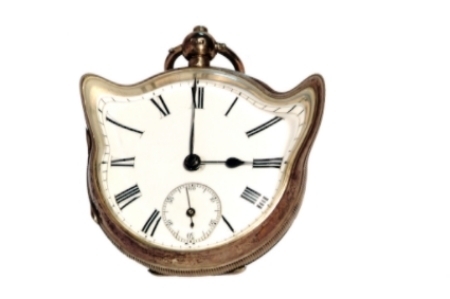
I love how this clock looks like it has cat ears.

I love how this clock looks like it has cat ears.

Here at the beginning of a new year, a curious phenomenon has arisen in the work I’ve been doing with my coaching clients. It comes down to this: what we believe about how long something will take is directly related to whether or not we actually do it.

These types of beliefs are time distortions, and a good example of this phenomenon comes from Seinfeld. There’s an episode where Jerry is trying to convince himself that it won’t be that bad staying for a few days with his parents in their Florida condo. To make the impending visit feel shorter, he tells himself that he can’t really count lunches and dinners and taking showers as part of the visit — so, actually, the whole visit will be “like fifteen minutes!”

Have you done this? I know I have. When we’re dreading something, our minds will go to all sorts of lengths to help us cope.

This is in some ways helpful and productive — I know there are experiences I would probably have never exposed myself to if I’d known in advance how hard and stressful they were going to be.

But my mind convinced me that “it wouldn’t be that scary.” In some cases, it was far scarier than I’d imagined, but in the end I was thrilled that I had the experience (so, thank you, dear mind!).

More commonly, though, our minds can protect us into not doing something at all (that we either want or need to do) with these types of distortions.

A client I worked with recently had not completed the “homework experiment” we’d set up for her. (I refer to any homework I give clients as an “experiment” rather than an “assignment” because approaching something as an experiment tends to engage more curiosity and less resistance. But not in this case!)

When we dug into why, it turned out that she’d been thinking the homework “would only take thirty minutes or so” and she could knock it out the night before our session. When we looked honestly at the homework, though, it was clear that she would need a minimum of three hours to do it.

So why had she decided it would only take about half an hour? Because she had a lot of resistance built up around doing it, and the only way she could bear to face it was to think that it would be over in a very short amount of time.

In this case, that meant she put it off until it simply didn’t get done. And I have a lot of compassion here, because I have SO done this.

Here’s another example, from a different client. She’d told a close friend she would run an errand for her, but hadn’t done it. For a month she’d been waking up thinking “I really need to do that today. I should do it.” Then she wouldn’t do it and the next day the whole cycle would repeat.

When we took a look at why she wasn’t doing the errand, another sort of time distortion revealed itself. She was certain the task was going to take hours and that it could become very complicated, and that she might have to get help to complete it that she wasn’t sure she could get.

I told my client that, while I could be wrong, to me it sounded like the task shouldn’t take more than about an hour to complete (and this included driving time). We looked at what would be the worst that could happen if, in fact, it did take her as long as she feared. “It would be really stressful and annoying,” she laughed.

But she agreed to go ahead and do it the next day. I told her to email me as soon as it was done and tell me how it had gone (this kind of check-in with someone who cares about you can be SO supportive!).

She emailed me way sooner than I’d expected to hear from her. Why? Because the task, including driving time, had taken her exactly 18 minutes — no complications, no extra help needed. Just straightforward driving to an office to pick up a folder and dropping it off at her friend’s house.

How do we keep ourselves from getting sucked into time distortions? Well, first we need to get our thinking about the task we’re avoiding out of our heads, where we can see it more clearly. It helps to write it down, or speak it aloud to yourself or someone else. (So often our thinking is automatic, bypassing our consciousness. We need to see it “out there” in order to be aware of it.)

If you notice there are time issues in your thinking (“I can write a draft of my chapter on the twenty-minute train ride”) and that you feel a considerable amount of anxiety with that thought, you can be pretty sure that what you’re telling yourself is deeply unhelpful. (We almost always avoid things because of the anxiety they bring up in us. If we can lessen the anxiety, we’re going to be far less likely to avoid them.)

So experiment with some mantras that will help you do a reality check when it comes to how long something will take. (Often, we just don’t know, and that needs to be factored in.)

Here are some of mine:

I won’t know how long it will truly take until I start doing it.

If it’s going to take a long time, I’d rather get started sooner than later. 

I want to feel as calm and grounded as possible around this action. What will help me feel that way?

All of these sentences give me a reality check. And for those of us with, shall we say, vibrant imaginations, reality checks can be a valuable part of our artist’s toolbox (as much as we might cringe at the idea of “mundane reality”!). As long as the reality check is supporting our bigger vision, it’s all to the good. 

What do you notice about how distortions of time play into your fears around getting things done? I’d love to hear from you.

And: Need some help moving your creative work forward in the new year? For a limited time, I’m offering three-packs of 30-minute coaching sessions. You can find out more, here.

Above image is “Old Distorted Clock,” © Jolin | Dreamstime Stock Photos

Welcoming the conscious pause

image

Conscious paws are always welcome 🍃

Somewhere on the continuum between torturous procrastination and frenetic “just so I feel like I’m doing something” action is a place of pausing. Of breathing. Of looking around, looking within, and inquiring: what do I really want here? What is it I truly need?

Or perhaps this place, which I call conscious pausing, is not on that continuum at all. Maybe it is actually off that continuum — the silent, sometimes-sacred space you step off the path to claim, like the big rock next to the river that runs along the highway.

I mention this place of conscious pausing because it took me four days to recognize that I was forgetting it was available to me. I returned from visiting my family for Christmas a week ago, and allowed myself a couple of days to recharge (which a younger me would have felt like a slacker for allowing myself, so, yay! Progress!).

But after those two days, I began to ping-pong between a feeling of severe procrastination (I should be doing something, but what? how?) and impulsive activity that felt pointless and disconnected.

(One sign that I, a Myers-Briggs INFP, am “in the grip” — read: under stress — is that I start taking urgent actions that actually make things worse. If you’re at all interested in personality type theory, it’s worth reading up on what your type looks like when it’s “in the grip.” You can start to recognize these behaviors in yourself and regroup.)

Once I noticed how I was acting, I realized my desire to “start the New Year off right” had caused me to fall back on old black-and-white thinking: “If you’re not doing productive things, you must be procrastinating. And if you’re procrastinating, you suck. And now 2016 sucks. Bah!” (Humbug.)

But the key, my friends, as always, is in noticing — a seemingly benign word with a ton of power.

Because once I noticed my swing from one end of that aforementioned spectrum to the other and back, I was able to consider the possibility that I had another choice. That, instead of beating myself up for procrastinating or jumping into frenetic doing, I could take that conscious pause and reconnect with what I truly wanted and needed.

***

Here are some questions I find helpful when I realize it’s time for a conscious pause.

(It’s good to ask them while placing awareness on your breath. I often find that writing the questions and my answers in my journal gives me a bit of detachment from myself so I can see what’s going on in me more clearly. But you can also speak them aloud, or have a friend read the questions to you.)

How exactly am I feeling right now? What emotions are coming up? (If you’re not sure, start here: are you more mad, sad, glad or scared?)

How does it feel in my body right now? (I have a headache, my chest is tight, my knees hurt.)

How do I want to feel right now? (excited, hopeful, peaceful, relaxed?)

How does my body feel when I’m in that place? (get specific here: my spine straightens, my pulse slows, I breathe more deeply.)

What thoughts am I having about the immediate future?

(Here are some of mine as examples: I can’t get it all done. I’m already behind. I won’t make the deadline. I can’t show up fully for my client.)

How can I change these thoughts to thoughts that feel better but also feel true? (When you work with your thoughts, you must believe your new thoughts — your essential self will not be fooled by hollow “positive affirmations”!)

Here’s how I changed my examples above:

I don’t have to get it all done, only the priority stuff. (I believed that.)

Exactly WHAT am I behind? A semi truck? (The frantic part of me didn’t have an answer for this; she just sort of laughed, nervously.)

If I absolutely can’t make the deadline, I can find a work-around. I’ll see it better when I’m in a place of peace.

I can offer my client my imperfect presence, my listening, my best for today. That is all I can ever do. It’s been enough in the past, so why wouldn’t it be enough now? (My frantic self rolled her eyes and scowled at me a bit here, but I could see her shoulders relaxing despite her best efforts to act intimidating.)

***

After you check in with these exercises, you’ll notice that what you’re wanting and needing will be all over your answers to the questions. (It’s amazing how easily and automatically we forget to ask ourselves what we want and need!)

It really helped that my cat climbed into my lap while I was checking in with myself. Is there anything more grounding than a warm feline?

By the way, you don’t have to answer all of these questions (you don’t HAVE to do anything!). You can start with the first one, and move on as it feels right. You may find relief after the first two.

Or, you can nix the questions altogether and simply focus on your breath and the fact that you are, indeed, choosing to consciously pause and stop the madness! What I love about going through these questions, though, is the clarity I come out with on the other side. Every time I see my behavior, my thinking, my feelings, with more clarity, it’s that much easier to navigate the stress when it arises the next time around.

Here’s to conscious pausing and a juicily creative 2016! How might you integrate the power of the conscious pause into your intentions and goals for the new year?

You only ever need to do one thing

christmasstar

Yesterday I was having one of those days where my mind spun with all that I was sure needed to be done. I sat at my kitchen table, staring out the window, trying frantically to access peace (as if “frantic” could ever be the way to peace).

There was so much I should be doing, surely, but it felt like there was so much that there was no point in starting — with such a huge to-do list, anything I did would only constitute a drop in the overflowing bucket of what must be done.

This is a familiar place I can go to when more than “the usual” is on my plate, and that’s the case for so many of us at the holidays. Even though I’ve made a conscious decision to do things more simply this year, I still travel for Christmas and, grrr — traveling? Not my favorite thing. I like being there, I just don’t like getting there.

As I backtracked and took a look at what I’d been thinking yesterday morning, I realized I was focused on the sheer hell that plane travel would surely be, and what a drag it is that every year I endure this, and how with everything going on in our world I have an extra layer of fear right now, and on and on.

And then I felt selfish and self-centered for not being able to be a “bigger person” and have gratitude that my parents are in good health and I have this opportunity to see them at the holidays.

This is a good example of what our minds tend to do (my mind is hardly unique in its patterns!). When we fixate on something we’ve decided will be unpleasant, reinforce the expected unpleasantness with fearful thoughts, and then judge ourselves for having the thoughts in the first place, we get into a vicious loop.

When we’re operating from that loop, it looks like only eliminating the circumstance we’re convinced is making us unhappy will restore our sanity — or, only making the exact “right choices” within that circumstance will keep us safe, secure, on steady or virtuous ground.

If feeling good is dependent on either eliminating circumstances or choosing the “correct” ones, we’re on a slippery slope. So much is out of our complete control, even in areas where we do have a good amount of legitimate power over what happens.

So when we approach our lives this way, it’s kind of like we’re either focused on the finish line, when the race will be over and (if we do it right) we’ll have won, or we’re looking for a way to bow out of the race altogether. But I don’t want to run! we think. Why does there have to be this stupid race?

As I sat obsessing about the “right way” to handle my commitments, I looked over at my boyfriend, who was sitting in a chair in the living room laughing heartily at something on TV.

How simple it is for him, I thought. He doesn’t analyze everything the way I do. He just does what needs to be done and doesn’t make a big thing out of it. (He would tell you this isn’t exactly true, but it was what I thought in the moment.)

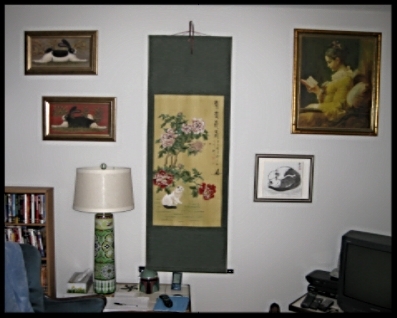
And then I noticed the mostly blank wall behind him. Since we moved in August, I’d been meaning to hang pictures on that wall, but I kept telling myself it wasn’t important enough to take precedence over everything else I needed to do.

But, I realized, I wanted to hang those pictures. Of everything I could have been doing in that moment, hanging those pictures felt like something I wanted to do. And, looking at the mostly empty wall, I realized that hanging the pictures — only that — was all I was called to do in that moment.

Just that one thing.

Back in August, during that last chaotic week before I moved to my new home, my friend Mary Montanye asked me via email how the moving preparations were going, and I told her I was mega-overwhelmed. She responded that when she was in the process of moving, she’d found it helpful to “just take the next indicated step.”

Those words spurred me on like you wouldn’t believe (thank you, Mary!). And yesterday, hanging the pictures and admiring them afterward, noticing how much more it feels like home in the living room now that the pictures are up, my mind began to quiet itself.

pictureshung

Pictures are up!

I was reminded that all I ever need to do is one thing. No matter how big the project, how sprawling the to-do list, I only ever need to do one thing.

And here’s the trick: Only when I am in the process of doing that one thing am I able to see clearly that it is being engaged with the process that I crave, not getting to the finish line or eliminating the task.

When I am caught up in thinking about all that needs to be done, and not actually doing the one thing that presents itself, I am disconnected from the rewards of the process of doing. I believe that the only reward comes from “having done it”.

This is why when I hear people say things like, “I hate writing, but I love having written,” something in me cries, but that’s no way to live! If we can’t find ways to make the process rewarding, we’re forever focused on the finish line, and therefore missing most of our lives.

And the process looks like this: one thing, one thing, one thing. (And yes, sometimes our “one thing” CAN be eliminating, or rescheduling, something on our to-do list! The key is in taking the action, rather than obsessing over it.)

I’m curious about how this works for you, and particularly about how you might apply “just one thing” to anything you have planned for the holidays.

And if, like me, you’re an introvert who’s needing a little more comfort and simplicity at this time of year, you might want to check out this post that I wrote last year at holiday time.

Top image © Jessie Eldora Robertson | Dreamstime Stock Photos

Avoiding the intimacy of creating

pensandpencils

Publishing this post today, my heart is heavy with the news of the horrible events in Paris. A prayer for love and kindness in the world, and for each of us to remember that it starts with the way we treat ourselves and those closest to us, and radiates outward.

As I’ve often noted here, I am a compulsive journaler and have been since my teen years. I don’t ever have to drag myself to my journal; in fact, I usually relish the expanse of the blank page there (this is not always, or even often, so for other forms of writing!).

Lately, though, I notice that while I go readily to my journal to write, I’m restless after a few minutes and it’s hard to stay there.

I’ve gone through these periods before, and they usually happen when I’m about to approach what I call “hardcore” journaling — meaning, there’s a lot that’s ready to come up, and I know it’s vital that I allow it to come up onto the page, but it’s not going to be easy. In fact, it’s going to be intense, and even draining. But it’s so worth it.

In this way, I compare journaling — or any kind of writing we do — to an athletic activity. We are building all kinds of muscles when we write regularly.

And this is true for any form of creative work (or play, as I prefer to call it!) that we do steadily. Doing it makes us stronger, more flexible, vaster — it widens our scope as human beings, as spiritual beings.

But sometimes, the process is especially tough and tender, as it has been for me lately in my journal.

Yesterday I was drawn to pull out Natalie Goldberg’s Thunder and Lightning, one of quite a few wonderful books she’s written on her writing life and process. In one chapter she describes leading a class in which she read to her students from Richard Nelson’s The Island Within. The writing was sinewy, alive, present, tender. And yet, she saw her students’ attention wandering; she saw them yawning and getting bored. How could this be happening when the writing was so alive?

The students, Goldberg realized, were resistant to the intimacy on the page. The writing was so there, it brought them so unflinchingly close to the subject, that they were afraid of that intimacy. They wanted to avoid it.

As someone who’s taken many writing classes and viewed them from the standpoint of both student and teacher, I’ve experienced this as well. There is something in us that is afraid of beauty, of aliveness, of what’s true — and, in our resistance to it, we feel tedium. We pull away.

When I was about twenty, I had a conversation with a guy in a coffeehouse that has always stuck with me. He talked about the book he was reading — it was a novel by Gabriel García Márquez, but I don’t remember which one — and he said, “You know, it’s a boring book. It tries my patience. I want to put it down a lot. But some of the most boring books I’ve ever read have been some of the best books I’ve ever read.”

This was a totally new idea to me at the time. I pondered what he meant for a while and I got it. He didn’t really mean that the whole of him thought the book was boring. He meant that the part of him that was afraid of being present, the part of him set on instant gratification, that part that just wanted to be distracted from itself, found the book tedious.

The whole of him felt compelled to finish the book — it knew something important was there for him — and, guided by his essential self and not his impatient instant-gratification-seeking self, he kept reading.

(A writing teacher of mine once said, “A ‘boring’ book is often a failing of the reader, not the writer.” Martha Beck talks about “the cultural pressure to seek excitement” here.)

There are so many challenges in this world to our staying with something. Anything. When I got an iPad several years ago, as much as I loved it, its built-in ease of use presented a huge test to my powers of concentration. Now, when I write, when I read, or even when I want to fully focus on a movie, I keep the iPad away from me. (Unless, of course, I’m reading or watching the movie on the iPad. A-hem.)

So how does this circle back to me and my journaling? I’ve been avoiding the intimacy of being with my own aliveness on the page. How crazy is that? Well, not crazy at all — actually, very human.

But I know I will stay with the journaling because I have been initiated into its magic. And the magic only comes when I stay with it.

Is this true for you and your creativity, whatever form it may take? Do you find yourself avoiding the intimacy that comes with staying present to yourself, to the world around you? I’d love to hear how you experience this, in the comments.

A few things I’m up to …

  • Reading Dog Medicine by Julie Barton, a beautifully-written memoir about a woman’s struggle with depression and how her bond with her dog helped her through it. It’s not an easy read by any means (I’ve cried through quite a bit of it), but having experienced first-hand the healing power of animals in my own journey, it’s helping me embrace my own story. Which, to me, is the most amazing thing writing can do.
  • Preparing to teach a class locally on supporting ourselves through the vulnerability and other rough stuff that comes with writing autobiographical material, a topic close to my heart.
  • Continuing my low-cost Autumn Transition Coaching Sessions (you can still grab one through Wednesday, Nov. 25). If you’re a sensitive creator who’s deep in transition and feeling stuck or scared, I’d love to help. Find out more here.

Image © Scarf_andrei | Dreamstime Stock Photos

Walking my talk about self-care + Happy Fall!

pumpkins15Maybe the hardest thing for me about going through a time of heightened activity (or, insanely heightened activity) is coming down from it all.

After the last couple of months of transitioning from my old home to the new one — and the accompanying “too much to do” feeling on a daily basis — things are starting to settle down just a bit.

And I’ve actually found myself at loose ends on certain days. My mind and body have gotten used to “too much to do.” It’s that “coming down from the adrenaline of momentum” feeling that I’ve written about before. The adrenaline that helps us to get through the period of heightened activity actually starts to feel normal to us.

This is where I can get into trouble if I don’t pay attention. Last week Saturday was the first day I really took an opportunity to fully catch my breath — and it felt wonderful. But the very next day, I noticed myself overscheduling and stuffing in activities here and there because, why not? I’ve gotten used to having too much on my plate.

And noticing this in myself clued me in to the fact that I’d fallen for it all over again — our culture’s glorification of “busy”.

Remember that saying, “If you need to get something done, give it to a busy person”? I heard that often from my parents and teachers when I was growing up, and again in college, and, heck, somebody just said it to me the other day.

And to a degree, being busy feels good and IS good, as long as we are occupied with things that are meaningful to us and notice our need to rest.

But there’s something insidious in the way we praise “busy”. We apologize for being “so busy”, and yet it also seems to give us some kind of quick validation. We’re busy, therefore we must be important, we must have value.

And: being super-busy also gives us a good reason to (finally) take a huge time-out and take care of ourselves.

But what if we didn’t need a “good” reason, or any reason at all? What if noticing our need to rest and then our need to be active and then our need to rest again, was simply part of our daily lives, part of our ongoing self-care? What if this kind of self-care was a must, a foundation for our lives, rather than something we have to hit a (sometimes very painful) wall to finally allow in?

For the past several months, I’ve been leading clients through my Stellar Self-Care program, which I created because I recognized that far too few of us truly anchor self-care into our lives at the foundational level. We wait until we’re in so much physical, mental or emotional pain that we simply can’t ignore the part of us that, ultimately, cannot be denied if we actually want to thrive and not just cling by a thread to survival.

And, here’s the thing I came to: I wasn’t walking my talk. I’d been seduced by the idea that I would practice better self-care after my move was over. When things calmed down. When things got less hectic. 

In these past few days, I’ve reminded myself that it’s okay to feel at loose ends as my body adjusts to living life in a less heightened way.

It’s okay to let go of activities that I’m tempted to “schedule in” but simply don’t feel necessary.

And it’s okay to do it all completely imperfectly as I discover how I want to live now (because now is not then!)

One thing I’ve learned while working with people in this new program is that we all have a tendency to turn self-care into “one more big to-do on the list.” And that’s exactly what I did when I starting telling myself I’d take better care of myself when the move was over. I already had such a giant to-do list I felt like I couldn’t possibly take on any more.

And I was right. I couldn’t.

But I was also wrong — because taking care of myself wasn’t about adding to the list; it was about leaning away from the list. About letting the list sit. If there was anything to “do”, it was simply to shift my relationship to the list. To trust that those things on the list would be done when they’d be done, rather than to hold my breath until I’d “tackled them.”

There’s nothing like “heightened times of activity” to trigger stress in us, and there’s nothing like stress to trigger our “fight, flight, freeze” reactions. Once we’re in fight, flight, freeze, we’re in survival mode and we try to “just get through it.”

If we can intervene before we get to that point, we absolutely should. And right now, as I’m writing this post, I’m noticing that part of me that is feeling like it’s pushed hard enough and is ready to stop. It’s saying “enough for today”.

Listening to that soft voice — right here, right now, not later, not when I’m sure this post is “good enough” — is key to me taking care of myself today. So I’m going to act on that urging. And stop. 🙂

I’d love to hear how YOU take care of yourself before getting to the “fight, flight, freeze” point. And you can learn more about my Stellar Self-Care program here.

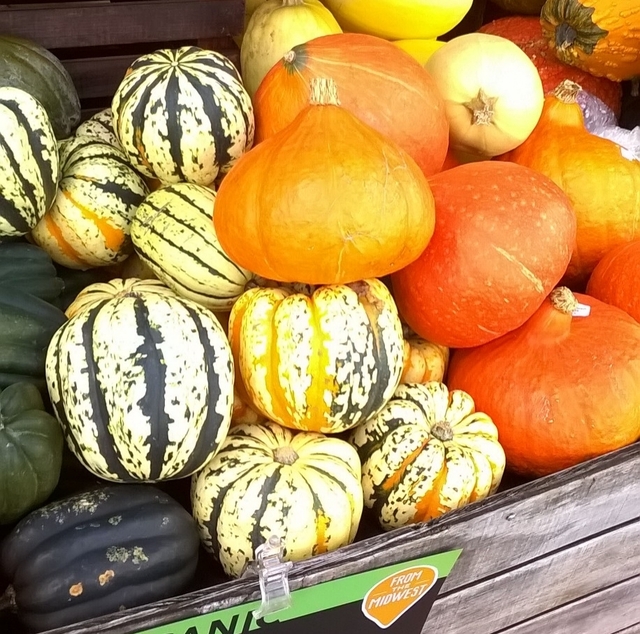
Gorgeous gourds: confirmation that fall has arrived!

Gorgeous gourds: confirmation that fall has arrived!

Good stuff this week:

  • My good friend, artist, writer, and creativity consultant Dawn Herring, interviewed me about journaling for one of her “Creative Conversations”. I had a terrific time chatting with Dawn (she got me thinking and making connections between my journaling and the rest of my life that I don’t know if I’d have gotten to otherwise!).
  • I absolutely love this interview with Elizabeth Gilbert about creativity on Marie Forleo’s site. I particularly love what Elizabeth had to say about being a “trickster” when it comes to our creative work as opposed to a “martyr.”
  • Fall is here! The pictures accompanying this post are gourds I saw on one of my walks this week. I wish you the spaciousness to relish this gorgeous season as it sweeps in.

Images © Jill Winski, 2015

Bringing the joy back to your creative work

paintedheartRecently, a writer friend and I had a great conversation about what to do during those periods when you feel like the joy has simply evaporated from your creative work (or your life!). The talk got me pondering.

I love a broad definition of creativity: I believe it is, simply, the life force moving through us. So when we’re not feeling joy, something is going on with the flow of that life force.

Consider the following three things if you’re wondering where your “creative joy” went:

* Structure: do you need more or less?

As with everything, as we change and our lives change, so does our need for structure. Back when I worked at a job that required me to be in an office from 9 to 5, I felt that my life was too heavily structured. I didn’t have the amount of “meandering, puttering time” that fed my creativity. However: when I quit that job and had more free time, I quickly found that I needed to create more structure in my life or I felt sluggish and unfocused.

Both feeling overly structured and “understructured” can squeeze the joy from our creative work. (As I was reminded last weekend while watching the movie Next Stop Wonderland, that quote from Emerson is NOT “consistency is the hobgoblin of little minds” but “a FOOLISH consistency is the hobgoblin of little minds.”)

Consistency in and of itself can provide the daily structure we need to show up for our creative work — but we need to be tapped in to what kind of structure and how much we truly need (or we can get into that foolish consistency territory!). There is no question that our souls crave those periods of open, meandering, wandering time. If you haven’t had one of these for a while, see how you can go about scheduling one and notice whether you see your joy resurfacing.

(I went into more depth on the topic of structure here.)

* Support: do you need more, or different?

Support for our creative work is so important — and/but it must be the kind of support that works for us, not for somebody else. If you feel like the joy is leaking out of your creative process, take a look at the support you’ve built around it. Is there too little? Is there any at all?

Or, are you surrounded by voices that encourage you in ways that don’t quite feel like the kind of encouragement you actually crave? Are you calling something “support” that actually isn’t? (For example, does the writing group you joined offer feedback in a way that doesn’t work for you? Can you ask them for what you need and move on if you’re not able to get it?)

Or, are you suffocating in information masquerading as support? I’ve become very picky about what I read online. So often, less is more, and in the end, it’s myself I need to consult, not “the experts.”

(I delved more deeply into the topic of support here and here.)

* Sovereignty: do you have enough? Do your boundaries need strengthening?

Sovereignty means that you are the ruler of your own kingdom.  In other words, you decide what comes into your life and what stays out, through creating boundaries around your creating.

Many times when I’ve felt I’ve “lost my joy”, when I’ve looked a little deeper (or perhaps had a friend, coach, or other compassionate witness point out the obvious to me), what’s really happened is I’ve lost my boundaries. I’ve allowed the desires and needs of others to encroach on my own to the point that I’ve felt angry and resentful — which is pretty much the opposite of joy!

Or, I may be eroding my own boundaries by being mean to myself (here it can be vital to look at my thoughts and how they’re influencing the way I feel) or getting out of whack in the realms of Structure and Support. (See how it’s all connected?)

Karla McLaren says in her wonderful books that when we feel anger, the questions we need to ask are “What needs to be protected?” and “What needs to be restored?” Very often, the answer is boundaries. We need to reclaim our crowns as rulers of our creative kingdoms (or use whatever metaphor works for you there!).

(I wrote more on the topic of setting boundaries around your creativity here and here.)

Reclaiming joy is a huge topic, but just taking a look at one (or all three) of these areas of your life can be a great jumping-off place.

How do you bring the joy back into your creating when it’s slipped through the cracks? I’d love to hear.

And by the way, if you’re needing more structure and support for your writing, you might want to check out The Writer’s Circle (where I am both a coach and a longtime participant!). Registration for our next session ends July 16.

Above image © Egidijus Mika | Dreamstime Stock Photos

Radical self-care: when your “normal” has changed

palebutterflies

As I’ve been working with clients in my Stellar Self-Care program, I notice how the tendency for many of us is to keep going on “as usual” — even though our lives have changed.

Maybe a health issue (for us or a loved one) has come up, and we’re still expecting ourselves to function as though it hasn’t.

Maybe we’ve started a new job, or we’re in the process of moving, or we have a project or business that is gaining momentum.

Maybe we’ve been through a break-up, or someone close to us has passed away recently.

Or, maybe a mix of ALL of the above is happening at once.

Whether our circumstances inspire hope, excitement, or sadness, the fact is that when things are changing profoundly in our lives, or when they’ve changed suddenly and without warning, we are affected.

So it’s really interesting to notice this human tendency to stay the course, to keep showing up, to expect “the usual” of ourselves, even though things are anything but “usual.”

None of this is “bad” or “wrong.” It’s just not necessarily effective — or kind to ourselves.

I notice for myself that my tendency is to toss self-care out the window — exactly when I need it the most.

When I’m really stressed, I also get really self-indulgent. (Read my take on the difference between self-care and self-indulgence, here.)

I start to obsess. I tell myself it’s more productive to worry than to sleep. I grab the quick food rather than the nutritious food (or don’t eat at all because I’m “too nervous”). I forgo my daily walk on the grounds that “there’s too much to do”. I feel much less creative because I’m tied up in knots and I’m “pushing the river”. (I like to think of creativity as a river that is always flowing — we can move with it, against it, or jump to shore and return later.)

And: I am getting a lot better at letting go of these behaviors and replacing them with acts of care for myself.

Sometimes this looks like:

* Declaring my sleep time as a “worry-free zone”.

Letting myself know that — if I want to — I can worry all I want at 9 a.m., but between between 9 p.m. and 9 a.m. I’m going to step into the worry-free zone.

Better yet, if I’m going to insist on worrying at all (which a part of me will), I can declare one hour a day as my “worry hour” and make the rest of the day the worry-free zone. (I’m not quite there yet, but I like this idea very much. A friend tells me that when she started doing this, eventually an hour became too long to worry — she got bored with it and found she couldn’t spend longer than about five minutes worrying when she was forcing herself to do it!)

* Taking my walk even though I’m having a thought that says “There’s no time for this, there’s too much to do.”

This might mean reminding myself that, often, if I walk long enough and focus on my body moving and my breath flowing in and out, problems have a tendency to solve themselves. (That’s because I’m back in the river of creativity, and I’m moving with it, rather than pushing upstream. Walking is great for reconnecting to the river of creativity.)

* Putting off the non-essentials for later, or for “never.”

I mentioned in an earlier post that I had taken on a freelance project even though I’ve been going through a hectic time because I just couldn’t say no to the opportunity. When I really looked at everything on my plate, I realized that the project was a non-essential, and I would be fine with taking on such a project later, or even never. Other opportunities would surely arise, but I was, at the moment, at bandwidth.

* Getting (or hiring) help where I can.

A couple of weeks ago, the lawnmower broke, and I got angry. After thirty minutes of going on about my terrible luck (The lawnmower breaks just when I have so much to do!), I realized this was a chance to give myself the gift of time and one less thing on my to-do list: I discovered a local lawn care service that would mow the lawn regularly for a very reasonable rate. The owner came over and gave me an estimate the very next day.

(This is a recurring theme in my life over the past couple of years: when something breaks, there is a gift in it for me.)

The bottom line, though: it starts with acceptance of where I am, and who I am.

If you feel like you’re slamming into the same wall again and again, ask yourself this: What needs to be accepted? And then: How can I accept myself, here?

Somewhere in there lies what is true, for you. And from that truth you will discover not only what caring for yourself looks like, now, but also that giving yourself that care is essential to navigating the reality of your life not as it was, but as it is.

Do you notice yourself resisting change in your life? What acts of care can you give yourself when change feels overwhelming?

Image © Phillip Wheat | Dreamstime Stock Photos

When you’re overwhelmed, get specific

blurrySomething I’ve noticed while working with clients who are “overwhelmed” is that, often, we remain in overwhelm because we are not getting specific enough.

We’re not specific about what exactly it means when we say “I’m overwhelmed.”

In this way, overwhelm is kind of like a stifling blanket of vagueness. We keep spinning in it, saying things like, “I just want to stop being overwhelmed” or “I feel so overwhelmed I can’t move forward.”

That’s the trick (and sometimes the gift) of overwhelm — it keeps us in the dark about what’s really going on with us. It keeps us spinning, obsessing, fighting, or zoning out.

Sometimes it is effective, when we realize we’re overwhelmed, to cut right through the “overwhelm story” and ask ourselves how we want to feel. And then, when we know how we want to feel, we can ask ourselves what would help us feel that way.

Sometimes, though, it’s more helpful to actually pull apart the overwhelm — to look at it as a mass that is made up of a number of components, and get really specific about those components.

What we call “overwhelm” is, in many ways, an attempt to focus on too much at once. So if we pull apart the elements of it, we can start to see what it is made up of. We can start to remove focus from pieces of it, and focus only on what we choose to focus on.

For example, as I mentioned in my last post, I have a move on the horizon, but I don’t know exactly where or when I’ll be moving. I am dying for more clarity around this move — the uncertainty, on some days, feels like it’s driving me crazy!

What I noticed a few days ago is that even though I have this fairly giant thing on my horizon, which is requiring a certain amount of focus and energy (looking at finances, neighborhoods, apartments, storage possibilities), I’d been demanding of myself that I focus on other “big things” as well. And my attention had become scattered and paper-thin.

So yesterday, I let go of a freelance project I’d taken on because it seemed like a good opportunity.

What I found was that even though my mind couldn’t pass up the opportunity, it was actually a terrible time to bring in another thing to take energy and focus from me, especially when it was a thing that didn’t totally light me up.

When I let go of the project, I also felt the overwhelm whoosh out of my body. From this place of more lightness and peace, my move and the elements surrounding it feel so much more doable.

Here are a few ways to get specific about what’s really going on if you’re feeling overwhelmed:

* Instead of saying, “I’m overwhelmed,” say, “I’m sensing overwhelm within me.”

This will create separation between you and the feeling of overwhelm. (You are not the feeling!) Then see what comes up. What happens when you recognize that you are bigger than the feeling of overwhelm?

* Give yourself ten minutes to write down what you’re feeling overwhelmed about.

Do this stream-of-consciousness — don’t try to “get it right.” (And don’t go on for longer than ten minutes — set a timer if you must.)

Then, read over what you’ve written. Notice what jumps out at you. Is there something here that you’re giving a lot of attention to that doesn’t warrant it? Is there anything you wrote down that you can just drop? Does it truly all have equal priority? (My guess is no!)

It can help to consult your “future self” here. If you were to ask you-five-years-from-now which of these issues is important, what does “future you” have to say?

* Bring your focus to your body.

What does your body feel like right now, while you’re in this space of overwhelm? Is it tightness in your abdomen, a clenched jaw, a headache? Shallow breathing? As you breathe, notice what thoughts bubble up for you with these body sensations.

The thought I had was, “If I don’t do this project, I’ll regret it.” I asked myself if this thought was true. What felt more true was, “If I DO this project, I’ll regret it.” That felt more true because doing the project was adding to my to-do list during an already stressful time, rather than taking away stress by giving me an opportunity! And that made it easier to let go.

* Ask yourself if perfectionism plays a role in your overwhelm.

Frequently, the idea that we have to “do it all well” triggers overwhelm because on some level we know it’s not possible or worthwhile. This creates a conflict — part of our attention is on “doing it all well” and part of our attention is on that nagging knowledge that we can’t do it all well.

If you had permission to show up for all parts of your life with C+ rather than A+ effort, how would that change your feeling of overwhelm? Is it possible that showing up in and of itself is enough?

What helps you break down this thing we call “overwhelm”? I’d love to hear what works for you.

And, if you’re struggling with overwhelm on an ongoing basis, you may want to check out my Stellar Self-Care (for Sensitive Creatives) program. You can learn more about that, and my other offerings, here.

Image is “Railway Station Through Glass Brick,” © Bx3t | Dreamstime Stock Photos