When “good enough” is plenty

coffeegrounds

My favorite morning ritual is to go for a walk and get coffee and then walk home. There is something about starting my day this way that just helps. Since I work from home, my “walk for coffee” is a transitional element — it smooths that space between waking and working.

But: the coffee at the places within walking distance just doesn’t really do it for me. Oh, there are many. Major chains, smaller independent places. But something is lacking in the taste of the coffee. It’s either too strong or too weak or it’s not quite the right flavor. Blah!

A few months ago I became obsessed with finding coffee that I could love. I was tired of paying for coffee I wasn’t thrilled with. I convinced myself that if I had better-tasting coffee to start my day, the day would go better. Like, way better.

So I decided to try just making my coffee at home. I did lengthy searches, read copious reviews, and found some fancy new flavors. And I was able to create the coffee I wanted, for the most part. And I felt satisfied. Sort of.

But: the walk. It was missing! And my morning walk is huge for me. It jump-starts my day. It connects me with the creative impulse, with birds, with squirrels and trees. It gets my body moving.

So: I decided I’d make my coffee at home, and then take it with me on my walk.

But: this didn’t work either.

Because: I like going into a coffee place and having that simple interaction with people. There is something about going into a place, talking to people a bit — just a bit, not too much — holding the door, that simple exchange — staring at the bulletin boards, smelling the coffee smells — I like all that. It connects me with the world. I need it.

So, I sat with this coffee conundrum, marveling that this seemingly small thing — really good coffee — had started to take up so very much space in my daily life.

And, eventually, I realized this: the perfect coffee just didn’t really matter that much.

Yes, it would be nice to have the coffee of my dreams on a daily basis, but it was the entirety of the experience I truly needed — walk/coffee/nature/people — and not really the coffee itself. Coffee was only one piece of a bigger thing — my foundational morning ritual.

I also realized something else: In preoccupying myself with my search for the perfect coffee, I was less available — even if only slightly — to the parts of my life that are more important to me. To the parts of my life where, perhaps, I need to take more risks and dial up my commitment. Or simply experience more presence, more of the “enough” of the here and now.

And so, I decided to let it go.

And you know what? Since I let it go, I am totally fine with my coffee, wherever I get it.

Sure, I will probably stumble on amazing coffee somewhere I don’t usually go, that is not near where I live (like the coffee they served at the Indian restaurant that went out of business!), and I will wish I could replicate that taste somehow.

But while fulfilling my desire for the perfect coffee would be nice, it’s not essential.

When it comes down to it, I’m okay with coffee that is good enough.

***

The coffee example is a simple one, but I see a version of this a lot with my clients, who sometimes feel like they need to hit upon the perfect product, or class, or book, or coach (or, in some cases, life path!) in order to feel like they’re really on their way.

While it is important in certain cases to find a great fit, sometimes it’s okay for the fit to be “good enough.”

(If we’ve struggled with perfectionism, and its shady sister, procrastination, we may use a tendency to hold out for the “perfect fit” as a way of keeping ourselves from showing up in ways that scare us. Check out the categories on the right to find my previous posts on perfectionism. )

Pouring energy into these non-essential areas may seem like a small thing, but it’s actually a huge drain on our creative energy to search for perfect when we already have enough.

And even when we are dealing with an area that is truly essential, like a central relationship or the pursuit of our soul’s work, the “search for perfect” can serve as an exquisite distraction from what is already available to us.

Do you see areas like this in your life,  where you’re looking for perfect when “good enough” would suffice? I’d love to hear how you experience this.

Need some support in making your creative work a priority in your life? I’d love to help. Click here to see if we might be a good fit. 

Above image © Dana Rothstein | Dreamstime Stock Photos

Embracing the beauty of being on the fence

ducksonfence

One of the most painful things we can experience, at times, is that feeling of being “on the fence.”

We’re not quite at “yes”, but it doesn’t exactly feel like a “no” either. This can happen with a creative project, a relationship, a job, or even an event we’re not sure we want to attend.

I know I can be a world-class waffler. Sometimes something is clearly a “hell yes” or a “hell no”, and there’s always a sense of relief for me when that’s the case. Because often, I have a whole bundle of feelings around something — an unwieldy mix of half-yeses, half-no’s, and everything in between.

I have a fascination for the murky, the muddy, the not-quite-clear. My partner said the other day, while I was debating whether or not I wanted to go out of town with him, that while he sees about two and a half sides to every situation and thinks that’s enough, I see eight sides and like to go for thirty.

Fair enough. Sometimes I love that I embrace the gray areas, the not-quite-defined. But it can also make life harder than it needs to be.

Because sometimes, I think I’m on the fence but I’m just plain fooling myself. Sometimes, I’m not on the fence at all but I’m afraid to own my “hell no” or my “hell yes.”

I’ve discovered over the years that there’s a true difference in feel between times I am genuinely on the fence and times when my “I’m not sure” is actually a cover-up for a yes or a no I’m afraid to see.

It’s all about how it feels in my body.

A true “hell no” for me feels like a hand pressing again my abdomen — a firm, strong hand. It’s a boundary; it makes me think of a drum skin pulled taut, with no give left. No. Not going there. Done. Or, eh, that just doesn’t feel right to me, for now.

A true “hell yes” for me feels like an opening. A “yes” for me is in my chest. My body lifts up and forward when I feel a true yes — it’s like an invisible string extends from my breastbone, right around the area of my heart, and pulls me toward what I want.

A true yes does not actually feel like a decision at all, much of the time — I simply find myself moving toward whatever it is. (As Byron Katie says, when we have the necessary information, decisions tend to make themselves.)

flowerfence

So what does the dreaded “fence” feel like? I’d like to first point out that, largely, what makes the fence painful is the belief that we should be off it. That being “on the fence”, feeling “maybe” instead of yes or no, means something is wrong.

When I’m genuinely on the fence (and not pretending to be there because I’m afraid of my yes or my no and what they might mean), there is a true sense of curiosity. Again, I feel it in my body. Curiosity shows up in my abdomen, chest, throat and jaw. It starts in my abdomen and moves upward — there’s a ticklish quality to it, a momentum that is born of wonder.

In fact, a good sign that I’m genuinely unsure is I hear myself saying “I wonder” and “what if?” a lot, in a musing, reverent way. I don’t mean “what if” here in the worrying, fearful sense. I mean it in the creative sense.

It’s like when I’m writing fiction, and I’m testing out story possibilities. What if she does this? And then he reacts by doing that? And then that causes this? It feels more like playing than the tense, cramped feeling that comes from analysis paralysis, from trying to “figure it all out and get it right.”

There is nothing wrong with being “on the fence”, unless we are perpetually there. In fact, when we are on the fence, it is a great opportunity to know ourselves intimately. It is autobiographical. No two people will be “on the fence” about the same situation in the same way.

I do a lot of “fence work” with my coaching clients because people often seek out a coach when they’re struggling with a big decision. Sometimes their truth is that they’ve already reached a “hell yes” or a “hell no” and they simply need to permission to see it and support in owning it.

And sometimes, they need support in embracing the beauty of their particular fence.

Very often, we can only step off the fence into the lush grass on the other side when we deeply get how the fence is serving us. It’s okay to be there for a while, as long as our being there is true for us. And if our truth is that we’re ready to jump off the fence — or shimmy down ever so gently — it’s okay to get support in doing that.

How do you know the difference between a true yes and a true no for yourself? How do they feel different than when you are genuinely “on the fence”? I’d love to hear your take on this!

Above images © Susinder | Dreamstime Stock Photos and © Steve Sharp | Dreamstime Stock Photos, respectively.

Permission to do it differently + last day to grab an Autumn Transition coaching session

coffeebeans

Scroll down to learn more about my Autumn Transition Coaching Sessions — the deadline to sign up is today!

Sometimes (often) I get really, really attached to the way I’ve always done something.

Like, when I was in my twenties, I wrote in coffeehouses a few times a week. It worked really well for me. I loved the hum of activity around me and the human company. I loved watching people walk by the window and the bottomless-cup-of-coffee served by a particular place that I went to most often.

But by my late twenties, the coffeehouse writer thing wasn’t working for me so well. I found that I was too prone to socializing when I wrote in a coffeehouse, and that the socializing felt exhausting rather than enlivening as it had when I was younger. I also found that the bottomless-cup-of-coffee wasn’t good for my body, but if it was available, I was likely to succumb to it.

For a while, I kept on trying to write in coffeehouses. But it just didn’t feel the same as it had. It just didn’t work. How could what had worked for such a long time — and helped me create a solid writing practice — no longer be helpful?

The answer is, I don’t know. My hunch is that my journey as a writer, as a person — as me! — changed. I no longer needed the particular brand of community and company and ritual that I got from the coffeehouse writing experience — I still needed to experience those things, but in new ways, and I craved a quieter, more solitary connection to my writing and myself.

A friend of mine who is a frequent blogger and who also has another job used to crank out a blog post on her lunch break three to four times a week. For a long time, this worked really well for her. She committed to doing it and showed up and did it.

And then, over time, it began to not work so well. She felt empty and distracted when she showed up to write. She wondered if perfectionism was getting the best of her and she was just becoming too picky about her topics. She wondered if she’d run out of material. She figured if she could just push herself a little bit harder, she could keep making it work.

Then one day we were talking and she said that she’d realized her days of cranking out three to four blog posts a week while at her other job were over. Like me with the writing-in-coffeehouses thing, she’d kept on trying to do what worked before, but it no longer did.

It seems it’s a human tendency to hang on to “what once worked.” We do it with rituals, and relationships, and jobs, and rituals within relationships and jobs.

And I’ve come to realize that the important question to ask, sometimes, is not why is it no longer working like it did before? but why am I trying so hard to make it work like it did before?

Because so often what we actually need is not to figure out how to keep doing it the way we once did, but permission to do it differently.

My hunch is that much of this boils down to identity. Our rituals and routines and the things we’re able to achieve regularly contribute to our feeling of who we are. And when we begin to perceive that they’re not feeling so good anymore, we wonder who we are without them.

Eventually, I gave myself permission to do my writing at home — even though I was afraid it would be boring and tedious and that that meant I was becoming boring and tedious (oh, the things I worried about in my twenties!). And I discovered that the truth was something far, far different.

And my friend has found that it feels a lot better to write one blog post a week (and that she is shifting to new subject matter, which feels both exciting AND like she’s not quite sure who the heck she is right now, and, as we like to remind each other, that’s totally okay).

If you find yourself attempting to do something the way you always have and it’s just not working, what if you simply gave yourself permission to do it differently? What if it was totally okay to let go of that old routine and do something new? I’d love to hear how this works for you, in the comments.

And if you’re in the U.S., I wish you a very happy Thanksgiving, with much to give thanks for.

Also: Today is the last day to grab one of my low-cost Autumn Transition Coaching Sessions. These thirty-minute sessions are only $39, and the deadline to sign up is midnight Pacific Time tonight. If you’re experiencing a lot of change in your life right now and feeling stuck, scared, or just plain confused, I’d love to help. Find out more here.

Above image © Johanna Goodyear | Dreamstime Stock Photos

The difference between “ready” and “comfortable”

gorgeous fall

Scroll down to find out about limited-time Autumn Transition Coaching Sessions. 

As I am settling into my new living space, I notice how satisfied I feel with this change. Being in this new place during the gorgeousness of fall, my favorite season, is lending a brisk beauty to this season of my life.

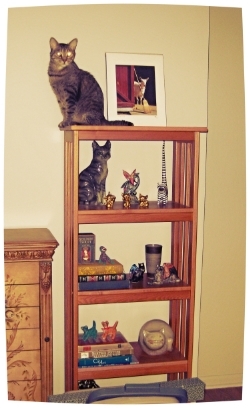
The other morning I was up with my cat at 4 a.m.  — he is a night prowler and shelf-climber, unfortunately (at least it’s unfortunate at that time of day). Even though it’s a drag to get up and monitor him at an insanely early hour, I often have insights at that time of day/night. (Isn’t 4 a.m. known as the witching hour? Hmm.)

The insight that came to me that morning was that, as with all the changes in my life that have felt most “right”, this move to a new home happened when I was ready for it, and not a moment before.

Now, what do I mean by “ready”?

There’s an idea out there in the world right now about “starting before you’re ready.” That if we wait to be “ready,” we’ll never begin.

I understand this concept, but my experience tells me something different. And I think it has to do with what is meant by “ready”.

I would say, “Start before you’re comfortable, but don’t start before you’re ready.”

For me, deep, true “readiness” has a feeling of acceptance attached to it.

With moving to this new home, for example, I wasn’t entirely happy about the change. For a long time after I began to perceive that it was going to be necessary for me to let go of my old home, I felt a lot of resistance to that idea.

About a year and a half before I made the move, I looked at apartments in the very building where I now live, and I had a feeling of wondering. Hmm, I wonder what it would be like to live here. I really like this street. I have a sense that I’d like to live here.

But: I was nowhere near ready to make a move at that point. My attachment to my old home was still so great that even thinking about a “real move” filled me with grief, exhaustion and overwhelm.

At that point, all I was ready for was wondering about where I might want to live next. The idea that I should be “more ready” to make a change than I actually was created lots of stress for me. (Funny how it’s always easier to see these things in retrospect.)

The shift for me came this past March or so, when I realized that even though things were still very much up in the air with my living situation and I was enduring frequent house showings, it felt right to simply be where I was. I stopped scrambling. I decided that despite the uncertainty of my situation, I was going to fully enjoy my home for as long as I had it.

And, from that place of full acceptance, I began to become truly, deeply ready to make a change. By June, my boyfriend and I had found our new home and we knew we would be moving in August.

But moving — despite feeling more truly ready for it — was not comfortable.

As I wrote previously, I had a ton of downsizing and letting go to do, on a number of levels. Aspects of that felt excruciating, not just from an emotional standpoint but from a logistical one.

And sometimes, in my new “streamlined” existence, I am still uncomfortable with the fact that I go looking for something that was part of my life for a long time and realize I donated it back in August. Or, now that my boyfriend and I do not have separate office rooms to go to, we sometimes feel on top of each other when we are trying to work. This change is not comfortable, even though I wanted it, I chose it.

pumpkintrio

Happy Halloween!

Another example: Back when I finished life coach training in 2011, a number of my fellow “cadets” began to go through the coaching certification process. My mind started in on a familiar loop: “Look at them! You’re falling behind. Hurry up and get certified!”

Luckily, my training had taught me to question my thoughts, and in doing that I realized that, deep in my bones, I was not ready to apply for certification. I wanted to do more coaching first. I wanted to “get” coaching at a deeper level before I went through the certification process so it would actually have meaning for me, rather than just feeling like a “should”.

This feeling came from a different place than the “never-quite-good-enough” thrust of perfectionism. It simply felt right to me to wait to get certified.

When I did go through the certification process, in November of 2011, I felt ready, but it was not comfortable. I still had all kinds of doubts and fears, but the way I knew I was ready was that I was not attached to the outcome. The process of certification was so “real” to me by this point that, even if I didn’t get certified, I knew what coaching meant to me, and I knew that I was a good coach. I’d walked coaching into my bones, and certification felt like a natural evolution of that process.

And, as it happened, certification went beautifully for me. But it wasn’t comfortable. I had all kinds of anxiety around it, but it was a different kind of anxiety than I would have had if I’d forced myself to go through the process six months earlier than I did, just as I would have had a different kind of discomfort around moving if I’d made myself do it a year earlier, just to end my discomfort!

(One of the most poignant things I’ve learned about humans since I became a coach is that, so often, in our hurry to end our discomfort, we create even more discomfort for ourselves. Then we look back and wonder what in the world we were thinking.)

What do you notice about the difference between the times you’ve felt “deeply ready” to make a change and the times you started too soon? Has being “ready” felt comfortable for you? I’d love to hear your experience.

Plus: In celebration of Halloween and the beauty of fall, I’ll be offering 30-minute Autumn Transition coaching sessions for just $39, now through November 25. If you find yourself in deep transition and not quite sure how to navigate your next step, I’d love to help. Find out more about Autumn Transition Coaching Sessions, here.

Above images © Jill Winski, 2015

Walking my talk about self-care + Happy Fall!

pumpkins15Maybe the hardest thing for me about going through a time of heightened activity (or, insanely heightened activity) is coming down from it all.

After the last couple of months of transitioning from my old home to the new one — and the accompanying “too much to do” feeling on a daily basis — things are starting to settle down just a bit.

And I’ve actually found myself at loose ends on certain days. My mind and body have gotten used to “too much to do.” It’s that “coming down from the adrenaline of momentum” feeling that I’ve written about before. The adrenaline that helps us to get through the period of heightened activity actually starts to feel normal to us.

This is where I can get into trouble if I don’t pay attention. Last week Saturday was the first day I really took an opportunity to fully catch my breath — and it felt wonderful. But the very next day, I noticed myself overscheduling and stuffing in activities here and there because, why not? I’ve gotten used to having too much on my plate.

And noticing this in myself clued me in to the fact that I’d fallen for it all over again — our culture’s glorification of “busy”.

Remember that saying, “If you need to get something done, give it to a busy person”? I heard that often from my parents and teachers when I was growing up, and again in college, and, heck, somebody just said it to me the other day.

And to a degree, being busy feels good and IS good, as long as we are occupied with things that are meaningful to us and notice our need to rest.

But there’s something insidious in the way we praise “busy”. We apologize for being “so busy”, and yet it also seems to give us some kind of quick validation. We’re busy, therefore we must be important, we must have value.

And: being super-busy also gives us a good reason to (finally) take a huge time-out and take care of ourselves.

But what if we didn’t need a “good” reason, or any reason at all? What if noticing our need to rest and then our need to be active and then our need to rest again, was simply part of our daily lives, part of our ongoing self-care? What if this kind of self-care was a must, a foundation for our lives, rather than something we have to hit a (sometimes very painful) wall to finally allow in?

For the past several months, I’ve been leading clients through my Stellar Self-Care program, which I created because I recognized that far too few of us truly anchor self-care into our lives at the foundational level. We wait until we’re in so much physical, mental or emotional pain that we simply can’t ignore the part of us that, ultimately, cannot be denied if we actually want to thrive and not just cling by a thread to survival.

And, here’s the thing I came to: I wasn’t walking my talk. I’d been seduced by the idea that I would practice better self-care after my move was over. When things calmed down. When things got less hectic. 

In these past few days, I’ve reminded myself that it’s okay to feel at loose ends as my body adjusts to living life in a less heightened way.

It’s okay to let go of activities that I’m tempted to “schedule in” but simply don’t feel necessary.

And it’s okay to do it all completely imperfectly as I discover how I want to live now (because now is not then!)

One thing I’ve learned while working with people in this new program is that we all have a tendency to turn self-care into “one more big to-do on the list.” And that’s exactly what I did when I starting telling myself I’d take better care of myself when the move was over. I already had such a giant to-do list I felt like I couldn’t possibly take on any more.

And I was right. I couldn’t.

But I was also wrong — because taking care of myself wasn’t about adding to the list; it was about leaning away from the list. About letting the list sit. If there was anything to “do”, it was simply to shift my relationship to the list. To trust that those things on the list would be done when they’d be done, rather than to hold my breath until I’d “tackled them.”

There’s nothing like “heightened times of activity” to trigger stress in us, and there’s nothing like stress to trigger our “fight, flight, freeze” reactions. Once we’re in fight, flight, freeze, we’re in survival mode and we try to “just get through it.”

If we can intervene before we get to that point, we absolutely should. And right now, as I’m writing this post, I’m noticing that part of me that is feeling like it’s pushed hard enough and is ready to stop. It’s saying “enough for today”.

Listening to that soft voice — right here, right now, not later, not when I’m sure this post is “good enough” — is key to me taking care of myself today. So I’m going to act on that urging. And stop. 🙂

I’d love to hear how YOU take care of yourself before getting to the “fight, flight, freeze” point. And you can learn more about my Stellar Self-Care program here.

Gorgeous gourds: confirmation that fall has arrived!

Gorgeous gourds: confirmation that fall has arrived!

Good stuff this week:

  • My good friend, artist, writer, and creativity consultant Dawn Herring, interviewed me about journaling for one of her “Creative Conversations”. I had a terrific time chatting with Dawn (she got me thinking and making connections between my journaling and the rest of my life that I don’t know if I’d have gotten to otherwise!).
  • I absolutely love this interview with Elizabeth Gilbert about creativity on Marie Forleo’s site. I particularly love what Elizabeth had to say about being a “trickster” when it comes to our creative work as opposed to a “martyr.”
  • Fall is here! The pictures accompanying this post are gourds I saw on one of my walks this week. I wish you the spaciousness to relish this gorgeous season as it sweeps in.

Images © Jill Winski, 2015

How moving is bringing up my stuff (literally)

sullivanshelfsitter

Sullivan claims his “right size” at the top of the hierarchy of our new home.

It’s been a month since my last post here, and for good reason: I moved to a new home two and a half weeks ago.

Well, sort of moved. I’m still somewhat in transition between the old place and the new — living in the new place, but going back regularly to the old to sort, organize, and get rid of before the place is officially sold. In other words: There’s a lot of letting go going on right now.

I lived in the house for ten years. When I first saw the second floor apartment (it was a two-flat), I had this inexplicable feeling of being home, and I knew I wanted to live there.

There are a number of complex reasons for my leaving the house, but let me just say that, over time, I have become the sort of “default” property manager.

And, as a friend of mine once wisely said, “houses are very greedy.” Especially old houses (this one was built in the 1880s). Although the house is in good shape for its age, its care, ultimately, has felt like too much for me to manage.

Still, I hung on until May, when some offers were made on the house and it became real to me that I really could not stay.

I am in a place in my life where I want to travel a bit more lightly in the physical world — and that means, less house and less stuff. But, as it’s becoming painfully clear, oh, do I have stuff!

***

When I moved into the house, I had been living in a teeny-tiny apartment, and I wanted to expand. I wanted to have people over for dinner.  I wanted to have get-togethers in the backyard. I wanted to have more room for beautiful things.

So when I moved my two-small-rooms-full of furniture and belongings over to the house (which had seven rooms), I could not begin to fill it up. And I kind of went hog-wild doing so. I had space! I was going to fill it with exactly what I wanted. I bought artwork — tons and tons of artwork — to cover my walls. I bought mirrors, and lamps, and ceramic cat statues, and, over time, lots of books and clothing as I became this new me who lived in this new space.

I was so in love with that house that I was determined, ten years ago, to live there for at least ten years. (Which, as it turns out, is what I did.)

But. It seems I have changed. Starting around five years ago or so, the house no longer fit me like a glove. It was almost imperceptible at first, the change — something just felt slightly off. It began to feel to me that there were too many rooms, rooms whose purpose was simply to house my stuff.

And those people who were supposed to come over for dinner and have barbecues in the backyard? Those things never really happened. The real me, it turns out, does not like having more than one or two people over at a time.

How could the house feel too big? After all, I was only living on the second floor of it, not even in the whole house! How could that be too big? I’d moved there in the first place because I wanted my life to expand. And plenty of my friends, and my parents, lived in much bigger spaces than this.

***

In the past few days I’ve been involved in two conversations about showing up in the world at our “right size.” Visionary types (and I do consider myself one) often encourage us “not to play small” and to “live a big life”. But is it really about being big, or about claiming our right size in the world?

And shouldn’t our living space support us in being our right size, having our “right effect”, in the world? Can our living spaces elegantly support us in living the lives we want to lead, the way we want to live them, rather than taking over our lives or defining us?

I guess what I am coming to is that the house, for all its aged charm and familiarity, grew over time to feel more like the house I thought I “should have” than the living space I actually wanted.

I know that I do not want to work hard to being able to pay for a living space that feels oddly “too big” and “too greedy” in the care it requires. I want to enjoy my work, and have a right-size-feeling living space that gives me the comfort and efficiency to do that. And somehow the word “cozy” applies here. It is important to me that my living space is cozy.

***

What this all means is that I have a lot of letting go to do. I’ve donated quite a lot of clothing, shoes, and household things over the past couple of months. And some of my beloved artwork will likely be given away, sold, or put into storage. (Only some: I’m hardly a minimalist and I can’t imagine my living space without artwork I adore surrounding me.)

This is hard. I had not realized how much I was identified with my stuff. How much I keep for sentimental reasons, how much I keep “just in case I need it some day”, how much I keep because it reminds me of a certain time in my life (even if I no longer particularly want or need to be reminded of that time).

And it’s not just about what I keep, but how hard I cling to what I keep.  There’s a part of me that says, I’m not going down without a fight! I will hold onto this Anthropologie sweater purchased in 2004 until my fingernails bleed! (And believe me, clothing is the easiest stuff for me to let go of.)

Even more than the stuff, I have been attached to the house itself. Its friendly oldness, its lovely crown mouldings, its creaky wood floors, its semi-treacherous winding staircases, its clutch of small rooms in unexpected places, its red back door with the cut-glass window.  Its retro 50s-diner-look kitchen, its bathroom with the green marbled tile from the 60s. Its arched walkways. The overhanging trees in the backyard, the across-the-street-neighbors’ dog we saw being walked several times a day, always with a white bandage on its hind leg. The house and its small swatch of neighborhood had character, and personality, and they met me where I was when I moved there.

***

It seems like every third person I know these days is reading The Life-Changing Magic of Tidying Up by Marie Kondo — I saw it referenced in two blog posts just today! Since I haven’t read it, I don’t know exactly what she talks about, but I have a sense that I am going through my own version of it right now.

I’ll write more on my (sometimes excruciating) letting go process in a future post. But for now, let me just say that, although it does not yet feel like home,  I am liking the new place (which I share with my dear boyfriend and Sullivan the Supercat — don’t tell him the vet says he’s a “senior”).

I'm a little grumpy that you've made me move ... but really, it already feels like home.

“I’m a little grumpy that you’ve made me move … but really, it already feels like home.”

One of the joys of moving in here has been the relative ease with which Sullivan has adjusted. He yowled his displeasure as we sat his carrier on the floor on the first day in the new place — but by day four, he was doing his usual intense shelf-climbing. (Sullivan is what cat behaviorist Jackson Galaxy calls a “tree dweller” — he’s most himself in high places.)

What about you? What have you noticed about how your living space and your “stuff” reflect who you are and what matters to you? I’d love to hear from you.

Do you have a “most creative” time of day?

colorfulshoelaces

I got an email from a client the other day (and she gave me permission to share parts of it here). It was a joyful update — she’d finally hit on a workable process for doing the beautiful paintings she creates.

We’d talked a lot during one session about her desire to work on her paintings during the early morning hours, and how this never seemed to quite work out. Usually, she didn’t get started as early as she wanted to and then felt she’d failed. And because her artwork requires a lot of “set-up”, it wasn’t so simple for her to grab fifteen minutes here or there, as, for example, a writer can.

She wrote that after a lot of testing and trying, she’s discovered she feels most creative between about 8 p.m. and midnight. And when she makes that segment of time her “working hours”, she falls into bed worn out, but satisfied — and she can sleep until she feels rested.

She’d had a sneaky suspicion that the night-time hours might be the best time for her to focus on her artwork, but a part of her (which I’d be willing to bet is her “social self”) believed that only “slackers” waited until that late in the day to do their work.

This is so fascinating to me, and it got me thinking about the demands we put on ourselves and our creativity. And I think there’s another component to this that has to do with the direction our energy flows throughout the day.

When I was in graduate school, taking writing classes, I discovered that I had an awful time connecting with my voice and generating writing in classes that started at 6 p.m. (I also had more trouble communicating and socializing with other students at this hour).

But during the classes that began in the early afternoon, I did some of my best, most connected writing. In the one 8 a.m. class I took, I felt like I was just fully waking up and getting energized as the class was ending.

This was great information for me. Now, I don’t necessarily think this means that I am most creative during the late morning/afternoon hours. What I actually think is that during these hours, I, an innate introvert, experience the biggest outward flow of my energy. That is why I like to schedule coaching clients and lead group coaching calls during these hours as well — I have the most “other-focused” energy available to me during this time.

By about 6 p.m. (as I discovered in my evening writing classes), my energy is moving inward again in order to rebalance me and replenish itself.

This doesn’t mean I am not creative during this time (after all, there is both an active and a receptive component to creative energy). But it does mean that my creativity takes on a more still, absorbent quality, rather than an exuberant, expansive quality, at night.

During the evening hours I tend to be taking things in, chewing on them, puttering and reflecting. I might enjoy talking quietly with one or two people in the evenings, but I generally don’t want to be a part of large groups that require a lot of “extroverting” from me at night.

(It’s worth noting that, for me, fiction writing and blogging feel more like “extroverting” in the sense that I am aware I’m communicating with an audience — whereas journaling feels more like “introverting”, in that I’m processing my own thoughts and feelings, or doing things like mind-mapping that are mostly for my eyes only. This is probably why it’s a lot more challenging for me to write a blog post or work on fiction at night, but I have no problem doing leisurely journaling in the evening.)

My client said that when she does her paintings, it feels like she is “deep diving”, and she can best do this when the “mundane tasks” of her day are finished and no one is clamoring for her attention. That’s why the late night hours work well for her — she has a harder time accessing her “deep diving” space earlier in the day.

And I love her awareness that a part of her hadn’t even considered doing her paintings at night because it didn’t seem “industrious” or “productive” to do “serious work” at that time!

I suspect that her essential self doesn’t care a whit about being industrious, productive or serious — though I could be wrong. But her discovery was a reminder for me about how deeply our assumptions can color our choices.

My sense is that it’s not so much that we’re “more creative” during certain times of day, but that our creative energy is in different phases throughout the day. And some phases are more conducive to certain aspects of creating than others.

What do you think? I’d love to hear from you.

(And by the way, there are quizzes you can take online to discover your “most creative time of day”, and also your “most productive time of day” — they are not always the same. I found my results did not necessarily reflect what is true for me, but they’re still fun to check out.)

Also: I won’t be taking on any new coaching clients until the last week of August, as I’ll be moving into my new home in just over a week! I’m looking forward to sharing more about that with you here, once I am post-move and a little more grounded and clear-eyed. 🙂 In the meantime, happy creating!

Image is “Colorful Shoelaces” © Judy Ben Joud | Dreamstime Stock Photos

Allowing yourself to dream fully

hotairballoons

Sometimes, when we realize we want to make changes in our lives — to show up more fully, to get our creative work out into the world — we hit a kind of wall.

The wall is at once universal (we all experience it in some form) and ultra-personal (the wall we run into will be unique to us and our particular experiences, struggles and strengths).

If we were to give our voice to the wall, it might sound something like this:

“Wait — I notice that I need this in order to do what I want to do and be who I need to be — but am I allowed to have this? I’m not sure if my family will approve. People at work will think I’m weird if I do this.”

Or: “I’m afraid to even pause to think about what I really need in order to make this dream happen. Because I don’t really believe I can have it/get it/do what it takes to do it. It’s too painful to think about what I really want because what if I just can’t have it?”

Usually, though, the wall doesn’t talk. It just kind of hangs out there and we keep slamming into it (unless we take steps to look at it more deeply).

So what can happen for many of us is we don’t really allow ourselves to go there. We don’t dream fully — we don’t let ourselves imagine what we really want.

That’s why I want to wave a little flag here in support of giving yourself a safe space to fully dream — on a regular basis.

Now, here’s the thing (and it may seem like a paradox): In order to allow yourself to fully dream, to really give consideration to what you truly want, you also need to make it totally okay NOT to pursue those dreams. 

Here’s why: Too often, we come up with an amazing idea about where we want to go or what we want to do, and then we jump immediately to how we are going to make that idea happen.

Any idea that is truly amazing and really lights us up in the deepest part of our being is going to require lots of change in us if we want to bring it to fruition. And not just in us, but in those around us and the way we lives our lives in general.

To a part of us, this is really, really scary. And that part is going to shrink back in fear — and sometimes total paralysis — if we hit it over the head with too much change, too quickly. In fact, that part of us will actually prevent change — sometimes for many years — if we force change on it.

But: that part of us is not opposed to change. Change is absolutely natural and necessary and all parts of our being know this.

It’s just that that fearful part of us wants to ensure our survival in the physical world, and it seeks a status quo in which it knows what’s what. So if we don’t take it into account at all, it will pull out all the stops to halt change for us.

That’s why, or order to let ourselves fully dream, we need to create a space where we tell this fearful part of us: “We’re just dreaming here. We’re not going to do any of this today, or even tomorrow. And if we do decide to do any of this, we’re going to keep you fully informed about the process and you’re going to be taken care of, we promise. But for today, we are just playing.”

Sometimes, we don’t have to make any enormous changes in our physical, day-to-day world in order to bring our dreams into reality. But sometimes, we do. And we always need to change internally when we bring a dream into the real world.

If this feels so scary to you that you feel a huge wall go up as soon as you entertain the idea, you are especially in need of a safe space for dreaming fully. You can call this space a “no action, no decision zone.”

Here is what happens when you allow yourself to hang out with your dreams in the “no action, no decision zone” fully for a while: You start to see how it is actually safe to bring those dreams into reality (the ones you truly want, anyway).

You start to prepare yourself for the “how” it will all happen. That terrified part of you that only cares about you surviving as you are right now begins to feel just a little bit less resistant to the idea of newness. And it loosens its grip on staying the same. And it even offers you its wisdom (because it does have some) about the road ahead.

Do you notice resistance to allowing yourself to dream fully? If you do, what helps you open up to your true possibilities? I’d love to hear from you.

And, if you’re running into a wall of your own right now, I’d love to help! I have a couple of spaces open for new clients in my one-on-one programs. During the month of August, I will not be taking on new clients due to the fact that I am finally moving to a new home! So now is a good time to sign up if you’re so inclined. You can learn more about working together here.

Above image is “Hot Air Balloons Inflating” © Alptraum | Dreamstime Stock Photos

Hearing my voice in a noisy world

my daily journaling station

my daily journaling station

I grew up in a chaotic and noisy home. I’m not sure why it was this way — we were (and are) a loving family, and our propensity is more toward the introvert side of the personality type spectrum. But with three kids, two dogs (and an assortment of other animals), and two working parents for most of my childhood, privacy and peace were hard to come by.

The only way I knew to get true quiet was to stay home sick from school. Then everyone else would be gone (except the dogs) and I could absorb the quiet of the house, the ticking of clocks, watch how the sunlight moved across the floor as morning drifted into afternoon.

I craved quiet, solitary time as a kid. I wanted to be able to hear myself think. But home was loud and school was loud and my friends seemed loud.

Seventh grade was different because my family moved to Hawaii for the year, something I resisted, kicking and screaming. People said, “You must be crazy not to want to go to Hawaii!”

But to my twelve-year-old self who craved fitting in and stability more than anything else, a move to a faraway place for just one year would be one more thing that made me different, one more thing that told my peer group, “She isn’t like us. She doesn’t fit.”

A life-altering thing came out of our year in Hawaii, however. My English teacher handed out black-and-white composition books and required us to keep journals.

I knew I liked to write, and prior to this, I had dabbled in journaling, but it was more of the “this is what I did today” variety. My teacher encouraged us to really get our thoughts on the page. What was important to us? What did we think about the books we read in class? What scared us? What filled us with joy?

I was hooked. I used all the pages in the first composition book and my words spilled over onto the cardboard back cover.

Finally, I could hear my own voice. I could read my own thoughts on the pages of the composition book. And my teacher validated it all — keeping a journal was a good thing. A healthy thing. It would help me know myself.

In all honesty, I don’t think I fully internalized what my teacher said at the time. This is probably adult me looking back and superimposing herself onto twelve-year-old me. But what I do know for sure is that I was hungry to keep a journal. It became a home for me, the only true safe space I could think of at the time.

Later, in my early twenties, I took frequent trips to New York City, and I remember sitting in the airport one day, my notebook spread out on my lap. I realized I felt at home in O’Hare Airport, waiting for my flight, despite the swirl of activity and noise around me. I wrote in my notebook that day, “As long as I can write in my journal, I can be at home anywhere. My journal is the only home I need.”

I smile a little at my early-twenty-something self now, because I am far less nomadic in spirit than I was then. Now, I like a home base that goes beyond my journal (I am a true homebody at heart despite my love of discovering new places).

But I am still in touch with the “me” who believed that, armed with my journal, I could feel safe enough to take on the world.

Decades after discovering the mysteries and joys of the depths of the black-and-white composition book in a classroom of girls in black-and-white uniforms at St. Andrew’s Priory School in Honolulu, I still meet with my journal at my dining room table every day. (Except now it’s a sketch book with wide, blank pages, so I can draw pictures next to my thoughts, too.)

And every time I put my pen on that page, I’m cutting through the chaos of not just the world, but my mind. I’m safe, and I’m home, and I know who I am, once again.

If you, too, keep a journal, what is the greatest benefit of journaling for you? I’d love to hear from you.

This post is my contribution to the Five-Year Anniversary Celebration of  #JournalChat Live. I’ve been proud to be a guest on #JournalChat Live several times. You can learn more about #JournalChat Live, including how to join the Facebook group, here.

Understanding the message of fear + new coaching programs!

shimmeryweb

When we try something new, or sense that change is on the horizon, or when we’re in a murky transition period that seems to have no end, it’s not unusual to feel varying amounts of fear.

Sometimes, though, the amount of fear we experience, well, scares us. (I’m reminded of the title of a song by Bauhaus: “In Fear of Fear.” That’s how it is sometimes!)

So I like to look at fear in two different ways (there are probably infinite flavors of fear, but this is a general distinction that is often helpful when fear’s got us confused or shrinking).

One kind of fear is what is sometimes referred to as “rollercoaster” fear.

You’ve got butterflies in your stomach, and your body is braced for an intense experience — but there’s a definite thread of excitement there. You want to go where the rollercoaster is taking you, even though sometimes it causes your stomach to drop to your feet or your heart to spring to your throat.

The other kind of fear feels different. You’re expecting an intense experience, but instead of butterflies in your stomach, you feel cement.

This fear weighs you down; it feels impossibly heavy; you don’t anticipate the rollercoaster, but even if you did you wouldn’t have the lightness of step to get on. This fear is entangled with a palpable sense of dread, and sometimes a feeling of “ick” or revulsion. You don’t want to go where it’s taking you.

We can become confused when we don’t take time to make a distinction between these types of fear.

How many movies have you seen where a character is about to get married, and confides to her best friend that “something doesn’t feel right,” and the ever-helpful friend says, “Oh, you just have cold feet. It’s normal to feel that way before taking such a big step.” And either the bride turns and runs back up the aisle and out of the church in the middle of the ceremony, or she goes ahead with the marriage and it’s a disaster.

This is a good example of that second type of fear, which can be an indication that something isn’t right for you on the road you’re about to take.

Now, here’s the tricky thing: It can also be an indication that something isn’t right in the way you’re thinking about the road you’re about to take.

So, it’s not necessarily as clear-cut as, “Oh, you’re experiencing a side of dread with your fear? That means you definitely shouldn’t get married!”

What fear combined with dread actually warrants is further inquiry into what is going on for you.

It could be that you don’t want to marry this person — ever. He’s wrong for you and that’s the awful truth.

But it could also be that you love this person deeply — but you don’t want to marry him.

Or, it could be that you love this person AND you want to get married — but not until you’ve gotten in contact with your estranged dad, because your heart sinks at the thought of ever being married without your dad in attendance.

We always have a good reason for feeling the way we feel (even if the reason doesn’t seem valid to our “logical mind” or our inner critic). When we hit on that good reason, we usually feel true relief, sometimes accompanied sadness. If your fear feels heavy or “icky”, this is a sign to stop and investigate before moving forward.

If your fear feels like you’re about to get on a rollercoaster (and rollercoasters thrill you rather than making you want to throw up), this is a good sign that you’re in for a wild ride and your essential self is up for it.

(It’s worth noting, though, that if, like me, you are highly sensitive, “good fear” can feel overstimulating, so make sure you have solid support and self-care as you embark on your journey.)

Speaking of support, I have a two new one-on-one coaching programs I’m excited to share with you (and yes, I do feel some of that “rollercoaster fear” in putting these programs out into the world!). There will be more to come on these programs soon, but for now, you can hop on over and learn about Light Up Your Creative Self and Stellar Self-Care Foundations, here.

What do you notice about the different “flavors” of fear, for you? How do you deal with them? I’d love to hear from you.

Above image is “Necklace” © Mihail Orlov | Dreamstime Stock Photos