Are you at the top of your mountain?

mountainreflectionI have to admit that I’ve felt overwhelmed by the flurry of goal-setting blog posts, announcements, and what have you as we’ve begun the new year. In fact, I’ve entered the new year in a bit of burnout.

Over the last couple of days, I’ve realized why.

I am in a season of needing to reflect on what I’ve accomplished over the past couple of years — to really take it in, acknowledge it, and absorb it a bit before I can move forward into a new season of envisioning fresh goals and horizons for myself.

And when I’m in a “reflective, introspective” season of my life, it can be difficult to rub up against a lot of “doing” energy. The energy doesn’t match my quieter, “being” energy, and it can also trigger quite a bit of “compare and despair” in me (“I should be doing more,” “I’ll never get to where he/she is,” etc.).

Back when I went through life coach training, my mentor Martha Beck often shared these words from The Buddha with us: “Just as you can tell it’s the ocean because it tastes of salt, you know it’s enlightenment because it tastes of freedom.”

My truth, my piece of enlightenment, for the moment, is that I’ve reached the top of my personal mountain and I need to sit here on a rock and take in the view.

And I realize, too, that I in fact needed to sit down and take in the view quite a while ago.

But I didn’t let myself.

I kept on pushing and goal-setting — even though I know all too well that “push” energy is not effective for me either in the short or long run — and now I am tired.

When we climb a mountain, we need to acknowledge it when we get to the top. We need to appreciate the gorgeousness of the view we’ve got from here. We need to acknowledge and integrate what we learned on the way up, at least for a while, before we start climbing again.

What we don’t need to do is immediately scan the landscape for an even higher mountain and decide it’s time to climb that one — right now. This is the way we get into burnout. This is the way we lose touch with ourselves, with our own inner compass which is specific to our journey, and not anyone else’s.

We live in a culture that believes busy is good. Doing is good. More goals, and pushing, and striving, are good.

I think goals are terrific, and necessary — but we are not always in “goal-setting season.” Sometimes we’re in “view-appreciating season.”

Here are some signs that we may not be in our personal “goal-setting season” and in fact may need to shift into our version of “view-appreciating.”

* The thought of doing anything “big” creates a feeling of instant exhaustion.

* We’re having trouble concentrating for more than a few minutes at a time.

* We notice that our “social self” — the self that cares a lot about what other people think — is chattering so much that our essential self is having a hard time getting a word in edgewise.

* We take lots of actions but they don’t seem to have much resonance for us. They don’t feel good or satisfying.

So, how can we appreciate (and really take in) the view we’ve arrived at?

* Think back on the accomplishments that truly pleased or delighted you that got you to where you are. Write them down or share them with someone. Writing them down and/or sharing them makes them more real. (And notice any tendency in yourself to downplay your accomplishments or compare them to someone else’s. This, too, contributes to burnout!)

* Commit to crossing the non-essentials off your to-do list for an entire week, or a month, or however long feels good to you.

* Acknowledge the person you were before you climbed this mountain, and notice the differences in yourself now that you’re at the top. Is there anything you let go of on the way up? A part of you? A job? A lifestyle? A way of being or doing? It’s important to acknowledge how we’ve changed so we can move forward from who we are now, not who we used to be!

* What are the “shoulds” that have been coming up for you? Are they based on what you really want — given who you are now — or are they based on the person you were before you reached the top of this mountain?

Are you at the top of your personal mountain? If you’ve been on a journey, have you really acknowledged what you’ve accomplished and let it sink in? I’d love to hear from you.

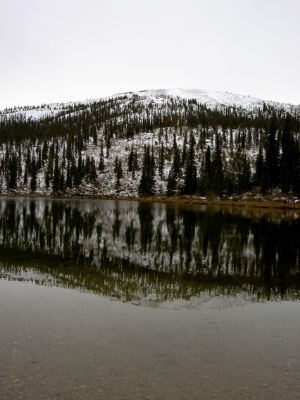
Image is “Snowy Reflection” © Martin Brown | Dreamstime Stock Photos

Momentum is not always obvious

frozenwaterfall

A friend and I had a conversation the other day about those times in life when we feel like we just can’t get any momentum going, and it got me thinking.

It can be painful to feel like we’re not moving forward. Part of this is due to external stuff (we live in a world that has little tolerance for the idea of “standing still”) and part of it is due to our innate desire to grow and become more of who we are.

If I look back over my life and pinpoint the periods of a lot of “obvious” momentum, it becomes clear that they were almost always preceded by a time (sometimes a long one) where I swore I was stagnating and that nothing would ever change.

Why is this?

In my experience, it’s because the part of us that has outgrown where we are is the one who is experiencing “where we are” as stagnant.

But: there’s another part of us, the slower part that isn’t quite ready to let go, that is NOT experiencing “where we are” as stagnant at all. This part of us is still receiving benefits, comfort, nourishment, even joy, from being exactly where we are.

When I look back on my life from the standpoint of “who I am now”, the “me” I am now sees the periods of my life that preceded a lot of change as stagnant.

But, when I actually was LIVING those periods, a part of me was okay with them. A part of me needed them to be exactly as they were. And until that part of me was ready to let go, they weren’t truly “stagnant” periods to ALL of me.

Maybe the truth is that when we feel a lack of momentum, and think we are “stagnating,” what’s really going on is we’re feeling an increasing sense of incongruence.  Who we are becoming is feeling incongruent with who we have been, but we are still ALSO who we have been.

I’ve found that it’s not helpful to rush along the part of me that needs to be exactly where it is for a while longer. When I do that, it holds on tighter out of fear and a kind of rebellion.

What’s more helpful is to reassure the part of me that wants to gallop ahead that it WILL have its day, and that, in fact it IS moving forward as we speak, and that’s why the divide between it and the part of me that wants to stay put is becoming more and more painful.

The pain is a good thing! The pain of incongruence is a sign of momentum, rather than evidence that there is NO momentum.

If you find yourself thinking that momentum has to look a certain way, play around with rethinking it. Are there signs of momentum in your life that may not be obvious or tangible? Does the fact that something is not obvious or tangible mean it isn’t real?

Nature is always a good role model for us here. During the winter, growth does not stop altogether. Growth goes into a different phase. Trees do not die; they sprout new buds in the spring. Some animals go into hibernation, conserving energy for their eventual reemergence. The fact that they’re inactive during this period does not mean they are dead!

Before you assume you have “no momentum,” look for ways that momentum may be showing up in your life that are not totally obvious. And check for signs that you may be in the middle of your personal “winter,” where growth is occurring in oh-so-subtle ways, deep beneath the surface.

Trust is helpful here. Trust and momentum make good partners.

What do you notice about what momentum looks like for you? What do you do when you feel your momentum is “lost”? I’d love to hear how this works for you, in the comments.

 Image is “Iced Waterfall” © Patricia Cale | Dreamstime Stock Photos

Happy Halloween + making room for your darkness

halloween

Halloween has long been my favorite holiday, and fall my favorite season.

There is something about the fact that nature is in a beautiful process of going into a dormant state for the long winter months during the fall that reminds me that transitions are inevitable, and full of light and dark. And we need to honor them and make room for them.

Halloween reminds me to invite and bring awareness to any “dark” places within me.

I grew up believing I should be nice, upbeat, “positive.” Occasionally when I write fiction, I realize I’ve created a character who suffers from this “nice syndrome” (it’s usually a female character, but not always). It can be hard to create a juicy, complex story around a character like this unless I open her up and and take a good look around to find her dark places.

Once, in a writing class, I had a “nice” character write a letter to a friend. When I was finished with the letter, I read it aloud to the class.

“Well, what do you know?” my teacher said. “She’s not so nice after all.”

It turned out the character had a history in which she had done something she was very ashamed of, and she went around being “nice” in order to make up for this misdeed. Suddenly she was vulnerable, complex, and even a little bit dangerous. My story began to fly.

I love how my fiction serves as a metaphor for my life. My characters sometimes need what I need (or, they need exactly the opposite). When I feel “stuck” in life, it’s often because I’m not allowing anything I perceive as “dark” within myself to come to the surface and inform me about who I am and what I need. Dark and light must co-exist; in fact, one only exists because of the other.

So perhaps that is why I always relish and welcome Halloween, and why I have a penchant for horror movies. It all keeps me in touch with my own dark, my own creep factor.

On that note, Happy Halloween!

And: Today is the last day to sign up for one of my Mini Unsticky Sessions. Do you have a creative project you just can’t seem to move forward, or to start at all? You might want to try a Mini Unsticky.  I will be retiring my Mini Unstickies after today, but you can still sign up through midnight Central Time tonight. Check them out here.

Good stuff this week:

I’m so pleased that Marianne Ingheim Rossi interviewed me about the power of journaling on her wonderful site, Journaling For Your Life. You can read the interview and explore her great posts, here.

I love this Halloween poem by “Monkey the Cat” at Cats at the Bar.

A few writers I know are on the fence about participating in NaNoWriMo. If that’s you, you may be helped by this post I wrote quite a while ago: “Are You Stretching or Pushing Yourself? How to Tell the Difference.”

Image © 2014, Jill Winski

Setting boundaries around your creative space: Part one

fence4

A conversation on one of our community calls for The Writer’s Circle (a wonderful group I’ve been involved with for a long time now, which supports me in my writing habit and process) got me thinking about how difficult it can be to truly own and set boundaries around our creative space.

What do I mean by creative space? I mean physical space, yes, but also mental, emotional and spiritual space. Psychological space. And that space means our own energy as well.

From the time I was a little girl, I liked to go off by myself with a big pad of paper and a pencil and write and draw. I also liked to sit by myself — sometimes on our front porch — and talk out loud, making up stories, creating characters and acting out all the roles. Although I often organized neighborhood kids into plays and skits and “pretend movies”, I had a deep need to spend much of my “creating time” in my own company, with no one else around.

This is still true for me. Being solely in my own company (and spending time with animals or in nature) is part and parcel to my writing process, just as my writing process is part and parcel to knowing and understanding myself, and knowing and understanding myself informs what I want to write and what I choose to do with my life.

Geesh, what a cycle! See how it’s all connected?

So, I can’t “just let go of” time alone — daydreamy, musing, reflective time spent in solitude — without letting go of a vital part of the organism that is my functioning life.

And along with that, I can’t “just let go of” my actual writing time, where I put pen to paper or fingers to keyboard.

But, as we discussed on our Writer’s Circle call, how challenging it can be to set boundaries around this sacred creative space on a daily basis!

Recently I had family visiting, and I noticed acutely (again) how I cannot “just shift” from socializing to writing, or socializing to reflecting time. I need to transition from one to the other.

This need for transitions, though, is a blessing. It is the transitioning that allows us to reinforce our boundaries around our creative space and creative energy.

For example, when I sat down to write this blog post, I did not “just sit down and start writing.” I first told my boyfriend, “Okay, I’m going to go work on a blog post now,” and I went into the next room to be away from his energy and more in my own. Then, I took a few deep breaths at my desk. And then I read a couple of blog posts by writers whose voices I love.

This all took only a few minutes, but within this transition space, I respected and protected my creative blog-writing space and energy.

Similarly, when I had family visiting last month, after spending most of the morning with my brother and his girlfriend, I didn’t “just” sit down and work on the presentation I had coming up. I told them I was going to the library for a while, gathered up my things, walked the two blocks to the library (walking is a great way to transition from one energetic space to another) and sat in a corner cubicle in the cool, quiet library environment. I took a few deep breaths, and starting in on writing notes for my presentation.

Taking note of how we will transition from “social space” to “creative space” is a great way to put solid boundaries around our solitary creating time, space, and energy.

Karla McLaren, in her wonderful book “The Art of Empathy,” calls this “thresholding.” She gives the example of actors who move from the state of being backstage, with others bustling around them, to actually being onstage, in the performance space. Anyone who’s performed on a stage of any kind knows there is quite a transition from being backstage to being onstage, and very quickly you go from one type of energy to another. It’s awareness and respect for the threshold that allows this transition.

Try this: Think about how you might create protective, supportive rituals and routines that act as boundaries around your creative energy and space. My walk for my morning coffee always puts me into “reflective, creative mode”, which is like tapping my writer self on the shoulder and whispering, “Hey — we’re going to be putting words on paper in a little bit.”

In Part Two of this post, we’ll talk about how we can own our right to our creative energy and space, especially when it’s challenged by others around us.

What about you? How do you set boundaries around your creative space, time, and energy?

Image is “Fenceline” © Digitalphotonut | Dreamstime Stock Photos

Trusting the deep pull inward

rowboat

Looking back over the past twenty years of my life, I notice that times of a lot of external change were usually preceded by a deep pull inward: a period of maybe a week, or two, or more, where I needed to become very still, write in my journal more than usual, and detach from the external world.

I remember a period like this in my early twenties where I took lots of long walks in the evening after work for several weeks. And another period years later where instead of going out on the weekends like I usually did, I stayed in and wrote intensely in my journal. I didn’t have the money to actually quit work or take a long vacation in order to go within, but it was like some force compelled me to figure out a way, anyway; it was a taking stock of where I’d been and where I was so that I could move forward in a clear and powerful way.

Except I didn’t really know this at the time. I can only see it in retrospect.

I have a couple of clients right now who are feeling this pull to move inward. And, not surprisingly, they’re having a hard time listening to it.

We often resist this inner calling for a while before we finally surrender to it. I think there are a several reasons for this:

1) We have an increasing number of distractions at our fingertips (the other night I was watching American Horror Story on my laptop WHILE looking up trivia about it on imdb on my iPad — and not fully present for either activity). I believe that our ability to focus — or maybe simply our willingness to concentrate on one thing — is becoming seriously impaired, and we need to take charge of this, STAT. It’s killing our souls.

2) We’re afraid of what we might find if we do go inward and be really present with what’s there. What if we discover that we need to make big, painful changes in order to live the life we want? Sometimes we’d rather not know and live in a murky sort of limbo.

3) We’re afraid of the intimacy that comes from having a relationship with ourselves. Truly tuning in and heeding that inward pull means we actually get to know ourselves on a really deep level. (I’ve had clients tell me that they don’t want to do morning pages for this reason. They aren’t sure they want to know themselves that well. They aren’t sure they’ll like the person who shows up on those pages.) Just as becoming more and more intimate with another person is a risk, so is getting to know ourselves. What happens when we encounter pieces of us that we just don’t want to be with?

The good news is that, whether sooner or later, our intolerance for a disconnect with our essential self wins out, and we do go inward. (It’s just usually better for us when we listen to the call sooner rather than later.) Our souls won’t tolerate the numbness that comes from a life half-lived, and eventually we are forced to listen.

Here are some suggestions, though, for making it easier to trust that pull inward, when it comes:

1) Take a weekly break from the online world. A total break, for a few hours, or more, if it feels workable for you. During this break, pay attention to your body, go out for a walk; remind yourself that you are a physical being in a body with a connection to the earth, not a just fingers and a brain connected to a device.

2) Just as you are allowed to take your time in getting to know another person (in fact, true intimacy with another often develops slowly, over time — the quick kind tends to evaporate), you are also allowed to take time in getting to know yourself. If you have resistance to connecting with yourself, it may be because you’re trying to do too much too soon. You can connect with yourself in small doses, whether that’s through journaling or just being present with what you’re feeling for a couple of minutes at a time.

3) Promise yourself that you don’t have to take action on anything you discover about yourself. Recognizing that you really want to move to Europe does not mean you have to take action on that knowledge, now or ever. You may choose to act on it (and hopefully, if it’s truly right for you, you will!). But, as I so often say to my clients, it’s simply good to know. That’s the point of connecting with yourself — to know the truth about yourself. It is not about forcing yourself to completely overhaul your life. I’ve seen time and again that we are far more willing to know our truth, and own it, when we trust that we do NOT have to take immediate action on it.

Have you struggled to trust the pull to go within and connect with yourself? What made it a challenge for you, and what helped? I’d love to hear, in the comments.

Image is “One Sepia Rowboat” © Tatiana Sayig | Dreamstime Stock Photos

Creating during the rough times

twinflowers

A reader wrote me with this question recently (and gave me permission to share it here):

Lately I have a number of unexpected stresses in my life that have descended on me all at once. Almost every day I reach a point of overwhelm where I just have to do the minimum and then rest. My work on my novel has gone out the window. It feels like I spend every day just keeping up and managing my emotions, and have no energy left for anything creative. I keep trying harder to “do the work” and it’s just not happening. Any words of wisdom for me?

Oh! Creating during the rough times. What a challenge it is to get hit with a lot of “life stuff” and try to keep on keepin’ on as we have been.

In answering this question, I want to look at it from two different angles.

The first has to do with embracing reality.

When life throws a lot at us — whether that change is external or internal, or both — things are not as they were before. Pretty obvious, right? But let me repeat: life has changed.

I really want to underline this, because what I see again and again (and I see it in myself for sure) is that when our lives change radically — or sometimes even when we are afraid that they could change radically in the near future — we have a tendency to go into denial for a while.

Sometimes this looks like freezing and not doing anything. Often, though, it looks like trying to keep on exactly as we have been — even though things are not as they have been.

Which is perfectly normal. But — after a point — not totally helpful.

What embracing reality means from the standpoint of doing our creative work is that when things change, it’s pretty much a given that we won’t be able to approach it exactly as we have been.

If we are suddenly taking care of a sick child (or parent), that is taking up time. If we have to take on a full-time job when previously we worked part-time, that is taking up time. We literally don’t have as many hours in the day available for our creative work: it’s a fact.

Another aspect of embracing reality is who we are.

How do you tend to handle a lot of sudden change, especially certain types of change? How emotional and sensitive do you tend to be? Some of these things are innate in us: we’re not going to change them — even if we want to — beyond a certain point.

I value the fact that I have a very emotional nature (I’m a Myers-Briggs “feeling type,” for sure) and I’m also highly sensitive.

But this means that, for example, when I lost two loved ones in the same week several years ago, it rocked me to my core and I could not “just keep on.” I remember people suggested to me at the time that my grief could be good for my creative work, and that I could “write through the pain.”

That felt wrong in every fiber of my being. I didn’t want to create at that time. I wanted to grieve. Things had changed, and I needed to ask myself if there was value in forcing myself to continue writing during that time.

For me, there wasn’t. For someone else, there certainly may have been. But we need to take ALL of us into account during the difficult times — not just the part that wants to create and keep momentum with creative work. If it feels right to scale back, we need to give ourselves permission to do that.

The other angle I want to take here has to do with our emotions themselves and the way we approach them.

If, like my reader (and me!), you tend to be “emotionally intense,” the way you approach your emotions in and of itself can create more stress for you during the hard times — or not.

When a lot was going “wrong,” I used to say things like, “This sucks! I am so overwhelmed!”

Venting is a good thing sometimes. But it’s also important to look at what we say when we vent.

Here’s why: When I say “I’m overwhelmed,” I’m fusing my identity with the emotion. And, even if I value how deeply and intensely emotional I can be, my emotions are not me. They are simply energies moving through me.

Probably one of the things I say most frequently to a client when they share how they’re feeling about something is “Good to notice.” That’s because noticing is pure gold. We can’t change a thing if we don’t first have awareness of it.

And, at the bottom of it all, “who we are” is simply that awareness — not what we’re doing, what’s happening to us, the emotions we’re having or how we’re reacting.

So, now, when I catch myself saying “I’m overwhelmed,” I say instead, “I’m noticing that I’m overwhelmed” or “I’m noticing a feeling of overwhelm within me.”

Do you see how this immediately creates a space between you and the feeling?

From this space, you are both the person experiencing the emotion and the observer of that emotion, how it feels in your body, the way you are reacting to it, the thoughts you are thinking around it. And from that space, you are not rocked and thrown by your emotions; you are not fused with them; you are simply experiencing them.

So, during the difficult times, here are two places to start. I’d love to know if anything here resonates for you, or if you have other suggestions, in the comments.

And: If you’re in a rough patch right now and you need a shift, my awesome friend Dawn Herring, founder of Refresh with Dawn Herring and #JournalChat Live on Twitter, will be offering a Refresh Intensive e-course, starting April 3 (the deadline to sign up is April 1). And it’s only $21! Want to learn more? Find out, here.

Image is “Out of the Darkness” © Emi Pascuzzo | Dreamstime Stock Photos

When you feel like you’re not doing enough

sleepydog

Last week I had an awful moment one day where I felt like I was sitting squarely in that valley-wide gap between where I am and where I want to be.

I felt despair.

In that moment, I could not see clearly how I was going to get from here to there. It just did not feel possible.

When I feel this way, my initial impulse is usually to push myself really hard to do more.

Which doesn’t work very well. Not when my “doing” is coming from a place of despair. I can do more from that place, and only see mounting evidence for how very much there is to be done.

The other thing that happens when I approach doing from a place of fear is that everything seems to have equal priority. There might be twenty things on my list and they all rise up at once, calling out to be done yesterday.

And this isn’t true. They do not all need to be done now, and some of them probably don’t need to be done at all.

The good thing about despair is that there is not a lot of energy in it. So, in that space, instead of making to-do lists or scheming about all the steps I needed to take to get “there”, I sat down. (Notice if a feeling of despair sometimes follows an unmet need to ease up on yourself. It often does for me.)

From the blue chair in my living room, I began to focus on the blowing snow outside, the newly de-cluttered room, my cat’s snore. I picked up my journal and began to write not about what was bothering me, but about what I was noticing in my surroundings. (This is what Natalie Goldberg calls “writing practice”.)

And within a few minutes, I came solidly back to the present moment — in which, truth be told, I had everything I needed. Nothing was lacking.

I still had that feeling of wanting to grow, expand, move into newness and openness to change.

But it was coming, now, from a space of desire, of welcome, and not from that space of “I need to be there in order to be happy.”

It was coming from a space of “I am already enough — and wouldn’t that, too, be wonderful?”

Subtle shift; huge difference.

And from that space, my true priorities rose up before me. And there were only a couple, and they felt light. Not twenty equally heavy things.

So often, when I think I should be doing more, it’s because I believe doing more is going to get me something I don’t already have. In an external sense, this can certainly be true. And it’s important to honor that — I do need to take certain actions in order to get things done.

But what I sometimes forget is that nothing I accomplish “out there” can give me something that can only be generated internally. When I pursue something “out there” from a space of grasping, I only see evidence for how graspy I am and how much more I need.

The idea here is not to try “not” to be graspy; it’s not to stop pursuing what I want. The idea is to notice the back and forth between wanting and having, doing and being, between what it means to feel empty and what it means to feel satisfied. And to notice what “doing more” can help me achieve, and what it absolutely can’t.

Something to try:

For the next week, notice what happens when you have the thought “I’m not doing enough.”

How does it feel? Does it feel deeply true? Does it motivate clear action? If so, terrific! If it feels icky or stressful or — like me — you find yourself in despair when you have this thought, notice what happens if you slow down rather than speed up. See how you can return to the present moment. And when you’re there, notice the true priorities that make themselves known to you.

Hatched into the World …

This year, I want to start a ritual of pointing you to gifted writers, artists, and other creators — people who are putting healing, nourishing, and amazing things out into the world.

My friend Terri Fedonczak writes beautifully on parenting from a place of joy and abundance (rather than lack) in her new book  “Field Guide to Plugged-In Parenting … Even if You Were Raised by Wolves.” (I love that title.) I had the pleasure of looking in a bit on Terri’s daily process of writing this book as she participated with me in Jenna Avery’s Writer’s Circle. And although I’m not a parent myself, this is a topic close to my heart, as I believe we’re all in the process of parenting ourselves, throughout our lives. Terri’s also the CEO of Girl Power for Good, LLC. You can check out Terri’s amazing work in the world at her website (which is beautiful, by the way), here.

Image is “Sleepy Dog”, © Mihai Dragomirescu | Dreamstime Stock Photos

How do we know we’re ready to let go?

twofeathers

In my first few coaching sessions of the New Year, I noticed this interesting theme of loss, fear of loss, and ambivalence about loss surfacing.

Some of it had to do with completing a piece of creative work and feeling the emptiness that can come with finishing. This thing that has taken up so much of our heart space and head space and waking hours is now up and walking on its own and it doesn’t need us the way it did. There’s sadness — and one heck of a void — in that.

Some of it had to do with letting go of a job or a relationship. And the big thing coming up around that was, is it truly time? How do I know?

And some of it was about giving ourselves permission to let a creative project, job, or relationship go — even though it did not feel “complete.” It was about deciding not to continue. (And that’s rough on perfectionists, which most of my clients tend to be. You mean I’m allowed to give up on it? I’m allowed to not see it to completion?)

My “big word” for this year is permission. I need to focus on permission because I’ve noticed that I can go for hours, sometimes days, forgetting that, yes, I actually do have permission to do things the way I need to do them. To feel things the way I feel them.

So I can’t help seeing these issues with letting go through the lens of permission.

And that leads me to this: Often, when we’re afraid of letting go, it’s because we haven’t given ourselves permission to NOT let go.

Some militaristic part of us jumps up and says, “Okay! Time to move on! Let’s get moving here!”

And those parts of us which are not ready to let go, sometimes not even NEARLY ready, get trampled in the stampede.

But, as I’ve written here before, we can’t truly arrive anywhere until ALL of us shows up. This concept came to me from the writings of Robyn Posin, whose beautiful website you can find here. She uses a stoplight analogy: We can race to the light, but if it’s red, we won’t actually move forward until it turns green.

There may be a part of us that is holding a green light, but many other parts of us are still cradling the red, tightly.

So, permission. To be right there.

That part of us that the light has already turned green for will probably be very impatient with the parts of us that need to go slower.

And working with the impatient part of us might mean saying to it, “Yes, I see that you’re really ready to go, and I get that. AND, the whole of us is not ready yet. You’re not allowed to let your impatience run the show. But you’re totally allowed to be impatient.”

As long as there is conflict between the parts of us that want to let go and the parts of us that don’t, we are not at peace.

And when we’re not at peace, when we’re locked in struggle, we’re in a poor place to make decisions about anything big. When we’re struggling, it’s painful, and any decision we make tends to be more about getting away from the pain than moving toward what actually feels right to us.

The questions to ask the impatient part of ourselves are: What’s scary about slowing down? What’s hard about being in the present moment?

The questions to ask the parts of us who aren’t ready to let go are: What’s scary about moving forward? What’s hard about stretching ourselves into the future?

Allow these parts to talk to each other. Write down what they have to say; you might try using a different color of pen for each part. When you can hear them all out (and notice that each of them has wisdom and truth), you can begin to integrate their needs.

And when you have integrity, you have peace. And from peace you can truly let go in wholeness.

What are your challenges around letting go? Do you tend to let go quickly, or do you really hang on? I’d love to know how it works for you, in the comments.

Image is Feathers Against the Sun © Kmitu | Dreamstime Stock Photos

Two kinds of urgency

hourglass2

Have you ever gone through an extended period where nothing felt clear to you, where everything seemed muddled and off and you wondered if it was ever going to end?

I’ve been there — many times (and if you’re going through this right now, I send you so much compassion. Yes, it’s hard.)

Way back when, I thought going through these periods meant there was something wrong with me, or that I just wasn’t trying hard enough. Uggh.

I now know that these periods of sluggishness, lack of clarity, and downright suckiness are simply part of the process of change. They’re what happens when we’re letting go of a version of ourselves that no longer fits, but we haven’t yet stepped into whoever it is we’re becoming.

These are liminal periods, and I’ve written about them quite a bit on this blog (click on the Categories list to the right, particularly Transitions and Letting Go, to read more on liminal periods).

Another term for these transitional periods, which I learned while I trained to become a life coach with Martha Beck, is “Square One.”

During Square One, a kind of urgency can rise up in us. It feels like we’d better do something, now! We’d better get out of this crappy place! We’d better make some kind of decision, now! (Even though usually we have no idea what it is we’re deciding, because one of the hallmarks of Square One is a lack of clarity on what we really want. We know what we don’t want, and the rest of it feels like one giant slog through toffee.)

A frequent reminder that I, and the folks I work with, need while in Square One is this: The faster we try to get out of Square One, the longer we stay in it. It’s the ultimate paradox. Square One needs to be fully processed, fully felt. Yes, it sucks, but it’s the only way to get truly clear.

When we rush forward because our period of transition is so uncomfortable, we inevitably end up in more discomfort.

That’s because instead of moving toward what we want (because we’ve gotten clear on it), we’re moving away from discomfort and confusion because they scare us. And where do we end up? Right back in the discomfort and confusion, scared out of our minds. Wherever we go, there we are.

So, if you’re going through a transition, or approaching one, right now, and it feels scary and like you’ve completely lost your footing, the best path to peace is not to hurry out of the scary place.

It’s to slow down, remind your panicked brain that there is no true urgency here, and realize that (in the ultimate irony), you’ll actually move through this icky transition place much more quickly by embracing an easy, one-day-at-a-time (or, on the worst days, one-hour-at-a-time) pace.

Now, there’s another kind of urgency, too. That kind of urgency is a bit different. It’s what I’d call a “transmission from your soul.”

This kind of urgency has a kind of ache to it. It contains a yearning you can’t stave off or press down, no matter how many months or years you try to do just that.

This is the urgency that recognizes that life is relatively short and there are things your heart longs to be or do, and you’re not being or doing them yet. And you’re tired of putting them off.

Or, it’s the kind of urgency that tells you a certain situation isn’t good for you and it has to stop. And that if you don’t stop it, you’re going to keep on feeling this particular ache.

This kind of urgency is the urgency that signals you’re ready for change. Not ten years from now, but as soon as is humanly possible.

Yes, I know: I just contradicted myself. I suggested that if you’re feeling urgency, you need to slow way down, not speed up. And then I said that if you’re feeling urgency, you need to act, now!

Both are true. Can you allow your mind to wrap itself around that? It’s hard for me, too.

But notice my descriptions of the two kinds of urgency. One kind is about moving away from discomfort. And the other is about moving toward what you want. (An ache or longing points us toward something in us that wants to be born.)

We can feel both these kinds of urgency on the very same day! In the very same hour! And we can accept, and work with, both of them.

The tricky part is that, when we’re feeling a lot of the first type of urgency, we need to come to a place of peace before we take any action.

Otherwise, our actions are likely to be fueled by panic and a need to escape discomfort. (Have you ever quit a job, or left a relationship, and found yourself, almost magically, back in what seemed like the exact same job or relationship six months or a year later? That’s because your actions were fueled by a need to escape discomfort, rather than movement toward what enlivens you.)

So how do you know which urgency is driving you? You might want to share what’s going on with someone you trust, or jot down the thoughts you’re having in a journal. Then ask yourself (or let someone reflect back to you): Does what I just said (or wrote) come from the part of my brain that is strictly concerned with my physical and/or social survival? Or does it feel like a mandate from my soul?

Whichever answer you get, the next step is acceptance. And remembering that fully processing what’s going on for you is, in the long run, the fastest way to actually create what you truly desire.

What do you think? What have you noticed when urgency comes up for you? I’d love to hear, in the comments.

Image is “Time’s Up!” © Nspimages | Dreamstime Stock Photos

What if you didn’t need a reason?

Happy Fall!

Last week, I was talking with the wonderful business coach Kristin Stevens, and I kept telling her about various things I wanted to do, and prefacing them with, “For some reason.”

“For some reason, I want to move into a smaller apartment.”

“For some reason, I want to streamline and simplify my life.”

Now, some coaches would have gone right to “Okay. Why? Let’s get clear on the reason.”

I would have gone there, if I were coaching someone. And it can be a good way to go.

But Kristin said, “You keep saying, ‘For some reason.’ What if you didn’t need a reason?

This stopped me. Because, in this case, I already feel clear. I already know that something in me wants to do these things — but my rational mind tells me I don’t have a good enough reason to do them.

For years, I lived in small apartments and had a great need for more space. In 2005, I moved and got the space I wanted. For the past eight years, I’ve lived in a beautiful space where I have plenty of room.

But now it feels oddly too big, like I’m a kid clomping around in my dad’s work shoes. And I realize I’ve filled it up with things I no longer necessarily want or need.

When I moved here, I had this idea of a life I thought I wanted. But now I realize that maybe that life was about who I wanted to be back then, and not who I actually am today.

My rational mind says, “But why would you want to go back to living in a small space? Isn’t that going backwards?”

Is it? I’m not sure it’s a good question, in this case, because questioning my desire is only keeping me in wheel-spinning mode. A good question sparks curiosity and creates spaciousness and movement.

That’s how I know Kristin’s question — what if you didn’t need a reason? — is a good one for me here.

If I didn’t need a reason, I’d start making plans to move. If I didn’t need a reason, I’d free up my energy to focus on things that are more important to me at this point in my life than having a larger living space and the maintenance that goes along with it.

It’s telling that a while ago on Pinterest I created a board called Cozy Spaces. Something in me longs for cozy right now. Why?

Do I really need to know? What if, in fact, I can’t know the answer to that question until I move toward what I’m longing for?

The nudges I get from my intuition feel simple and straightforward. “Do this.” Or, “Don’t do that.” Or, “Wear something blue today.” “Call about that class.”

Intuition doesn’t explain itself. It lives in the world of trust, not the world of guarantees. And often, when I’m clear but I’m still not taking action on that clarity, it’s because I want a guarantee. I want a guarantee that the direction my intuition is pointing me in will be pain-free, that if I go there, “everything will work out.”

Experience tells me there is no such guarantee. Sometimes, I think I am waiting for clarity but it has already arrived. The truth is, I’m not waiting for clarity — I’m waiting for that guarantee.

“Why?” is a good question if it creates more clarity. But if I’m already clear, I don’t need to ask why. I need to act on what I know.

What do you think? Do you ever second-guess the next step that comes to you from your intuition? I’d love to hear how this works for you, in the comments.

Image ©Jill Winski 2013