Two kinds of urgency

hourglass2

Have you ever gone through an extended period where nothing felt clear to you, where everything seemed muddled and off and you wondered if it was ever going to end?

I’ve been there — many times (and if you’re going through this right now, I send you so much compassion. Yes, it’s hard.)

Way back when, I thought going through these periods meant there was something wrong with me, or that I just wasn’t trying hard enough. Uggh.

I now know that these periods of sluggishness, lack of clarity, and downright suckiness are simply part of the process of change. They’re what happens when we’re letting go of a version of ourselves that no longer fits, but we haven’t yet stepped into whoever it is we’re becoming.

These are liminal periods, and I’ve written about them quite a bit on this blog (click on the Categories list to the right, particularly Transitions and Letting Go, to read more on liminal periods).

Another term for these transitional periods, which I learned while I trained to become a life coach with Martha Beck, is “Square One.”

During Square One, a kind of urgency can rise up in us. It feels like we’d better do something, now! We’d better get out of this crappy place! We’d better make some kind of decision, now! (Even though usually we have no idea what it is we’re deciding, because one of the hallmarks of Square One is a lack of clarity on what we really want. We know what we don’t want, and the rest of it feels like one giant slog through toffee.)

A frequent reminder that I, and the folks I work with, need while in Square One is this: The faster we try to get out of Square One, the longer we stay in it. It’s the ultimate paradox. Square One needs to be fully processed, fully felt. Yes, it sucks, but it’s the only way to get truly clear.

When we rush forward because our period of transition is so uncomfortable, we inevitably end up in more discomfort.

That’s because instead of moving toward what we want (because we’ve gotten clear on it), we’re moving away from discomfort and confusion because they scare us. And where do we end up? Right back in the discomfort and confusion, scared out of our minds. Wherever we go, there we are.

So, if you’re going through a transition, or approaching one, right now, and it feels scary and like you’ve completely lost your footing, the best path to peace is not to hurry out of the scary place.

It’s to slow down, remind your panicked brain that there is no true urgency here, and realize that (in the ultimate irony), you’ll actually move through this icky transition place much more quickly by embracing an easy, one-day-at-a-time (or, on the worst days, one-hour-at-a-time) pace.

Now, there’s another kind of urgency, too. That kind of urgency is a bit different. It’s what I’d call a “transmission from your soul.”

This kind of urgency has a kind of ache to it. It contains a yearning you can’t stave off or press down, no matter how many months or years you try to do just that.

This is the urgency that recognizes that life is relatively short and there are things your heart longs to be or do, and you’re not being or doing them yet. And you’re tired of putting them off.

Or, it’s the kind of urgency that tells you a certain situation isn’t good for you and it has to stop. And that if you don’t stop it, you’re going to keep on feeling this particular ache.

This kind of urgency is the urgency that signals you’re ready for change. Not ten years from now, but as soon as is humanly possible.

Yes, I know: I just contradicted myself. I suggested that if you’re feeling urgency, you need to slow way down, not speed up. And then I said that if you’re feeling urgency, you need to act, now!

Both are true. Can you allow your mind to wrap itself around that? It’s hard for me, too.

But notice my descriptions of the two kinds of urgency. One kind is about moving away from discomfort. And the other is about moving toward what you want. (An ache or longing points us toward something in us that wants to be born.)

We can feel both these kinds of urgency on the very same day! In the very same hour! And we can accept, and work with, both of them.

The tricky part is that, when we’re feeling a lot of the first type of urgency, we need to come to a place of peace before we take any action.

Otherwise, our actions are likely to be fueled by panic and a need to escape discomfort. (Have you ever quit a job, or left a relationship, and found yourself, almost magically, back in what seemed like the exact same job or relationship six months or a year later? That’s because your actions were fueled by a need to escape discomfort, rather than movement toward what enlivens you.)

So how do you know which urgency is driving you? You might want to share what’s going on with someone you trust, or jot down the thoughts you’re having in a journal. Then ask yourself (or let someone reflect back to you): Does what I just said (or wrote) come from the part of my brain that is strictly concerned with my physical and/or social survival? Or does it feel like a mandate from my soul?

Whichever answer you get, the next step is acceptance. And remembering that fully processing what’s going on for you is, in the long run, the fastest way to actually create what you truly desire.

What do you think? What have you noticed when urgency comes up for you? I’d love to hear, in the comments.

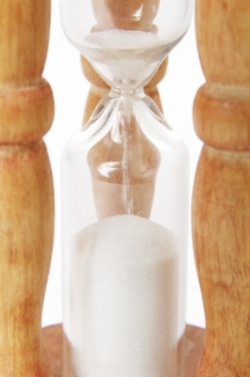
Image is “Time’s Up!” © Nspimages | Dreamstime Stock Photos
What if you didn’t need a reason?

Happy Fall!

Last week, I was talking with the wonderful business coach Kristin Stevens, and I kept telling her about various things I wanted to do, and prefacing them with, “For some reason.”

“For some reason, I want to move into a smaller apartment.”

“For some reason, I want to streamline and simplify my life.”

Now, some coaches would have gone right to “Okay. Why? Let’s get clear on the reason.”

I would have gone there, if I were coaching someone. And it can be a good way to go.

But Kristin said, “You keep saying, ‘For some reason.’ What if you didn’t need a reason?

This stopped me. Because, in this case, I already feel clear. I already know that something in me wants to do these things — but my rational mind tells me I don’t have a good enough reason to do them.

For years, I lived in small apartments and had a great need for more space. In 2005, I moved and got the space I wanted. For the past eight years, I’ve lived in a beautiful space where I have plenty of room.

But now it feels oddly too big, like I’m a kid clomping around in my dad’s work shoes. And I realize I’ve filled it up with things I no longer necessarily want or need.

When I moved here, I had this idea of a life I thought I wanted. But now I realize that maybe that life was about who I wanted to be back then, and not who I actually am today.

My rational mind says, “But why would you want to go back to living in a small space? Isn’t that going backwards?”

Is it? I’m not sure it’s a good question, in this case, because questioning my desire is only keeping me in wheel-spinning mode. A good question sparks curiosity and creates spaciousness and movement.

That’s how I know Kristin’s question — what if you didn’t need a reason? — is a good one for me here.

If I didn’t need a reason, I’d start making plans to move. If I didn’t need a reason, I’d free up my energy to focus on things that are more important to me at this point in my life than having a larger living space and the maintenance that goes along with it.

It’s telling that a while ago on Pinterest I created a board called Cozy Spaces. Something in me longs for cozy right now. Why?

Do I really need to know? What if, in fact, I can’t know the answer to that question until I move toward what I’m longing for?

The nudges I get from my intuition feel simple and straightforward. “Do this.” Or, “Don’t do that.” Or, “Wear something blue today.” “Call about that class.”

Intuition doesn’t explain itself. It lives in the world of trust, not the world of guarantees. And often, when I’m clear but I’m still not taking action on that clarity, it’s because I want a guarantee. I want a guarantee that the direction my intuition is pointing me in will be pain-free, that if I go there, “everything will work out.”

Experience tells me there is no such guarantee. Sometimes, I think I am waiting for clarity but it has already arrived. The truth is, I’m not waiting for clarity — I’m waiting for that guarantee.

“Why?” is a good question if it creates more clarity. But if I’m already clear, I don’t need to ask why. I need to act on what I know.

What do you think? Do you ever second-guess the next step that comes to you from your intuition? I’d love to hear how this works for you, in the comments.

Image ©Jill Winski 2013

How kindness helps you create

ducks

So often when I’m feeling unhappy and stuck (whether in my life or in my creative work), I find myself frantically trying to control circumstances.

My thoughts go something like this: “If I could just get rid of [X circumstance] and find [X circumstance], and get [X amount of money], and if [X person] wasn’t so hard to deal with, I could stop feeling so bad.”

Or sometimes it goes like this: “If I could just figure out if what I really want is [X] or [Z], then I could move forward. But I’m so confused; I can’t figure it out. So I’m unhappy and I’ll be unhappy until I figure it out.”

There’s a kind of paralysis that sets in when I believe that circumstances are causing my unhappiness. It’s often a breed of analysis paralysis, closely tied to perfectionism, where I’m sure that if I choose the “wrong” thing, I’ll increase my current unhappiness in spades. So I don’t choose.

It usually takes me a while in this spin cycle before I remember: Ohhh. Waiiittt.

It’s not about circumstances. It’s not about making the “right” decision.

It’s about kindness. The kindness I’m forgetting to give to myself.

I don’t know about you, but when I remember to treat myself with kindness, there’s a palpable shift within myself. I feel it in my abdomen first, then my jaw — my entire body softens. I literally feel the rigidity seeping out of me, almost like it forms a puddle around my feet. And then I feel a surprising thing: hope.

From this place, there is fluidity — there is movement. How can that be? I haven’t changed my external circumstances, and yet, there’s movement?

Yes. Martha Beck, with whom I trained to become a life coach, likes to remind her coaches that our circumstances do not create our feeling states; it’s the opposite. Our feeling states create our circumstances.

When our focus is outside ourselves, on what we’re sure the “right” circumstances will bring us, we are disconnected from what’s inside us. We forget where our power actually lies — in our ability to choose how we relate to ourselves, and how relate to the world around us.

And here’s how this relates to our creativity: As I’ve often written on this blog, creativity, as I define it, is nothing more or less than the life force within us.

That life force needs to move. It needs to flow, and to ebb.

When I try to control circumstances, or second-guess my decisions, or try to make the “perfect” choice, that life force gets frozen in time. I’m teetering on the edge of the belief that the “reward” lies on the other side of “right” or “wrong” — when, in fact, the “reward” is right here, within me, if I can remember to treat myself with kindness.

Some of my clients say at first that they simply don’t know how to treat themselves with kindness — or that it seems self-indulgent, or a waste of time.

But my clients are often the kindest people I know — they are truly skilled at directing kindness outside of themselves, toward others. They just haven’t practiced directing it toward themselves.

And there’s a distinct difference between kindness toward ourselves and self-indulgence: Kindness creates movement that comes from the heart; it radiates outward. It’s intimately linked to “inspired action.” Self-indulgence, like a clenched fist, closes us off from ourselves, from the world. Rather than engaging the heart, self-indulgence feels like avoidance of something we fear. Kindness feels like an openness to what we love, to what inspires us.

Sometimes, when I think about doing something like, say, write a blog post about the importance of remembering to treat ourselves with kindness, there’s a hard, embittered piece of me that says things like, “Kindness? How cliche and cheesy and abstract is that?”

And then I have to laugh, because that’s exactly the voice that makes treating myself with kindness my last resort so much of the time. I often come to kindness — or it comes to me — because I’m at the end of my rope with treating myself harshly.

I come to kindness because I realize I’ve literally exhausted all my options if I’m viewing myself, and life, with harshness. Most importantly, I’ve forgotten to acknowledge that I am suffering. Of course it seems like I need to manipulate circumstances and choose perfectly if I’m coming from a harsh, rigid place. Wherever I go, there I am.

So, if I feel backed into a corner, if I believe I’m trapped and there are no good options — whether in my real life or in my creative work — it may be that I’ve forgotten this oh-so-basic step: Treat myself kindly. Exquisitely kindly. Time and again, I learn that from that space of kindness, unseen options emerge.

(To learn more about the amazing benefits of treating ourselves with kindness, check out Kristin Neff’s work at http://selfcompassion.org.)

Do you remember to treat yourself with kindness? Do you think it’s worth doing? Do you apply it in your creative process? I’d love to hear, in the comments.

Image is “Hand Feeding” © David Coleman | Dreamstime Stock Photos

What gift can you give yourself?

swirlgift

Sometimes I start my day with this question: “What gift can I give myself today?”

On some days, a particular word immediately comes to me. Yesterday it was “stretch.” And I knew I wanted to move my body, so I went for a morning walk, even though we had a sweltering day here.

On another level, I knew stretch meant something else. And I made a phone call I’ve been putting off for a while — the conversation was going to be a stretch for me, but since “stretch” was the gift, I knew it would be okay. And it was.

Sometimes a word doesn’t immediately come to me. So then I let an image bubble up in my mind’s eye.

Once, I saw a heart, with wings. I wasn’t sure what it meant at first, but then some words came to me: courage, Cowardly Lion courage. And flight. On that particular day, flight meant literal flight — I gave myself permission to take a trip I’d been on the fence about, and booked my plane ticket.

And permission is another one. It’s one of the most powerful gifts I can give myself, but I have to be reminded of this often. And, I need to get specific about it. Permission to what? Once, I asked this question and an image of me sleeping bubbled up. I needed permission to rest that day.

Another day I asked, permission to what? And an image of me reading from my novel-in-progress to a large group of people bubbled up. Ahhh. Permission to be seen.

What other gifts have I given myself? The gift of endings, of allowing things to end — even things that have been a success and are still successful. The gift of beginnings, of stepping into what is new, even when I’m unsure of the first step and the second is hazier still.

Some of my favorite gifts are curiosity, wonder, and play. Sometimes the gift is tenacity. Sometimes it’s sovereignty. Sometimes the gift sounds something like “no ground to give.” And I know I want to focus on holding boundaries that day.

The gift can be something concrete and material as well. One time the image that came to me was of an exceptionally gorgeous journal I’d seen in a shop down the street. It had a filigreed gold cover with a turtle on it. The journal was expensive and I knew I didn’t want to spend the money on it right then, but the image of the turtle reminded me of my belief in taking slow, steady steps; that so many of our worthwhile journeys are marathons, not sprints.

One day last week the gift was “soft.” I was feeling extra-hard on myself that morning and my energy felt tight, rigid. I knew I needed to shift into soft energy. And I moved through my day with so much more kindness toward myself, and therefore, toward the world.

That is why I make my focus what I can give to myself. I like to think I’m pretty good at giving to others, but in truth I can’t give what I don’t have.

Want to try it? What gift can you give yourself as you move forward in your day?

Work With Me: I have openings for new coaching clients beginning in September. Need some support in connecting with your gifts? Check out my offerings, here.

Image is “Swirl Gift with Echo Blur” [cropped] © Patricia Ulan | Dreamstime Stock Photos

Can you wrap a system around that?

field

I used to think that I didn’t like systems. Every time I found myself dealing with any kind of system — which implies structureI would rebel.

Part of this probably stems from having a childhood that felt way, way overstructured to me. My heart wanted to lounge in open fields with cows, sheep, books, and my journal (not that I lived near any fields), but my days always felt completely scheduled with activities from morning to night — not just riding the bus (an ordeal in and of itself) to school and back, but with afterschool activities, and then homework.

This seems so nuts to me now, but it was considered normal, and, thirty years later, though I don’t have kids myself, my sense is that many kids are even more overscheduled than I was (plus today’s kids have so much more technology to manage).

I think another reason I’ve tended to rebel against systems and structure is that I’m a Myers-Briggs INFP, and we “P” types like to keep things open-ended. Too much structure can feel overly planned and rigid for a “P” and trigger our rebelliousness.

At the same time, I’ve had to admit over the past several years, especially since becoming a coach and attracting clients who also tend to rebel against structure, that the right amount of structure can be a true godsend for those of us who cling to open-endedness (which can sometimes result in saying things like “I’ll write when I’m feeling inspired” or leaving ourselves one hour to complete something that actually takes four — woops!).

Systems and structure do not have to be elaborate or complicated. There just needs to be enough of a system to get it done — whatever “it” is.

Here’s my (very simple) example:

I was having a huge issue with mowing the lawn. It only takes me about 30 minutes, but it was becoming this thing that I so didn’t want to do and eventually I’d have to force myself to do it, angrily, usually swearing. Even though, once I’m doing it, I don’t hate it (except for that one time I mowed over some dog poop). It actually feels kinda good, moving my body, the smell of grass and dirt around me, the heft of the mower.

About a month ago, I figured out the issue. My brother, who used to live here and used to mow the lawn, had told me I should do it “about every ten days.” And I tried this. But it felt increasingly stressful to me. Because “every ten days” could fall on any day of the week. It might be a Wednesday, and then next time a Saturday, and then next time a Tuesday.

It occurred to me that if I mow the lawn every two weeks, it really doesn’t look all that much worse than if I do it every ten days. So I’ve made every other Sunday afternoon my mowing-the-lawn-time. And I think about it so, so much less. On Saturday, or Wednesday, I’m not thinking, “should I do it today?” because I know Sunday is lawn day. Every other Sunday, “mow lawn” is on my to-do list, and I know I’ll do it, and that’s that.

That was all the system that was required. It was actually way more stressful to keep the “when” I’d mow the lawn up in the air than it was to assign a day to do it.

This applies to anything I want to do on a regular basis, whether that’s writing or yoga or doing the dishes: Keeping the “when” up in the air creates stress and vagueness, and vagueness does not produce specific results.

And I think that’s worth consideration for us “open-ended” types. Is keeping something unstructured and open-ended giving us a feeling of peace and freedom, or stress and confusion?

The way to know you’ve hit on the right amount of “system” for you is that you use the system without a huge desire to rebel. (If you have a very strong inner rebel, as I do, you may be a little bit edgy around any amount of system, but when it’s the right amount, you’ll find yourself using it anyway.)

Your body is an excellent guide for whether or not a certain amount of structure is too much or too little. When I am overstructured, I feel frazzled, frenetic, like I’m on a treadmill. There’s a need to catch my breath (literally). When I have too little structure, I can feel sluggish, unfocused and fatigued.

There’s no right or wrong here; each of us has a “sweet spot” where we have enough structure, but not too much. So when I’m struggling with something that just won’t seem to get done, I’ve started to ask myself, “Can I wrap a system around this?” And then I brainstorm a little about what might feel like enough.

How do you feel about systems and structure? Do you tend to rebel against them, or do you find them helpful, or both? I’d love to know, in the comments.

Image is “Poppy Field with Powerlines” © Peter Gustafson | Dreamstime Stock Photos

Five things I’ve learned about trust

This is my second post for The Declaration of You BlogLovin’ Tour (scroll to the bottom of this post to find out more). This is the final week of the tour, and the topic is Trust.

ferriswheel

I used to think I couldn’t trust others and I couldn’t trust life. It took me a long time to see the turnaround: It was me I thought I couldn’t trust. Once I saw this, I wanted to really know what it meant to trust myself. Here are a few of the things I’ve learned:

1) Trusting myself means that I allow myself to experiment, to stretch, to make mistakes.

I first encountered the idea of trusting myself when I discovered the writing of Geneen Roth in my early twenties. I was a chronic dieter at the time, and Geneen’s concept of trusting myself to know when I was hungry and to stop eating when I was full was a radical thing to me.

When I first tried it, the perfectionist in me wanted to “do this trusting myself thing right.” I thought if I made a mistake, it was proof I couldn’t trust myself.

It took me a few years before I’d integrated the truth that trusting myself is about the way I relate to myself when things don’t go as I want them to — it is about the way I relate to myself, period. It has nothing to do with being “good” or “right” or even wise. It is a way of living in the world. It is a choice.

2) Self-trust is intimately linked to self-acceptance.

If I’m judging myself, you can bet I am not in a place of self-trust. In fact, I’ve found that my intuition will “hide out” when I’m judging myself harshly. Intuition is fierce, but it’s often quiet and subtle in how it comes to us.

My cat usually disappears when someone who speaks loudly and has heavy footsteps enters the house. Intuition is similar — it tends to hide out in the closet when my inner critic starts raging. It’s not that intuition is afraid of the inner critic (intuition fears nothing; it simply is). It’s more that intuition (like my cat) has a very low tolerance for drama. So it goes silent and seems to disappear when that harsh voice within me goes on a rampage.

I can always reconnect with my intuition, though. I just need to get quiet again. Intuition never fails to show up when I’m in a place of peace. And the more deeply I can accept myself, the more peaceful I feel.

3) Trusting myself means having faith that my intuition is there for a reason, and taking the risk to follow it.

It’s the process of acting on my intuition that makes me feel alive, not the outcome, which will never be completely within my control, and which, I’ve found, I often cannot accurately predict.

The more I trust myself to take action on my intuition, the better I get at it, because I create more and more evidence for the fact that it feels good and right and empowering when I trust myself. It’s like strengthening a muscle. (You may not be sure you have the “self-trust” muscle if you haven’t used it a lot — but you do. Trust me.)

4) No one else’s truth is a substitute for my own.

The best help from others is guidance that points me back to my own inner compass, and reminds me how important it is.

It’s good — and often necessary — to gather information and receive advice from others, especially those who’ve been where we are. But at some point, we need to sift through this guidance, integrate it, and check inside ourselves for what feels right for us.

How do we know it’s time to stop going to outside sources? When the information we’re getting is creating more confusion, not contributing to clarity.

5) “Trusting myself” is a belief system.

There are no guarantees of what the outcome will be if I trust myself.

I may trust myself, take action from that place, and find that things happen in a way I couldn’t have predicted.

I’d love to tell you that the way they happen is always better than I could ever have imagined — but while that is sometimes true, it doesn’t always feel like that. Sometimes, I trust myself and things don’t turn out the way I’d like them to — and I don’t understand why things happened the way they did until years later, if at all.

But regardless of outcome, it’s a heck of a lot easier for me to make decisions — and to live with them — when I operate from a platform of self-trust. It comes down to how I want to live: From a space of doubting myself, or from that solid foundation of knowing I’m worthy of my own trust.

I know this: It feels better to trust myself, and to act on that trust, than it does to spin my wheels in the sticky mud of indecision, doubt, and fear.

What have you learned about trust? I’d love to know — feel free to share, in the comments!

TDOY_bloglovintour_banner

The Declaration of You, published by North Light Craft Books and available now, gives readers all the permission they’ve craved to step passionately into their lives, discover how they and their gifts are unique and uncover what they are meant to do. This post is part of The Declaration of You’s BlogLovin’ Tour, which I’m thrilled to participate in alongside over 200 other creative bloggers. Learn more — and join us! — by clicking here.

Top image is “Ferris Wheel” © James Hearn | Dreamstime Stock Photos

Allowing your idea of success to change (as you do)

TDOY_bloglovintour_banner

This post is part of The Declaration of You’s BlogLovin’ Tour, which I’m thrilled to participate in alongside over 200 other creative bloggers. This week’s theme is “Success.”

rainbowmanhattan

When I was eighteen, I visited New York City for the first time. (Technically it was the second time, but the first time I was three and literally all I remember from that visit is staring at an array of pastel-colored plush kittens in a little shop that also sold candy and newspapers, and crying because I couldn’t decide which color of kitten I wanted. Ultimately I chose yellow).

My best friend had an audition for music school there, and my father and I journeyed to NYC from our home in the Chicago suburbs to hang out with her during her audition process, and SEE THE BIG CITY.

Although I lived in the Chicago area, my life was suburban. Only very rarely at this point had I ventured into the actual city of Chicago, to see a Cubs game or go to a museum. But New York! As a diehard fan of Woody Allen movies, New York City was a place I was, surely, born to experience.

I loved it. I saw “Cats” and “A Chorus Line” on Broadway (yes, this was a long, long time ago), and hung out at coffeehouses and saw iconic landmarks I’d only seen in movies. I even had a celebrity sighting – film critic Gene Siskel (ironically, a Chicagoan and to me right up there with Bruce Springsteen in terms of awesomeness) walked right in front of our hotel.

That was it, I decided then and there – I was destined to live in New York City! There, I would experience success. There, I would experience BRILLIANCE!

My friend got accepted into music school in NYC, and although I was starting college as a theater major at Indiana University in the fall, I was now convinced New York was the place for me to be. Over the next several years, I visited my friend in New York from time to time and we kept scheming on the phone about how, after college, I’d join her there.

Except that didn’t happen. Every time I went to New York, I had tons of fun and I loved being with my friend and pretending I was in “Manhattan” or “Hannah and Her Sisters.”

But I never truly considered living in New York City. I never seemed to take any concrete steps to get myself there.

The reality, at this point, was that I had set up a life for myself in Chicago. And I liked it. A lot. But, Chicago was no New York, my brain nagged, and some part of me believed that I was “playing small” and somehow not living the life I was meant to live by remaining in Chicago.

At twenty-six, I visited my friend in New York for what turned out to be the last time. And, for the first time, I didn’t like it. It felt overwhelming, loud, and expensive. I listened to my friend complain about her exorbitant rent fee and endured shoulder-to-shoulder subway rides I’d once found exhilarating.

On a cab ride, I rolled down the window and peered out and the city rose up around me, beautiful and decadent and amazing. And I still loved New York. I just didn’t want to live there. After eight years of believing I wanted to live in New York, I had to tell myself the truth — I was perfectly happy where I already was.

We do this to ourselves – we fixate on an idea of what it means to be successful, to “live in the big city,” to have the stellar career (whatever it may be) that has us leaping into the stratosphere.

And this is good – it’s part of discovering ourselves. It’s part of listening to our longings and yearnings and understanding what they mean.

But sometimes our longings and yearnings point us toward something not so we can do it or possess it, but so we can own the qualities it represents to us in order to be who we are.

Our definitions of success are usually strongly merged with our perceptions of ourselves. This is why when we talk about success, we’re often really talking about identity, about what we know about who we are.

So at age eighteen, my definition of success was something like “being a sought-after actress who lives in New York City.”

Twenty-plus years down the road, my version of success is radically different — today, it’s “knowing and understanding myself better and better, and helping others do the same.” (Read more about defining your version of success, here.)

When it comes down to it, for me, success is a feeling within me that reinforces to me who I truly am.

Something about New York City – its aliveness, its diversity, its bigness, its vibrance – felt like what I wanted. And I thought I needed to live there to have it.

But as I began to recognize that that same aliveness, diversity, bigness and vibrance that I associated with NYC was actually within me already – as I started to own those aspects of myself – I no longer needed to be in New York to feel that way.

As a coach, so often I see clients cling to a dream, to a version of success, that they have started to outgrow, or that they’ve always been sure they need in order to be happy. But they’ve never really asked themselves if this is actually true.

How do you find out if you really want that thing?

By asking yourself how you think you would feel if you had it.

It’s the feeling of having that thing that you want, not necessarily the thing itself. (Get really specific here about what feelings you think having that thing would bring you.)

Once you’re in touch with the feeling you want – once you realize you can generate that feeling inside yourself without any particular circumstances attached to it – ask yourself if you still truly want that thing, if that “thing” is still a valuable part of your path. The answer may be “yes.” And if so, go for it!

But you may find out it’s like me and New York City: it may be something you thought you needed when you didn’t know yourself as well as you do today — when you simply weren’t owning the brilliance that, today, you know you possess. Whether you live in New York City or Timbuktu.

What about you? Are there any old definitions of success you’re ready to let go of? Does your current definition of success support who you are today? I’d love to hear, in the comments.

(Below, living vicariously through Woody: I still love New York.)

___________________________________________________________________

The Declaration of You, published by North Light Craft Books and available now, gives readers all the permission they’ve craved to step passionately into their lives, discover how they and their gifts are unique and uncover what they are meant to do.  This post is part of The Declaration of You’s BlogLovin’ Tour. Learn more – and join us! – by clicking here.

Image is “Rainbow Over Manhattan” © Andrew Kazmierski | Dreamstime Stock Photos

Two ways to deal with “idea paralysis”

sepiabulb2

A while ago, I had a session with someone who had so many ideas, she felt paralyzed as to which to choose and where to begin. Every time she took a little action on an idea, another one of her ideas started to haunt her and she was sure that one was better. So she’d stop working on the current thing and start this other thing. And then the other thing wouldn’t feel quite right, and some shiny new idea would start hovering and she’d drop the current thing and start in on the shiny new thing. And so on.

I so relate to this. It doesn’t happen to me that frequently, but when it does, it is crazymaking. What’s going on when we’re knee-deep in a sea of ideas and we just can’t choose, or stick with one long enough to bring it to completion?

For me, there are one of a couple of things happening:

1) Perfectionism has reared its oh-so-troublesome head.

We’re wanting the idea to be the be-all and end-all of ideas, rather than a stepping stone to what the idea can become. There’s no way an idea won’t transform as we work on it, so most of the time, it’s not going to stay the same as the seedling in our heads. But if we have perfectionistic tendencies, we want to know it’s going to be great, it’s going to knock everybody’s socks off. We can’t know that at the beginning of the process. We can’t know that at the end of the process.

Our own interest in the idea has to be enough. The only thing we have an absolute guarantee of is that we will check in with ourselves about how we are responding to our idea, from day to day. And I can guarantee you that our relationship to it will change from day to day, week to week.

Perfectionists often feel “it’s not quite right, so I’m not ready to begin.” My question to perfectionists (and that includes myself!) is: Is there enough here for me to work with? Is there enough here to sustain my interest, for now?

When I was in college, I had a screenwriting teacher I remember really well because he talked a lot about things that I sensed were true, but didn’t yet have the life experience to know were true. He looked at twenty or so pages of the screenplay I was writing and said, “You don’t have to telegraph your themes to the audience. The themes that are important to you as a writer are going to be there because they’re important to you. They can’t not be there. So stop telegraphing your themes and just tell the story.”

This felt like a huge relief. And I think this applies to those of us who struggle over choosing the “perfect” idea. No matter which idea we pick, the common theme behind it is going to be US. Just because you decide to tell the story about the guy who goes fishing with his estranged father instead of the story about the woman who learns her teenage son is in trouble with the law doesn’t mean your usual themes of loss, loneliness, heartache and redemption are not going to be there. They’ll be there because you will be there.

So relax. You, and the things that are important to you, will be there, in spades, no matter what path you choose.

And, on the flipside:

2) You may be knee-deep in ideas because you are only knee-deep. And what you really need is to be completely submerged in one idea, so your heart is engaged. In other words, there may be a bunch of ideas swirling around your ankles but they’re not really involving the whole of you, so it’s easy to jump off of one and onto another.

I’m reminded of someone I know who, many years ago, was caught up in romantic involvements with two different guys. Time went on and on, and she just couldn’t decide between the two. Finally, she ended both relationships, realizing that neither of these guys was a “hell, yes!” for her and that was why she couldn’t decide. The question wasn’t actually “which of these men is the better choice?” but “who am I and what do I really care about?”

If you’re flitting from one idea to the next, stop. Take some time out and ask yourself, what do I really want? Why am I doing this (writing, artwork, coaching, whatever it may be)? How can you engage the whole of you — starting with your heart, which tells you what you care about the most — in your creative process? And go from there.

Looking at it this way, you’re not choosing the idea so much as letting it choose you. And when something chooses us, there’s no contest.

(On this topic, I highly recommend Miranda July’s wonderful memoir, “It Chooses You.”)

Do you struggle with “idea paralysis”? How do you decide which idea to choose? Or do you let it choose you? I’d love to hear, in the comments.

Work With Me: I have a couple of openings for new coaching clients, starting in July. Interested? See if we might be a good fit, here.

Image is “Sepia Bulb” © Graham Stewart | Dreamstime Stock Photos

Honoring the pace of your dream

caterpillar

Often I hear from my clients that their dreams are progressing much more slowly than they’d like. Because I love to work with people on clearing out the “stuck stuff” that keeps them from deeply engaging with their creative work (or play, as I prefer to call it), clients usually come to me when they are in this space. Either they feel disconnected from their creativity, or they are judging their process for being “too slow” and therefore creating a feeling of stuckness around their process.

Our creative projects, our creative visions and dreams, have different ways of unfolding. Some of these unfold very quickly, so quickly it can feel frightening. I remember writing a short story that poured out of me so fast I felt like the top of my head was going to come off. Truly, it felt like I did not “write” this story — it had its own momentum and its own timing, and that happened to be an extremely fast “birth” from inside of me into the physical world.

I’ve experienced this type of velocity with other creative projects, but more often than not, the pace of my creative projects and dreams tends to be much slower. When the dream is large, like writing a book or creating a business, we often have a huge learning curve, even if it is something we’ve done before. The new book (or business) is a completely different entity from the old one, and the guideposts we created in the process of doing the previous thing may no longer apply. We must discover new ones.

It’s important to accept that we are not necessarily in control of the pace of a creative project. I know that can feel frustrating to hear when we have deadlines we want to meet, or if we feel we haven’t put our creative work into the world as much as we’d like, but it’s still important to honor. My friend and fellow writer and coach Terri Fedonczak (with whom I participate in Jenna Avery’s Writer’s Circle*), often said during the process of writing her forthcoming book, “I am not the timekeeper.”

I love this. It’s true — we can plan and plan, but within each creative dream lies the knowledge of its own unfolding. When we allow a dream to unfold at the pace that feels right and juicy to us — no matter how slow or fast we judge it to be — we are creating a solid foundation for that dream. We’re creating a dream that’s got legs.

If we rush our vision, or, at the other extreme, try to halt its momentum because the momentum is unsettling to us, the project can either burn itself out before it has a chance to truly take root within us, or lose its glow for us because it’s not allowed to fly as fast as it wants to.

If the process of creating your dream feels like it is moving too slow, ask yourself:

* Slow by whose standards?

* Why do I think I need to move faster? What do I believe would be gained, or lost, by moving faster? Is this true?

* Do I have enough support (inner and outer) for this project or dream?

* If I totally trusted myself and the unfolding of this dream, would I be okay with this pace?

If your project, vision or dream feels like it’s moving too fast and you’re getting scared, here are some things to remember:

* It’s essential to develop a practice of grounding and centering yourself regularly, particularly if you are highly sensitive. Your nervous system is going to be more reactive to rapid change than that of the “average” person, and you are going to need to practice radical self-care now more than ever.

* It’s important — and totally valid — to feel safe. At the same time, we can feel unsafe when in fact we truly are safe. Ask yourself: How can I create a feeling of deep inner safety for myself, even if my external world feels like it’s moving too quickly for me right now?

* When change is moving quickly — and that change feels like it is good for us — we are also growing and changing very quickly. When I’m in a period of rapid change, I know that the “me” who does not feel capable of handling the change today will be more than capable of handling that change tomorrow, or tonight, in the moment I am called on to handle it.

Accepting the pace of our dreams starts with deep self-acceptance. When we’re not accepting of an aspect of ourselves, we are going to project that onto our dream and thwart the growth of that dream.

Think of your creative dream as a child: some kids need lots of time to play in blissful solitude; others run right out into the throng and play until they drop. If the kid who needs to play mostly alone, at her own pace, is forced out into the throng, she suffers and withdraws. If the kid who wants to immediately join the pack and play hard until the sun sets is forced into slower, solitary play, he feels isolated and suffers.

If you can accept your own needs AND the needs of your particular vision, your dream will unfold in a way that’s good for you AND the dream.

How do you deal with the unfolding of your creative projects? What have you learned about yourself along the way? I’d love to hear in the comments.

Work With Me: Need some support in allowing your creative vision to unfold? I have openings for new coaching clients. Find out more, here!

*And: Tomorrow, June 13, is the last day to register for the next session of Jenna Avery’s Writer’s Circle. If you’d like to develop a more regular writing habit with group support, check it out here.

Image is “Caterpillar” © Christy Mitchell | Dreamstime Stock Photos

Overwhelmed? Step back, then scale back.

bench&sky

So I spent the last three days trying to write a blog post. Now, I happen to truly enjoy writing blog posts. I look forward to writing them. They are fun and exciting for me, because I’m always discovering something about myself while I write them. Discovery! So much a “why” for me when it comes to writing.

And usually I can sit down and write a rough draft of a post in about an hour or so. The process doesn’t always work that way. But often, it does.

This week, however, it didn’t. I arrived at the computer determined to work on a blog post and I couldn’t manage to crank out more than a paragraph or two. And then I got frustrated. And then I got angry. And this happened three days in a row.

I said to my boyfriend,  “Maybe I’ve said all I want to say in my blog posts already. Maybe that’s it.”

“No way,” he said. “I don’t believe that.”

And I didn’t believe it either. But something was off, very off, and it made me panicky.

And I’ve been here before — maybe not recently in relation to blog posts, but in relation to other things. Like my novels. Like my relationships. Like cleaning the house, or taking that trip I’d planned. That place where I think that something is supposed to be happening and it shouldn’t be so hard, but it’s terribly, terribly hard. It’s a feeling of spinning my wheels in mud and just getting further entrenched. A feeling of doing and doing and nothing actually getting done.

I call it “the spin cycle.”

I found myself staring out the window instead of looking at the computer screen as I tried to write the blog post, and I realized my body, in its infinite wisdom, was pointing me to the fact that it was not time to write, it was time to be. Regardless of how “behind schedule” I was.

So, I went to the sofa and I lay down, staring at the ceiling for a while. And I began to relax. And I began to get it.

This time around in the spin cycle, here’s what I’ve learned:

1) When I feel this way, more often than not there is some type of resistance going on. Resistance to what is: a sure route to insanity. What have I been resisting this week? What’s the reality of this week?

Well, my parents came to visit one week ago and left today. And I had a freelance project I was working on in addition to my usual daily routine.

But I didn’t factor any of this in and kept right on with my “usual” schedule. I didn’t factor in the fact that I’m an introvert and I need alone time to recharge and I wasn’t getting much of it this week. I didn’t factor in the extra hours and toll on my energy the freelance project took.

The reality of my personal energy: I am a finite being with limited energy, much as I fantasize about being able to “do it all,” seamlessly.

The reality of time: There are 24 hours in a day.

2) When something that is usually enjoyable and do-able feels really hard, it is not a sign to step it up and push it harder. It is a sign to step back and ease up and ask what is going on.

But my mind will tell me I need to keep pushing and that easing up is a sign of weakness and a lack of discipline and commitment. This is what my mind does, and how it thwarts my need for self-care. But it is a lie.

How do I know it’s a lie? Because of the way it feels. If stepping it up and pushing harder were the truth in this case, it would feel challenging but expansive, like doing it was helping me grow. But that’s not how it felt. It felt like pushing myself to do it was diminishing me. (Interestingly, I kept getting an image of myself writing on a tiny notebook with a tiny flashlight inside of a tiny black tent, my legs bursting out of the flaps like Alice in Wonderland after she drank the potion that turned her into a giant.)

So, after I lay on the couch for half an hour or so, allowing myself to space out (and giving myself full permission NOT to write the blog post), I realized that writing just one paragraph of a blog post would actually feel good. And so what if I am “usually” able to write more than that? Different week, different guidelines. I went to the computer, wrote one paragraph, and then, as it turned out, I wrote the whole darned thing.

Which brings me to the third thing I learned, this time around in the spin cycle:

3) When I keep trying to get something done and it’s just not happening, it may be because I’ve lost my connection with why I’m doing it at all.

“Because it’s time to publish a blog post” was not enough motivation for me to write one when my creative well was empty and I was in spin. When I’m in that space, I’m like a ship without a rudder. Doing for the sake of doing is meaningless if I’m totally out of touch with why I’m doing it. My “why” is what propels me into inspired action.

As it turned out, giving myself what I really needed — a time-out — connected me back to my “why”.  And my “why” led me right back to writing the blog post that had felt so impossible to write only hours earlier.

What are your ways of dealing with “the spin cycle”? I’d love to hear your thoughts in the comments.

Work With Me: Do you need some support in practicing better self-care? I’d love to help. See if we might be a good fit, here.

Image is “Outlook” © Guyerwood | Dreamstime Stock Photos