Pausing is not the same as stopping

stopsign

Sometimes it is incredibly, excruciatingly hard for me to step away from something, when stepping away is exactly what I need to do.

Step away from that phone call that is not going anywhere and sucking up a lot of time.

Step away from my novel when I keep forcing it even though I’m beyond frustrated and realize I have gotten so far away from the heart of the story that I have no investment in what I’m writing.

Step away from the problem I’m desperately trying to solve (when it’s becoming more and more obvious that the mind that created the problem is not the one that can solve it).

Step away from the internet. Because, it’s the internet. And I need sizeable breaks from it if I’m going to remain sane.

I think one of the reasons it’s hard for me to step away is because of the idea that I am supposed to tackle things. Take control of them, wrestle them to the ground, and force them to cry uncle. This is the way I was taught to solve problems when I was very small, and, even though I’ve never been very good at it,  it’s deeply engrained in me.

Only, sometimes — often — it just isn’t effective. There’s a point where I’m trying so hard to control the outcome of something that I am way too emotional to be effective. It’s at this point that pressing the pause button can be so essential.

But there’s another reason it’s hard for me to step away. It’s because of trust, or the lack of it. Allowing myself to step away means I am trusting that I will get back to whatever it is I’m struggling with — whether it’s a phone conversation or a tough scene in my novel.

And this kind of trust takes some practice to cultivate. I’ve been working with this for years and yet I can still go way too far out of fear.

We can never solve an internal problem by changing an external circumstance. If something within me feels out of control, no amount of controlling the external world will change that. This is the recipe for compulsion and, eventually, addiction. I’ve got to get back into balance within myself before I meet the world again.

This is why I suggest to my coaching clients that they not make huge decisions when they’re feeling intense emotions. We don’t know what the truth is for us until we come back to center. Our emotions are messengers, but they’re often not the message. (Extreme anger at your boss may just be saying, hey, let’s take a look at what’s happening here, not hey, let’s quit!)

So we’ve got to make it okay for ourselves to step away when we’re getting into a place that feels out of balance — no matter how important we’re making what we’re doing. Stepping away for now does not mean stopping altogether — in fact, it can mean letting another part of us — our subconscious — take the wheel for a while.

So, how do we do this?

1) If you’re struggling with something you’re creating (a painting, a novel, a website) and you’re ready to take a knife to the canvas or put your fist through the computer screen, know you’ve reached that point where you need a little less perspiration and a little more inspiration.

I know, I know, there’s that awful saying about how creating is one percent inspiration and 99% perspiration. Please. I don’t believe we need to feel inspired all the time to create — inspiration often comes in the course of creating, and some days it doesn’t come at all — but if, in the long haul, you’re only feeling one-percent inspired, you need more inspiration. If the whole thing feels like a struggle every step of the way, you’re forgetting how important it is to fill your creative well.

2) If you’re having a really hard time in several areas of your life (if you’re in what we Martha Beck life coaches refer to as “Square One”, where you’re going through a massive identity shift and you don’t know what the hell is happening), realize you may need to move much more slowly.

You may need to take more time-outs. You need to practice really good self-care during these times. If you’re in Square One, the question is never “how can I get out of Square One?” but “how can I make it okay to go slow?” (I love Kristin Neff’s guided meditations on self-compassion for these times, and all times, really.)

3) Know the point at which you are getting in your own way. See if you can step outside of your emotional self and be the observer. What do you look like when you’re in need of pressing the pause button? What happens with your body, your behavior?

A few years ago, I was walking home in a seriously foul mood, and a car rolled through the stop instead of letting me cross the street. I actually reached out and hit the back of the car as I walked behind it. Feeling the sting of the hot metal on my fingers (it was like a 100-degree day, which was part of why I was ready to maim), I knew I’d crossed one of my personal boundaries into nutso territory, territory I did not want to stay in. It was time for me to stop wrestling and take a time out. Know these places in yourself, and find ways to clue yourself in to when you’re getting into this territory. Hopefully you will not have to slap a defenseless Honda Civic to know you’ve entered “that zone.”

4) Above all, cultivate trust in yourself. Take baby steps. If you’d normally force yourself through something to the point of frustration, try stepping back even five minutes before you usually would.

One of my clients recently made the decision, for a number of reasons, to take a month off from her artwork. (Namely, because it was feeling too much like art-WORK. She said she didn’t want to return to it until it felt like art-PLAY. I love this!) She was afraid a month was too long, but she felt like she needed it. The need for the break felt like it was coming from her intuition, not from a place of fear. It felt deeply right.

A week into the month off, she emailed me. As of today, she said, I am back to my art-PLAY. It turned out she didn’t need an entire month off after all. Something in her was more than willing to return to creating when it was ready. Now that’s self-trust.

For an article on a similar theme, check out Practicing Reverent Curiosity.

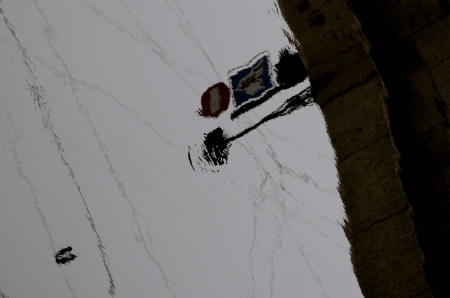
Image is “Reflected Stop Sign” © Vladimir Zanadvorov | Dreamstime Stock Photos

What one thing can you let go of?

lizards1

I’ve noticed a pattern with myself and some of my clients. We want to add new things to our lives and we’re excited about that. But our current lives are so full that there literally isn’t any space for that newness. We try to stuff the newness into the cracks in our current lives, but our lives start to feel like they’re bursting at the seams. Ouch. The newness can’t truly take root and grow because there’s no rich soil for it to anchor itself to.

We need to actually make space in our lives for the newness. We need to create room where the future can enter. If we keep ourselves constantly busy and scheduled every day, if we choose not to notice our need to let go of something which no longer feels good or serves us, we spin our wheels.

I know, this sounds mildly upsetting and maybe even scary. Change can suck, even when you desperately want it.

But you can open up this space in your life, this space in which to allow for the new, bit by bit. You don’t have to do a massive overhaul of your entire life.

One of my clients who felt ready for change but completely burdened by her schedule had been taking a weekly Pilates class for more than two years. It wasn’t feeling great to her anymore, but how could she let go of it? It was Pilates, and therefore, good for her! Right?

After some poking around on the issue, we realized that the energy of the group in the class had shifted significantly and it didn’t resonate for her anymore. What had once felt like a supportive habit no longer did. She quit the class, and just that one open evening a week began to pave the way for change. She found herself using the open time to sit quietly and within a couple of weeks she started cleaning out a closet and packing up some very old stuff to donate to charity.

Sometimes the “one thing” might just be a one-time letting go, too. A friend of mine who never, ever takes a day off work recently decided she would take just one day off. She’d been convinced that things would “go to hell in a handbasket” (I love that phrase! — what does it mean?) at her office if whe wasn’t there.

As it turned out, everything went smoothly in her absence and it occurred to her that she could loosen her grip on things around there a little, delegate more, and maybe take a day off here and there in the future. (If you have perfectionistic tendencies, you are likely addicted to “showing up”. See what happens when you don’t. Just once.)

So, I know you’re thinking, what if the one thing you choose to let go of is on a grander scale, like a job, a relationship, a project near and dear to your heart? I know. That is so, so hard. But, while there’s no denying letting go can feel utterly crappy, the way we think about letting go can make it either harder or easier.

Letting go happens in layers. You don’t have to do it all at once. Even the big things we let go of are full of tiny things you can let go of one at a time.

Years ago, I left a job I’d been at for a long time, and it was hard. I knew in my heart that letting go was the thing I needed to do, but the thought of it was so overwhelming. The change! The massive change! For several months, I spun around in this cycle: I want to leave. But it’s so hard. It’s so overwhelming. I can’t do it! I won’t. But I want to leave. But it’s so hard. I can’t do it!

Then one day it occurred to me that I could make the decision to leave without having to act on it. I know, it sounds counterintuitive, right? But that’s what I did. Making the decision to leave was my “one thing.” And as soon as the decision was made, my entire body felt lighter. I didn’t actually give my notice at the job until almost a month after I’d made the decision to do it. Giving notice was another “one thing” in a series of “one things” that needed to happen for me to exit the job.

Note that my making the decision to leave — even before I’d actually given my notice at work, before I’d actually physically left the job — created space for newness to enter. Because I was no longer spinning my wheels — do I or don’t I? — my energy was freed up to magnetize itself to my not-yet-created future. And because I could see a finite end to the work situation, it became far more bearable for the remaining time I was there.

As I write this, I remember, too, that another “one thing” that helped me make the decision to leave was that I had decided to sit on the blue chair in my apartment instead of the couch where I usually sat. Yep, that was it. I looked at the chair and thought, I’m sitting here while I write in my journal today. Not there. And from that journaling space on the blue chair came my decision to leave my job.

Do not underestimate the power of letting go of one thing. Even if it’s only for today.

For a variation on this theme, check out my previous article, “The power of tiny new things.”

Work With Me: Are you in transition and feeling stuck or scared about moving forward? I have two openings for new coaching clients. Read more here to see if we might be a good fit.

Image is “Lizard 1” © Alexey Lisovoy | Dreamstime Stock Photos

Getting clear on “success”

bridge

Too often we are vague about our definitions of success. We don’t really clarify what we mean by “successful,” or we take on somebody’s else’s definition (maybe a family member’s) and work toward it without actually asking ourselves if it’s what we want.

Or, our idea of success is all tied up with money, even though the amount of money we make and the feeling of being successful are very different things.

My current definition of success is “knowing and understanding myself better and better and showing up for others who want to do the same.”

Notice how I can go into literally any situation and be successful based on my personal definition? Can I be this version of success working as a receptionist? Check. Can I be this version of success at a cocktail party? Check. Can I be this version of success in prison? Sure.

For me, a definition of success that works is one that lights me up, one I feel deeply connected to, and one that is NOT dependent on an external circumstance that is outside of my control.

I can live my current definition of success when I’m writing or when I’m coaching a client, but I can also live it when I’m with a friend, at the dentist’s office, or riding the bus. I may or may not choose to act on this definition, say, at the dentist’s office, but it can still light me up while I’m there.

The problem with getting too situation-specific with our definitions of success is not that it’s unlikely we can make whatever situation it is happen. (We’re very often led into the exact situations we want because our interests, passions and curiosities take us right to them.) This is not at all about saying, well, it’s unlikely to happen so don’t dream it! It is wonderful, and necessary, to dream big. But let me give you a little example of what I’m talking about.

Say your definition of success is “becoming an Oscar-winning filmmaker.” First off, winning an Oscar is never going to be totally within your control. (Even if your film is nominated for best picture, you can be snubbed in the director category; just ask Ben Affleck.)

Still, could this definition of success be one that lights you up and that you feel deeply connected to? Sure. The idea of winning an Oscar one day could totally inspire you to make great films.

The problem with this definition of success is that winning an Oscar for your film isn’t really what you want. It’s only the costume your definition of success wears. The real definition of success beneath that Oscar disguise might be something like this: “My definition of success is making movies that affect others in a powerful way.”

But wait: Even that is not really it. “Making movies” is still window-dressing for something else. Let’s try again: “My definition of success is telling stories that affect others in a powerful way.”

Okay, now we’re getting somewhere. “Telling stories” is close enough to the essence of what you want to do that this definition of success can work if you’re a receptionist, at a cocktail party, or in prison. You’re not dependent on standing behind a camera with a crew behind you in order to tell stories.

But wait: There’s still a problem with this definition of success. “Telling stories that affect others in a powerful way.”

Do you see it?

It’s dependent on an external circumstance. You do not have any real control over how others react to you. I know that’s not a popular thing to say, but it’s true. You might be able to give me all kinds of evidence that seems to prove that you have some kind of control over others’ reactions, but it won’t hold water. In the end, the way others react is up to them. They are choosing to react to something in a powerful way, by what they’re thinking about it, based on who they are and their experiences.

This is why I can think What’s Eating Gilbert Grape is a beautiful and amazing movie, and my friend’s brother falls asleep twenty minutes into it.

So what’s actually the definition of success we’re really looking for here?

How about this: “My definition of success is telling stories that affect me in a powerful way.”

Because YOU are the only one you truly have any control over affecting. The only person you are guaranteed to inspire is yourself. Which is very good news. Imagine if we all went around inspiring ourselves rather than angsting over whether or not we were inspiring others enough?

Ahhh. So, can you have this definition of success working as a receptionist? At a cocktail party? In prison? In a box? With a fox? Totally.

This doesn’t mean you don’t pursue becoming an Oscar-winning moviemaker if that’s what lights you up. Of course you do! It’s just an invitation to notice that the core essence of what you want doesn’t necessarily have anything to do with getting behind a camera or holding a golden statuette. Knowing this actually frees you up to pursue success — as you define it — in any number of ways. It isn’t out there, when the “great thing” happens — it’s within you, right now.

What might you do differently if “success” were already here? How do you act when you feel successful  right now?

Work With Me: I help writers, artists, artisans and coaches who are feeling stuck get moving again. I have openings for new clients in April. Learn more, here.

Image is “Bridge into the Mountains” © Pat Young | Dreamstime Stock Photos

The shark is working well enough … really.

sharkkite

Anyone who knows me fairly well knows that I am obsessed with the movie Jaws. I’m not sure how many times I’ve seen Jaws, but … just … don’t get me started. (Writers, study Jaws if you want to see a movie where every single scene moves the story forward. Nothing is wasted.)

If you know anything about the making of Jaws, you know that the mechanical shark, a.k.a. “Bruce”, didn’t work very well. In fact, there were so many problems with the shark that it wasn’t seen on screen nearly as much as director Steven Spielberg had originally intended. During production on Martha’s Vineyard in 1974, the frequent refrain from the loudspeakers was “The shark is not working. The shark is not working.”

Welp. As we all know, the shark worked well enough. In fact, the semi-working shark worked so well that Jaws was the movie for which the term “summer blockbuster” was coined, back in 1975 when it first appeared in theaters.

One of the main things I do as a coach, when I have a session with a client, is listen for stressful thoughts. Thoughts are stressful when they are not deeply true for us, but we believe them anyway. So when I hear something that strikes me as painful or stressful for a client, I scribble it down in my notebook. If it seems important, I’ll point this thought out to the client and we’ll work with it.

I was going back over some notes before a session recently, and it really hit me just how often our thoughts are perfectionistic. They have to do with how we’re not doing enough, not doing it well enough (whatever it is), and how our reality is not matching the vision inside our heads. (I say “our” because, like my clients, I have a strong penchant for perfectionism. I’m always teaching what I most need to learn.)

I’ve written a lot here about perfectionism in the past (you can click on the categories link titled Perfectionism to the right to check out more). But I don’t know if I’ve emphasized how important it is for perfectionists to make a point of noticing what is working — and what is working well enough.

Because one of the biggest issues I see perfectionists struggling with is decision paralysis. We’re so terrified of making an imperfect decision and the havoc it will surely wreak that we hang out in indecision until it hurts. And then, then, we beat ourselves up for not making decisions quickly enough! It’s a totally lose-lose scenario.

And here’s the thing: We don’t struggle with decision paralysis as much when we give ourselves credit for having made good decisions in the past. Most perfectionists have a pretty big story about being poor decision-makers (it’s in keeping with the idea that we never quite measure up). We are also control freaks, so we tend to think we have much more control over our futures than we actually do.

Therefore, we think, we have to weigh each present or future decision very, very carefully, so we don’t repeat our past mistakes and don’t screw up our futures.

Why do we have this story? Probably because when life happens, as it will, it feels more familiar for us to blame ourselves than to admit the truth: Life is messy, and life is not fair. No matter how “good” we are, we can’t escape this reality.

So what if we were to flip this story on its head? What if we were to look back and notice how we made good enough decisions, and how some of them were even really good? How would we proceed if we basically believed that our lives worked well enough?

I think we’d go on making our movies, doing our writing, living our lives. We’d trust ourselves to create something good. What if Spielberg had decided to resign in the middle of production on Jaws because the shark wasn’t good enough? (Well, probably Universal would have replaced him with a different director. And we’d have had a very different Jaws. Which would have been a damn shame.)

At the bottom of it all, the stories we tell ourselves about ourselves, about our lives, are either helpful or not helpful.

I don’t mean that we should tell ourselves things we don’t truly believe. I’m not talking about piling positive affirmations on top of our fear like white-washing a rotted fence. I’m saying we need to really give ourselves some credit. I’m saying we need to lower our standards enough that we can show up in our lives and in our creative work (or creative play, as I prefer to call it).

Perfectionists, aim for the B rather than creating A+ work that exists only in your head. Make the decision that feels best to you and call it a day, knowing you can course-correct tomorrow. Admit that the shark at the core of your movie is working well enough to continue the filming. Create your flawed-but-amazing works of art and live your flawed-but-amazing lives.

Work With Me: I work with writers, artists, artisans and coaches who are feeling vulnerable and stuck. Learn more about how we might work together, here.

Image is Shark Kite by Ryan Somma at flickr; some rights reserved

The power of tiny new things

bluejay

I was talking with one of my clients the other day about how when we’re getting ready to let go of an old, painful pattern, it usually seems to get worse. It seems worse because (yay!) we notice it more. We’re really, really aware of how terribly incongruent this pattern is with the new-us-we-are-becoming. So of course it feels more painful than it ever has before.

When a pattern is really painful, I know my tendency can be to get really hard on myself about it. “How could you create this mess?” “How can you be here, again?” “Are you never going to learn from your stuff?”

These kinds of thoughts are like a smokescreen, or code, for: big internal changes are happening, and they scare me, so I need to slow down the process by being really hard on myself. Then I have something to struggle with and rail against, so I can ensure that the change is as slow as a part of me needs it to be.

The part of me who is deep and wise knows that I don’t need to do this; I don’t need to make the process harder than it is. Actually, when a pattern is playing itself out and it’s really, really painful, this is the time to step back and be the observer. I don’t have to do anything; I don’t have to fight with the pattern or try to get rid of it.

By the time I’m noticing how acutely painful it is, it’s already on its way out.

Mixed in with the pain of “this so doesn’t work for me anymore” is, believe it or not, some grief — sometimes a lot of grief. A coping mechanism that, on some level, has been useful for (often) many years is being let go. There’s sadness in that. That coping mechanism has become part of my identity, so, truly, I am letting go of something that feels like me (even if it isn’t).

In these periods of watching old patterns rev themselves up to high speed until they burn up and work themselves out of my system, it can be so gratifying to notice tiny new good-feeling things that enter my life. As the old stuff is leaving, I like to set an intention to notice what feels new and good and light.

The new and the good and the light are so often commonplace AND unexpected. Like this morning when I was getting dressed, I saw this sweater in the bottom of my drawer that I’d bought a long time ago but never really worn. I put it on and smelled the sharp, fresh scent of new wool and it felt so snuggly and cocoon-like.

And then when I was reaching into my drawer for my earrings, I noticed this blue jay pin I love but haven’t ever worn much, either, and I put it on the sweater. And it looked like it was made for that sweater, like, how could I not have put these two things together before?

A tiny thing, yes, putting a pin on a sweater. But tiny bits of newness can be powerful. Because I’ve never put this sweater and this blue jay together before, they are already creating a tiny new alchemy that is about now, not then. Good to notice as the old stuff comes up to be kissed goodbye and released.

Try this: Experiment with tiny change. Move two tiny things in your house to new places, or put two things next to each other that have never shared the same space before. Notice what this tiny change sets into motion for you.

Coaching in the New Year: I have limited open slots for new coaching clients. If change is on the horizon for you, or you’re already knee-deep in it and need some support, check out my one-on-one coaching. Consultations are always free!

Practicing Reverent Curiosity

kittenwindow

“Novel-writing is not so much a profession as a yoga, or ‘way’, an alternative to ordinary life-in-the-world.” — John Gardner

On Thanksgiving Day, I was hit with a bad cold. I spent two days pretending the cold wasn’t actually there and that I could go on functioning as if I were well. By the third day, I had to admit that I really was sick — and this meant I had to let go of my need for that thing I fondly call “momentum.”

I like the feeling of momentum. I like the idea that I am moving forward. The trouble comes in when I start to believe I can truly control exactly how things move.

When I returned to working on my novel after being sick, I felt disconnected from what I really wanted to say, at a loss with the story. My characters seemed like they were doing silly things, just marking time, moving around the rooms of my pages for no purpose.

Yesterday, during a group writing sprint with other members of Jenna Avery’s Just Do the Writing Accountability Circle, I went to the page with the same feeling of stuckness and confusion about my story that I’ve had lately. “This is terrible!” a familiar voice inside me piped up. “You have to get over this! You need to make this story work!” (No pressure, or anything.)

When, as a coach, I work with a client who’s stuck, I often use metaphor to help them see their situation clearly. I asked for a helpful image to come to me, and the image that bubbled up in my mind was my cat, when we have a vet visit scheduled and he’s caught on to the fact that the cat carrier has entered the room. Once he gets under the bed, my mission is impossible: he knows he can hide there from me as long as he wants, because I can’t physically pick up the bed and get him out. And we’ve certainly had incidents where I’ve chased him around the house, and sometimes I end up standing the cat carrier on its end and stuffing him into it while he braces his back legs on its sides and writhes furiously. I hate this. And, of course, so does he.

There was this one time, though, when my cat snuck under the bed and I just didn’t have it in me to figure out a way to get him out and stuff him into the cat carrier. I set the carrier on the floor in the living room and sat down in a chair. I called the vet and told them we probably weren’t going to make it to our appointment.

The vet’s assistant was completely laidback about this. “Come on in if you catch him,” she said, laughing.

I sat quietly in my chair. Really, chasing my cat just didn’t seem worth it. He wasn’t ill; it was just a routine check-up since he’s getting into his senior years.

Within fifteen minutes, my cat emerged from beneath the bed and tentatively walked into the living room. He saw me sitting in the chair, looking quite harmless; he approached the cat carrier and sniffed at it. Then he began to investigate the carrier very thoroughly, with a kind of reverent curiosity. It was like he wanted to fully understand this instrument of his impending doom.

I realized that I was treating my story the way I treat my cat when I just want to get him to the damn vet. I stuff him into a box and endure his plaintive meows, feeling like a world-class jerk. Because I want to fix things. Because I want to make sure I’m doing the right thing. Because I’m driven by a kind of urgency.

Obviously, sometimes my cat needs to go to the vet and we do engage in this routine (though I’ve gotten quieter and better at doing sneak attacks, so neither of us struggle as much these days — usually).

But does this pattern work with my novel, with my characters?

I was stuck and overwhelmed because I was invested in the idea that my story needed to be “fixed,” that it contained a problem that needed to be solved. There are certainly plenty of books and advice out there that can tell me how to “fix my novel problem.” And some of them can be very helpful, at certain points in the process. But I realized yesterday that approaching my story in this top-down way, as if it was something I could fix from the outside by forcing it into a box of my choosing, was disconnecting me from anything the story had to show me, from letting it reveal itself.

When I sat back, relaxed, and made the choice to approach my story with that reverent curiosity my cat is so good at, I discovered a fascinating thing: I got really interested in my story again. I wasn’t trying to make it be, or do, anything; I was just interested in it. That all-important question, “What is it about?” welled up in me, and I realized I knew exactly what it was about. I also realized that this novel does not want to be as long as I’ve been thinking it should be. It just might want to be a novella. It knows what it is; and I’ve been so set on “fixing it” that I’ve lost touch with the thread that connects one scene to the next.

My story started to move again. I wrote beyond the 0ne-hour set time of the group sprint, I was so caught up in it.  Hallelujah! I understand my story better. And why did I get into this writing in the first place, if not to better understand?

Can I approach my life, too, from this space of reverent curiosity? Can I step back, breathe for a moment, and give my life the space and kind attention it needs in order to be what it wants to be?

Work With Me: I love helping writers and artists who are feeling stuck. Check out my one-on-one coaching, here.

Image is “Wonder Cat” © Eden Daniel | Dreamstime.com

Being Patient with Impatience

Two Saturdays ago, I had one of my marathon journaling sessions where I seemed to be taking dictation from the universe, and I made a long list of things I want to do to move forward with my coaching practice, my writing, and my life in general. All the things on this list felt exciting, organic, juicy. Enthusiasm flooded through me. Clarity! Momentum! I couldn’t wait to get started. I was sure that in, say, a week, all these things would be effortlessly accomplished and I’d be “on my way” — whatever it is that means.

Fast-forward nine days, to this past Monday evening. I’d spent the most of the day, and the night before, in frustration, confused, vaguely panicked, complaining to my boyfriend that I just couldn’t get anything done and I didn’t know why. This shouldn’t be so hard, I kept hearing myself say. I’m so behind schedule, I kept hearing myself say. Somehow my exuberance, enthusiasm and excitement had become — what? I couldn’t pinpoint it at first, and then I realized what it was: Impatience. Of the extreme variety.

There’s a line from the movie “Postcards from the Edge” — I’m paraphrasing here, but it goes something like this: “In the movies, you have a big realization and your life changes. In life, you have a big realization and six months later your life changes.”

Sigh. Yes, it’s true — things generally do not happen as quickly as I think I would like them to happen. And often, I get clear on a vision of what I want, and then realize — thud! — that there’s a lot of letting go and restructuring that has to happen before that vision can actually become reality. And sometimes, in the process of moving toward that vision, I change, or I understand myself better, and I realize that what I thought I wanted is no longer what I do want.

Sometimes it really will be six months before the change I want is ready to be born. Sometimes it will be a year. Sometimes (as in this case — I think!), it just means I have to do what I want to do over the course of a month instead of a week.

What’s clear is that that graspy, impatient, want-it-yesterday voice inside me is not the voice of my inner wisdom — though it certainly seems like the truth when I’m in the grip of it. But I can tell it is not the truth by the behavior and results it creates — haste, confusion, spinning in circles, accidentally deleting almost-finished blog posts, stubbing my toe on the chair leg.

Impatience is one of the most common themes with my coaching clients. And I’m right there with them. We want to hurry the process so we can get to the reward, forgetting that the only tangible reward is right here, in the process.

The voice of impatience ruins the process.

I picked up SARK’s wonderful book “Make Your Creative Dreams Real” last night for a little bit of guidance. I knew I needed to get grounded. Can you believe the book actually opened to a section titled “Impatience”? I didn’t even remember ever reading this section of the book before, but there it was.

She writes: “Being patient with our creative dreams, our lives, and ourselves can only shelter and nourish us. I am learning ways to be patient with myself and my creative dreams.”

Most of us are pretty familiar with impatience. Our culture teaches us impatience and instant gratification. Be counter-culture. Nurture patience in yourself, even though it may feel unnatural and unfamiliar.

There’s an upside to impatience, too, though. It means you’re opening up to bigger stuff. It means you’re getting ready for newness. Sometimes, it means you’re no longer willing for things to be as they have been because you’ve outgrown them.

And that is all good! But if it’s not moving as quickly as you’d like it to, see if you can hold that impatience in patience’s wider lens. See if you can take a more expansive view — what Martha Beck calls “eagle vision” — and allow yourself to feel that deep knowing that you are exactly where you are supposed to be right now, doing exactly what you are supposed to do in this moment.

Image is AUTUMN STAIRCASE © Lbwhaples | Dreamstime.com

Being in the In-Between + Happy Fall

It occurred to me a while back that part of the reason I love fall (besides the excuse to start wearing my beloved sweaters again) is because fall is about “the great in-between.” To me, it always feels like a passageway, like a crisp tunnel of flaming reds and yellows in which things I no longer need start to fall away, and I begin to get a sense of what will flow in to replace them.

I’ve always been fascinated — and, until recently, tormented by — those in-between, liminal periods in life.

For most of my life, I hated the uncertainty that comes with being “in-between” so much that I rushed to get out of it as quickly as I could — only to end up right back in it. As in, I wanted to get out of the discomfort of “not knowing,” so I took action just to get away from my discomfort, and ended up creating more discomfort. (When we take action based on a desire to avoid something, we actually create more of what we’re hoping to avoid. It’s pretty annoying how that works.)

These days, I’m learning to truly be in the in-between.

And fall is a great reminder of how beautiful the in-between can be, if I open to it, breathe into it. There’s a sacred hush to fall, if I give myself a chance to feel it. The old is dying off, and the “what’s to come” isn’t here yet. When it comes down to it, there’s nothing but uncertainty, but during transitional periods we feel this more acutely. In fact, after fall there will be a winter in which much goes underground. In our personal winters, things are being worked out in us, things we may not be able to see or articulate. And it can feel terrifying, if we look at the unknown as anything but our friend.

I’ve come to feel that this dying-off, if you want to call it that, can be exciting, even exhilarating. And maybe that’s why I see fall as all about beginnings as well.

What are you open to letting go of as the fall season begins? What are you willing to let fall away? What might you be open to beginning?

Announcements:

I have two openings for new coaching clients starting in October. I help sensitive creators who struggle with overwhelm make their creativity a priority  — you can find out more here!

The last day to register for our next session of Jenna Avery’s Just Do the Writing Accountability Circle is this Thursday, Sept. 27. I’ve written quite a bit here about the huge benefits I’ve experienced in being a participant in this group, and I’m also Jenna’s co-coach. If you need to create a regular writing habit, or would like some group support as you write, be sure to check it out!

Image is WET LEAF© Jay O’brien | Dreamstime.com