Squirrel wisdom (or, the power of a good question)

squirrelfoodA couple of weeks ago, I was sitting at my kitchen table with my journal, and I paused to stare out the window. It was cold out, bitterly cold, and I watched a squirrel make her way up a telephone pole across the parking lot with a frozen piece of hamburger bun.

When the squirrel had made it almost to the top of the pole, just inches from the wire she wanted to access in order to make it across to the tree branches many yards away, she dropped the bread. I watched it plummet — its trajectory was swift, and it bounced twice on the pavement.

On realizing she had dropped the bread, the squirrel immediately — and I mean immediately — turned around and started down the pole to retrieve it. It took her a while; eventually, she got to the pavement, located the bread (which was about twice the size of her head), put it in her mouth and headed back up the pole.

The squirrel had very little — if any — reaction to her loss of the bread. She simply noticed it had fallen and recalculated.

But here was my reaction, from the kitchen window: Oh my God! All that work and she drops it! Poor squirrel! What a hard life she has in the winter! It’s not fair! All that work just to get a scrap of bread! What if she drops it again? What then? Why is life so hard?

I watched as the squirrel made it up the pole a second time, this time without dropping the bread. She balanced with it on the wire and managed to reach the tree branches, at which point I stopped observing her because I couldn’t bear to see her drop it a second time. If she did, that would mean … what?

I was making the squirrel’s dropping the bread, or potentially dropping the bread, mean all sorts of things. Bad, sad, things.

But the squirrel wasn’t making it mean anything. She was just going on with life, not shaking her little squirrel fist at the heavens and saying, Woe is me! What a pitiful squirrel life I lead, dropping bread left and right! How will I ever eat? I am so incompetent and life is unfair to me!

What are you making it mean? is one of my favorite questions ever. I learned to employ this question during my life coach training back in 2010, and once I learned it I didn’t know how I’d lived without it. It’s probably one of my favorite questions to use with my clients, too.

Our thinking is often automatic. It bypasses our conscious awareness and, before we know it, we’re off into all kinds of stories.

Notice what I did when the squirrel dropped the bread? My mind just went there. It applied all my human concerns to the squirrel and her squirrel-ness. It took maybe three seconds — if that — for my mind to go from noting that the squirrel had dropped the bread to asking an unanswerable question: “Why is life so hard?”

It’s worth it — so worth it — to slow down and observe our thinking. We can’t stop our minds from spewing out thoughts — some research shows that we think thousands of thoughts per day — but we can step back and notice how what we’re thinking is affecting us.

Sometimes (often!) I respond to myself the way I did to the squirrel. Something doesn’t turn out the way I wanted it to, or it’s harder than I thought it would be, and my mind is off and running — I shouldn’t have tried, what’s the point, that was so hard there’s no way I can do it again, why is life so unfair? 

It’s not bad, or wrong, that I have these thoughts. It’s what minds do. The not-so-great thing is when I believe them and take action (or not) accordingly.

When the “bad thing” happens, when I drop my proverbial bread, this is where What are you making it mean? can be a really helpful question to pose to myself. (Notice the difference in feel between this question and a profoundly unhelpful question like “why is life so unfair?”)

Humans are not squirrels, and not meant to be, but I’d like to become a little more like the squirrel. A little more undaunted, a little less self-pitying, a little less thwarted by inevitabilities that have absolutely nothing to do with me. Life is unfair (okay, I guess you can argue that thought, if you want to!). But the squirrel in her squirrel-ness reminds me that what I do with that fact is up to me.

(Two of my favorite resources for noticing and working with my thoughts are Byron Katie’s The Work, and Brooke Castillo’s Self-Coaching 101.)

What are you making it mean? I’d love to hear what you notice about how your reactions shape your world. (Noticing is always the first step!)

Need some support in bringing your creative work into the world? Check out the ways we can work together, here.

Above image is “Squirrel Food” © David James | Dreamstime Stock Photos
How time distortions keep you from getting things done

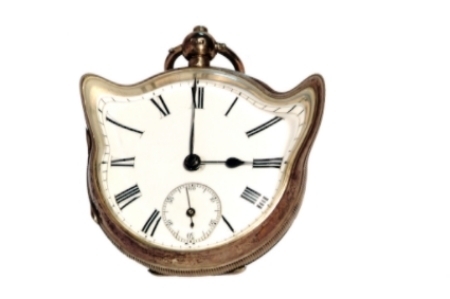
I love how this clock looks like it has cat ears.

I love how this clock looks like it has cat ears.

Here at the beginning of a new year, a curious phenomenon has arisen in the work I’ve been doing with my coaching clients. It comes down to this: what we believe about how long something will take is directly related to whether or not we actually do it.

These types of beliefs are time distortions, and a good example of this phenomenon comes from Seinfeld. There’s an episode where Jerry is trying to convince himself that it won’t be that bad staying for a few days with his parents in their Florida condo. To make the impending visit feel shorter, he tells himself that he can’t really count lunches and dinners and taking showers as part of the visit — so, actually, the whole visit will be “like fifteen minutes!”

Have you done this? I know I have. When we’re dreading something, our minds will go to all sorts of lengths to help us cope.

This is in some ways helpful and productive — I know there are experiences I would probably have never exposed myself to if I’d known in advance how hard and stressful they were going to be.

But my mind convinced me that “it wouldn’t be that scary.” In some cases, it was far scarier than I’d imagined, but in the end I was thrilled that I had the experience (so, thank you, dear mind!).

More commonly, though, our minds can protect us into not doing something at all (that we either want or need to do) with these types of distortions.

A client I worked with recently had not completed the “homework experiment” we’d set up for her. (I refer to any homework I give clients as an “experiment” rather than an “assignment” because approaching something as an experiment tends to engage more curiosity and less resistance. But not in this case!)

When we dug into why, it turned out that she’d been thinking the homework “would only take thirty minutes or so” and she could knock it out the night before our session. When we looked honestly at the homework, though, it was clear that she would need a minimum of three hours to do it.

So why had she decided it would only take about half an hour? Because she had a lot of resistance built up around doing it, and the only way she could bear to face it was to think that it would be over in a very short amount of time.

In this case, that meant she put it off until it simply didn’t get done. And I have a lot of compassion here, because I have SO done this.

Here’s another example, from a different client. She’d told a close friend she would run an errand for her, but hadn’t done it. For a month she’d been waking up thinking “I really need to do that today. I should do it.” Then she wouldn’t do it and the next day the whole cycle would repeat.

When we took a look at why she wasn’t doing the errand, another sort of time distortion revealed itself. She was certain the task was going to take hours and that it could become very complicated, and that she might have to get help to complete it that she wasn’t sure she could get.

I told my client that, while I could be wrong, to me it sounded like the task shouldn’t take more than about an hour to complete (and this included driving time). We looked at what would be the worst that could happen if, in fact, it did take her as long as she feared. “It would be really stressful and annoying,” she laughed.

But she agreed to go ahead and do it the next day. I told her to email me as soon as it was done and tell me how it had gone (this kind of check-in with someone who cares about you can be SO supportive!).

She emailed me way sooner than I’d expected to hear from her. Why? Because the task, including driving time, had taken her exactly 18 minutes — no complications, no extra help needed. Just straightforward driving to an office to pick up a folder and dropping it off at her friend’s house.

How do we keep ourselves from getting sucked into time distortions? Well, first we need to get our thinking about the task we’re avoiding out of our heads, where we can see it more clearly. It helps to write it down, or speak it aloud to yourself or someone else. (So often our thinking is automatic, bypassing our consciousness. We need to see it “out there” in order to be aware of it.)

If you notice there are time issues in your thinking (“I can write a draft of my chapter on the twenty-minute train ride”) and that you feel a considerable amount of anxiety with that thought, you can be pretty sure that what you’re telling yourself is deeply unhelpful. (We almost always avoid things because of the anxiety they bring up in us. If we can lessen the anxiety, we’re going to be far less likely to avoid them.)

So experiment with some mantras that will help you do a reality check when it comes to how long something will take. (Often, we just don’t know, and that needs to be factored in.)

Here are some of mine:

I won’t know how long it will truly take until I start doing it.

If it’s going to take a long time, I’d rather get started sooner than later. 

I want to feel as calm and grounded as possible around this action. What will help me feel that way?

All of these sentences give me a reality check. And for those of us with, shall we say, vibrant imaginations, reality checks can be a valuable part of our artist’s toolbox (as much as we might cringe at the idea of “mundane reality”!). As long as the reality check is supporting our bigger vision, it’s all to the good. 

What do you notice about how distortions of time play into your fears around getting things done? I’d love to hear from you.

And: Need some help moving your creative work forward in the new year? For a limited time, I’m offering three-packs of 30-minute coaching sessions. You can find out more, here.

Above image is “Old Distorted Clock,” © Jolin | Dreamstime Stock Photos

The difference between “ready” and “comfortable”

gorgeous fall

Scroll down to find out about limited-time Autumn Transition Coaching Sessions. 

As I am settling into my new living space, I notice how satisfied I feel with this change. Being in this new place during the gorgeousness of fall, my favorite season, is lending a brisk beauty to this season of my life.

The other morning I was up with my cat at 4 a.m.  — he is a night prowler and shelf-climber, unfortunately (at least it’s unfortunate at that time of day). Even though it’s a drag to get up and monitor him at an insanely early hour, I often have insights at that time of day/night. (Isn’t 4 a.m. known as the witching hour? Hmm.)

The insight that came to me that morning was that, as with all the changes in my life that have felt most “right”, this move to a new home happened when I was ready for it, and not a moment before.

Now, what do I mean by “ready”?

There’s an idea out there in the world right now about “starting before you’re ready.” That if we wait to be “ready,” we’ll never begin.

I understand this concept, but my experience tells me something different. And I think it has to do with what is meant by “ready”.

I would say, “Start before you’re comfortable, but don’t start before you’re ready.”

For me, deep, true “readiness” has a feeling of acceptance attached to it.

With moving to this new home, for example, I wasn’t entirely happy about the change. For a long time after I began to perceive that it was going to be necessary for me to let go of my old home, I felt a lot of resistance to that idea.

About a year and a half before I made the move, I looked at apartments in the very building where I now live, and I had a feeling of wondering. Hmm, I wonder what it would be like to live here. I really like this street. I have a sense that I’d like to live here.

But: I was nowhere near ready to make a move at that point. My attachment to my old home was still so great that even thinking about a “real move” filled me with grief, exhaustion and overwhelm.

At that point, all I was ready for was wondering about where I might want to live next. The idea that I should be “more ready” to make a change than I actually was created lots of stress for me. (Funny how it’s always easier to see these things in retrospect.)

The shift for me came this past March or so, when I realized that even though things were still very much up in the air with my living situation and I was enduring frequent house showings, it felt right to simply be where I was. I stopped scrambling. I decided that despite the uncertainty of my situation, I was going to fully enjoy my home for as long as I had it.

And, from that place of full acceptance, I began to become truly, deeply ready to make a change. By June, my boyfriend and I had found our new home and we knew we would be moving in August.

But moving — despite feeling more truly ready for it — was not comfortable.

As I wrote previously, I had a ton of downsizing and letting go to do, on a number of levels. Aspects of that felt excruciating, not just from an emotional standpoint but from a logistical one.

And sometimes, in my new “streamlined” existence, I am still uncomfortable with the fact that I go looking for something that was part of my life for a long time and realize I donated it back in August. Or, now that my boyfriend and I do not have separate office rooms to go to, we sometimes feel on top of each other when we are trying to work. This change is not comfortable, even though I wanted it, I chose it.

pumpkintrio

Happy Halloween!

Another example: Back when I finished life coach training in 2011, a number of my fellow “cadets” began to go through the coaching certification process. My mind started in on a familiar loop: “Look at them! You’re falling behind. Hurry up and get certified!”

Luckily, my training had taught me to question my thoughts, and in doing that I realized that, deep in my bones, I was not ready to apply for certification. I wanted to do more coaching first. I wanted to “get” coaching at a deeper level before I went through the certification process so it would actually have meaning for me, rather than just feeling like a “should”.

This feeling came from a different place than the “never-quite-good-enough” thrust of perfectionism. It simply felt right to me to wait to get certified.

When I did go through the certification process, in November of 2011, I felt ready, but it was not comfortable. I still had all kinds of doubts and fears, but the way I knew I was ready was that I was not attached to the outcome. The process of certification was so “real” to me by this point that, even if I didn’t get certified, I knew what coaching meant to me, and I knew that I was a good coach. I’d walked coaching into my bones, and certification felt like a natural evolution of that process.

And, as it happened, certification went beautifully for me. But it wasn’t comfortable. I had all kinds of anxiety around it, but it was a different kind of anxiety than I would have had if I’d forced myself to go through the process six months earlier than I did, just as I would have had a different kind of discomfort around moving if I’d made myself do it a year earlier, just to end my discomfort!

(One of the most poignant things I’ve learned about humans since I became a coach is that, so often, in our hurry to end our discomfort, we create even more discomfort for ourselves. Then we look back and wonder what in the world we were thinking.)

What do you notice about the difference between the times you’ve felt “deeply ready” to make a change and the times you started too soon? Has being “ready” felt comfortable for you? I’d love to hear your experience.

Plus: In celebration of Halloween and the beauty of fall, I’ll be offering 30-minute Autumn Transition coaching sessions for just $39, now through November 25. If you find yourself in deep transition and not quite sure how to navigate your next step, I’d love to help. Find out more about Autumn Transition Coaching Sessions, here.

Above images © Jill Winski, 2015

Radical self-care: when your “normal” has changed

palebutterflies

As I’ve been working with clients in my Stellar Self-Care program, I notice how the tendency for many of us is to keep going on “as usual” — even though our lives have changed.

Maybe a health issue (for us or a loved one) has come up, and we’re still expecting ourselves to function as though it hasn’t.

Maybe we’ve started a new job, or we’re in the process of moving, or we have a project or business that is gaining momentum.

Maybe we’ve been through a break-up, or someone close to us has passed away recently.

Or, maybe a mix of ALL of the above is happening at once.

Whether our circumstances inspire hope, excitement, or sadness, the fact is that when things are changing profoundly in our lives, or when they’ve changed suddenly and without warning, we are affected.

So it’s really interesting to notice this human tendency to stay the course, to keep showing up, to expect “the usual” of ourselves, even though things are anything but “usual.”

None of this is “bad” or “wrong.” It’s just not necessarily effective — or kind to ourselves.

I notice for myself that my tendency is to toss self-care out the window — exactly when I need it the most.

When I’m really stressed, I also get really self-indulgent. (Read my take on the difference between self-care and self-indulgence, here.)

I start to obsess. I tell myself it’s more productive to worry than to sleep. I grab the quick food rather than the nutritious food (or don’t eat at all because I’m “too nervous”). I forgo my daily walk on the grounds that “there’s too much to do”. I feel much less creative because I’m tied up in knots and I’m “pushing the river”. (I like to think of creativity as a river that is always flowing — we can move with it, against it, or jump to shore and return later.)

And: I am getting a lot better at letting go of these behaviors and replacing them with acts of care for myself.

Sometimes this looks like:

* Declaring my sleep time as a “worry-free zone”.

Letting myself know that — if I want to — I can worry all I want at 9 a.m., but between between 9 p.m. and 9 a.m. I’m going to step into the worry-free zone.

Better yet, if I’m going to insist on worrying at all (which a part of me will), I can declare one hour a day as my “worry hour” and make the rest of the day the worry-free zone. (I’m not quite there yet, but I like this idea very much. A friend tells me that when she started doing this, eventually an hour became too long to worry — she got bored with it and found she couldn’t spend longer than about five minutes worrying when she was forcing herself to do it!)

* Taking my walk even though I’m having a thought that says “There’s no time for this, there’s too much to do.”

This might mean reminding myself that, often, if I walk long enough and focus on my body moving and my breath flowing in and out, problems have a tendency to solve themselves. (That’s because I’m back in the river of creativity, and I’m moving with it, rather than pushing upstream. Walking is great for reconnecting to the river of creativity.)

* Putting off the non-essentials for later, or for “never.”

I mentioned in an earlier post that I had taken on a freelance project even though I’ve been going through a hectic time because I just couldn’t say no to the opportunity. When I really looked at everything on my plate, I realized that the project was a non-essential, and I would be fine with taking on such a project later, or even never. Other opportunities would surely arise, but I was, at the moment, at bandwidth.

* Getting (or hiring) help where I can.

A couple of weeks ago, the lawnmower broke, and I got angry. After thirty minutes of going on about my terrible luck (The lawnmower breaks just when I have so much to do!), I realized this was a chance to give myself the gift of time and one less thing on my to-do list: I discovered a local lawn care service that would mow the lawn regularly for a very reasonable rate. The owner came over and gave me an estimate the very next day.

(This is a recurring theme in my life over the past couple of years: when something breaks, there is a gift in it for me.)

The bottom line, though: it starts with acceptance of where I am, and who I am.

If you feel like you’re slamming into the same wall again and again, ask yourself this: What needs to be accepted? And then: How can I accept myself, here?

Somewhere in there lies what is true, for you. And from that truth you will discover not only what caring for yourself looks like, now, but also that giving yourself that care is essential to navigating the reality of your life not as it was, but as it is.

Do you notice yourself resisting change in your life? What acts of care can you give yourself when change feels overwhelming?

Image © Phillip Wheat | Dreamstime Stock Photos

Understanding the message of fear + new coaching programs!

shimmeryweb

When we try something new, or sense that change is on the horizon, or when we’re in a murky transition period that seems to have no end, it’s not unusual to feel varying amounts of fear.

Sometimes, though, the amount of fear we experience, well, scares us. (I’m reminded of the title of a song by Bauhaus: “In Fear of Fear.” That’s how it is sometimes!)

So I like to look at fear in two different ways (there are probably infinite flavors of fear, but this is a general distinction that is often helpful when fear’s got us confused or shrinking).

One kind of fear is what is sometimes referred to as “rollercoaster” fear.

You’ve got butterflies in your stomach, and your body is braced for an intense experience — but there’s a definite thread of excitement there. You want to go where the rollercoaster is taking you, even though sometimes it causes your stomach to drop to your feet or your heart to spring to your throat.

The other kind of fear feels different. You’re expecting an intense experience, but instead of butterflies in your stomach, you feel cement.

This fear weighs you down; it feels impossibly heavy; you don’t anticipate the rollercoaster, but even if you did you wouldn’t have the lightness of step to get on. This fear is entangled with a palpable sense of dread, and sometimes a feeling of “ick” or revulsion. You don’t want to go where it’s taking you.

We can become confused when we don’t take time to make a distinction between these types of fear.

How many movies have you seen where a character is about to get married, and confides to her best friend that “something doesn’t feel right,” and the ever-helpful friend says, “Oh, you just have cold feet. It’s normal to feel that way before taking such a big step.” And either the bride turns and runs back up the aisle and out of the church in the middle of the ceremony, or she goes ahead with the marriage and it’s a disaster.

This is a good example of that second type of fear, which can be an indication that something isn’t right for you on the road you’re about to take.

Now, here’s the tricky thing: It can also be an indication that something isn’t right in the way you’re thinking about the road you’re about to take.

So, it’s not necessarily as clear-cut as, “Oh, you’re experiencing a side of dread with your fear? That means you definitely shouldn’t get married!”

What fear combined with dread actually warrants is further inquiry into what is going on for you.

It could be that you don’t want to marry this person — ever. He’s wrong for you and that’s the awful truth.

But it could also be that you love this person deeply — but you don’t want to marry him.

Or, it could be that you love this person AND you want to get married — but not until you’ve gotten in contact with your estranged dad, because your heart sinks at the thought of ever being married without your dad in attendance.

We always have a good reason for feeling the way we feel (even if the reason doesn’t seem valid to our “logical mind” or our inner critic). When we hit on that good reason, we usually feel true relief, sometimes accompanied sadness. If your fear feels heavy or “icky”, this is a sign to stop and investigate before moving forward.

If your fear feels like you’re about to get on a rollercoaster (and rollercoasters thrill you rather than making you want to throw up), this is a good sign that you’re in for a wild ride and your essential self is up for it.

(It’s worth noting, though, that if, like me, you are highly sensitive, “good fear” can feel overstimulating, so make sure you have solid support and self-care as you embark on your journey.)

Speaking of support, I have a two new one-on-one coaching programs I’m excited to share with you (and yes, I do feel some of that “rollercoaster fear” in putting these programs out into the world!). There will be more to come on these programs soon, but for now, you can hop on over and learn about Light Up Your Creative Self and Stellar Self-Care Foundations, here.

What do you notice about the different “flavors” of fear, for you? How do you deal with them? I’d love to hear from you.

Above image is “Necklace” © Mihail Orlov | Dreamstime Stock Photos

Making friends with creative transition

making friends with creative transitionRecently I spoke with a client who had just completed a massive project that took several years of her life to bring to fruition. It was a huge accomplishment for her to send her “baby” out into the world, and she was really happy about it.

Except that … she also wasn’t. She also felt lost and … sad?

How could this be? This was the time she’d been waiting for! In fact, at points during her journey she’d sworn the project would never be finished and couldn’t wait for it to leave her hands.

Because this was the first creative project of this scope that my client had seen from start to finish, she was unprepared for the letdown she felt when it was done. And it was making her really nervous that she wasn’t sure what her next project would be.

She didn’t even have any ideas. She kept trying to grab onto opportunities that came her way, but none of them felt right.

What my client was feeling was so, so normal.

When we imagine finishing something big, we often envision the elation that will come with the accomplishment but we don’t realize that there is a sense of loss in finishing, too.

We get thrown into “creative transition.”

Our tendency during these times is to rush ourselves through them because they feel so uncomfortable.

If we rush ourselves through, though, we miss out on the opportunity to become the new “us” that the transition time provides. That’s what transitions are, after all — bridges or tunnels from one version of ourselves to the next.

It’s kind of like when we end a relationship. Most of us have had that experience of breaking up with someone and then (oh, crap!) getting back together with them a week or a month later.

What happened there? We crawled back into our former lives, not quite ready to go through the “deep cocooning”  process we must embrace in order to emerge as that new “us.”

This is okay. As Robyn Posin says in one of her wonderful posts, we’re never fully anywhere until all of us arrives there. (I’m also reminded of an episode of Seinfeld where Jerry compares ending a relationship to knocking over a Coke machine. It has to rock back and forth a few times before the whole thing falls over.)

So what can we do to make times of creative transition easier? Here are a few suggestions.

* Allow yourself to come down from the trip.

Recognize that at the end of a long creative journey, we’re often functioning — to some extent — on adrenaline. This is especially true if we have a bunch of deadlines to meet or events to attend in order to complete our journey and we’re (understandably) tired. Adrenaline will kick in to help us make it through.

Remember how badly you wanted the semester to be over back in college, and you got all your papers in and exams taken, and then didn’t know what to do with yourself for a few days? That’s because you were still pumped with adrenaline and it was compelling you to do something, anything! When we come down from that heightened state (which, by the way, is not healthy for us to remain in), we will feel more centered and present and at choice.

* Allow yourself to feel sadness and loss.

There is nothing wrong with you if you feel a sense of loss and even grief after achieving a huge success. It is part of the natural process of moving from one phase of life to another. It’s normal to enter a “liminal state” at this time, what Martha Beck refers to as “Square One.” (Martha’s wonderful book Finding Your Own North Star explains “Square One” at length.)

* This is an excellent time to cultivate curiosity.

As the sadness and loss mix with your joy at your achievement and wash through you, what’s taking your interest? What do you notice about the change in yourself from the beginning of this journey to now? As you move through your daily life, what are you needing? Comfort? Connection with trusted friends?

Journaling about what you’re going through can be a great way to gain more awareness of your current needs, and the ways your inner compass is pointing you to your next step.

* It’s okay to go slow — in fact, it’s best to go slow — at this time.

When you allow yourself slowness as you enter creative transition, you really get a chance to experience who you’re becoming and what this transition is all about (though that may not be totally clear to you until you exit the transition phase!). This time is an amazing gift and you’ll never get it back in exactly the same form again. So how can you find ways to savor rather than hurry it?

You may need support in doing this. Our culture does not encourage savoring and slowness. Trust that support is out there in the form you need it!

What have you noticed about creative transitions for yourself? Has anything in particular helped to make them easier for you? I’d love to hear from you.

And: These are the last several days (through March 31) to purchase my package of four coaching sessions as I will have new offerings up on my site soon (I can’t wait to share them with you!). The package of four saves you $75 and is a great way to get ongoing support from me. Take a look here to learn more!

Image is “Tunnel Under Railroad” © Peterguess | Dreamstime Stock Photos

Making decisions from a place of peace

Making decisions from a place of peace

Something I often notice when I work with a coaching client is how urgent everything can feel when we are in a space where we have unmet needs.

The interesting thing about this urgency is that it can feel really true.

Sometimes, before we even consciously recognize it, we have acted on this feeling of urgency when — actually — the best course of action might have been, in this moment, no action.

One of the biggest push-backs I get from clients is when I suggest that if they are feeling frantic or highly anxious, they become peaceful before making whatever decision it is that they are sure they need to make.

Two things usually come up:

1) But I can’t get peaceful until I figure out what the heck I’m doing. I need to have my life sorted out first.

2) My needs are enormous and unless I take the “right” action to fulfill them, they will not be met. I am so tired of having these unmet needs. I need to do something about it, now!

I totally get both of these reactions. It can feel so frustrating and overwhelming to have a pile of unmet needs sitting there, unsure of how we will ever resolve any of it.

On top of the fact that the needs seem to be hanging there unmet, we can get really hard on ourselves for not meeting them immediately, or for having them in the first place. (The Buddha told a story where he referred to this as “the second arrow” — when something difficult happens, we in effect have “one arrow” in us, and our tendency is to “shoot another arrow into ourselves” by being hard and judgmental just when we most need to be compassionate.)

Here’s the thing: When we proceed from a place of panic, anxiety, or otherwise stirred-up feelings, we often end up making decisions that either do not actually need to be made right now (or at all), OR we make choices that only create more pain for us and have to backtrack and undo them.

So I like to share this Lao Tzu quote with clients (and sometimes they find this really annoying): “Muddy water, let stand, becomes clear.”

Clients usually say, but what do I do to get peaceful? How can I make the muddy water become clear, faster?

These questions make me laugh. They are so, so funny. Can you see why? (And I’ve asked the same questions myself, many many times, so I’m laughing from a place of compassion, for sure.)

Sometimes, it’s not about doing, and it’s not about making things happen, faster.

How can we tell? Because our doing has that frantic, anxious energy behind it. And, the biggest tip-off that we are doing in order to resist being with what is coming up for us: we don’t feel any better for having taken an action or made a decision.

Here are some better questions to ask ourselves:

What is so hard about staying with these uncomfortable feelings until they settle down a little and point me to clarity?

How can I make it easier to allow these feelings to be there, without trying to change them?

How might I support myself in being with the hard stuff that’s coming up for me right now?

Sometimes we might think, but how will I know that I’m ready to take a particular action or make a decision?

The answer is, you’ll know because you will find yourself in the middle of doing the action or making the decision.

When we’re in a place of acceptance, what truly needs to be done and decided arises naturally. We make the call to get the help we need. We withdraw the money from the bank. We comfort the friend who is hurting. We sleep because we’re tired.

This is all there ever is when we’re able to be with what’s actually true for us, right now: the next step presents itself, and we take it. (Or maybe what presents itself is that there is no action to be taken right now.)

But in order to be in our truth, in order to sense our true next step, we may need to allow our muddy water to clear. We may need to exercise some patience and be with whatever is coming up for us. And we can do that a few minutes, or seconds, at a time. We can break it down that much if we need to.

(Byron Katie says that we don’t make decisions — “decisions make us” when we have the necessary information to make them. Do you notice this for yourself?)

What have you learned about your decision-making process? What have your best decisions felt like for you? I’d love to hear.

And: I’m in the process of changing my coaching offerings and won’t be offering them in the current format for much longer. If you’d like to work with me in the current way, check out my offerings, here.

Image is “Water 4” © Chrisharvey | Dreamstime Stock Photos

What if it’s not as hard as you think?

redonstone

The other day I had to do something that I thought was going to be very hard.

In fact, I’d been putting it off for a while because I thought it was going to be so hard, so uncomfortable, so taxing. I imagined all kinds of stressful scenarios that were going to result from my doing this thing, how a chain of negative events would be set into motion if I did it, how maybe I’d regret doing it.

So I didn’t do it as quickly as I might have. In fact, I started getting very irritated with myself for “procrastinating.” (I like to put procrastinating in quotes because there’s a big difference between procrastination and waiting for the right time, and we need to do a little digging sometimes to recognize which is which.)

Basically, the “thing” involved saying no to someone who had asked me to collaborate with her. I was torn at first because in some ways I wanted to do it, but the reality of my life right now is that I simply don’t have the time or the energy for this level of collaboration.

So I put off saying no, even after my intuition had clearly let me know that “no” was the way to go. (Sorry for the Dr. Seuss-ian sentence — actually, I love it!)

Finally, I made the call. I said, “A part of me would love to, but I’m choosing to say no to this right now.”

Guess what? It wasn’t that hard. My heart raced, yes; my hand slipped a little on the phone because it was wet with sweat.

But all in all? Not that hard. Not nearly as hard as I’d built it up to be. In fact, the person involved thanked me for being direct (she didn’t even think I’d taken that long to get back to her), and then we had a conversation about how much we prefer hearing “no” to hearing nothing at all and being left hanging. (That’s a topic for a whole other post!)

Sometimes, something we need to do proves to be harder than we’d imagined it would be.

But, sometimes, much of the “hard” has to do with our thought that “it’s going to be really hard”. So we don’t do whatever the thing is, and in the not doing it, we create more hard on top of our idea that it’s going to be hard.

Another thing we sometimes do when a task we perceive as “hard” looms before us is we tell ourselves, “I need to have courage. I need to muster up the courage to face this.”

This can actually create yet another hurdle. This “mustering up the courage.” The idea that we need “courage” to face whatever it is actually makes the “thing” seem even harder. Our brain goes, “We need courage here? Wow, it must be really hard! It must be extra hard!”

What if we didn’t need courage? What if, instead of courage, what was more helpful turned out to be acceptance of the situation, acceptance of our fears about it, and trust in our ability to handle it?

It’s worth considering.

Image is “Red on Stone” © Cristina | Dreamstime Stock Photos

What would make it easier?

Drop of water

Several months ago, I led a small group of my clients through a support session to help them with fears that were coming up around their creative projects. They were all nearing the finish line and feeling a lot of resistance to completing, so I thought, maybe we could all support each other in this.

Something we noticed during our session was that we all had a tendency to complicate things to the point that we felt utterly paralyzed about how to move forward. The closer we got to finishing, the more questions about what might happen when we brought our projects into the “real world” came up.

A lot of the stuckness, we found, was based on fears of what might — or might not — happen in the future, if we actually did finish the projects. What if we put them out into the world and no one noticed? What if we put them out there and offended someone close to us with our content? What if we put them out there and got criticized or booed?

All of these things, of course, are distinct possibilities when we put our work out into the world. Focusing on these possibilities can also be effective ways to distract ourselves from actually finishing our work so it can BE out there.

So we came up with this question to ask ourselves when analysis paralysis set in: What would make it easier? What would make it easier, right now?

Just asking this question, we noticed, created a feeling of relief (which good questions usually do — and most of us are not in the habit of asking ourselves good questions!).

We brainstormed a list of possibilities this question generated, and here are some of the things we came up with:

* I could, just for today, commit to staying in the present moment with my work.

* I could stay in my own business. (This comes from Byron Katie’s “three kinds of business” — my business, your business, and God’s business [you might also call this the universe’s business or simply “reality”]. As I’ve written here before, much of the time I feel stress it’s because I’m in someone else’s business. That includes worrying about how my creative work will affect others in the future. There’s a place for this concern, but it’s not while we’re creating the work.)

* I could go to bed earlier and wake up earlier.

* I could check in with someone who helps me gain perspective when I’m stuck.

* I could drink more water. (This might sound silly and completely unrelated, but truly, dehydration can cause us to feel stuck, because water helps our physical systems move and flow. And, particularly if your system is highly sensitive, you may be susceptible to the effects of dehydration.)

* I could take more walks. (Sitting at a desk, especially if you use a computer to do your creative work, can cause you to feel sluggish and static. Moving your body shakes things up and help you shift perspective.)

* I could employ tunnel vision (in a good sense). Think of a racehorse who has blinders on so he is not distracted by what’s on either side of him — he’s only focused on the immediate few yards ahead.

* I could shift my work time to earlier (or later) in the day.

* I could work in a warmer (or cooler) room.

* I could take more frequent breaks when I work.

* I could aim for a B- rather than an A+ (this one is especially important for perfectionists, which most of my clients are). If it didn’t have to match your perfect vision, how much freer would you be to finish? Think about your favorite books, movies, music, artwork. Are they perfect, or are they inspired? There’s a big difference.

* I could, just for today, let go of the idea that I can please everyone with my work.

* I could, just for today, let go of the idea that I can please everyone in my existing audience with my new work.

These are only a few examples of what we came up with. But notice how simple most of them are. Sometimes there’s one small tweak we can make that really helps. And we noticed that the phrase “just for today” was especially helpful.

It’s very human to make things much more complicated than they are. Usually, when I find myself in the land of analysis paralysis, it simply means that I’m scared and I need some support. Notice if this might be the case for you.

What might make your current project easier — particularly if you’re getting close to finishing? I’d love to hear, in the comments.

And: If you’re stuck near the finish line and need some support in completing a large project, I’ll be forming another small, low-cost support group soon. Feel free to contact me if you’d like to be put on the list to learn more.

Image © zaliha yussof | Dreamstime Stock Photos

Trusting the deep pull inward

rowboat

Looking back over the past twenty years of my life, I notice that times of a lot of external change were usually preceded by a deep pull inward: a period of maybe a week, or two, or more, where I needed to become very still, write in my journal more than usual, and detach from the external world.

I remember a period like this in my early twenties where I took lots of long walks in the evening after work for several weeks. And another period years later where instead of going out on the weekends like I usually did, I stayed in and wrote intensely in my journal. I didn’t have the money to actually quit work or take a long vacation in order to go within, but it was like some force compelled me to figure out a way, anyway; it was a taking stock of where I’d been and where I was so that I could move forward in a clear and powerful way.

Except I didn’t really know this at the time. I can only see it in retrospect.

I have a couple of clients right now who are feeling this pull to move inward. And, not surprisingly, they’re having a hard time listening to it.

We often resist this inner calling for a while before we finally surrender to it. I think there are a several reasons for this:

1) We have an increasing number of distractions at our fingertips (the other night I was watching American Horror Story on my laptop WHILE looking up trivia about it on imdb on my iPad — and not fully present for either activity). I believe that our ability to focus — or maybe simply our willingness to concentrate on one thing — is becoming seriously impaired, and we need to take charge of this, STAT. It’s killing our souls.

2) We’re afraid of what we might find if we do go inward and be really present with what’s there. What if we discover that we need to make big, painful changes in order to live the life we want? Sometimes we’d rather not know and live in a murky sort of limbo.

3) We’re afraid of the intimacy that comes from having a relationship with ourselves. Truly tuning in and heeding that inward pull means we actually get to know ourselves on a really deep level. (I’ve had clients tell me that they don’t want to do morning pages for this reason. They aren’t sure they want to know themselves that well. They aren’t sure they’ll like the person who shows up on those pages.) Just as becoming more and more intimate with another person is a risk, so is getting to know ourselves. What happens when we encounter pieces of us that we just don’t want to be with?

The good news is that, whether sooner or later, our intolerance for a disconnect with our essential self wins out, and we do go inward. (It’s just usually better for us when we listen to the call sooner rather than later.) Our souls won’t tolerate the numbness that comes from a life half-lived, and eventually we are forced to listen.

Here are some suggestions, though, for making it easier to trust that pull inward, when it comes:

1) Take a weekly break from the online world. A total break, for a few hours, or more, if it feels workable for you. During this break, pay attention to your body, go out for a walk; remind yourself that you are a physical being in a body with a connection to the earth, not a just fingers and a brain connected to a device.

2) Just as you are allowed to take your time in getting to know another person (in fact, true intimacy with another often develops slowly, over time — the quick kind tends to evaporate), you are also allowed to take time in getting to know yourself. If you have resistance to connecting with yourself, it may be because you’re trying to do too much too soon. You can connect with yourself in small doses, whether that’s through journaling or just being present with what you’re feeling for a couple of minutes at a time.

3) Promise yourself that you don’t have to take action on anything you discover about yourself. Recognizing that you really want to move to Europe does not mean you have to take action on that knowledge, now or ever. You may choose to act on it (and hopefully, if it’s truly right for you, you will!). But, as I so often say to my clients, it’s simply good to know. That’s the point of connecting with yourself — to know the truth about yourself. It is not about forcing yourself to completely overhaul your life. I’ve seen time and again that we are far more willing to know our truth, and own it, when we trust that we do NOT have to take immediate action on it.

Have you struggled to trust the pull to go within and connect with yourself? What made it a challenge for you, and what helped? I’d love to hear, in the comments.

Image is “One Sepia Rowboat” © Tatiana Sayig | Dreamstime Stock Photos