Bringing the joy back to your creative work

paintedheartRecently, a writer friend and I had a great conversation about what to do during those periods when you feel like the joy has simply evaporated from your creative work (or your life!). The talk got me pondering.

I love a broad definition of creativity: I believe it is, simply, the life force moving through us. So when we’re not feeling joy, something is going on with the flow of that life force.

Consider the following three things if you’re wondering where your “creative joy” went:

* Structure: do you need more or less?

As with everything, as we change and our lives change, so does our need for structure. Back when I worked at a job that required me to be in an office from 9 to 5, I felt that my life was too heavily structured. I didn’t have the amount of “meandering, puttering time” that fed my creativity. However: when I quit that job and had more free time, I quickly found that I needed to create more structure in my life or I felt sluggish and unfocused.

Both feeling overly structured and “understructured” can squeeze the joy from our creative work. (As I was reminded last weekend while watching the movie Next Stop Wonderland, that quote from Emerson is NOT “consistency is the hobgoblin of little minds” but “a FOOLISH consistency is the hobgoblin of little minds.”)

Consistency in and of itself can provide the daily structure we need to show up for our creative work — but we need to be tapped in to what kind of structure and how much we truly need (or we can get into that foolish consistency territory!). There is no question that our souls crave those periods of open, meandering, wandering time. If you haven’t had one of these for a while, see how you can go about scheduling one and notice whether you see your joy resurfacing.

(I went into more depth on the topic of structure here.)

* Support: do you need more, or different?

Support for our creative work is so important — and/but it must be the kind of support that works for us, not for somebody else. If you feel like the joy is leaking out of your creative process, take a look at the support you’ve built around it. Is there too little? Is there any at all?

Or, are you surrounded by voices that encourage you in ways that don’t quite feel like the kind of encouragement you actually crave? Are you calling something “support” that actually isn’t? (For example, does the writing group you joined offer feedback in a way that doesn’t work for you? Can you ask them for what you need and move on if you’re not able to get it?)

Or, are you suffocating in information masquerading as support? I’ve become very picky about what I read online. So often, less is more, and in the end, it’s myself I need to consult, not “the experts.”

(I delved more deeply into the topic of support here and here.)

* Sovereignty: do you have enough? Do your boundaries need strengthening?

Sovereignty means that you are the ruler of your own kingdom.  In other words, you decide what comes into your life and what stays out, through creating boundaries around your creating.

Many times when I’ve felt I’ve “lost my joy”, when I’ve looked a little deeper (or perhaps had a friend, coach, or other compassionate witness point out the obvious to me), what’s really happened is I’ve lost my boundaries. I’ve allowed the desires and needs of others to encroach on my own to the point that I’ve felt angry and resentful — which is pretty much the opposite of joy!

Or, I may be eroding my own boundaries by being mean to myself (here it can be vital to look at my thoughts and how they’re influencing the way I feel) or getting out of whack in the realms of Structure and Support. (See how it’s all connected?)

Karla McLaren says in her wonderful books that when we feel anger, the questions we need to ask are “What needs to be protected?” and “What needs to be restored?” Very often, the answer is boundaries. We need to reclaim our crowns as rulers of our creative kingdoms (or use whatever metaphor works for you there!).

(I wrote more on the topic of setting boundaries around your creativity here and here.)

Reclaiming joy is a huge topic, but just taking a look at one (or all three) of these areas of your life can be a great jumping-off place.

How do you bring the joy back into your creating when it’s slipped through the cracks? I’d love to hear.

And by the way, if you’re needing more structure and support for your writing, you might want to check out The Writer’s Circle (where I am both a coach and a longtime participant!). Registration for our next session ends July 16.

Above image © Egidijus Mika | Dreamstime Stock Photos

Allowing yourself to dream fully

hotairballoons

Sometimes, when we realize we want to make changes in our lives — to show up more fully, to get our creative work out into the world — we hit a kind of wall.

The wall is at once universal (we all experience it in some form) and ultra-personal (the wall we run into will be unique to us and our particular experiences, struggles and strengths).

If we were to give our voice to the wall, it might sound something like this:

“Wait — I notice that I need this in order to do what I want to do and be who I need to be — but am I allowed to have this? I’m not sure if my family will approve. People at work will think I’m weird if I do this.”

Or: “I’m afraid to even pause to think about what I really need in order to make this dream happen. Because I don’t really believe I can have it/get it/do what it takes to do it. It’s too painful to think about what I really want because what if I just can’t have it?”

Usually, though, the wall doesn’t talk. It just kind of hangs out there and we keep slamming into it (unless we take steps to look at it more deeply).

So what can happen for many of us is we don’t really allow ourselves to go there. We don’t dream fully — we don’t let ourselves imagine what we really want.

That’s why I want to wave a little flag here in support of giving yourself a safe space to fully dream — on a regular basis.

Now, here’s the thing (and it may seem like a paradox): In order to allow yourself to fully dream, to really give consideration to what you truly want, you also need to make it totally okay NOT to pursue those dreams. 

Here’s why: Too often, we come up with an amazing idea about where we want to go or what we want to do, and then we jump immediately to how we are going to make that idea happen.

Any idea that is truly amazing and really lights us up in the deepest part of our being is going to require lots of change in us if we want to bring it to fruition. And not just in us, but in those around us and the way we lives our lives in general.

To a part of us, this is really, really scary. And that part is going to shrink back in fear — and sometimes total paralysis — if we hit it over the head with too much change, too quickly. In fact, that part of us will actually prevent change — sometimes for many years — if we force change on it.

But: that part of us is not opposed to change. Change is absolutely natural and necessary and all parts of our being know this.

It’s just that that fearful part of us wants to ensure our survival in the physical world, and it seeks a status quo in which it knows what’s what. So if we don’t take it into account at all, it will pull out all the stops to halt change for us.

That’s why, or order to let ourselves fully dream, we need to create a space where we tell this fearful part of us: “We’re just dreaming here. We’re not going to do any of this today, or even tomorrow. And if we do decide to do any of this, we’re going to keep you fully informed about the process and you’re going to be taken care of, we promise. But for today, we are just playing.”

Sometimes, we don’t have to make any enormous changes in our physical, day-to-day world in order to bring our dreams into reality. But sometimes, we do. And we always need to change internally when we bring a dream into the real world.

If this feels so scary to you that you feel a huge wall go up as soon as you entertain the idea, you are especially in need of a safe space for dreaming fully. You can call this space a “no action, no decision zone.”

Here is what happens when you allow yourself to hang out with your dreams in the “no action, no decision zone” fully for a while: You start to see how it is actually safe to bring those dreams into reality (the ones you truly want, anyway).

You start to prepare yourself for the “how” it will all happen. That terrified part of you that only cares about you surviving as you are right now begins to feel just a little bit less resistant to the idea of newness. And it loosens its grip on staying the same. And it even offers you its wisdom (because it does have some) about the road ahead.

Do you notice resistance to allowing yourself to dream fully? If you do, what helps you open up to your true possibilities? I’d love to hear from you.

And, if you’re running into a wall of your own right now, I’d love to help! I have a couple of spaces open for new clients in my one-on-one programs. During the month of August, I will not be taking on new clients due to the fact that I am finally moving to a new home! So now is a good time to sign up if you’re so inclined. You can learn more about working together here.

Above image is “Hot Air Balloons Inflating” © Alptraum | Dreamstime Stock Photos

Radical self-care: when your “normal” has changed

palebutterflies

As I’ve been working with clients in my Stellar Self-Care program, I notice how the tendency for many of us is to keep going on “as usual” — even though our lives have changed.

Maybe a health issue (for us or a loved one) has come up, and we’re still expecting ourselves to function as though it hasn’t.

Maybe we’ve started a new job, or we’re in the process of moving, or we have a project or business that is gaining momentum.

Maybe we’ve been through a break-up, or someone close to us has passed away recently.

Or, maybe a mix of ALL of the above is happening at once.

Whether our circumstances inspire hope, excitement, or sadness, the fact is that when things are changing profoundly in our lives, or when they’ve changed suddenly and without warning, we are affected.

So it’s really interesting to notice this human tendency to stay the course, to keep showing up, to expect “the usual” of ourselves, even though things are anything but “usual.”

None of this is “bad” or “wrong.” It’s just not necessarily effective — or kind to ourselves.

I notice for myself that my tendency is to toss self-care out the window — exactly when I need it the most.

When I’m really stressed, I also get really self-indulgent. (Read my take on the difference between self-care and self-indulgence, here.)

I start to obsess. I tell myself it’s more productive to worry than to sleep. I grab the quick food rather than the nutritious food (or don’t eat at all because I’m “too nervous”). I forgo my daily walk on the grounds that “there’s too much to do”. I feel much less creative because I’m tied up in knots and I’m “pushing the river”. (I like to think of creativity as a river that is always flowing — we can move with it, against it, or jump to shore and return later.)

And: I am getting a lot better at letting go of these behaviors and replacing them with acts of care for myself.

Sometimes this looks like:

* Declaring my sleep time as a “worry-free zone”.

Letting myself know that — if I want to — I can worry all I want at 9 a.m., but between between 9 p.m. and 9 a.m. I’m going to step into the worry-free zone.

Better yet, if I’m going to insist on worrying at all (which a part of me will), I can declare one hour a day as my “worry hour” and make the rest of the day the worry-free zone. (I’m not quite there yet, but I like this idea very much. A friend tells me that when she started doing this, eventually an hour became too long to worry — she got bored with it and found she couldn’t spend longer than about five minutes worrying when she was forcing herself to do it!)

* Taking my walk even though I’m having a thought that says “There’s no time for this, there’s too much to do.”

This might mean reminding myself that, often, if I walk long enough and focus on my body moving and my breath flowing in and out, problems have a tendency to solve themselves. (That’s because I’m back in the river of creativity, and I’m moving with it, rather than pushing upstream. Walking is great for reconnecting to the river of creativity.)

* Putting off the non-essentials for later, or for “never.”

I mentioned in an earlier post that I had taken on a freelance project even though I’ve been going through a hectic time because I just couldn’t say no to the opportunity. When I really looked at everything on my plate, I realized that the project was a non-essential, and I would be fine with taking on such a project later, or even never. Other opportunities would surely arise, but I was, at the moment, at bandwidth.

* Getting (or hiring) help where I can.

A couple of weeks ago, the lawnmower broke, and I got angry. After thirty minutes of going on about my terrible luck (The lawnmower breaks just when I have so much to do!), I realized this was a chance to give myself the gift of time and one less thing on my to-do list: I discovered a local lawn care service that would mow the lawn regularly for a very reasonable rate. The owner came over and gave me an estimate the very next day.

(This is a recurring theme in my life over the past couple of years: when something breaks, there is a gift in it for me.)

The bottom line, though: it starts with acceptance of where I am, and who I am.

If you feel like you’re slamming into the same wall again and again, ask yourself this: What needs to be accepted? And then: How can I accept myself, here?

Somewhere in there lies what is true, for you. And from that truth you will discover not only what caring for yourself looks like, now, but also that giving yourself that care is essential to navigating the reality of your life not as it was, but as it is.

Do you notice yourself resisting change in your life? What acts of care can you give yourself when change feels overwhelming?

Image © Phillip Wheat | Dreamstime Stock Photos

Hearing my voice in a noisy world

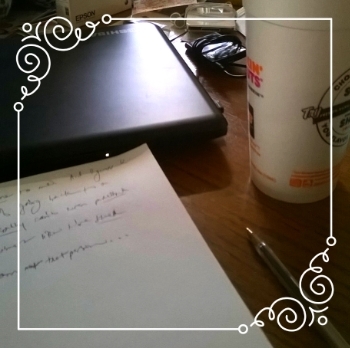
my daily journaling station

my daily journaling station

I grew up in a chaotic and noisy home. I’m not sure why it was this way — we were (and are) a loving family, and our propensity is more toward the introvert side of the personality type spectrum. But with three kids, two dogs (and an assortment of other animals), and two working parents for most of my childhood, privacy and peace were hard to come by.

The only way I knew to get true quiet was to stay home sick from school. Then everyone else would be gone (except the dogs) and I could absorb the quiet of the house, the ticking of clocks, watch how the sunlight moved across the floor as morning drifted into afternoon.

I craved quiet, solitary time as a kid. I wanted to be able to hear myself think. But home was loud and school was loud and my friends seemed loud.

Seventh grade was different because my family moved to Hawaii for the year, something I resisted, kicking and screaming. People said, “You must be crazy not to want to go to Hawaii!”

But to my twelve-year-old self who craved fitting in and stability more than anything else, a move to a faraway place for just one year would be one more thing that made me different, one more thing that told my peer group, “She isn’t like us. She doesn’t fit.”

A life-altering thing came out of our year in Hawaii, however. My English teacher handed out black-and-white composition books and required us to keep journals.

I knew I liked to write, and prior to this, I had dabbled in journaling, but it was more of the “this is what I did today” variety. My teacher encouraged us to really get our thoughts on the page. What was important to us? What did we think about the books we read in class? What scared us? What filled us with joy?

I was hooked. I used all the pages in the first composition book and my words spilled over onto the cardboard back cover.

Finally, I could hear my own voice. I could read my own thoughts on the pages of the composition book. And my teacher validated it all — keeping a journal was a good thing. A healthy thing. It would help me know myself.

In all honesty, I don’t think I fully internalized what my teacher said at the time. This is probably adult me looking back and superimposing herself onto twelve-year-old me. But what I do know for sure is that I was hungry to keep a journal. It became a home for me, the only true safe space I could think of at the time.

Later, in my early twenties, I took frequent trips to New York City, and I remember sitting in the airport one day, my notebook spread out on my lap. I realized I felt at home in O’Hare Airport, waiting for my flight, despite the swirl of activity and noise around me. I wrote in my notebook that day, “As long as I can write in my journal, I can be at home anywhere. My journal is the only home I need.”

I smile a little at my early-twenty-something self now, because I am far less nomadic in spirit than I was then. Now, I like a home base that goes beyond my journal (I am a true homebody at heart despite my love of discovering new places).

But I am still in touch with the “me” who believed that, armed with my journal, I could feel safe enough to take on the world.

Decades after discovering the mysteries and joys of the depths of the black-and-white composition book in a classroom of girls in black-and-white uniforms at St. Andrew’s Priory School in Honolulu, I still meet with my journal at my dining room table every day. (Except now it’s a sketch book with wide, blank pages, so I can draw pictures next to my thoughts, too.)

And every time I put my pen on that page, I’m cutting through the chaos of not just the world, but my mind. I’m safe, and I’m home, and I know who I am, once again.

If you, too, keep a journal, what is the greatest benefit of journaling for you? I’d love to hear from you.

This post is my contribution to the Five-Year Anniversary Celebration of  #JournalChat Live. I’ve been proud to be a guest on #JournalChat Live several times. You can learn more about #JournalChat Live, including how to join the Facebook group, here.

When you’re overwhelmed, get specific

blurrySomething I’ve noticed while working with clients who are “overwhelmed” is that, often, we remain in overwhelm because we are not getting specific enough.

We’re not specific about what exactly it means when we say “I’m overwhelmed.”

In this way, overwhelm is kind of like a stifling blanket of vagueness. We keep spinning in it, saying things like, “I just want to stop being overwhelmed” or “I feel so overwhelmed I can’t move forward.”

That’s the trick (and sometimes the gift) of overwhelm — it keeps us in the dark about what’s really going on with us. It keeps us spinning, obsessing, fighting, or zoning out.

Sometimes it is effective, when we realize we’re overwhelmed, to cut right through the “overwhelm story” and ask ourselves how we want to feel. And then, when we know how we want to feel, we can ask ourselves what would help us feel that way.

Sometimes, though, it’s more helpful to actually pull apart the overwhelm — to look at it as a mass that is made up of a number of components, and get really specific about those components.

What we call “overwhelm” is, in many ways, an attempt to focus on too much at once. So if we pull apart the elements of it, we can start to see what it is made up of. We can start to remove focus from pieces of it, and focus only on what we choose to focus on.

For example, as I mentioned in my last post, I have a move on the horizon, but I don’t know exactly where or when I’ll be moving. I am dying for more clarity around this move — the uncertainty, on some days, feels like it’s driving me crazy!

What I noticed a few days ago is that even though I have this fairly giant thing on my horizon, which is requiring a certain amount of focus and energy (looking at finances, neighborhoods, apartments, storage possibilities), I’d been demanding of myself that I focus on other “big things” as well. And my attention had become scattered and paper-thin.

So yesterday, I let go of a freelance project I’d taken on because it seemed like a good opportunity.

What I found was that even though my mind couldn’t pass up the opportunity, it was actually a terrible time to bring in another thing to take energy and focus from me, especially when it was a thing that didn’t totally light me up.

When I let go of the project, I also felt the overwhelm whoosh out of my body. From this place of more lightness and peace, my move and the elements surrounding it feel so much more doable.

Here are a few ways to get specific about what’s really going on if you’re feeling overwhelmed:

* Instead of saying, “I’m overwhelmed,” say, “I’m sensing overwhelm within me.”

This will create separation between you and the feeling of overwhelm. (You are not the feeling!) Then see what comes up. What happens when you recognize that you are bigger than the feeling of overwhelm?

* Give yourself ten minutes to write down what you’re feeling overwhelmed about.

Do this stream-of-consciousness — don’t try to “get it right.” (And don’t go on for longer than ten minutes — set a timer if you must.)

Then, read over what you’ve written. Notice what jumps out at you. Is there something here that you’re giving a lot of attention to that doesn’t warrant it? Is there anything you wrote down that you can just drop? Does it truly all have equal priority? (My guess is no!)

It can help to consult your “future self” here. If you were to ask you-five-years-from-now which of these issues is important, what does “future you” have to say?

* Bring your focus to your body.

What does your body feel like right now, while you’re in this space of overwhelm? Is it tightness in your abdomen, a clenched jaw, a headache? Shallow breathing? As you breathe, notice what thoughts bubble up for you with these body sensations.

The thought I had was, “If I don’t do this project, I’ll regret it.” I asked myself if this thought was true. What felt more true was, “If I DO this project, I’ll regret it.” That felt more true because doing the project was adding to my to-do list during an already stressful time, rather than taking away stress by giving me an opportunity! And that made it easier to let go.

* Ask yourself if perfectionism plays a role in your overwhelm.

Frequently, the idea that we have to “do it all well” triggers overwhelm because on some level we know it’s not possible or worthwhile. This creates a conflict — part of our attention is on “doing it all well” and part of our attention is on that nagging knowledge that we can’t do it all well.

If you had permission to show up for all parts of your life with C+ rather than A+ effort, how would that change your feeling of overwhelm? Is it possible that showing up in and of itself is enough?

What helps you break down this thing we call “overwhelm”? I’d love to hear what works for you.

And, if you’re struggling with overwhelm on an ongoing basis, you may want to check out my Stellar Self-Care (for Sensitive Creatives) program. You can learn more about that, and my other offerings, here.

Image is “Railway Station Through Glass Brick,” © Bx3t | Dreamstime Stock Photos

The difference between self-care and self-indulgence

strongtreesI have to admit that I’ve been pretty on edge lately. At times I feel unsafe. The house I rent is up for sale, and I know I need to move soon.

Being in limbo mode with my living space brings up all my “stuff” around safety, feeling like I don’t have a true home base, and, well, strangers. Strangers coming through my home and seeing all my stuff, deciding if they’re interested in living here themselves.

It’s weird and, somehow, it makes me feel like a little kid. It brings up the part of me that wants to hide out.

And so, I’ve had to practice extra self-care in order to stay sane, to feel safe.

I’ve had to remind myself, it’s okay, you’re an adult, you can take care of yourself with these strangers who suddenly show up.

I’ve had to pause and ground myself, remind myself to breathe, more than usual.

What’s interesting is how, because I’m also extra-busy right now, another voice comes up a lot.

It’s a high-pitched voice that snaps at me, “What’s with all this self-care stuff? Self-care? Aren’t you being just a little self-indulgent? I mean, look at all you have to do! And you’re letting yourself sleep an hour later than usual?”

This voice is old. Years ago, I thought “self-care” meant taking bubble baths and sitting on a cushion drinking tea. Or spa treatments. Or buying expensive moisturizers.

Self-care can look like those things, but what I’ve come to realize over the past twenty years is that it goes much, much deeper.

What I’ve also come to realize is what self-care is not: it’s not self-indulgence. There’s a big difference, but I think many of us confuse these two terms, which are most definitely not interchangeable.

I’ve mentioned quite a few times on this blog that in my twenties I developed a chronic illness and ended up in the hospital. Then and only then was my cynical twenty-five-year-old too-hip-to-do-self-care self forced to recognize that I had to take better care of me.

That’s all self-care is, really. It’s acknowledging that without putting YOU at the center of your life, there ultimately is no life that feels like you.

Many of the clients I’ve worked with over these past several years have had a pattern in common: feeling bad about not showing up for their creative work in the world as fully as they’d like because they just can’t make it important enough to put themselves front and center in their own lives.

Or: They’re doing their creative work in the world, they’re getting it out there, but they’re so overwhelmed and overstimulated from both the work itself and their interactions with others that they’re totally depleted and aren’t sure they can go another step on their journey.

Self-care, in my book, is about recognizing that YOU are at the center of any creative journey you’re on. Both when you begin the journey, and during it.

And yet, so many of us have a judge-y inner voice like mine that insists that taking good care of ourselves might just actually be, you know, self-indulgence.

How is self-care different from self-indulgence?

For me, “self-care” is about noticing what I am needing — truly needing — in the physical, emotional, and spiritual realms, and making it important that I provide it for myself.

The focus of self-care is not doing, but noticing and acknowledging — and then doing, if necessary. (Often, practicing better self-care means practicing un-doing!)

It’s the noticing and acknowledging piece that we tend to lose sight of in our driven society. And often, when we do notice and acknowledge, we don’t allow ourselves to know what we know about what we need.

Self-indulgence, on the other hand, is fueling the part of us that doesn’t notice or acknowledge what we need. 

Self-indulgence is buying six more sweaters when we already have fifty and only wear ten (I’m raising my hand here!) — and the buying of the sweaters feels like an avoidance rather than a coming home.

It’s eating or checking Facebook or staying on the phone too long or having an extra glass of wine or pushing ourselves to work longer hours in order to avoid checking in with ourselves.

It may feel good or “righteous” or like we “deserve it” in the moment, but in the long run it’s actually continuing to do something that hurts when we know it hurts us.

Self-indulgence can also look like committing to something, or someone, and only giving it half our effort, or half our attention. It can look like always holding back just that little bit so we’re never fully present to our lives.

Now, I do want to emphasize that a little indulgence is not wrong, and sometimes it’s exactly what we need. (Particularly if we have a tendency toward perfectionism, we may need to “balance ourselves out” a little with some indulgence.)

The key is to be honest with yourself. When are you crossing the line from enjoyment to making yourself sick with enjoyment (I’m thinking about French silk pie here) simply because it’s hard to be present with yourself?

When are you crossing the line from doing an extra hour of work on the book you’re writing to feeling burned out but forcing yourself to continue? That, too, is self-indulgence. It’s starting to hurt, not help, and you’re rationalizing doing it anyway.

Self-indulgence always has a seed of avoiding ourselves in it; self-care always feels like coming home to ourselves. That’s how we know the difference.

And so, all this extra grounding myself and focusing on my breath and allowing myself to sleep more than usual? I know it’s self-care because it feels like coming home. Which reminds me that home is within me, wherever I happen to be. It’s a great reminder when my external living space is in flux.

What challenges you about practicing self-care, especially during times of a lot of stress when you need it the most? I’d love to hear from you.

And, I have a new program called Stellar Self-Care (for Sensitive Creatives). If you’re wanting to put YOU at the center of your life, or get back to it, I’d love to be that support for you. You can learn more about the program, here.

Image is “Sunset at Peace” © Shannan Thiel | Dreamstime Stock Photos

Understanding the message of fear + new coaching programs!

shimmeryweb

When we try something new, or sense that change is on the horizon, or when we’re in a murky transition period that seems to have no end, it’s not unusual to feel varying amounts of fear.

Sometimes, though, the amount of fear we experience, well, scares us. (I’m reminded of the title of a song by Bauhaus: “In Fear of Fear.” That’s how it is sometimes!)

So I like to look at fear in two different ways (there are probably infinite flavors of fear, but this is a general distinction that is often helpful when fear’s got us confused or shrinking).

One kind of fear is what is sometimes referred to as “rollercoaster” fear.

You’ve got butterflies in your stomach, and your body is braced for an intense experience — but there’s a definite thread of excitement there. You want to go where the rollercoaster is taking you, even though sometimes it causes your stomach to drop to your feet or your heart to spring to your throat.

The other kind of fear feels different. You’re expecting an intense experience, but instead of butterflies in your stomach, you feel cement.

This fear weighs you down; it feels impossibly heavy; you don’t anticipate the rollercoaster, but even if you did you wouldn’t have the lightness of step to get on. This fear is entangled with a palpable sense of dread, and sometimes a feeling of “ick” or revulsion. You don’t want to go where it’s taking you.

We can become confused when we don’t take time to make a distinction between these types of fear.

How many movies have you seen where a character is about to get married, and confides to her best friend that “something doesn’t feel right,” and the ever-helpful friend says, “Oh, you just have cold feet. It’s normal to feel that way before taking such a big step.” And either the bride turns and runs back up the aisle and out of the church in the middle of the ceremony, or she goes ahead with the marriage and it’s a disaster.

This is a good example of that second type of fear, which can be an indication that something isn’t right for you on the road you’re about to take.

Now, here’s the tricky thing: It can also be an indication that something isn’t right in the way you’re thinking about the road you’re about to take.

So, it’s not necessarily as clear-cut as, “Oh, you’re experiencing a side of dread with your fear? That means you definitely shouldn’t get married!”

What fear combined with dread actually warrants is further inquiry into what is going on for you.

It could be that you don’t want to marry this person — ever. He’s wrong for you and that’s the awful truth.

But it could also be that you love this person deeply — but you don’t want to marry him.

Or, it could be that you love this person AND you want to get married — but not until you’ve gotten in contact with your estranged dad, because your heart sinks at the thought of ever being married without your dad in attendance.

We always have a good reason for feeling the way we feel (even if the reason doesn’t seem valid to our “logical mind” or our inner critic). When we hit on that good reason, we usually feel true relief, sometimes accompanied sadness. If your fear feels heavy or “icky”, this is a sign to stop and investigate before moving forward.

If your fear feels like you’re about to get on a rollercoaster (and rollercoasters thrill you rather than making you want to throw up), this is a good sign that you’re in for a wild ride and your essential self is up for it.

(It’s worth noting, though, that if, like me, you are highly sensitive, “good fear” can feel overstimulating, so make sure you have solid support and self-care as you embark on your journey.)

Speaking of support, I have a two new one-on-one coaching programs I’m excited to share with you (and yes, I do feel some of that “rollercoaster fear” in putting these programs out into the world!). There will be more to come on these programs soon, but for now, you can hop on over and learn about Light Up Your Creative Self and Stellar Self-Care Foundations, here.

What do you notice about the different “flavors” of fear, for you? How do you deal with them? I’d love to hear from you.

Above image is “Necklace” © Mihail Orlov | Dreamstime Stock Photos

Making friends with creative transition

making friends with creative transitionRecently I spoke with a client who had just completed a massive project that took several years of her life to bring to fruition. It was a huge accomplishment for her to send her “baby” out into the world, and she was really happy about it.

Except that … she also wasn’t. She also felt lost and … sad?

How could this be? This was the time she’d been waiting for! In fact, at points during her journey she’d sworn the project would never be finished and couldn’t wait for it to leave her hands.

Because this was the first creative project of this scope that my client had seen from start to finish, she was unprepared for the letdown she felt when it was done. And it was making her really nervous that she wasn’t sure what her next project would be.

She didn’t even have any ideas. She kept trying to grab onto opportunities that came her way, but none of them felt right.

What my client was feeling was so, so normal.

When we imagine finishing something big, we often envision the elation that will come with the accomplishment but we don’t realize that there is a sense of loss in finishing, too.

We get thrown into “creative transition.”

Our tendency during these times is to rush ourselves through them because they feel so uncomfortable.

If we rush ourselves through, though, we miss out on the opportunity to become the new “us” that the transition time provides. That’s what transitions are, after all — bridges or tunnels from one version of ourselves to the next.

It’s kind of like when we end a relationship. Most of us have had that experience of breaking up with someone and then (oh, crap!) getting back together with them a week or a month later.

What happened there? We crawled back into our former lives, not quite ready to go through the “deep cocooning”  process we must embrace in order to emerge as that new “us.”

This is okay. As Robyn Posin says in one of her wonderful posts, we’re never fully anywhere until all of us arrives there. (I’m also reminded of an episode of Seinfeld where Jerry compares ending a relationship to knocking over a Coke machine. It has to rock back and forth a few times before the whole thing falls over.)

So what can we do to make times of creative transition easier? Here are a few suggestions.

* Allow yourself to come down from the trip.

Recognize that at the end of a long creative journey, we’re often functioning — to some extent — on adrenaline. This is especially true if we have a bunch of deadlines to meet or events to attend in order to complete our journey and we’re (understandably) tired. Adrenaline will kick in to help us make it through.

Remember how badly you wanted the semester to be over back in college, and you got all your papers in and exams taken, and then didn’t know what to do with yourself for a few days? That’s because you were still pumped with adrenaline and it was compelling you to do something, anything! When we come down from that heightened state (which, by the way, is not healthy for us to remain in), we will feel more centered and present and at choice.

* Allow yourself to feel sadness and loss.

There is nothing wrong with you if you feel a sense of loss and even grief after achieving a huge success. It is part of the natural process of moving from one phase of life to another. It’s normal to enter a “liminal state” at this time, what Martha Beck refers to as “Square One.” (Martha’s wonderful book Finding Your Own North Star explains “Square One” at length.)

* This is an excellent time to cultivate curiosity.

As the sadness and loss mix with your joy at your achievement and wash through you, what’s taking your interest? What do you notice about the change in yourself from the beginning of this journey to now? As you move through your daily life, what are you needing? Comfort? Connection with trusted friends?

Journaling about what you’re going through can be a great way to gain more awareness of your current needs, and the ways your inner compass is pointing you to your next step.

* It’s okay to go slow — in fact, it’s best to go slow — at this time.

When you allow yourself slowness as you enter creative transition, you really get a chance to experience who you’re becoming and what this transition is all about (though that may not be totally clear to you until you exit the transition phase!). This time is an amazing gift and you’ll never get it back in exactly the same form again. So how can you find ways to savor rather than hurry it?

You may need support in doing this. Our culture does not encourage savoring and slowness. Trust that support is out there in the form you need it!

What have you noticed about creative transitions for yourself? Has anything in particular helped to make them easier for you? I’d love to hear from you.

And: These are the last several days (through March 31) to purchase my package of four coaching sessions as I will have new offerings up on my site soon (I can’t wait to share them with you!). The package of four saves you $75 and is a great way to get ongoing support from me. Take a look here to learn more!

Image is “Tunnel Under Railroad” © Peterguess | Dreamstime Stock Photos

Procrastination? Or no payoff?

brokenwagonwheels

A while back while channel-surfing I had the pleasure of happening on Tootsie, one of my favorite movies of all time which I hadn’t seen in way too long.

In the movie, Dustin Hoffman plays Michael Dorsey, an impassioned, perfectionistic but unemployed actor, and we get this great opening montage of Michael auditioning and teaching his acting class and we get to see how he cares almost impossibly deeply about the craft of acting, but that he’s also kind of a pain in the butt.

Early in the movie, Michael and his playwright roommate (played by Bill Murray, need I say more?) are walking home from the restaurant where they both work as waiters, and the roommate asks Michael why he has to be “Michael Dorsey the great actor” or “Michael Dorsey the great waiter” — why can’t he just be, you know, Michael Dorsey? And Michael says, “I don’t know what the payoff is there.”

(Tootsie is packed front to back with great dialogue, so writers, go watch it immediately. But not before you read this blog post.)

Obviously, Michael means he can’t see a dramatic payoff for being Michael Dorsey (and this “throwaway” line has a number of meanings in the context of the movie). But the line kept popping into my mind for a while afterward because I tied it to some situations a couple of my clients were going through, where they kept beating themselves up for not doing something they said they wanted to do.

In other words, for “procrastinating.” I always like to put quotes around that word, because, as I’ve said here quite a few times, it tends to be a quick go-to descriptor when we’re not taking action on something.

But it’s not always true that we’re procrastinating when we’re not taking action. Sometimes we tell ourselves we’re procrastinating because we don’t want to look more deeply at what’s actually going on. (And sometimes, yes, we are actually procrastinating. But true procrastination has a different feel than the more complex stuff, which I wrote about here.)

What I’ve noticed over the years is that sometimes when we’re not taking action toward something we say we want, it’s because we don’t really believe there’s a payoff in doing whatever it is we think we should do. And I don’t necessarily mean an external, tangible payoff here.

It could be that we are not sensing an intrinsic payoff.

In other words, we don’t really believe that doing that thing is going to make us feel any better.

Feelings are incredibly strong motivators. It’s our feelings that drive us to action. And although we may say we want something, if on some level we don’t actually believe that having that thing will make a difference for us, we’re just not going to feel drawn to it, and when it comes down to it, we won’t take action toward it.

It’s easy to fool ourselves here — we say we want something, and it sounds good on the surface, and maybe we’re even getting into a kind of urgency where we feel like we desperately want it or need it. We may be really attached to the idea that we need the thing, or need to do the thing. But do we, really?

There are some layers that need to be peeled here.

We can start by asking ourselves what we believe the payoff will be for doing this thing. Can we see a payoff? One of my clients had to admit, when we delved into her situation, that there was no payoff for her in doing her thing. No wonder she wasn’t taking any action toward it!

We only ever want anything because of how we believe it’s going to make us feel. There’s really no other reason we want it. We can name all sorts of other things — acclaim, money, knowledge, experience — but all of that really comes down to how we think acclaim, money, knowledge and experience will feel or make us feel.

How we feel is the intrinsic payoff for anything we do, anything we move toward. But so often we leave it out of the equation!

Experiment with this the next time you’re feeling stuck or stopped on something you believe you want to accomplish. Is there a true payoff for you in accomplishing this thing? How do you think accomplishing it will make you feel? Is that how you want to feel?

If not, you need to get back in touch with how you want to feel, and go from there. The goal may need some tweaking, or you may want something completely different than you thought you did.

What about you? Do you notice yourself “procrastinating” on something you want to accomplish? Is it possible there isn’t enough of a payoff for you in accomplishing it? I’d love it if you’d share.

Also: Because I am in the process of creating new coaching offerings, these are the last two weeks to work with me in the current format. As of the end of March, the package of four sessions will be gone (the one-session-at-a-time option will remain, but the package of four saves you $75 if you’re wanting to purchase multiple sessions). Learn more about working with me here.

Image is “Broken Wagon Wheels” © Geoffrey Kuchera | Dreamstime Stock Photos

Making decisions from a place of peace

Making decisions from a place of peace

Something I often notice when I work with a coaching client is how urgent everything can feel when we are in a space where we have unmet needs.

The interesting thing about this urgency is that it can feel really true.

Sometimes, before we even consciously recognize it, we have acted on this feeling of urgency when — actually — the best course of action might have been, in this moment, no action.

One of the biggest push-backs I get from clients is when I suggest that if they are feeling frantic or highly anxious, they become peaceful before making whatever decision it is that they are sure they need to make.

Two things usually come up:

1) But I can’t get peaceful until I figure out what the heck I’m doing. I need to have my life sorted out first.

2) My needs are enormous and unless I take the “right” action to fulfill them, they will not be met. I am so tired of having these unmet needs. I need to do something about it, now!

I totally get both of these reactions. It can feel so frustrating and overwhelming to have a pile of unmet needs sitting there, unsure of how we will ever resolve any of it.

On top of the fact that the needs seem to be hanging there unmet, we can get really hard on ourselves for not meeting them immediately, or for having them in the first place. (The Buddha told a story where he referred to this as “the second arrow” — when something difficult happens, we in effect have “one arrow” in us, and our tendency is to “shoot another arrow into ourselves” by being hard and judgmental just when we most need to be compassionate.)

Here’s the thing: When we proceed from a place of panic, anxiety, or otherwise stirred-up feelings, we often end up making decisions that either do not actually need to be made right now (or at all), OR we make choices that only create more pain for us and have to backtrack and undo them.

So I like to share this Lao Tzu quote with clients (and sometimes they find this really annoying): “Muddy water, let stand, becomes clear.”

Clients usually say, but what do I do to get peaceful? How can I make the muddy water become clear, faster?

These questions make me laugh. They are so, so funny. Can you see why? (And I’ve asked the same questions myself, many many times, so I’m laughing from a place of compassion, for sure.)

Sometimes, it’s not about doing, and it’s not about making things happen, faster.

How can we tell? Because our doing has that frantic, anxious energy behind it. And, the biggest tip-off that we are doing in order to resist being with what is coming up for us: we don’t feel any better for having taken an action or made a decision.

Here are some better questions to ask ourselves:

What is so hard about staying with these uncomfortable feelings until they settle down a little and point me to clarity?

How can I make it easier to allow these feelings to be there, without trying to change them?

How might I support myself in being with the hard stuff that’s coming up for me right now?

Sometimes we might think, but how will I know that I’m ready to take a particular action or make a decision?

The answer is, you’ll know because you will find yourself in the middle of doing the action or making the decision.

When we’re in a place of acceptance, what truly needs to be done and decided arises naturally. We make the call to get the help we need. We withdraw the money from the bank. We comfort the friend who is hurting. We sleep because we’re tired.

This is all there ever is when we’re able to be with what’s actually true for us, right now: the next step presents itself, and we take it. (Or maybe what presents itself is that there is no action to be taken right now.)

But in order to be in our truth, in order to sense our true next step, we may need to allow our muddy water to clear. We may need to exercise some patience and be with whatever is coming up for us. And we can do that a few minutes, or seconds, at a time. We can break it down that much if we need to.

(Byron Katie says that we don’t make decisions — “decisions make us” when we have the necessary information to make them. Do you notice this for yourself?)

What have you learned about your decision-making process? What have your best decisions felt like for you? I’d love to hear.

And: I’m in the process of changing my coaching offerings and won’t be offering them in the current format for much longer. If you’d like to work with me in the current way, check out my offerings, here.

Image is “Water 4” © Chrisharvey | Dreamstime Stock Photos