Moving Through the Fear

In early September, I had two unfinished novels sitting around, and I’d built up a huge amount of fear, resistance, and guilt in relation to them. I was ready to just trash both of them and start afresh, pretend they’d never existed. And that would have been okay, if it was what I genuinely wanted to do. But it wasn’t. I felt like I’d left parts of myself in those unfinished pieces. And I had a deep desire to go back and complete what I’d begun.

Enter Jenna Avery’s Just Do the Writing Accountability Circle, a.k.a. The Writer’s Circle. I joined the group, started logging in my daily writing progress on the website, got support from group members, and, as I wrote about here, I completed a draft of one of my novels in late October. Now, I’ve gone back to my other unfinished novel and I’m working on that one.

This stuff felt too scary for me to touch as recently as four months ago. But I’ve been able to get to it with the help of this group, and by taking small, manageable, daily steps. And I have to tell you, it feels pretty darned powerful.

I’ll be one of the coaches for the next session of the Writer’s Circle, which starts Dec. 26. The last day to sign up is Thursday, Dec. 22. If you have a languishing creative project, or would like to start writing again, or write for the first time ever, this can be a great gift to give yourself. And it’s not a bad way to start the New Year, either.

You can sign up for the Writer’s Circle here. I’d love to see you there!

There’s Enough Time. Really.

This week, I had quite a few conversations with creators around the idea of time. The general consensus seemed to be: There’s not enough. I have too much to do — which, by the way, I wish I’d done ten years ago — and there’s too little time in which to do it. Frequently when I hear people say this, I want to agree with them, so they know that I sympathize. “Oh, I know, isn’t it true? There’s just not enough. There’s too much to do. No wonder I can’t get to my (fill in the blank — novel, artwork, yoga, relationship).”

Here’s the thing, though: It’s not true that there isn’t enough. Whether we’re talking about time or money or love.

What we really mean when we say “There’s not enough time” is: I’m trying to outrun my painful thoughts about not accomplishing enough. I’ve got to hurry up. So let me add more and more to my to-do list, so I don’t see more evidence for what I haven’t accomplished. If I can get it ALL DONE, I’ll feel better.

Do you see how backwards this kind of thinking really is? (Because, fellow creators, it doesn’t come down to time — it comes down to our thinking. Always.) The thought “There isn’t enough” creates feelings of urgency, anxiety, sadness, regret. In a nutshell, fear. Then we take desperate, urgent, anxious actions based on these feelings. And no matter what results we get, they don’t feel like enough, because all of these results have, as their backdrop, the belief that there just isn’t enough. We’ve cycled right back into our original thought, and it all continues — no matter what we have, no matter what we’ve created, it isn’t enough, because our belief is that there isn’t enough.

Unless: We look at our thoughts about time. Is it true that there isn’t enough? How much time do I need to feel good about creating today? To feel good about anything today?

I’m going to suggest that the “time issue” is not about time at all. It’s really about our stressful thought that, at some point, our lives will be over and we won’t have done what we wanted to do with them. It’s really about our lack of self-acceptance, about the fact that we’re afraid to meet ourselves, to accept ourselves, exactly where we are. It’s about a belief that there’s a finish line we should have crossed years ago, and we haven’t even made our way to the starting gate.

What if we were to believe that what we need more of is not time, but acceptance — of ourselves, of our lives, of where we are, who we are, now? How would we move forward from that belief? If we are okay exactly as we are, my hunch is that we are more likely to create for thirty minutes today and celebrate that, rather than wait two years for the day when we have a block of six hours to create.

As my awesome mentor Jenna Avery says, “Start small and start now.” What we really fear is not that there isn’t enough time, but that we won’t accept ourselves if we don’t live up to our perfectionistic standards, if we don’t do more, more, more. Do me a favor: do less. Write for fifteen minutes. Sketch for fifteen minutes. Dance for fifteen minutes. And do it today. It takes no time to accept yourself exactly where you are, right now.

The Gift of Finishing

This weekend I finished a first draft of my novel about a forty-year-old unemployed woman obsessed with the musical Cats who leaves her seemingly pretty awesome husband and rekindles a relationship with the crazy artist who made her life hell in her twenties. Whewwww. That was a mouthful.

Finishing the draft was a big deal. I wanted to pour champagne for my fellow participants in Jenna Avery’s Writer’s Circle, who encouraged me through the last ninety pages of this draft. I glowed to my boyfriend. I’m still trying to figure out how to reward myself (can Crystal the Monkey come over and play Galaga with me?).

I started writing this draft in October of 2009, exactly two years ago. I worked on it pretty regularly — okay, more off and on — for a few months. And then I started losing faith in it. I wasn’t sure what the story was about. This is really bad, I thought. And so it sat. And then I went back to it. And then it sat again. And so on. Until I started to worry it was “on the pile” — the pile of my unfinished novels. (This would have been the third.)

I don’t believe we need to finish everything we start. That’s a thought that can definitely be questioned. We can’t imagine every twist and turn our lives will take, how our experiences will shape us internally so that we may not want or need what seemed so vital five years ago. It’s okay to let go.

But I wasn’t happy that these last two novels had been abandoned about two-thirds of the way through. I was starting to think it was a pattern that didn’t feel good: When I feel stuck, I stop. I talked to Jenna in a coaching session and it came out that this last novel, I was kinda bored with. The voice didn’t seem quite right. I didn’t think I cared about the subject matter. The earlier novel, the second to last one, well, as I told Jenna, it scares me. It’s been sitting so long. I don’t even want to look at it. “That’s the one you need to finish!” Jenna said. And I suspect she is dead right.

So I resolved to let this last novel go and get back to work on the scary one, the earlier one. Only, the thing was, this last novel didn’t want to be let go. Hey you, it whispered to me while I was trying to fall asleep one night. I’m not letting you off so easy!

So when the opportunity to join Jenna’s Writer’s Circle arose, I decided I would use it to finish this not-quite-right, kinda boring book. I embraced Anne Lamott’s terminology, “shitty first drafts,” wholeheartedly.

And I learned something: This novel was also the scary one. My boredom with the book, my seeming apathy toward it, was a cover-up for fear. I didn’t want to go where the story wanted to go. I didn’t want bad things to happen to my characters. I wasn’t sure my writing muscles were in very good shape. And I wanted it to be good, dammit.

It was overwhelming.

So, with the daily structure put into place by Jenna’s group, I made my goals feel eminently doable: I’d write at least fifteen minutes a day, five days a week. Often, when I filled out my daily comments for the group, my negative thoughts were something like: I don’t know where to go next. It isn’t very good. And the killer: It’s not dynamic enough. I replaced them with: I just need to write the next sentence. It isn’t bad. And: Who am I to say what’s dynamic? I’ll figure that out in the next draft.

In noticing the thoughts that keep me from moving forward, I take the charge out of them. They are just thoughts. In doing this with a group, I saw that we ALL have roughly the same negative thoughts about our writing. The same fears. That took the charge out of it all a little more.

In forty-five days, I wrote ninety pages. I still have no idea if the draft is good. But by writing, by moving forward step by tiny step, I learned what the story was about. I got a clearer idea of what my characters wanted. And it wasn’t overwhelming because I didn’t have to do it all at once.

Most importantly (and this part makes me plain old tear up), I remembered the joy of disappearing into my story because I can’t wait to find out what happens next.

We can put so much pressure on ourselves when we create. As if, through our creating, we make the world turn. We can be easier on ourselves. We can show up, write for a while — take it sentence by sentence if we need to — and let the writing come through us. It knows what it wants to be. (“Listen to your broccoli,” says Anne Lamott in Bird by Bird, referencing Mel Brooks’ line, “Your broccoli will tell you how to eat it.”)

But we can also be gently firm with ourselves: by committing to a regular habit of creating. And we can get the support we need to keep that commitment.

If you are feeling massively stuck on a creative project — if you’re terrified to go near the thing or even to speak of it — you are exactly the kind of person I looooove working with. Check out my Free Creativity Consultations — I have some openings coming up.


Image is CONTROLLING THE WORLD… © Radu Razvan Gheorghe | Dreamstime.com

A Short Post about Overwhelm

Today’s blog article is short, because it needs to be in order for me to do it.

I’m overwhelmed. Well, I was overwhelmed earlier today. I’ve had family visiting from out of town for the past ten days, and yesterday, they left. Today, have-to’s and should’s about neglected work stampeded through my brain, and the more I added to the to-do list, the less I actually felt capable of getting any of it done.

And in the midst of all that, I had a very unhelpful thought, something in the realm of “What will so-and-so think if I don’t get this done?”

So, today, here’s how I dealt with my overwhelm (it might be different on another day):

1) I asked myself, what are the musts? What really feels vital and important for me to take on today? (The answer was: working on my novel; laundry; doing the dishes — the housework wouldn’t usually feel as vital, but it’s really piled up).

2) What part of the musts must I do? In other words, what chunk of each must would feel like enough for today? (The answer: thirty minutes of writing; two loads of laundry; half of the dishes).

3) Where am I getting into somebody else’s business? Byron Katie tells us there are three kinds of business: my business, your business, and God’s business. When I’m wondering what my mother will think if I don’t get my dishes done (even though she lives hundreds of miles away), I’m in my mother’s business, and nobody’s taking care of mine. And I’m adding to my overwhelm by neglecting my own business and trying to control what I can’t possibly control.

So that’s it for today. The writing’s done, half the dishes are done, and that second load of laundry is in the dryer. Tomorrow, if overwhelm creeps in, I will look at tomorrow’s musts. But that’s tomorrow, and tomorrow, my friend, is another day.

Defining Creativity

Yesterday I was chatting with my coaching buddy and awesome fellow coach Marte Gehlken and she mentioned how often she hears people say this: “I’m not creative.”

I hear this a lot too. Or, “I used to be creative, back when I did a lot of artwork.” Or, “I would be creative if I had more time.”

We need to expand what we typically define as creative. Marte said during our conversation, oh so wisely, “Creating your own reality is creative.” Yeah, it is! But we tend not to see creativity this way. We think it is something outside of us, something we “should” be doing, but (frequently) aren’t.

I remember the summer of 2008, which was a very low, “dark night of the soul” place for me. Now I realize it was what we coaches who went through Martha Beck Life Coach Training call a “liminal period”, or Square One. You’ve shifted out of a place that felt really good for quite a while, because it no longer fits. But you don’t know where you’re going yet, nothing new and solid has emerged in you to guide you on your way, and it kind of sucks.

So one day in 2008 I was feeling crappy and uncreative and I was on one of my very early morning walks and pretty soon, lo and behold, I got into The Zone. I became unattached to my thoughts and was just kind of watching them and my body moved me along and I felt my breath coming in and out. And I looked down and saw this little house sparrow hop into a puddle, in which he dipped the ends of his wings and the underside of his tiny body and then shook himself off.

I felt actively engaged in my observation of this sparrow. I could feel what it was like to be the sparrow, the warmth of the water that had been sitting out in the sun on my feathers, and what it must feel like to know you’re going to take off and — fly! — in a moment.

And a message bubbled up in my chest and translated itself this way: This is creativity! Actively observing this sparrow, I had the exact same sensation I do when I write, when I paint, when I do all the things we typically label “creative.”

Creativity is a way of being in the world. It’s a way of interacting with our surroundings. We’re soaking it up. We’re actively engaged. We’re feeling it.

I’m not saying you shouldn’t write, paint, act, dance, or do whatever it is we typically label “creative.” Absolutely you should, and you must, if it calls to you. But don’t say, “I’m not creative” just because you are not doing these things. Notice where you ARE creative — which, my friend,  can be everywhere — and then do whatever you’re inspired to do.

On that note, on my walk this morning I came upon some birdseed the neighbors one street over regularly scatter on a square of sidewalk. Except today, mixed in with the birdseed, were some large cheese curls. You know, the big fat puffy Cheetos. That, I thought, is creativity.


What’s the Essence of What You Want?

Lately, I’m feeling really excited about things. There’s a lot I want to do, a lot I want to create. The thing is, the more I’m in “doing mode,” the more I see that needs to be done. It’s kinda like when you tell yourself to look for all the red things in a room, you suddenly see a ton of red.

So on Tuesday, I was feeling frustrated because I hadn’t done a lot of what I’d planned to get done. I sat at my desk at the end of the day wondering where the day had gone. My cat jumped up into my lap, and I began breathe more slowly. I began to relax. (Ever noticed how cats tend to have that effect?)

I asked myself, why am I so upset that I haven’t accomplished what I wanted to accomplish today? The answer was, because I’m really excited about my writing, my coaching, and all my projects. And I want to get them out there, I want to share them with people.

I asked myself, why do you want to share them? The answer was, because I want to connect with my peeps. I want the feeling state of sharing myself with, and giving to, my right people. And I don’t feel like I did that today.

I asked myself, Really? What did you do today?

And then I started laughing. I’d spent the morning with one of my very favorite people, talking and laughing and feeling very connected. Then I’d spent the afternoon with another of my very favorite people, talking and laughing and feeling very connected. Then I’d rushed home for a coaching call with another of my very favorite people. We talked and laughed and I felt very connected. Then I got an email from another of my very favorite people who asked for some coaching.

At that very appropriate moment, my cat dug his claws into my thigh. You’ve already got it, silly, he said. You’re already very connected to your right peeps. And you forgot about me! You’re so worried about not being connected you forgot that your most favorite, er, person, is sitting right here in your lap! He looked up at me, as he so often does, as if I were the most astonishing, frustrating alien creature.

The more I’m able to get a little distance from myself, the more I’m able to be the observer of me, the more I see how much I fret about not having what I already have. This realization doesn’t mean that I’m not open to more good stuff, to more connection with my right people. It just means that it’s not “out there” somewhere, something I need to try to grasp. It’s in here. I already have the essence of it in my life, in spades.

What’s the essence of what you want? Is it possible you already have it in your life? Try noticing.

Celebrating What I No Longer Do

Today I was thinking about an issue I’ve been working on for years and I started beating myself up because it seems like I’ve made so little progress on it. (I am being purposely vague — my “issue” will be the subject of a future article.) At one point, I caught myself thinking, How can I still be doing this?!?!  Then I remembered an exercise taught to me by the wonderful writer Joyce Maynard, whose workshop I attended a couple of years ago. Joyce suggested it as a good way to come up with story movement, but I think it works equally well as a way to celebrate the changes we’ve made.

It goes like this: “I used to _______ , but now I ________ .”

Here’s what I wrote at Joyce’s workshop:

I used to be a chronic dieter, but now, most of the time, I eat when I’m hungry and stop when I’m full.

I used to be afraid to ask for help in a store, but now I can walk up to someone and tell them what I need.

I used to go numb and forget how to speak when someone did something that hurt me, but now I can tell them to stop (even if it’s an hour or a day later).

This all caused me to think about Victor. Victor is a character in a short story I wrote. I like Victor. He’s about to turn fifty, and although he works as an office manager, he’s really more of a philosopher. He likes to sit cross-legged on the floor of his office in the middle of the day and … ponder. He has a twenty-six-year-old son who can’t seem to get his life together, and a wife who has long since ceased to connect with him. Victor just wants everyone he loves to be happy and he thinks he can make this happen by just going along with what everybody around him wants. It begins to occur to Victor that it’s been a helluva long time since he’s thought about what he wants.

Victor used to pretend it was okay when his wife ignored him, but today he’s telling her he wants to connect with her.

I might want to up the drama for the purposes of my story. Maybe Victor tells her he needs to connect with her or he’s leaving the marriage, and instead of saying, “Victor, don’t leave me!”, his wife says, “Do whatever you want.” What does Victor do then?

However, if Victor were a real person I was working with who told me he was stuck, I’d tell him to celebrate the changes that are even smaller.

Victor used to pretend it was okay when his wife ignored him, but now he notices it’s not okay with him.

Go Victor!! Just that act of noticing it’s not okay — wow! This is the way we progress as humans. Sometimes things take a long time. Sometimes an issue reappears for the entirety of our lives (my therapist called these our “core issues”; Eckhart Tolle calls them “structures in the mind”). But wherever we notice change, wherever we notice movement, no matter how tiny it may seem to us, we have evidence that we are not stuck, we are not hopeless. It is, in fact, in our very nature to grow, to change. We just need to do this at our own rate.

I guarantee you that if you make a list of “I used to … but now I’s”, you will start feeling pretty darn awesome about all the progress you’ve made in your life. We need to be gentle with ourselves. We need to celebrate the small stuff, maybe especially the really small stuff. The more we celebrate the small stuff, the easier it is to create what we really want. The big stuff.

Saving the Worms

Two weeks ago I was out for one of my long, long Saturday walks. It had rained the night before. I looked down at my shoes and saw worms wriggling on the sidewalk. Oh, no.

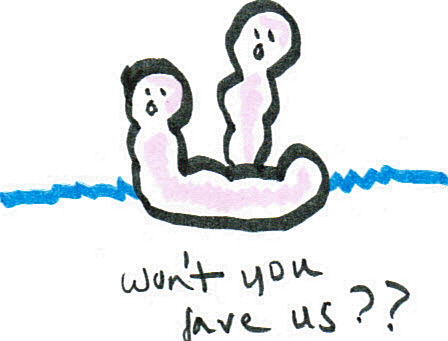
I have this thing about worms on the sidewalk after a rain. See, I have to save them. All of them. I pick them up and toss them back onto wet earth somewhere, next to a tree, under the bushes in somebody’s yard. I tell myself this means I have “saved” them from wriggling on the sidewalk, having to crawl their way back to a muddy spot, and possibly getting stepped on or baked in the sun.

One night, after a day in which I’d been out saving worms on my walk, I had a dream. I was on my walk, iPod clicking away, and I saw a worm near my shoe. So I picked it up and tossed it into the mud. A little ways up, I saw another worm. Picked it up, tossed it. Two squares of sidewalk up, more worms. Picked them all up, one by one, etc.

Except the thing was, as I glanced further up the sidewalk and saw the sun glinting off the cement, there were hundreds, maybe thousands of worms, writhing, waiting to be saved. By me. It was like that moment in Raiders of the Lost Ark where Indy and Marion see a snake, then shine a flashlight around them and realize they are surrounded by said-snake times about a million.

So I wanted to save all these worms, and I started to scoop them up by the handful and throw them onto wet earth. But there were too many of them. The further along the sidewalk I got, the more worms there were. Piles of worms, half as tall as I am, rose up and toppled over; I waded through them, wishing I were wearing rubber hip-boots.

So I had to stop. I stood with my head to the sky, my hands in my hair, and had one of those movie moments (except it was a dream moment) where the person yells, “Whhhhyyyy???”

My dream pointed me to one of the recurring themes in my life: It’s All Up to Me. (There is a sub-theme underneath this one which is something like, Nothing Should Suffer or Die, at Least Not on My Watch.)

The It’s All Up to Me theme has several purposes:

 a) it allows me to hang on to the illusion that I have control where I really don’t;

b) in focusing on those areas in which I really have no, or little, control, I excuse myself from focusing on the areas where I actually do have control (i.e., writing this blog post, which I have procrastinated on finishing for two weeks);

c) it reinforces the idea that if I just try hard enough, and if I do everything “right”, I will be granted the gift of certainty in life. (I have never, ever been granted this gift, but I still catch myself working very, very hard for it.)

There’s another purpose to the It’s All Up to Me theme, too: if I buy into it, then I don’t have to ask for help. And I don’t like to ask for help. I’d really rather not. It’s much more comfortable for me to believe I am so powerful, so resourceful, so independent, that I can do it all on my own. But this isn’t true, and deep down I know it.

So for now, I am just noticing. I will likely pick up worms from the sidewalk the next time I’m out walking after a rain. I will probably believe that I am saving them, and it will probably even feel good. But I’ll just try to notice when I cross over into that place of “I’ve got to save them all! It’s all up to me!” I’ll remind myself that it’s really okay — really — if I just pick up two or three worms from the sidewalk and set them gently in the muddy grass. There might even be other kind-hearted souls out walking who notice the worms on the sidewalk. I don’t have to save them all myself.

Feeling Lizardy?

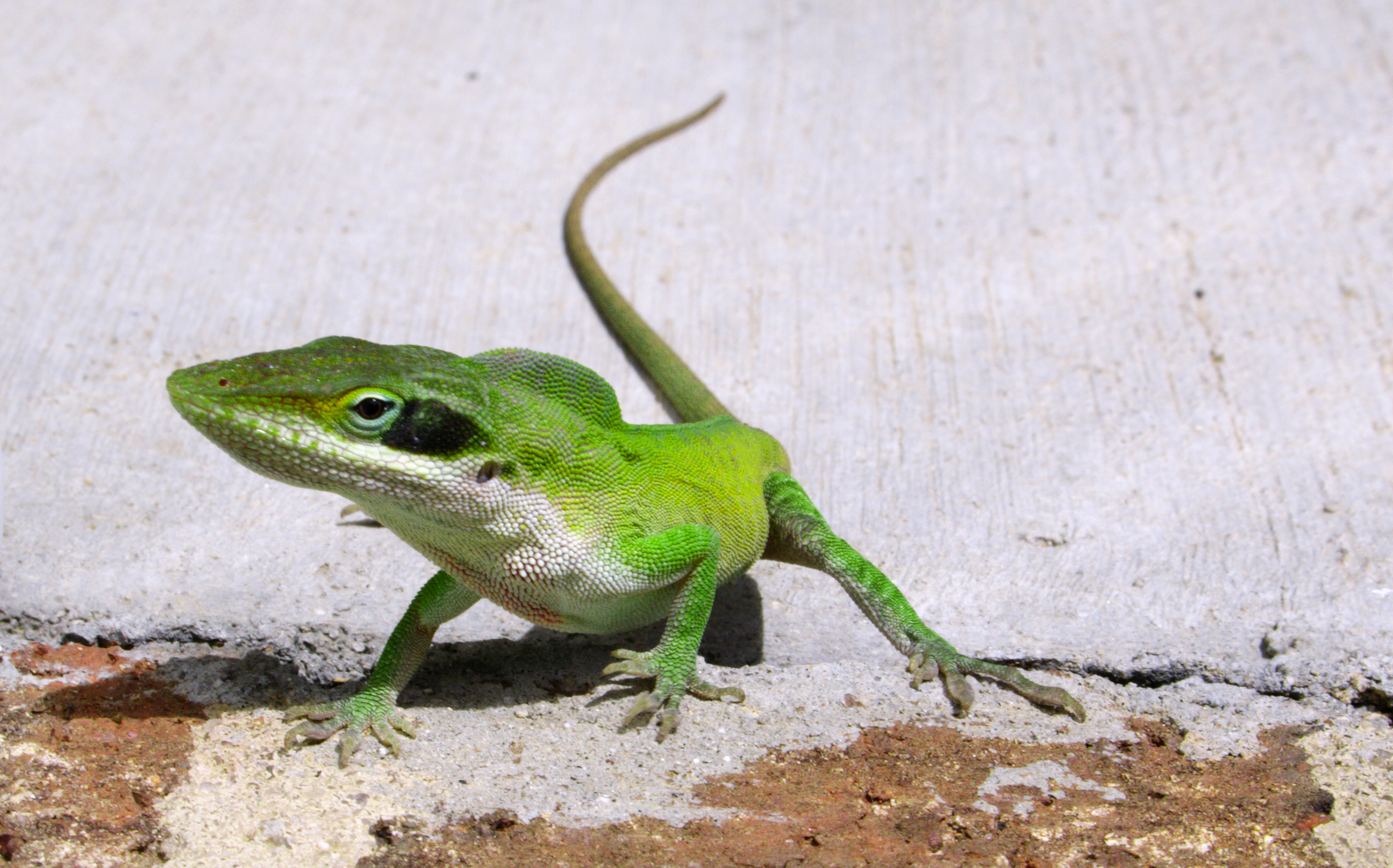
Image is Green Anole © David Huntley | Dreamstime.com

When I went through life coach training with Martha Beck, one of my assignments was to get in touch with my “inner lizard” and give it a name. Up until that point, I didn’t even know I had an inner lizard. But I do. And you have one too.

What Martha Beck terms the “inner lizard” is our reptilian brain. It’s the part of our brain that is purely interested in our physical survival. It’s a really helpful mechanism — when our physical survival is actually at stake. If Krusty the Klown is chasing me down an alley wielding a giant knife (because this is the world I live in), my inner lizard is a wonderful asset: it says, Run! You’re going to die! Krusty wants to kill you! And I do run, because, see, Krusty wants to kill me.

The problem is that our inner lizards react as though our survival is at stake ALL THE TIME, because that’s what they do. But most of the time, my survival is not actually at stake. If I listen to my lizard in these instances, I can quickly turn into an adrenaline-soaked, sleep-deprived sugar junkie (which is where I personally go when I listen to my lizard — you might go to a completely different place, and I hope it’s a happier place than mine. But if you’re listening to your lizard when you don’t need to, it’s probably not.)

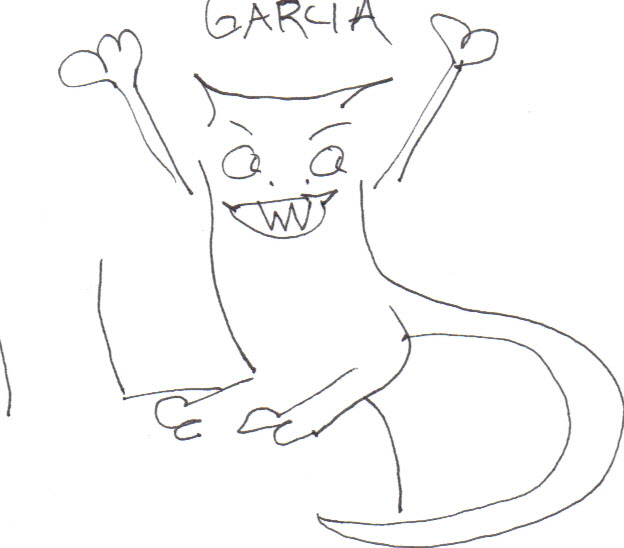
When I got acquainted with my inner lizard, I discovered a raging, shaking, lime-green creature about the size of a squirrel. He sat on my shoulder, breathed his filmy lizard breath into my ear and and threw his little lizard arms up a lot (yes, in my world my lizard has arms). He said things like, “If you don’t return that person’s call right away, they are going to hate you, and then they are going to reject you, and then you are going to be all alone! And then you’re going to die … alone!”

He said things like: “If you don’t get a good night’s sleep tonight, you’re going to be too tired to get through the day! And then you won’t be able to get anything done! And then you’ll never make any money! And then you’ll be on the street! And then you’ll die … alone!”

I named my lizard Garcia (there was this great pizza place called Garcia’s I hung out at more than twenty years ago at Indiana University. They had an ice cream concoction with whipped cream on the top called a Lizard. I had way too many of those. So Garcia seemed like a fittingly nostalgic name for my lizard). Just naming the little guy caused me to feel much more tenderly toward him. I mean, geez, look how scared he is all the time. I’ve learned to talk very tenderly and soothingly to him. When he freaks out, I say things like, “Well, sweetie, let’s see. Is what you’re freaking out about really true? Will we really end up on the street if we don’t get a good night’s sleep tonight? Let’s take a look.”

Garcia on my shoulder

Sometimes, I say to Garcia, “Your concerns are noted, and I’m going to get back to you later. Now have a very nice nap while I go on with my day.”

And sometimes, many times, I totally buy into what Garcia is telling me. “Oh my God, Garcia, you’re right! We are going to be friendless and homeless if we aren’t extra-nice to the neighbor we don’t like!” “Oh, Garcia, you have a point! If we don’t go to that baby shower we really don’t want to go to, we are going to be shunned, and we’ll end up on the street!”

I’ve come to realize that a lot of what underlies my perfectionistic tendencies are survival fears. Garcia and my inner perfectionist have a pretty tight relationship. My inner perfectionist believes that if I’m always doing more, it means I am good, I am productive, I am needed, I am valued. And this pleases Garcia very much (though he’s never really pleased), because he translates this as “survival”. But is it really true that if I am not good, productive, needed and valued, my survival is at stake?

If I can allow Garcia and my inner perfectionist to go off and take a nap together, I can get calm enough to access the part of me that knows that, right in this moment, my survival is not being threatened. I can then go to a place of choosing. I can choose to be good, productive, needed and valued (whatever those things mean to me), if I really want to. Or I can choose not to be. Either way, I am here, breathing. Knife-wielding Krusty is nowhere in sight. If the neighbor shuns me, if my money runs low, I have choices. And I can pat Garcia on his scaly little head and listen to him snore.

Are You Really Procrastinating?

I had planned to write my next blog post on the subject of overwhelm, but inspiration took me in a different direction. Recently I was chatting with my wonderful friend and fellow coach Mackie Schaars about how “procrastinating” and “waiting for the right time” have different energies. “What a great topic for a blog post,” she said. Well, here it is. (There will be plenty more on the subject of overwhelm in coming weeks.)

In our “Just Do It” culture, it took me a while to really get that “not doing it” does not necessarily equal “procrastinating.” There was a time in my life when I firmly believed that if I wasn’t taking action on something, I was procrastinating. Then I would really beat myself up, which inevitably, eventually, led to further, worse procrastinating.

I like to refer to this type of extreme procrastination, triggered by extreme rebellion, as rebellinating. Way back in my teens and up through my early twenties, when I was a dieter (and my inner perfectionist had a deep preference for starvation diets), rebellinating would show up as bingeing on lasagna for six and an entire box of Twinkies after a week of carrots and sugar-free Popsicles. Rebellinating is a good tip-off that something bigger, something deeper, is probably going on.

Because here’s the deal: Sometimes, when I’m not taking action on something, it truly is procrastination. I’ll give you an example: I am long overdue for a visit to the dentist. We’re not talking months here, my friends. How do I know I am procrastinating on seeing the dentist? Because it feels really simple: I want to take care of my teeth, but I’m not doing it. There’s not going to be a “better time” to take care of my teeth. There’s nothing complicated going on. I know it’s a need I want to meet, and I’m not meeting it.

Sometimes, though, a situation feels a little more complex. I might tell myself I’m “procrastinating,” but that might be a lie. I need to look a little more closely. I need to ask questions.

Many years ago, I was having a rough time and I moved back in with my parents. I didn’t have a job, and my attempts to find one were few and far between. I felt lousier and lousier and started hating myself for procrastinating. I made some half-hearted attempts to job hunt, but my energy seemed to be repelling work. When I did get work through a temp agency, I left in the middle of an assignment, in the middle of the day.

The temp agency called and left an angry message. How dare I leave an assignment in the middle of the day? Yes, I thought — how dare I? What is wrong with me? I am ruining my life!

I called my therapist for an emergency session. What became clear as I spewed my stuff to her was that I was really, really tired. It was October, and back in April my immune system had shut down. I’d been sick with fevers for weeks, then months, and had finally ended up in the hospital for a few days when I could no longer eat or drink. Little by little, I’d gotten better physically, but my inability to work when I’d been sick had created quite a bit of debt, and that’s how I’d ended up back in Mom and Dad’s house.

My therapist pointed out that I hadn’t really rested that entire year. “Are you kidding me?” I said. “I’ve spent half the year lying in bed.” “No,” she said with a smile. “You’ve spent half the year fighting an illness.”

She instructed me to go home and dedicate myself to at least two full weeks of true relaxation. No job hunting, no beating myself up for procrastinating. I laughed at her; it was one of those laughs that came out like a snort. Yeah, right. I’d never known how to truly relax. My inner perfectionist enjoyed it when I ran myself into the ground (which, I was beginning to realize, was a big part of the reason I’d gotten so sick in the first place).

But I felt strangely light and free after the therapy session. I did the best I could to put job hunting out of my mind for a full two weeks. Maybe it was three.

What happened over those weeks of not thinking about looking for a job was that I realized I’d been desperate. I hadn’t even had much idea of what kind of job I wanted. I was just throwing spaghetti at the wall to see what would stick. The desperation was still alive in me, but I managed not to act on it. Since my therapist had given me permission (and sometimes I truly need permission from someone I view as very wise to allow myself what I most need), I spent a lot of time curled up in bed and a lot of time taking very long walks.

During that time, I got clear. I got clear on the fact that I was tired, my body still wasn’t at its best, and I needed to respect that. I got clear on what kind of job I wanted. I got clear on why I wanted it. I found some job listings for a couple of jobs that sounded very much like what I wanted. Applying for them didn’t feel heavy or desperate. It felt kind of right.

Within a month of that eye-opening therapy session, I was offered both jobs. Apparently, I was no longer repelling work.

When our energy is aligned, there is movement toward what is right for us. If you think you are procrastinating, it could be that you are not aligned with what you most deeply want. Maybe you don’t know what you most deeply want.

Before you beat yourself up for procrastinating (and I suggest never beating yourself up for any reason if you can possibly avoid it), get clear. You’ll know what your truth is because when you’re in it, no matter what it is, you’ll feel free. If I tell myself I’m procrastinating and my deepest self says, “Yep, that’s right,” I know it’s true. I can then start taking small steps toward whatever it is I want.

But if I tell myself I’m procrastinating and it feels heavy, icky, and like I’m trapped in very tiny box, it just might be a lie. That’s when I need to investigate, to gently ask myself, “Hey, what’s really going on here? Let’s take a look.” It’s always worth it to take that look.