How do we know we’re ready to let go?

twofeathers

In my first few coaching sessions of the New Year, I noticed this interesting theme of loss, fear of loss, and ambivalence about loss surfacing.

Some of it had to do with completing a piece of creative work and feeling the emptiness that can come with finishing. This thing that has taken up so much of our heart space and head space and waking hours is now up and walking on its own and it doesn’t need us the way it did. There’s sadness — and one heck of a void — in that.

Some of it had to do with letting go of a job or a relationship. And the big thing coming up around that was, is it truly time? How do I know?

And some of it was about giving ourselves permission to let a creative project, job, or relationship go — even though it did not feel “complete.” It was about deciding not to continue. (And that’s rough on perfectionists, which most of my clients tend to be. You mean I’m allowed to give up on it? I’m allowed to not see it to completion?)

My “big word” for this year is permission. I need to focus on permission because I’ve noticed that I can go for hours, sometimes days, forgetting that, yes, I actually do have permission to do things the way I need to do them. To feel things the way I feel them.

So I can’t help seeing these issues with letting go through the lens of permission.

And that leads me to this: Often, when we’re afraid of letting go, it’s because we haven’t given ourselves permission to NOT let go.

Some militaristic part of us jumps up and says, “Okay! Time to move on! Let’s get moving here!”

And those parts of us which are not ready to let go, sometimes not even NEARLY ready, get trampled in the stampede.

But, as I’ve written here before, we can’t truly arrive anywhere until ALL of us shows up. This concept came to me from the writings of Robyn Posin, whose beautiful website you can find here. She uses a stoplight analogy: We can race to the light, but if it’s red, we won’t actually move forward until it turns green.

There may be a part of us that is holding a green light, but many other parts of us are still cradling the red, tightly.

So, permission. To be right there.

That part of us that the light has already turned green for will probably be very impatient with the parts of us that need to go slower.

And working with the impatient part of us might mean saying to it, “Yes, I see that you’re really ready to go, and I get that. AND, the whole of us is not ready yet. You’re not allowed to let your impatience run the show. But you’re totally allowed to be impatient.”

As long as there is conflict between the parts of us that want to let go and the parts of us that don’t, we are not at peace.

And when we’re not at peace, when we’re locked in struggle, we’re in a poor place to make decisions about anything big. When we’re struggling, it’s painful, and any decision we make tends to be more about getting away from the pain than moving toward what actually feels right to us.

The questions to ask the impatient part of ourselves are: What’s scary about slowing down? What’s hard about being in the present moment?

The questions to ask the parts of us who aren’t ready to let go are: What’s scary about moving forward? What’s hard about stretching ourselves into the future?

Allow these parts to talk to each other. Write down what they have to say; you might try using a different color of pen for each part. When you can hear them all out (and notice that each of them has wisdom and truth), you can begin to integrate their needs.

And when you have integrity, you have peace. And from peace you can truly let go in wholeness.

What are your challenges around letting go? Do you tend to let go quickly, or do you really hang on? I’d love to know how it works for you, in the comments.

Image is Feathers Against the Sun © Kmitu | Dreamstime Stock Photos
A journaling experiment for the New Year

littledeer2

I’m staring out my window taking in the snow-globe-soft snow that’s falling in the street light, thinking about what I’d like to share as this New Year begins.

And what I most want is to help you trigger some discoveries for yourself this year.

I’ve never been much on resolutions, but I do love open-ended intentions, or simply focusing on things that hold mysterious and positive questioning for me.

So here’s a little experiment I tried in my journal yesterday, and I thought I’d share it with you — if it feels good, see if it sparks anything for you as you move into 2014.

Step one:

Look around the room you’re in right now, or out your window if you’re near one. Choose three objects that light you up, that resonate for you in some way. Not necessarily the objects that you “like” the most, or are the most beautiful, but the ones that speak to you or call to you or trigger something in you that feels good.

Step two:

For each object, write down three adjectives that describe the object. (Hint: it helps if the adjectives work on two different levels — i.e., “solid” as opposed to “brown”.) Quick, off the top of your head — don’t think too hard about this! Do this for each object, one right after the other.

Step three:

Look through your list of adjectives — you should have nine words total. Pick the three from this list that resonate for you the most. Again, don’t think too long about this — pick the ones that jump out at you, quick!

Step four:

Take your list of three adjectives and look at it for a few moments. Now you can slow down a bit and get reflective. These words represent qualities that mean something to you, qualities you may want to bring into your life in 2014. 

Take out a fresh piece of paper and write each of these words across the top of the page. Now, draw an arrow from each word down the page and come up with at least one way you’d like to bring each of these qualities into your life this year.

Let your intuitive self take over here — allow yourself to make unexpected connections.

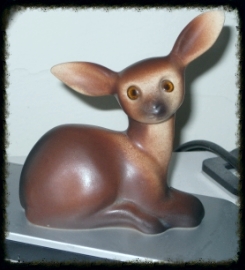
For example, one of my objects was the ceramic deer pictured above. It sits on my desk beneath my computer screen. The words I got from it were wide-eyed, healed (it has a broken ear that I’ve glued back on) and plump.

I like all of those words, but “plump” jumped out at me as the important one, so it went on my final list.

My logical mind thought, plump? Really? But intuitively, I know that plump, for me, represents robustness, stability, exuberance. How can I bring more of this “plumpness” into my life this year?

The first thing that popped into my head was “play around with more physical exercise.” So I wrote that down. (Ah, a clue! Any new form of exercise I try out needs to feel like play. And isn’t it funny how the idea of bringing MORE “plumpness” into my life — not less — led to me to exercise?)

Actually, I love “wide-eyed”, too. I want to face this year with even more curiosity, beginner’s mind, and freshness. How can I bring this wide-eyed quality into my life this year? The first thing that comes to mind is “Slow down and listen even more closely when people share with you.” Yes. That feels right.

If you give this a try, I’d love to hear how it went for you, in the comments.

Wishing you a beautiful start to your 2014! Whether we connected here on my blog or we worked together or we’re only “meeting” now for the first time, I’m truly grateful you’re a part of my experience as the New Year begins.

What if you didn’t need a reason?

Happy Fall!

Last week, I was talking with the wonderful business coach Kristin Stevens, and I kept telling her about various things I wanted to do, and prefacing them with, “For some reason.”

“For some reason, I want to move into a smaller apartment.”

“For some reason, I want to streamline and simplify my life.”

Now, some coaches would have gone right to “Okay. Why? Let’s get clear on the reason.”

I would have gone there, if I were coaching someone. And it can be a good way to go.

But Kristin said, “You keep saying, ‘For some reason.’ What if you didn’t need a reason?

This stopped me. Because, in this case, I already feel clear. I already know that something in me wants to do these things — but my rational mind tells me I don’t have a good enough reason to do them.

For years, I lived in small apartments and had a great need for more space. In 2005, I moved and got the space I wanted. For the past eight years, I’ve lived in a beautiful space where I have plenty of room.

But now it feels oddly too big, like I’m a kid clomping around in my dad’s work shoes. And I realize I’ve filled it up with things I no longer necessarily want or need.

When I moved here, I had this idea of a life I thought I wanted. But now I realize that maybe that life was about who I wanted to be back then, and not who I actually am today.

My rational mind says, “But why would you want to go back to living in a small space? Isn’t that going backwards?”

Is it? I’m not sure it’s a good question, in this case, because questioning my desire is only keeping me in wheel-spinning mode. A good question sparks curiosity and creates spaciousness and movement.

That’s how I know Kristin’s question — what if you didn’t need a reason? — is a good one for me here.

If I didn’t need a reason, I’d start making plans to move. If I didn’t need a reason, I’d free up my energy to focus on things that are more important to me at this point in my life than having a larger living space and the maintenance that goes along with it.

It’s telling that a while ago on Pinterest I created a board called Cozy Spaces. Something in me longs for cozy right now. Why?

Do I really need to know? What if, in fact, I can’t know the answer to that question until I move toward what I’m longing for?

The nudges I get from my intuition feel simple and straightforward. “Do this.” Or, “Don’t do that.” Or, “Wear something blue today.” “Call about that class.”

Intuition doesn’t explain itself. It lives in the world of trust, not the world of guarantees. And often, when I’m clear but I’m still not taking action on that clarity, it’s because I want a guarantee. I want a guarantee that the direction my intuition is pointing me in will be pain-free, that if I go there, “everything will work out.”

Experience tells me there is no such guarantee. Sometimes, I think I am waiting for clarity but it has already arrived. The truth is, I’m not waiting for clarity — I’m waiting for that guarantee.

“Why?” is a good question if it creates more clarity. But if I’m already clear, I don’t need to ask why. I need to act on what I know.

What do you think? Do you ever second-guess the next step that comes to you from your intuition? I’d love to hear how this works for you, in the comments.

Image ©Jill Winski 2013

Trusting in where your energy takes you

leafwater

One day last week I sat down to write and felt distracted. This is not uncommon. I often experience resistance, confusion, tedium, and occasionally even dread, when it comes to working on my novel.

In fact, I don’t usually call it (in my own head at least) “working on my novel” anymore. I call it “playing with my novel.” This feels much lighter and opens up possibility, curiosity, excitement. When I make it less grave and serious, I’m more in touch with why I actually want to do it in the first place.

That said, sometimes I feel stuck and it feels hard. And I hang in there with it anyway, because it is a commitment. And because sometimes I reach that lovely place of getting lost in my story. And the more I practice hanging in there with it, the more I reach that place.

But on that day last week, something else was going on. I sat and I sat and I sat, and I wrote and revised and tinkered. But my energy was not with the writing. I had the odd sense of pushing something away.

I glanced over at my open notebook, to some morning pages I’d done the day before. Jotted in the margin at the top of the page was a reminder to call a friend of mine, a dear friend whom I’d been meaning to call for a while. But I’d been putting it off because, although I knew that talking to my friend would be nourishing and fun, I’d told myself that she was probably busy and wouldn’t have much time to talk, anyway. I kept telling myself I’d wait and call “when we were both less busy.”

Now, the reminder note jumped off the page at me. And I realized that there was a ton of energy in calling my friend right then, right in that moment.

So, I stepped away from my computer and dialed my friend’s number. She was home and said she’d been thinking about calling me, too — that very morning. But she figured I was probably busy with coaching or writing and she’d wait to call me until the weekend.

We talked for an hour and it felt soooo good. It filled my creative well to — at least — a 10 (read Julia Cameron’s The Artist’s Way to find out more about the creative well). You know those friends who accept and love you so deeply that it doesn’t matter what’s happening for you, or not happening for you, because the connection is about your very essence? That is this friend, for me.

And something important came out of this call. I realized that I often make an assumption that the people I care about are busy and they need to “fit me in.” And this assumption is not reality. In fact, my friend was making the same assumption about me, but in truth I would have welcomed a call from her.

After we talked,  I returned to my novel with a sense of lightness and new possibility, and I no longer had that nagging sensation that there was something important I wasn’t attending to. I could give the writing my full attention.

If I hadn’t followed my energetic pull toward calling my friend, I would have missed out on that connection and that insight.

And yet, my rational mind wondered if I wanted to step away from the novel simply because it was hard and it was my way of “procrastinating.” It can be tempting to “power through” at these times, no matter what. And that’s not necessarily a bad thing to do when we’re developing a habit, whether it’s writing or something else.

But we get to the good stuff in life by acting on what feels juiciest for us in the moment. I don’t mean by acting on our every impulse, but by following our intuitive urges. Often, it’s as simple as asking, “What would light me up right now?”  On that day last week, contacting my friend was that thing. It was “up” for me, calling out for attention. And I needed to listen.

Sometimes, our “creative work” can serve as a means of avoiding doing our inner work. Just as we can avoid our creative work, we can also use our creative work to avoid — or push down the list — other things that are vital to our well-being. Like our relationships. Most particularly, our relationship to ourselves.

So notice the quality of your energy as you create. Is the creating connecting you with yourself, with the world, with that beautiful mysterious space we go to when we create — even if it’s a huge challenge at the moment?

Or, do you have the sense that you are using your writing, artwork, business brainstorming, or whatever it may be, to push something else away, as I did last week? Just notice. You don’t have to stop what you’re doing. Just tell yourself the truth, whatever it is for you.

Because, ultimately, creativity is being connected to what’s true for you in the moment. Because that is when you are most you. And that is what I wish for you — that you be most you as often as possible. That, more than anything else, is your gift to the world.

Image is “Leaf on Steel” © Chris Mccooey | Dreamstime Stock Photos