Three ways you can feel more creative — right now

1c0f7770-4689-4e06-9a87-405ae800c500_zpsb1a48ada

When people tell me they’re “not creative,” I know they are lying. The truth is, we are profoundly creative — it’s our natural state. We don’t need to “work” at being creative. And I think most of us know that when we’re in a truly creative space, it feels like play, not work.

What we do need to work at is sustaining solid habits that support our creativity (which often isn’t easy). We need to commit to making regular time and space for our creativity to take center stage.

Believing we need to work at being creative is a good way to get stuck. We can’t “lose” our creativity. We can only lose touch with its flow.

But sure, we don’t always feel creative. And that’s okay. While I don’t believe we should force the flow, I do believe there are things we can do to welcome its return, to summon it back to us.

1) Get rid of things that feel unsupportive to you.

These can be small things — I’m not necessarily talking about ending a relationship or quitting a job here (though you may make those choices at some point!). I’m talking about things that consistently drag you down, in small, nagging ways.

For me, recently, that meant unsubscribing to a couple of popular blogs, one for writers and one for entrepreneurs. I’d been telling myself that the authors “knew what they were talking about,” and I needed their information — but I felt slightly depressed every time I read one of their posts. I finally realized that their messages of “This is what you must do to be successful” didn’t apply to me, because I don’t define success the way they do.

We’re all hit with so much information in a given day, it’s vital to get rid of any that doesn’t feel supportive to us.

2) Make your workspace appealing to you.

Whether you write, paint, or bake amazing things, having an uncluttered workspace that you love can make a huge difference.

I am hardly a minimalist when it comes to decorating — I actually feel good having a certain amount of “friendly clutter” in my home; it’s part of how I relate to my environment. But yesterday I took some time to clear piles off the table I work on, to dust its surface, to put away some coats and scarves that were thrown over a chair. And it’s like I’ve been given a fresh slate when I sit down to write. My mind feels clearer — I can even see the characters I’m writing about more clearly.

Decluttering also shifts energy and signals that we are willing to let go. This willingness is crucial to creating, which is a process of birth and death, building up and eventually letting go of — or even destroying — what we’ve built.

3) Briefly revisit what you love.

You can do this immediately. I have a framed Jaws poster in my office, and I only have to glance over at it to be reminded of why it’s one of my favorite movies of all time (characters! editing! Quint’s Indianapolis speech!).

Or, a couple of nights ago I made a Pinterest board dedicated to Beatrix Potter. That woman was an amazing artist and writer, and when I look at one of her pictures — and her accompanying words — I am instantly reconnected with some of my deepest loves: animals, stories, and dark humor. (Yes, Beatrix Potter’s books are full of dark humor. Only in “The Tale of Samuel Whiskers” can you find two mice trying to make a kitten into a pudding).

None of this has to take very long. And for days when you’re feeling overworked and profoundly uncreative, a few minutes of presence can be priceless.

What helps you reconnect with your creativity on a moment’s notice? I’d love to hear, in the comments.

Writers: Tomorrow, Feb. 27, is the last day to register for the next session of The Writer’s Circle. This group offers terrific support for writers who are struggling to finish a project or build a daily writing habit. Find out more, here!

Image is “Colorful Bubbles” © Judy Ben Joud | Dreamstime Stock Photos

When your downtime doesn’t happen

emptybench

One of the most common issues that comes up for my clients, approximately 90% of whom identify as introverts (and most are also highly sensitive), is what I call Downtime Chasing.

It looks something like this: You were planning to stop working for the day at 5:30 p.m., eat some dinner, and have the evening to just hang out and experience some quiet and revamp your resources in preparation for tomorrow. Or, if you’re like me, maybe you wanted to get in a good solid hour of journaling before going to bed.

But: At 6 p.m., the phone rings. And even though you know you really need tonight’s downtime in order to reconnect with yourself and feel energized for tomorrow, it’s a family member and you wonder if something might be wrong. Or, it’s a work-related thing. Or, it’s a friend in a crisis and you want to be there for him.

So you pick up the phone, and before you know it, it’s time to go to bed and your much-needed downtime hasn’t happened.

Now you’re kind of irritated, maybe even angry, because you wanted downtime the night before, and last Thursday, and the same thing happened. And now you haven’t had any real time to yourself in over a week and you’re starting to feel like you’re running on empty.

Introverts need downtime alone to recharge. This is not optional; it is a necessity. We simply can’t renew our resources by being around other people the way extroverts can.

The tricky thing is, because introverts are usually very good at adapting to more “extroverted” ways, we may easily toss our need for downtime out the window. It might even be habitual for us.

If we’re highly sensitive as well, we’re often so attuned to what others need that it feels sometimes like their needs are just as pressing, if not moreso, than ours. So we jump into “helping” mode before we realize what we’re doing.

And then there’s this sneaky thought: “Well, so-and-so is an introvert, and she doesn’t seem to need the amount of downtime that I do. Maybe I need too much. Maybe I can go without it.”

I often see introverts going to two extremes with this issue:

The first is the introvert who gets angry and frustrated and locked into the “Desperately Seeking Downtime” cycle, which means that trying to get enough downtime becomes the main purpose in her life. Because she feels so deprived of time to herself, everything on her “to-do list” starts to feel like the enemy of downtime. This constant seeking doesn’t actually get her much downtime, but she thinks if she stays angry about not having it, somehow it will magically appear, someday.

The other extreme is the introvert who decides to just forget about downtime altogether and pretend she doesn’t need it. After all, she’s so good at adapting, maybe she doesn’t really need it! Maybe the problem is she’s trying to meet a need that simply can’t be met, and she’d be better off getting rid of that need, letting go of it.

Except … she actually does need downtime. It keeps her sane, keeps her connected to herself, keeps her energized and keeps her life in perspective.

Okay. So what’s the answer?

Well, I wish I could tell you the precise end-all-and-be-all solution to this issue for you. I can’t. Only you can do that. But here are some things I’ve found helpful for me, and my clients.

1) Know yourself.

How much downtime do you truly need to feel sane, to feel like you’re thriving and not just surviving? Be really honest here. 

The answer for me is: a significant amount. Definitely more than fifteen minutes grabbed here or there.

But, I often don’t need as much as I think I do.

When I deprive myself of downtime, I start to feel like I need it all the time. I don’t. Even though I’m pretty up there on the introversion scale, it’s not often that I actually need days of downtime. In fact, if I fully and freely give myself an entire day where my intention is mostly downtime, I usually find a couple of hours of true downtime will do just fine.

2) Notice where you’re getting into comparisons.

You need as much time to yourself as you need.

It doesn’t matter if Jane is also an introvert and doesn’t need as much downtime as you do. She’s not you; her constellation of needs, choices, and wiring is different.

When you can own how much downtime you actually need, without feeling like you “shouldn’t” need it, you are about a hundred times more likely to make that downtime happen.

We live in a world that believes “busy” is good. So we can feel pressure around owning our need to shift into “being mode,” whether we’re introverts or not. Sometimes, it takes real courage to own this need. Take that into account.

3) Notice where you are rigid around only getting your downtime in a certain way.

Be open to fluidity and flexibility around your downtime — without giving it up.

I once heard someone (I think it was Eckhart Tolle? — feel free to correct me!) use this analogy about money: We think money has to come in through the front door, when in fact it might also come in through the windows.

The same is true for downtime. It can come to us in myriad ways if we’re open to that idea.

If we think it must look like sitting in total quiet on the couch in our living room, we might miss out on the opportunity to have absolutely blissful, rejuvenating time to ourselves while walking home from our dentist appointment or cleaning up the kitchen (yes, it’s possible!).

4) There’s a discipline to downtime.

And I’m not a big fan of the word “discipline,” but, for introverts, it’s a commitment.

Notice the ways you’re too willing to break this commitment. Notice why you’re willing to give it up. Are there two tempting social opportunities this weekend, and deep down you know you can only handle one? What makes you want to schedule in both? What do you think you’ll be getting by doing the extra activity and cutting out your downtime?

It’s okay to drop the downtime to do something you want to do — as long as it’s a choice and you have a strategy for how you’re going to replenish yourself (it might mean you need next weekend totally to yourself, with absolutely nothing scheduled, so you can bounce back).

With the holidays right around the corner, it’s a great time to think about your needs for downtime. How do you make sure you get enough? I’d love to hear your thoughts on this.

Image is “Empty Park Bench” © Theresa Martinez | Dreamstime Stock Photos

Can you wrap a system around that?

field

I used to think that I didn’t like systems. Every time I found myself dealing with any kind of system — which implies structureI would rebel.

Part of this probably stems from having a childhood that felt way, way overstructured to me. My heart wanted to lounge in open fields with cows, sheep, books, and my journal (not that I lived near any fields), but my days always felt completely scheduled with activities from morning to night — not just riding the bus (an ordeal in and of itself) to school and back, but with afterschool activities, and then homework.

This seems so nuts to me now, but it was considered normal, and, thirty years later, though I don’t have kids myself, my sense is that many kids are even more overscheduled than I was (plus today’s kids have so much more technology to manage).

I think another reason I’ve tended to rebel against systems and structure is that I’m a Myers-Briggs INFP, and we “P” types like to keep things open-ended. Too much structure can feel overly planned and rigid for a “P” and trigger our rebelliousness.

At the same time, I’ve had to admit over the past several years, especially since becoming a coach and attracting clients who also tend to rebel against structure, that the right amount of structure can be a true godsend for those of us who cling to open-endedness (which can sometimes result in saying things like “I’ll write when I’m feeling inspired” or leaving ourselves one hour to complete something that actually takes four — woops!).

Systems and structure do not have to be elaborate or complicated. There just needs to be enough of a system to get it done — whatever “it” is.

Here’s my (very simple) example:

I was having a huge issue with mowing the lawn. It only takes me about 30 minutes, but it was becoming this thing that I so didn’t want to do and eventually I’d have to force myself to do it, angrily, usually swearing. Even though, once I’m doing it, I don’t hate it (except for that one time I mowed over some dog poop). It actually feels kinda good, moving my body, the smell of grass and dirt around me, the heft of the mower.

About a month ago, I figured out the issue. My brother, who used to live here and used to mow the lawn, had told me I should do it “about every ten days.” And I tried this. But it felt increasingly stressful to me. Because “every ten days” could fall on any day of the week. It might be a Wednesday, and then next time a Saturday, and then next time a Tuesday.

It occurred to me that if I mow the lawn every two weeks, it really doesn’t look all that much worse than if I do it every ten days. So I’ve made every other Sunday afternoon my mowing-the-lawn-time. And I think about it so, so much less. On Saturday, or Wednesday, I’m not thinking, “should I do it today?” because I know Sunday is lawn day. Every other Sunday, “mow lawn” is on my to-do list, and I know I’ll do it, and that’s that.

That was all the system that was required. It was actually way more stressful to keep the “when” I’d mow the lawn up in the air than it was to assign a day to do it.

This applies to anything I want to do on a regular basis, whether that’s writing or yoga or doing the dishes: Keeping the “when” up in the air creates stress and vagueness, and vagueness does not produce specific results.

And I think that’s worth consideration for us “open-ended” types. Is keeping something unstructured and open-ended giving us a feeling of peace and freedom, or stress and confusion?

The way to know you’ve hit on the right amount of “system” for you is that you use the system without a huge desire to rebel. (If you have a very strong inner rebel, as I do, you may be a little bit edgy around any amount of system, but when it’s the right amount, you’ll find yourself using it anyway.)

Your body is an excellent guide for whether or not a certain amount of structure is too much or too little. When I am overstructured, I feel frazzled, frenetic, like I’m on a treadmill. There’s a need to catch my breath (literally). When I have too little structure, I can feel sluggish, unfocused and fatigued.

There’s no right or wrong here; each of us has a “sweet spot” where we have enough structure, but not too much. So when I’m struggling with something that just won’t seem to get done, I’ve started to ask myself, “Can I wrap a system around this?” And then I brainstorm a little about what might feel like enough.

How do you feel about systems and structure? Do you tend to rebel against them, or do you find them helpful, or both? I’d love to know, in the comments.

Image is “Poppy Field with Powerlines” © Peter Gustafson | Dreamstime Stock Photos

Overwhelmed? Step back, then scale back.

bench&sky

So I spent the last three days trying to write a blog post. Now, I happen to truly enjoy writing blog posts. I look forward to writing them. They are fun and exciting for me, because I’m always discovering something about myself while I write them. Discovery! So much a “why” for me when it comes to writing.

And usually I can sit down and write a rough draft of a post in about an hour or so. The process doesn’t always work that way. But often, it does.

This week, however, it didn’t. I arrived at the computer determined to work on a blog post and I couldn’t manage to crank out more than a paragraph or two. And then I got frustrated. And then I got angry. And this happened three days in a row.

I said to my boyfriend,  “Maybe I’ve said all I want to say in my blog posts already. Maybe that’s it.”

“No way,” he said. “I don’t believe that.”

And I didn’t believe it either. But something was off, very off, and it made me panicky.

And I’ve been here before — maybe not recently in relation to blog posts, but in relation to other things. Like my novels. Like my relationships. Like cleaning the house, or taking that trip I’d planned. That place where I think that something is supposed to be happening and it shouldn’t be so hard, but it’s terribly, terribly hard. It’s a feeling of spinning my wheels in mud and just getting further entrenched. A feeling of doing and doing and nothing actually getting done.

I call it “the spin cycle.”

I found myself staring out the window instead of looking at the computer screen as I tried to write the blog post, and I realized my body, in its infinite wisdom, was pointing me to the fact that it was not time to write, it was time to be. Regardless of how “behind schedule” I was.

So, I went to the sofa and I lay down, staring at the ceiling for a while. And I began to relax. And I began to get it.

This time around in the spin cycle, here’s what I’ve learned:

1) When I feel this way, more often than not there is some type of resistance going on. Resistance to what is: a sure route to insanity. What have I been resisting this week? What’s the reality of this week?

Well, my parents came to visit one week ago and left today. And I had a freelance project I was working on in addition to my usual daily routine.

But I didn’t factor any of this in and kept right on with my “usual” schedule. I didn’t factor in the fact that I’m an introvert and I need alone time to recharge and I wasn’t getting much of it this week. I didn’t factor in the extra hours and toll on my energy the freelance project took.

The reality of my personal energy: I am a finite being with limited energy, much as I fantasize about being able to “do it all,” seamlessly.

The reality of time: There are 24 hours in a day.

2) When something that is usually enjoyable and do-able feels really hard, it is not a sign to step it up and push it harder. It is a sign to step back and ease up and ask what is going on.

But my mind will tell me I need to keep pushing and that easing up is a sign of weakness and a lack of discipline and commitment. This is what my mind does, and how it thwarts my need for self-care. But it is a lie.

How do I know it’s a lie? Because of the way it feels. If stepping it up and pushing harder were the truth in this case, it would feel challenging but expansive, like doing it was helping me grow. But that’s not how it felt. It felt like pushing myself to do it was diminishing me. (Interestingly, I kept getting an image of myself writing on a tiny notebook with a tiny flashlight inside of a tiny black tent, my legs bursting out of the flaps like Alice in Wonderland after she drank the potion that turned her into a giant.)

So, after I lay on the couch for half an hour or so, allowing myself to space out (and giving myself full permission NOT to write the blog post), I realized that writing just one paragraph of a blog post would actually feel good. And so what if I am “usually” able to write more than that? Different week, different guidelines. I went to the computer, wrote one paragraph, and then, as it turned out, I wrote the whole darned thing.

Which brings me to the third thing I learned, this time around in the spin cycle:

3) When I keep trying to get something done and it’s just not happening, it may be because I’ve lost my connection with why I’m doing it at all.

“Because it’s time to publish a blog post” was not enough motivation for me to write one when my creative well was empty and I was in spin. When I’m in that space, I’m like a ship without a rudder. Doing for the sake of doing is meaningless if I’m totally out of touch with why I’m doing it. My “why” is what propels me into inspired action.

As it turned out, giving myself what I really needed — a time-out — connected me back to my “why”.  And my “why” led me right back to writing the blog post that had felt so impossible to write only hours earlier.

What are your ways of dealing with “the spin cycle”? I’d love to hear your thoughts in the comments.

Work With Me: Do you need some support in practicing better self-care? I’d love to help. See if we might be a good fit, here.

Image is “Outlook” © Guyerwood | Dreamstime Stock Photos

Pausing is not the same as stopping

stopsign

Sometimes it is incredibly, excruciatingly hard for me to step away from something, when stepping away is exactly what I need to do.

Step away from that phone call that is not going anywhere and sucking up a lot of time.

Step away from my novel when I keep forcing it even though I’m beyond frustrated and realize I have gotten so far away from the heart of the story that I have no investment in what I’m writing.

Step away from the problem I’m desperately trying to solve (when it’s becoming more and more obvious that the mind that created the problem is not the one that can solve it).

Step away from the internet. Because, it’s the internet. And I need sizeable breaks from it if I’m going to remain sane.

I think one of the reasons it’s hard for me to step away is because of the idea that I am supposed to tackle things. Take control of them, wrestle them to the ground, and force them to cry uncle. This is the way I was taught to solve problems when I was very small, and, even though I’ve never been very good at it,  it’s deeply engrained in me.

Only, sometimes — often — it just isn’t effective. There’s a point where I’m trying so hard to control the outcome of something that I am way too emotional to be effective. It’s at this point that pressing the pause button can be so essential.

But there’s another reason it’s hard for me to step away. It’s because of trust, or the lack of it. Allowing myself to step away means I am trusting that I will get back to whatever it is I’m struggling with — whether it’s a phone conversation or a tough scene in my novel.

And this kind of trust takes some practice to cultivate. I’ve been working with this for years and yet I can still go way too far out of fear.

We can never solve an internal problem by changing an external circumstance. If something within me feels out of control, no amount of controlling the external world will change that. This is the recipe for compulsion and, eventually, addiction. I’ve got to get back into balance within myself before I meet the world again.

This is why I suggest to my coaching clients that they not make huge decisions when they’re feeling intense emotions. We don’t know what the truth is for us until we come back to center. Our emotions are messengers, but they’re often not the message. (Extreme anger at your boss may just be saying, hey, let’s take a look at what’s happening here, not hey, let’s quit!)

So we’ve got to make it okay for ourselves to step away when we’re getting into a place that feels out of balance — no matter how important we’re making what we’re doing. Stepping away for now does not mean stopping altogether — in fact, it can mean letting another part of us — our subconscious — take the wheel for a while.

So, how do we do this?

1) If you’re struggling with something you’re creating (a painting, a novel, a website) and you’re ready to take a knife to the canvas or put your fist through the computer screen, know you’ve reached that point where you need a little less perspiration and a little more inspiration.

I know, I know, there’s that awful saying about how creating is one percent inspiration and 99% perspiration. Please. I don’t believe we need to feel inspired all the time to create — inspiration often comes in the course of creating, and some days it doesn’t come at all — but if, in the long haul, you’re only feeling one-percent inspired, you need more inspiration. If the whole thing feels like a struggle every step of the way, you’re forgetting how important it is to fill your creative well.

2) If you’re having a really hard time in several areas of your life (if you’re in what we Martha Beck life coaches refer to as “Square One”, where you’re going through a massive identity shift and you don’t know what the hell is happening), realize you may need to move much more slowly.

You may need to take more time-outs. You need to practice really good self-care during these times. If you’re in Square One, the question is never “how can I get out of Square One?” but “how can I make it okay to go slow?” (I love Kristin Neff’s guided meditations on self-compassion for these times, and all times, really.)

3) Know the point at which you are getting in your own way. See if you can step outside of your emotional self and be the observer. What do you look like when you’re in need of pressing the pause button? What happens with your body, your behavior?

A few years ago, I was walking home in a seriously foul mood, and a car rolled through the stop instead of letting me cross the street. I actually reached out and hit the back of the car as I walked behind it. Feeling the sting of the hot metal on my fingers (it was like a 100-degree day, which was part of why I was ready to maim), I knew I’d crossed one of my personal boundaries into nutso territory, territory I did not want to stay in. It was time for me to stop wrestling and take a time out. Know these places in yourself, and find ways to clue yourself in to when you’re getting into this territory. Hopefully you will not have to slap a defenseless Honda Civic to know you’ve entered “that zone.”

4) Above all, cultivate trust in yourself. Take baby steps. If you’d normally force yourself through something to the point of frustration, try stepping back even five minutes before you usually would.

One of my clients recently made the decision, for a number of reasons, to take a month off from her artwork. (Namely, because it was feeling too much like art-WORK. She said she didn’t want to return to it until it felt like art-PLAY. I love this!) She was afraid a month was too long, but she felt like she needed it. The need for the break felt like it was coming from her intuition, not from a place of fear. It felt deeply right.

A week into the month off, she emailed me. As of today, she said, I am back to my art-PLAY. It turned out she didn’t need an entire month off after all. Something in her was more than willing to return to creating when it was ready. Now that’s self-trust.

For an article on a similar theme, check out Practicing Reverent Curiosity.

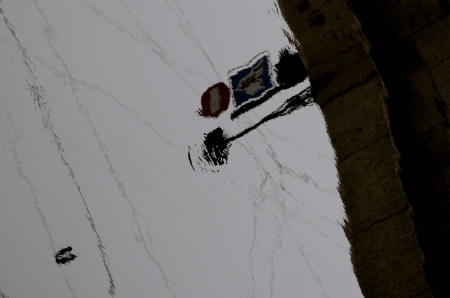
Image is “Reflected Stop Sign” © Vladimir Zanadvorov | Dreamstime Stock Photos

How to Take a Pretend Vacation

I realized this afternoon that, kind of without being totally aware of it, I’ve slid into one of my oh-so-rare “pretend vacations.”

A Pretend Vacation is something I give myself when I’m a little overwhelmed, a little run-down, or maybe just feeling more reflective and inward than usual. It might last a day; it might last three. It’s never a planned thing. It’s like a need that asserts itself in a small voice; if I don’t listen, it speaks up more sharply.

I suspect the need for a Pretend Vacation has been coming on for several weeks. Maybe it’s kicked in because of the events of this past weekend: Saturday morning, while eating a Larabar, my crown popped off and I almost swallowed it. Did you know when a crown comes completely off, it has a little pointy screw thing sticking out of it? Be warned.

Then, Saturday night, there was a party. I have an interesting relationship with parties. If I can get myself to them, I like them. For about twenty minutes. I stayed at this one for three hours. (But it was a Halloween party! Costumes! Gummy worms soaked in vodka! And “Poltergeist” and “The Exorcist” on TV all night! My inner scary-movie-lover was happy; my inner HSP-introvert was overstimulated.)

I spent Wednesday morning in my lovely dentist’s office as she dealt with the gaping hole in my gum. Throw in a couple other unexpected and stress-inducing issues over the past few days and, on cue, need for Pretend Vacation makes itself known.

A real vacation is planned in advance. It involves taking time away from work, maybe more time with family or friends, or not, maybe traveling to another place, or not, but there is an interruption of one’s normal routine.

In my Pretend Vacations, my normal routine goes on. I just scale it back as much as possible. I do everything that’s a priority — keep my appointments with clients, do my writing, feed my cat. But I cut out anything I might normally do but don’t really need to. Today, for example, laundry and the dishes fell right off the list so I could sit quietly and drink Midnight Velvet tea. I haven’t been on social media much. I let a couple of phone calls go to voice mail.

The intention behind a Pretend Vacation is to create a container for the part of me that is vulnerable, tired, and wants to move inward to reflect or rest, while not completely removing myself from my life. I’ve noticed on a Pretend Vacation, choices I might usually waver over become really, really clear. I also notice I’m gentler with myself than I usually am, and I’m less likely to respond to things that don’t really require a response from me.

There’s something to be learned here, methinks. Can I invoke this Pretend Vacation mindset for the parts of me that are vulnerable, overwhelmed, or scared, while still attending to the parts of me that don’t want to leave the party because “The Exorcist” hasn’t gotten to the really good parts yet?

I can’t necessarily care for all these parts of myself — all these selves — on the same day, in the same moment, but I can let them all know that they will get their say, they will be heard by me, and none of them will be left out.

I can also let the sensation-seeking parts of me — my inner adventurer, my inner scary movie buff — and the driven, perfectionistic parts — know that, in the long run, a Pretend Vacation is good for all of us.

And a Real Vacation is even better.

For a related article, click here.

Image is TOY ON THE BEACH © Cristina | Dreamstime.com

Understanding our Limits: Self-care and Creativity

The foundation of a healthy relationship with our creativity is self-care.

And yet, creators know that the act of creativity is also part of our self-care. So how do we negotiate the needs of our physical and emotional selves, and the needs of our spirits?

When I was in my twenties, I thought that all the good feelings I got from creativity meant I could override and ignore pesky things like getting enough sleep, eating well, and having relationships that felt reciprocal and nurturing. I thought I could be this wildly creative being and forget the fact that I am a physical being with physical needs that are not going to go away just because I ignore them.

This turned into a vicious cycle which went something like this: let me create more because it helps me feel bigger and better and then I’ll have more energy to pour into my relationships and I won’t need as much sleep or to slow down and pay attention to what I’m eating and whether or not I really have enough money to support myself. Okay, now I’m really wired and tired and my relationships aren’t very healthy and I don’t have enough money; but let me create more because it makes me feel good and then I don’t have to think about these other annoying things that are part-and-parcel to living.

This was a form of grandiosity, though it took me a while to understand it. I didn’t want to believe that I had limits, that I was a physical being with a body that got tired and emotions with messages like, “I’m burning out here.”

I did burn out on this way of life at about age twenty-five. I ended up in the hospital, dehydrated, with an unbearably sore throat and an enlarged liver and spleen. (“You don’t actually need your spleen,” the doctor told me. “But it’s nice to have it.”)

It took me a couple of years to transition into a different, slower, deeper way of living. At first I thought this way of life would be boring; I kept trying to go back to my old way of burning the candle at both ends and ignoring my physical and emotional needs. But my body wouldn’t let me.

This was the beginning of transforming my definition of creativity and what it means to be “a creative person.” I still created, regularly, but over time I saw that I did it because I wanted to, because it felt good — I stopped using it as a means to avoid the aspects of life that I had previously considered too “mundane” to deal with.

I also realized that I had a deeply held belief that if I wasn’t actively creating something — something tangible in the form of words on paper or paint on canvas or what have you — I had no value as a person. I was so wrapped up in this “doing” mentality that it took me a while to realize that, for me, “creating” had become completely entangled with proving my own worth as a human being.

What I now know is that creativity is a natural extension of my human experience. Though it’s vital to have a regular habit or routine of creating, it’s also important to recognize that I don’t make creativity “happen.” It’s a natural part of being; a regular habit of creating is simply a way of building a container to give our creativity a form and a shape. (If you want to test me on this, try not creating anything for a day and see how impossible it is.)

That’s why, now, when I work with creators, I’m committed to helping them accept not just the natural ebbs and flows of the creative process, but their own personal, internal and external ebbs and flows. When I work with someone and hear something like “I need to be writing eight hours a day,” I ask, why? Because you really love writing all the time and it brings you joy and purpose, or because you believe it’s giving you worth and value to be constantly doing?

It’s so important to examine what we believe and how it drives our actions. What I know for sure is that if I drive myself too hard — even in the name of creating — I will wear out my body, and it’s this body that, ultimately, carries out my purpose on this earth.

The fascinating paradox of all this is that when I build into my life the care for my body that it truly needs, I accomplish more of what I deeply want to accomplish — not less — and I feel better about what I do.

I’d love to hear your thoughts on this. How do you balance self-care and your creative projects?

If you need a reminder to listen to your body, hang out with animals. When they’re tired, they rest.

Image is LOUNGING CAT © April Turner | Dreamstime.com