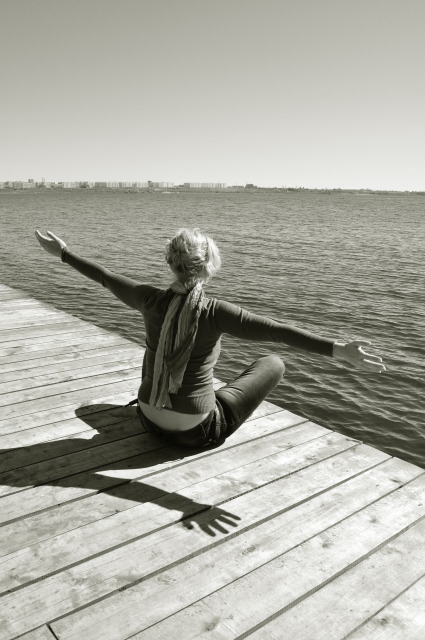
Creative Ebbs: Not the Same as Stuckness

If you think about any relationship you’ve ever had, you’ll notice that there were phases to the relationship. Sometimes you were sitting on the couch shoulder to shoulder eating cookie dough ice cream and watching Netflixed episodes of “The Office” (British version, preferably) and you couldn’t stop laughing and finishing each other’s sentences. Other times, you were kind of quiet and it was just nice. Other times you went rollerskating and you couldn’t stop falling down, in a good way.

And then there were those times when there was just nothing to say. Phone calls felt heavy; there were lots of long pauses, and not the good kind. You got on each other’s nerves without meaning to; previously endearing odd little habits began to seem like dealbreakers.

Maybe in your younger years, the not-so-good times felt like sound reasons to end the relationship; but as you got older and had more experience, you began to see that it was important to ride them out because the ice-cream-on-the-couch times could always come back.

You have a relationship with your creativity, too. And it needs to be accepted, nurtured and protected just like any other relationship you care about. But a lot of times (and what I see happening most often with my clients) is that we either neglect this relationship or ignore it — or, at the other end of the spectrum, we push it so hard and try to control it so much that it withers or hides from us.

Accept that your relationship with your creativity has seasons, cycles, ebbs and flows. You can — believe it or not — trust these ebbs and flows. Most of us are afraid to trust them. We love the flow, but the ebb, not so much.

So I won’t talk about what to do when you’re in creative flow. Most of us love that place. I’ll address the dreaded ebb (though you shouldn’t dread it — it’s really simply the yin to the yang that is the flow).

A creative ebb is a period in which nothing much feels like it’s happening creatively for you. It’s not the same thing as feeling stuck — stuck has to do, usually, with your fears around what you’re creating, or when you’ve reached, say, the middle of your novel and you have no idea what happens next and nothing you try feels right. When we’re stuck, it’s important to bring our fears to light and give them voice so we don’t dig our wheels further into the mud.

An ebb is a bit different. You might feel it for a few days or weeks after you’ve had a period of unusually high creativity. I used to create and sell these little paintings, mostly of cats. The way my process worked was I’d get a very clear picture of what I wanted to paint in my mind, often when I was out walking, and then I’d come home and get out one of my little canvases and the image would flow out onto it, usually quite similar to what I’d envisioned.

For a period of time, I did about three of these paintings a week. And the more people bought them the more I wanted to create them. But after about nine months or so of this, the ideas gradually stopped coming. I didn’t rush to my canvases the way I had. The art I created didn’t feel as inspired to me. Some of it wasn’t selling.

I was at an ebb. How do I know it was an ebb? Well, luckily for me, in this case I’d thought of this artwork as pure fun, not at all my “life’s work” or “serious art” — I didn’t have any of those ideas attached to it that can create stuckness because we make it so big and important. So when the “flow” stopped happening, I didn’t freak out. I just kind of noticed. By now I was about to move into a new home anyway, so I focused on that. The part of me that did the paintings rested.

And within about six weeks, I was ready to go again. I starting getting new ideas and now I was incorporating collage into the paintings. I began selling them again and I got my first overseas customers.

Creative ebbs don’t necessarily last for weeks. The ebb can occur, on a smaller scale, on a daily basis, when you do your writing in the morning, say, and it goes amazingly well but by evening you’re wiped out. That evening time is what Julia Cameron calls “filling the well” time. Although it’s true that the more I create, the more creative energy I tend to have, it’s also true that a prime component to our creativity is this resting phase, whether that’s a few minutes, a few hours, or a few days.

So what do you do when you’re faced with a creative ebb? Ideally, not much of anything — putter, water plants, daydream. But I know that doesn’t sit well with you if you make your living through your creativity, or if you’re on a tight deadline. In those cases, let the resting, “be-ing” energy be there as much as you can, while keeping up a regular creative habit. Sometimes this looks like doing the minimum that needs to be done and calling it a day.

Whatever you do, don’t demand of yourself that you reach for the creative high you experience when you’re in creative flow. That, my friend, is a sure-fire recipe for getting stuck.

Allow the ebb. The ebb is your friend. When the flow returns, you’ll reap the benefits of the ebb and see just how much richness that “fallow” period has brought to your creativity.

Announcement: This Thursday, Aug. 2, is the last day to sign up for the next session of Jenna Avery’s Just Do the Writing Accountability Circle. I’m Jenna’s co-coach, and I’ve also been a participant in this group for nearly a year. It’s a great way to develop a regular writing habit and get group support. Check it out here!

Also: I’ll have openings for new coaching clients starting in mid August. If you’re feeling stuck or scared around your creativity, or it seems like life just won’t stop getting in the way, feel free to set up a free consultation with me.

Image is MUD FLATS © Slidepix | Dreamstime.com

Creating: There’s No Right Way to Do It

A friend of mine recently attended her first ever writing class. She was really nervous. She didn’t know if she’d “fit” there. She thought maybe she wasn’t brilliant or wacky or temperamental enough to be a writer.

She showed up, and things were going along okay, and then the teacher said this: “If you’re not willing to reveal everything about yourself, you have no business being a writer.”

Ouch. My friend felt like a hermit crab retreating into its shell. It had been hard enough just getting herself to the class, and now here’s someone in a position of authority saying that if she doesn’t put it all out there, she has no right to write.

Here’s the thing:

When we begin something new, we are tentative. This is normal. Feeling tentative does not mean we are not serious or that we “won’t make it.” We need to start small, and stretch ourselves a little each time we begin again. And little by little, we become less tentative. We take bigger risks.

When we create, we are exposing pieces of ourselves. We are saying, in essence, this is what fascinates me, this is what I struggle with, this is what I really care about. And that can be hard. That can be terrifying. Particularly if we’re just starting out. And even if we’re seasoned creators, we continue to explore new territory and there’s always an element of fear in that.

Starting small and feeling tentative about it is so much better than not starting at all.

And this is exactly why we need to start small if we are really, really afraid. If you get vertigo when you stand on a chair, you don’t climb up a bell tower and look down (well, unless you are Jimmy Stewart in Vertigo, but you get my point).

Some new writers are excited and motivated by the idea of  “laying it all on the line.” And that’s terrific.

But if you’re not excited and motivated by that, if it scares the hell out of you, that doesn’t make you any less a writer. And you shouldn’t have to hide this fear because you’re afraid someone will tell you that if you don’t want to lay it all on the line, it means you “don’t really want it.”

And here’s another truth: The more you care about something, the more tender the subject, the closer it is to your very essence, the harder it’s going to be to write about — or, at least, the harder it’s going to be to share with others.

But this doesn’t mean that, if you’re not feeling ready to do that now, you have no business being a writer. It just means you’re not feeling ready to do that now.

Here’s a question I like: What might help me to feel a little more okay about starting?

Obviously, the idea that she had to be willing to reveal everything about herself shut my friend down. She didn’t want to return to the second writing class; she didn’t even want to write.

So here’s what we worked out together. We changed “I have to be willing to reveal everything about myself” to “I’m willing to reveal some things about myself.” This felt much better to her. And here’s another thought that felt true for her: “I have the right to be a writer because I have a deep desire to write.”

I tell this story because we create resistance when we believe black-and-white, all-or-nothing thoughts about our creativity. There’s no “right” way to create. You can be a “real” writer even if you are not putting one hundred percent of your inner turmoil out there for the world to see.

Here’s what I’ve found: I can usually do more and go farther than I thought I could. But I don’t find that out if I don’t give myself full permission to meet myself where I am. If I set up a challenge for myself that feels insurmountable (or, when it comes down to it, undesirable), I’m going to shut down.

So give yourself full permission to be a beginner (and we’re all beginning, again and again and again). If someone criticizes you for being “too tentative,” or “not serious,” say, “‘I am serious. I’m seriously tentative. I’m trying something new.” And then tell them they have to stop criticizing you. And this goes double if you’re criticizing yourself.

If a belief shuts you down, it’s not the truth for you. There are as many kinds of creators as there are human beings who have the desire to create. And we’re all motivated in different ways. It’s not one-size-fits-all, and thank goodness for that.

Image is MESSY PAINTS © Paige Foster | Dreamstime.com

Creativity and the selves within us

Lately with the wonderful creators I’m coaching, I’m noticing a theme of “shoulds.”

“I should be taking more risks with my writing.”

“I shouldn’t be spending so much time lolling around on the beach.”

“I shouldn’t be taking on so many creative projects” or, the flipside, “I should be trying harder to get out there and be more creative.”

First of all, creativity isn’t something you do. It’s something you are.

Our projects are simply a way of tapping the creativity that is always within us, giving it a form. It’s important to remember this, because our minds tend to work in a black-and-white way: “I’m creative when I’m sitting at the computer typing the words of my novel, but I’m not creative when I’m doing the dishes.” (Check out my previous post on defining creativity.)

Actually, you are creative when you are doing both. Creativity is simply the energy of life moving through us, and our particular perspective on that energy at that particular moment. It is always available. 

And, we all have different selves within us. I know I have an adventurous self who loves the idea of living on the edge, taking creative risks, going all out in search of a particular truth (I saw the awesome “Prometheus” last night, and I came out of the theater totally in touch with the adventurous risk-taker part of me).

But I also have many other selves within me. One of my core selves is about twelve years old, vulnerable, self-conscious, unsure of her place in the world and wanting very much to feel safe and cherished. This self is often completely at odds with the risk-taker part of me. And she needs a very particular kind of care.

A quick way for me to get into “shoulds” and create big-time resistance is to ignore the needs of one self or another.

If I ignore the needs of the risk-taker, I find I’m playing it safe (this particularly shows in my writing, when I read what I wrote the day before and realize I’m bored; I just don’t care about what I’m writing because the stakes aren’t high enough).

If I ignore the needs of the vulnerable twelve-year-old who craves safety and boundaries, I wear myself out, I throw myself into situations and relationships without questioning whether or not they are good for this part of me. I find I’m pushing and forcing myself a lot. I can also feel angry, teary, and like I am betraying myself. I may attempt to do something (write about a topic that is tough for me, for example) before I have built the inner resources to go there.

But it’s not an either/or. It’s a both/and. Believe it or not, I can meet the needs of both of these aspects of myself (and the many others as well — though I won’t necessarily be able to meet the needs of all of them at the same time). I can fuel the risk-taking needs of my inner adventurer and also reassure my inner twelve-year-old that I won’t drag her along on these risk-taking expeditions unless she is ready and willing.

This might look like, for example, taking on writing material that feels challenging and scary and risky, but promising myself that I will stop for the day if it starts to feel overwhelming and I’m physically tired or emotionally upset. I can continue the next day, if it continues to feel right for all of me.

And listening to as many aspects of ourselves as we can is beautiful for whatever we’re creating. The more we honor our complexity, the more complex and wondrous our creations will be.

How do you meet the needs of the different selves within you, and what impact does this have on your creativity? I’d love to hear your story.

Image is FREE TIME, ENJOYING THE SUN © Svetlana Komolova | Dreamstime.com

Noticing you’re “in it”: what does perfectionism look like?

This is the final post in my May article series on perfectionism and how it interferes with our creativity — and how we can recognize it before it has its way with us! There’s plenty more on this site about perfectionism, as well as its partner in crime, procrastination — just click on the Categories listing on the right.

It can be tricky to recognize when we’re in the grip of perfectionism, because we often applaud ourselves for the very behavior it creates. I struggled so much with overachieving as a child that by the time I was fifteen years old, I burned out and literally had no clue as to why I did anything at all — all I knew was that nothing I did gave me the sense of satisfaction I wanted it to give me for very long. The why beneath what we do is important; in fact, it’s essential.

Perfectionistic behavior is fear-based. We’re acting to secure what we think we’d be lost without. We do more because we fear that if we don’t, we won’t have enough.

When we take action from a place of wholeness and authenticity, we act based on the conviction that we are already secure. We do more because we enjoy it, because it enhances our lives. We stop when we’ve had enough.

So, how can you tell you’re in perfectionism’s clutches?

You can tell by the way you feel. For me, that’s often urgent, anxious, overly driven (I feel I can’t stop or slow down), a tight stomach, clenched jaw, contracted body, slumped-over posture. I physically “clench up”, become smaller than I actually am. Sometimes I feel extra-irritated and want to snap at people.

(Can you imagine the extra burden we place on ourselves when we sit down and try to create from this feeling, from this place?)

Sometimes, though, I’m not necessarily in touch with my feelings or my body. I’m totally in my head, and although I know lots of techniques for getting into my body, I don’t always do them because my mind is telling me I don’t have time, or there’s no point (tricky, tricky mind!).  This is when I can look to my behavior for clues.

For me, perfectionism manifests itself in the following behaviors:

* Going above and beyond just because I can; staying really, really on top of things (i.e. responding to emails immediately; setting daily goals that are way bigger than they actually need to be because my ego likes the way they look).

* Saying YES a lot, when I really mean maybe, or no. Often I do this to avoid conflict. Will saying no really create conflict? I can always say, “Let me think about that,” instead of “yes.”

* Finishing what I’ve planned to do for the day and then doing more, rather than, as we like to say in Jenna Avery’s Writer’s Circle, “declaring myself satisfied!” A similar version of this is sneaking “doing” into time I’ve set aside for “being.”

* People-pleasing and all its graspy little offspring. This can look like refusing to set boundaries around my time and energy, or affecting an “always smiling” persona so I don’t “upset anyone.”

* Cutting back on, or cutting out, fun activities until I’ve “gotten it all done.”

* Using the terms “should” and “have to” a lot.

Any of these behaviors are good pointers, alerting me that I’m “in it.” The value in noticing them is that when they go unchecked, I get further and further cut off from my true feelings, my true needs. Stopping them before they snowball can prevent the build-up that creates “the backlash” (a term I got from Cynthia Curnan, author of “The Care and Feeding of Perfectionists”), where I burnout, crash, and want to remain immobile for hours or days at a time because I’ve pushed and criticized myself for so long.

What behaviors alert you that you’re “in it”? Jot down a list of these (writing them down really helps you remember them) and the next time you notice yourself doing them, pause and course-correct until your actions stem from what you authentically want. It is so worth it.

If you struggle with perfectionism (or what can often be its flipside, procrastination), check out my one-on-coaching, here. I have a ton of tools in my arsenal to help you!

Image is PRICKLY PEAR CACTUS © Ronalesa Salstrand | Dreamstime.com

How to tell if perfectionism is running the show

Here’s the second article in my May perfectionism series. You can read the first one here. And there’s plenty more on this site about perfectionism — just check the “categories” listing on the right.

Sometimes — often — I get into a space of confusion where I’m aware that a rather ugly shift has occurred, but I’m not sure why.

It’s when I’ve been doing something I’m really excited about — something, like writing, that may be hard and challenging, but it’s also energizing because it feels like I’m doing what I’m meant to do. I’m humming along, excited, full of enthusiasm, with a feeling of deep rightness. Or maybe I’m just feeling pretty okay. It’s going well. Well enough.

And then: the shift. Something starts to nag at me. I feel a tightness in my head, my chest. I notice I’m tired. I notice I’m a little angry. Suddenly, that feeling of deep rightness is gone and in its place is fatigue, a bad mood, depletion.

When this used to “happen to me,” I thought it was because I was just moody. I thought it was because I was emotionally unstable. I thought it was because I was doing something wrong.

Now, I know it’s because perfectionism has taken over. Without my awareness, I’ve shifted from the challenge and joy of the aims of my inner enthusiast, to the futile agenda of my inner perfectionist.

The truth is, I don’t “suddenly” shift from a space of enthusiasm and energy to Suckville. There are some “middlemen” that I typically don’t notice because they’re so subtle and automatic. Those middlemen are: 1) my physical sensations and 2) my thoughts.

“The shift” happened to me last night. I was at my computer working on something with my cat in my lap, feeling content, peaceful, energized. Everything was humming along; for about an hour or so, I was in a pretty blissful place.

And then: I started to get a little bit sleepy. That was all. Just a little sign from my body that it was beginning to be time to call it a night. (Middleman #1 — physical sensation.)

Not a problem, right? I’d put in a good hour of work (and it’s unusual for me to get much done in the evening anyway, so this was a plus after a day that had been pretty “productive” already.)

However, when I started feeling physically tired, my mind spewed out the following thoughts: You’ll never get anywhere if you always stop when you’re tired. You know tomorrow is a busy day and you won’t have the evening free to work. Why don’t you ever have the energy to make a real dent in the important stuff? You really need to push yourself to do more. (Middleman #2 — my thoughts.)

This was just a sampling of my thoughts — there were probably dozens triggered by the simple fact that my body was ready to call it a day and my inner perfectionist, a.k.a. that part of me that believes I’m not enough and I must constantly prove myself by doing more, wasn’t having it.

Last night, I was able to catch the poor little inner perfectionist and assure her that we’d done more than enough for the day and she was going to have to take a nap, which she badly needed. Sometimes, I don’t catch onto her as quickly. I believe she is telling me the truth. I push myself to do more and more, and I burn out.

The aims of my inner enthusiast feel inspiring, expansive. They challenge me, open me up, make me feel “greater than” I was before. The aims of my inner perfectionist feel like a clamping down. They tighten and close me. They make me feel “less than.” They may look like valuable ideals that are meant to get me to a better place (this is the tricky part), but the truth is in how they feel.

During my life coach training, Martha Beck liked to remind us, “You can tell it’s enlightenment because it tastes of freedom.” The pursuits of my inner enthusiast ultimately feel like freedom — even when they’re challenging as hell. The agenda of my inner perfectionist feels like punishment — even when it looks good on paper, even when it looks awfully appealing to my “social self.”

Saying “enough for now” does not mean my inner enthusiast won’t propel me toward my dreams again tomorrow.

I’d love to hear from you. How do you know when you’re in the grip of perfectionism? And how do you move out of it?

For more on this topic, check out my article on how to tell if you’re stretching or pushing yourself, here.

Don’t let perfectionism keep you from getting started (or from finishing)

This is the first in a series of several articles I’ll be publishing on perfectionism and how it keeps us from doing what we most want to do, or from enjoying it when we do accomplish it!

I finished a first draft of my novel yesterday. I had to declare myself finished. This draft had been sitting for more than three years when I returned to it early this year.

I had a hard time starting the novel way back when because I wasn’t sure I had the “just right” story, and I wasn’t sure I had the “just right” point of view (I even wrote 200 pages of it in third person and then rewrote it all in first, which, if you write fiction, you know is a lot harder than just changing “she” to “I”). I kept rehashing and rewriting these 200 pages, polishing scenes, cutting scenes and creating new ones, changing the order. At one point I went back to third person and wrote from multiple points of view. Then I went back to first.

At some point, I realized I needed to make some choices, stick with them, and continue — even if the draft wasn’t exactly the way I envisioned it.

So I did. And as I finally neared the end of my draft this week, everything felt bittersweet. I didn’t want to say goodbye to the writing of it (generating the writing is my favorite part; I like editing and rewriting much less). But mostly, I wanted to feel I had the best possible ending. I wanted to feel like, wow! This ending rocks. (That was how I felt when I finished the first draft of my other novel, a few months ago, which you can read about here.) I’d venture to say we all want that from our endings, and our readers, of course, want that too.

But this was a first draft, and at some point, I realized I needed to call it enough. As Anne Lamott tells us, it’s totally okay for first drafts to be shitty. My friend and mentor Jenna Avery said, “How about calling it enough for now?”

Yep. “Enough for now” felt exactly right.

Those of us who tend to be perfectionists can forget the concepts of “enough” and “for now.” We want it to be right, we want it to be brilliant, we want it to be perfect. Only the thing is, in wanting that so badly, we often don’t actually do our work, don’t get it to those who can benefit from it and appreciate it, because we don’t get started, or we don’t ever allow ourselves to finish.

A first draft is just that. It’s something rough, something messy, something that takes chances and probably contains lots of mistakes.

That is good. What if we could apply a “first draft” mentality not only to our first drafts of our writing, but to our lives? I know I love the things I love in part because they are messy, and rough around the edges, and imperfect. Not because they’re polished to a high shine, but because they move me, in all their imperfection.

I’d love to hear about your experiences with starting and finishing. What helps you begin something you’re afraid of, and what helps you say I’m done, for now?

Also: Today, May 10, is the last day to register for Jenna Avery’s Just Do the Writing Accountability Circle. It’s through my participation in this group that I’ve now completed drafts of two novels. (I’m also one of the coaches.) If you can’t seem to get started on something you’d love to create, or you’ve gotten stuck, check it out here!

And: I have a couple of spots open for new one-on-one coaching clients. Find out more here.

Things I’m noticing while I write, list #2

Here’s the second in my series of lists of things I’m noticing as I work on my novel.

1) It’s fun to write with friends. This morning, some members of Jenna Avery’s Just Do the Writing Accountability Circle sprinted with me. We checked in with each other before and after the sprint. Writing can feel so solitary. And sometimes that solitude feels good. But it’s also nice to know there are others out there doing it too, struggling with the same stuff I am.

2) It’s okay to go back. Although I’ve been really encouraging myself in this draft to move forward, forward, forward (since I have a tendency to go back and rewrite and rewrite and rewrite, and therefore not to finish my drafts), something kept nagging at me and I knew I’d taken a wrong turn. The story didn’t feel as alive as I knew it could, because two chapters earlier I’d gone left instead of right. So I went back, and made that right turn. And that right turn, was, well, the right one. My story felt alive again, and it just starting writing itself (righting itself?). When a story writes itself, fun things happen. (Like, who knew there was a ghost living in my main character’s apartment? The ghost wouldn’t have revealed itself if I hadn’t gone back and course-corrected.)

And by the way, you can do this in life too. You can always course-correct, no matter how far off the path you’ve wandered. And sometimes, wandering off the path becomes your new path.

3) I do better when I write earlier in the day. In keeping with my last post, about trusting my own process, I’ve noticed that there’s a world of difference for me when I write earlier. Maybe it’s because, often, writing is the most difficult thing I have on my plate, and when I get it done earlier, I know I can handle anything else that comes my way that day.

4) When I’m writing what I know I must write — when it’s coming through me and I’m aware that I’m not really the author, I’m just the conduit — I’m not concerned with how good it is.  This doesn’t mean I won’t look at it with editor’s eyes later on in the process and see how it might be improved. It’s just that there’s a huge difference between “I want to write something terrific” and “This writing was just waiting to be born. And now it’s here.” (Am I making the writing, or am I allowing the writing?)

And by the way, the more I make it about me, the more blocked and stuck I get.

What are you noticing while you write? I’d love to hear how it’s going for you.

Things I’m noticing while I write, list #1

I’m fascinated by the challenges creators face, which is why I coach creators. And I’m my own client — in fact, I’m the one client I’d better love working with, because I’m kinda stuck with me, for life. So every now and then I’m going to post some brief lists of things I’m noticing while I work on my novel draft. Just little tidbits that might spark you to say, hey, that’s true for me too. Or, hmm — that’s not true for me at all. Interesting.

Here’s today’s list.

1. When the writing feels really daunting, there’s only one thing to do: Write one sentence. Really. And there’s only one thing to do after that: write one sentence. I can go the whole way that way.

2. Sometimes, I worry I’ve gone in the wrong direction with a scene. But the problem isn’t that I’ve gone in the wrong direction. The problem is the worrying about it. I don’t have to worry. When I’m clear that it’s wrong enough, I will change it. That’s all I need to know.

3. Discomfort is okay. It’s not a sign I should stop, or that what I’m writing is terrible. It does mean I need to be extra-compassionate with myself in order to keep moving forward. Yes, my dear. This is hard. The fact that it’s hard doesn’t mean something is wrong.

4. I love the process. And I thank my lucky stars that I do. When I get very results-focused, I can forget that I write to begin with because I love it. Because it’s my particular way of expressing what I value, who I am. The process can be its own reward, even when I desire a certain outcome. Valuing, even relishing, the process does not mean I am giving up on results. It just means I get to be happy now, instead of then.

What are you noticing while you create? I’d love to hear from you.

Also: while I’m on the subject of writing, as I’ve mentioned previously, I’m both a participant and a coach for Jenna Avery’s Just Do the Writing Accountability Circle. Tomorrow, March 15, is the last day to sign up for the next session. If you’re having trouble committing to a daily writing habit, I highly recommend you check out this group! Click here to find out more.

And: I offer free Creativity Consultations. If you’re feeling stuck or scared and having a hard time moving forward on your creative project, check them out here.

Join Me for Muse Office Hours, tomorrow!

Feeling stuck, scared to begin, or flat-out immobilized around something you’re creating? Does it feel like you just can’t stop procrastinating? Do you need some support to get going again? I really know how you feel, and I want to help you get started. To that end, I am offering Muse Office Hours, tomorrow, Feb. 24, from noon to 2 p.m. Central Standard Time. (If you need help figuring out the time zone difference, click here).

What are Muse Office Hours? They’re a two-hour window of time in which you can call in and get fifteen minutes of free, focused coaching from me on any creative issue you’re experiencing. If you’re feeling stuck, scared, so excited you’re freaking out, or anything at all around something you’re creating, and you need some feedback or support, this is totally for you. And the “something” you’re creating can be anything from a novel to a business to a new way of life.

The “muse” in Muse Office Hours does not mean that I, Jill, am your muse — no way! You carry within yourself your own very specific muse, precious and utterly unique, and my purpose with Muse Office Hours is to help you awaken it. Or maybe you just need to get back in touch with it, cheer it up, or knit it a fancy scarf so it will feel warmer and more connected to you. I can help with all that, too.

I love talking to creators about their fears around creativity — and by the way, if you’re having these fears, you’re totally normal. We’ve all got ’em. It’s talking about them and getting support that allows us to get unstuck.

To take advantage of Muse Office Hours, call in to +1 708 689 9480 at any time during the two-hour window, up to fifteen minutes before the window ends — if you get my voice mail, it means I’m coaching someone else; leave a message and I will call you back as soon as I’m able! Muse Office Hours are first-come, first-served.

Thanks to my friend and fellow coach Melissa Wirt for dreaming up Muse Office Hours. 🙂

And stay tuned for my article on the difference between stretching and pushing ourselves, coming soon!

Image is FAIRY © Darrenw | Dreamstime.com

Perfectionism vs. Creativity: The Gloves are Off!

Note: Scroll down to the bottom of the article for a free opportunity for coaching with me!

Last week, the topic of perfectionism arose in several conversations. Each time, we reached a consensus that perfectionism contributes heavily to burnout, which is a huge creativity killer.

Perfectionism tells us we need to drive ourselves. And it’s a pretty tricky little devil. It can wrap its tentacles around an innocent thought like, “I want to create more.” Sounds like a good thought, right? So let’s say your form of creating is writing your novel, and you work on your novel for thirty minutes one day. You feel good, satisfied. But a shrill little voice pipes up and says, “Only thirty minutes? Surely you can do more than that tomorrow!”

So the next day you sit down and you find it’s a little harder to write for thirty minutes than it was yesterday. And on top of it, now you feel like you have to write for more than thirty minutes, because you have to make sure you’re besting what you did yesterday. So you manage to write for sixty. It’s not much fun. You feel like you’re grinding it out, because you’re so focused on how much you do (making sure it’s “more”) that you’ve lost sight of the fact that you wanted to create in the first place because it enlivens you, because it’s a way of using your gifts, of exercising your creative muscles.

The next day, not only do you feel like you’d better write more than you wrote yesterday, but you talk to Jane and she says she writes for three hours every day, getting up at 5 a.m. to do so. The shrill little voice pipes up again and says, “Look how much Jane is doing! Surely you can do that much!”

The following day you get up at 5 a.m., determined to write as much as Jane writes so you can “be a real writer”. Then you read an interview where someone mentions that Philip Roth writes 365 days a year. So now, not only do you need to get up at 5 a.m. and write for three hours a day like Jane, but you need to write every single day of the year. Naturally, it’s already way too late for you to be Philip Roth, but maybe you can still salvage some semblance of being a “real writer” if you write every single day of the year.

You manage to keep this up for about two weeks. By the fourteenth day, you’re so frazzled from keeping up this frantic pace and sleep-deprived from getting up at 5 a.m. — and by now Jane is telling you she’s writing four hours a day, not a wimpy three! — that you never want to write another word, ever, ever again. You get irritated when you hear people talking about how great it is to “create.” Who wants to create? you think. It’s exhausting and it makes you feel bad about yourself. Screw creating!

You don’t do any writing, or any other form of creating, for months (though occasionally you catch yourself doodling in the pages of your journal, in which you scribble illegible fragments that describe how uncreative you feel … hmm). Now you are so not Jane. (Darn that Jane!) You are so far away from Philip Roth, it’s not even funny. You had such good intentions. What happened to how fun, how joyful, it felt to write, way back when? You just wanted to recapture that. What went wrong?

Perfectionism is the behavior created by black-and-white, all-or-nothing thinking. If you’re not writing four hours a day, 365 days a year, you might as well not write at all. If the short story you submitted to the literary journal was rejected, it’s because it was sucky and you just don’t know how to write. If the writing isn’t flowing today, you might as well quit, the well has run dry. Perfectionist behavior looks like this: Drive yourself, push yourself, force yourself. And when this doesn’t produce the results you want, quit. For months. For years. Forever.

Cynthia Curnan, in her terrific book “The Care and Feeding of Perfectionists” (which appears to be out of print, but is well worth finding if you can), writes that when we drive ourselves relentlessly with perfectionism, we create burnout, and burnout creates what she calls the “backlash.” The backlash is a long period of “underachieving” to balance out our “overachieving”.

Here’s the solution: Notice. Awareness is so, so powerful. I’ll get more into the topic of awareness and how to manage your perfectionism in my next article, where we’ll talk about the difference between pushing ourselves and stretching ourselves.

By the way, despite the title of this blog post, I encourage you not to duke it out with perfectionism. The more you fight perfectionism, the more formidable it becomes, because it engages with that defensive, fearful aspect of you that’s afraid you’ll never have enough, never be enough. It’s better to deftly swim out of perfectionism’s way, and let it go to battle with itself, like the shark in Jaws thrashing the empty underwater cage. (Sometimes I just have to get in a Jaws reference, because Jaws is awesome.)

And finally, here’s the freebie I’ve been talking about in my last couple of posts: Friday, Feb. 24, from noon to 2 p.m. CST, I’ll be hosting Muse Office Hours. This is a two-hour window in which you can call in and get up to fifteen minutes of free, focused coaching from me on any creative issue you’re having. My purpose here is to reconnect you with your muse! It’s a great opportunity to talk about why perfectionism is getting in your way, why you just can’t seem to get started, or how to continue if you’ve gotten stuck or stalled. Call (708) 689-9480 at any time during the two-hour window; if you get my voice mail, leave a message and I’ll be sure to get back to you in the order the calls were received. I’ll be posting updates about Muse Office Hours in the coming days.

Image is GIRL AND LAPTOP © Geraktv | Dreamstime.com