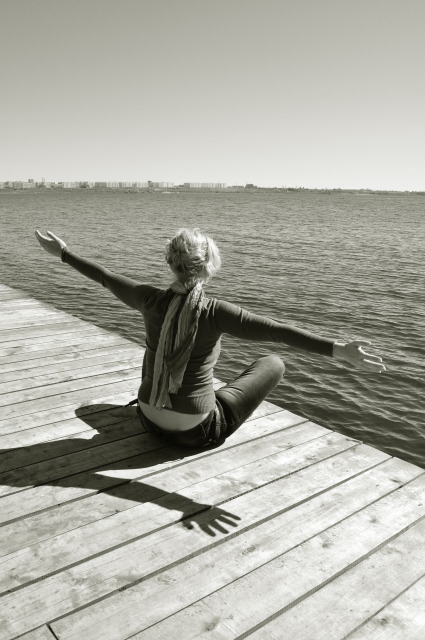
Support: What it is, what it’s not

I’ve been thinking a lot lately about the concept of support. There are few things more frustrating and alienating than reaching out for support and getting something that feels like the opposite, even if support is what’s intended.

I like to say, “It begins with us.”

And this is true. Self-support is the cornerstone of any true support. Sometimes it’s impossible to let support from “out there” truly land if we aren’t first practicing self-support.

But, said one of my dear clients the other day, what if I’m in a place where I simply can’t access my self-support system? What if I’m so turned around and upside down and frantic that I just can’t get to that place in myself?

Of course. This happens. That’s when support from “the outside” can be most valuable. That gentleness from a trusted friend that we can’t seem to manage to give ourselves. That perspective we just never would have considered if left to our own devices. So. Important.

But: sometimes it’s when I’m in need of support the most that I am the most reluctant to reach out for it. In fact, this is usually what happens. The more I feel like a black hole of sucking need and desperation, the less I want to reach out, and the more I get sucked down, down, down into the vortex.

And, sometimes, into that vortex is exactly where I need to go. It’s not about “forcing myself” out of the vortex to ask for help. This doesn’t necessarily feel safe, and I’m also not necessarily in a place where I can receive any external support when I’ve gotten to this point. (More on this in my next post.)

True support meets us where we are. It doesn’t force, criticize, or project. It’s curious, interested; it asks open-ended questions. (See my previous post on true support, here).

There are, however, a few things I’ve learned that can contribute to getting into the vortex of swirling, sucking need that feels like it will never end and will never be met. Here are some I’ve noticed:

1) Calling something “support” that doesn’t feel like support. For example, the internet. There’s more than enough information for any of us to digest on any topic we want to do a search on for the next bazillion years. But information is not the same thing as support. And getting overwhelmed by information definitely doesn’t feel like being supported. Posting a question on Facebook and getting fifty different “here’s what I’d do” responses is not necessarily support; it just might be overwhelm — more to process, more to weed through.

2) Going for support, again and again, to people who just aren’t able to provide the kind of support you need. Different people provide different types of support. One of my ingenious ways of alienating myself for many years was going to people who weren’t able to give me the kind of support I needed in the past, hoping that this time they’d show up for me the way I wanted them to. It didn’t happen. Embracing reality: always a good thing.

3) Expecting people to support you exactly the way you’d like them to, without telling them the kind of support you need. If you just want to vent and you don’t want to be coached, you can let someone know that — even if they’re your coach. I used to have a habit of just accepting whatever support was offered, even if it was so not what I needed in that moment. I’d feel alienated by the other person, but really I was alienating myself by not stating what I needed. (This isn’t always, easy, of course. Sometimes, we’re just not sure what we need. We need to be really, really compassionate with ourselves here. We’ll figure it out.)

4) Thinking we need a LOT of support, when what we actually need is the right KIND of support. (See #1.)

5) Thinking that what feels supportive to others should feel supportive to us — even when it doesn’t. The same week my cat died two years ago, I had a trip planned. I literally had no energy for travel and wanted to be at home with my grief, even though other people told me the trip “might be just what you need!” It wasn’t; puttering at home feeling totally safe to burst into tears at any moment was.

In my next post, I’ll write about what to do — or not do — when we’re swirling in the vortex of need and we don’t know how to support ourselves.

What are your thoughts about support? Where do you look for it? What works for you and what doesn’t? I’d love to know.

Work with me! Check out my one-on-one coaching opportunities.

Image is LADY-BIRD © Nikolajs Strigins | Dreamstime.com

How to Take a Pretend Vacation

I realized this afternoon that, kind of without being totally aware of it, I’ve slid into one of my oh-so-rare “pretend vacations.”

A Pretend Vacation is something I give myself when I’m a little overwhelmed, a little run-down, or maybe just feeling more reflective and inward than usual. It might last a day; it might last three. It’s never a planned thing. It’s like a need that asserts itself in a small voice; if I don’t listen, it speaks up more sharply.

I suspect the need for a Pretend Vacation has been coming on for several weeks. Maybe it’s kicked in because of the events of this past weekend: Saturday morning, while eating a Larabar, my crown popped off and I almost swallowed it. Did you know when a crown comes completely off, it has a little pointy screw thing sticking out of it? Be warned.

Then, Saturday night, there was a party. I have an interesting relationship with parties. If I can get myself to them, I like them. For about twenty minutes. I stayed at this one for three hours. (But it was a Halloween party! Costumes! Gummy worms soaked in vodka! And “Poltergeist” and “The Exorcist” on TV all night! My inner scary-movie-lover was happy; my inner HSP-introvert was overstimulated.)

I spent Wednesday morning in my lovely dentist’s office as she dealt with the gaping hole in my gum. Throw in a couple other unexpected and stress-inducing issues over the past few days and, on cue, need for Pretend Vacation makes itself known.

A real vacation is planned in advance. It involves taking time away from work, maybe more time with family or friends, or not, maybe traveling to another place, or not, but there is an interruption of one’s normal routine.

In my Pretend Vacations, my normal routine goes on. I just scale it back as much as possible. I do everything that’s a priority — keep my appointments with clients, do my writing, feed my cat. But I cut out anything I might normally do but don’t really need to. Today, for example, laundry and the dishes fell right off the list so I could sit quietly and drink Midnight Velvet tea. I haven’t been on social media much. I let a couple of phone calls go to voice mail.

The intention behind a Pretend Vacation is to create a container for the part of me that is vulnerable, tired, and wants to move inward to reflect or rest, while not completely removing myself from my life. I’ve noticed on a Pretend Vacation, choices I might usually waver over become really, really clear. I also notice I’m gentler with myself than I usually am, and I’m less likely to respond to things that don’t really require a response from me.

There’s something to be learned here, methinks. Can I invoke this Pretend Vacation mindset for the parts of me that are vulnerable, overwhelmed, or scared, while still attending to the parts of me that don’t want to leave the party because “The Exorcist” hasn’t gotten to the really good parts yet?

I can’t necessarily care for all these parts of myself — all these selves — on the same day, in the same moment, but I can let them all know that they will get their say, they will be heard by me, and none of them will be left out.

I can also let the sensation-seeking parts of me — my inner adventurer, my inner scary movie buff — and the driven, perfectionistic parts — know that, in the long run, a Pretend Vacation is good for all of us.

And a Real Vacation is even better.

For a related article, click here.

Image is TOY ON THE BEACH © Cristina | Dreamstime.com

What It Really Means to be an Introvert

Many of the creators I work with as a coach are introverts. But some of them have a hard time owning this.

I get it. As I was growing up, I learned that there were these “social definitions” of introvert and extrovert. These definitions went something like this: An introvert is quiet, shy, and keeps to herself. She’s not very friendly. She needs to learn to be more outgoing and social. An extrovert is gregarious, charming, engaging. She has lots of friends. People really like her and she’s socially well-adjusted.

Naturally, most people wanted to feel they were the second thing, not the first. I know I absolutely hated being labeled “shy”, and my parents and most of my teachers wanted me to “combat my shyness.” I always felt they were not seeing me for who I was.

I think a lot of people nowadays (I hope, anyway) have a better understanding of what an introvert actually is. But I know here in the U.S. there’s still a cultural bias in favor of extroversion. Recently when I mentioned to someone that I work mostly from home, she said, “Oh, gosh, you don’t want to spend too much time at home. You might become an introvert!”

It hit me once again that the reason some of us struggle to accept ourselves as introverts — and try to live contrary to our nature — is because these old “social definitions” of introvert and extrovert are still intact.

Actually, the definitions of introvert and extrovert that I prefer may be even older. Jung defined introversion as “predominately inward-looking” and extroversion as “predominately outward-looking.” What this means is that introverts are naturally inclined toward delving into their inner worlds, whereas extroverts are more inclined toward interacting in the outer world. And everyone is at a different point on the introvert-extrovert spectrum — we’re all some of both, but to varying degrees.

I am probably not the most extreme of introverts, but I’m way up there on the scale. This DOESN’T mean that I am always quiet and that I dislike being around people. It means that because I take anything I experience in the outer world and turn it inward in order to process it, I need a certain amount of downtime in which to chew on things and recharge my battery.

So, my bandwidth for socializing and being in the “outer world” is finite, and if I don’t respect that and push myself beyond my limits, I’ll become overwhelmed and depleted. What overwhelmed and depleted looks like in me is spacey, irritated, tired, quiet, withdrawn, and yes, sometimes it may look “shy” or create shy behavior — in other words, I may become fearful in situations that normally wouldn’t cause me to be so because my battery isn’t charged and I know I don’t have the energy to deal with them at the moment.

This is why traditional school and work settings are often not ideal for introverts — we run out of steam and feel like we’re running on empty, try to retreat to our inner worlds to get recharged, and discover this isn’t acceptable in the company of (most) others. Then we start judging ourselves for not being able to act like extroverts, who recharge their batteries by being with people and engaging in activities.

Because I understand my introversion so well (though I’m always learning more about my needs) I love the fact that I’m an introvert and I fully embrace it. This hasn’t always been true for me, but now that it is, my life flows so much more smoothly. When I can accept the ebbs and flows of my own energy and give myself the downtime I need — and own that in the company of others — I can show up fully myself.

I’d love to see all introverts embrace their nature and see how it works for them as creators. I’ll talk more about this future posts.

Check out Marti Olsen Laney’s “The Introvert Advantage” or Susan Cain’s “Quiet” if you’d like to read more about embracing your introversion (or understanding a loved one who’s an introvert). And if you struggle with accepting and working with your introverted nature, check out my one-on-one coaching opportunities. I love working with introverts!

Image is FEATHER IN THE FOREST © Paige Foster | Dreamstime.com

Being Patient with Impatience

Two Saturdays ago, I had one of my marathon journaling sessions where I seemed to be taking dictation from the universe, and I made a long list of things I want to do to move forward with my coaching practice, my writing, and my life in general. All the things on this list felt exciting, organic, juicy. Enthusiasm flooded through me. Clarity! Momentum! I couldn’t wait to get started. I was sure that in, say, a week, all these things would be effortlessly accomplished and I’d be “on my way” — whatever it is that means.

Fast-forward nine days, to this past Monday evening. I’d spent the most of the day, and the night before, in frustration, confused, vaguely panicked, complaining to my boyfriend that I just couldn’t get anything done and I didn’t know why. This shouldn’t be so hard, I kept hearing myself say. I’m so behind schedule, I kept hearing myself say. Somehow my exuberance, enthusiasm and excitement had become — what? I couldn’t pinpoint it at first, and then I realized what it was: Impatience. Of the extreme variety.

There’s a line from the movie “Postcards from the Edge” — I’m paraphrasing here, but it goes something like this: “In the movies, you have a big realization and your life changes. In life, you have a big realization and six months later your life changes.”

Sigh. Yes, it’s true — things generally do not happen as quickly as I think I would like them to happen. And often, I get clear on a vision of what I want, and then realize — thud! — that there’s a lot of letting go and restructuring that has to happen before that vision can actually become reality. And sometimes, in the process of moving toward that vision, I change, or I understand myself better, and I realize that what I thought I wanted is no longer what I do want.

Sometimes it really will be six months before the change I want is ready to be born. Sometimes it will be a year. Sometimes (as in this case — I think!), it just means I have to do what I want to do over the course of a month instead of a week.

What’s clear is that that graspy, impatient, want-it-yesterday voice inside me is not the voice of my inner wisdom — though it certainly seems like the truth when I’m in the grip of it. But I can tell it is not the truth by the behavior and results it creates — haste, confusion, spinning in circles, accidentally deleting almost-finished blog posts, stubbing my toe on the chair leg.

Impatience is one of the most common themes with my coaching clients. And I’m right there with them. We want to hurry the process so we can get to the reward, forgetting that the only tangible reward is right here, in the process.

The voice of impatience ruins the process.

I picked up SARK’s wonderful book “Make Your Creative Dreams Real” last night for a little bit of guidance. I knew I needed to get grounded. Can you believe the book actually opened to a section titled “Impatience”? I didn’t even remember ever reading this section of the book before, but there it was.

She writes: “Being patient with our creative dreams, our lives, and ourselves can only shelter and nourish us. I am learning ways to be patient with myself and my creative dreams.”

Most of us are pretty familiar with impatience. Our culture teaches us impatience and instant gratification. Be counter-culture. Nurture patience in yourself, even though it may feel unnatural and unfamiliar.

There’s an upside to impatience, too, though. It means you’re opening up to bigger stuff. It means you’re getting ready for newness. Sometimes, it means you’re no longer willing for things to be as they have been because you’ve outgrown them.

And that is all good! But if it’s not moving as quickly as you’d like it to, see if you can hold that impatience in patience’s wider lens. See if you can take a more expansive view — what Martha Beck calls “eagle vision” — and allow yourself to feel that deep knowing that you are exactly where you are supposed to be right now, doing exactly what you are supposed to do in this moment.

Image is AUTUMN STAIRCASE © Lbwhaples | Dreamstime.com

Creating: There’s No Right Way to Do It

A friend of mine recently attended her first ever writing class. She was really nervous. She didn’t know if she’d “fit” there. She thought maybe she wasn’t brilliant or wacky or temperamental enough to be a writer.

She showed up, and things were going along okay, and then the teacher said this: “If you’re not willing to reveal everything about yourself, you have no business being a writer.”

Ouch. My friend felt like a hermit crab retreating into its shell. It had been hard enough just getting herself to the class, and now here’s someone in a position of authority saying that if she doesn’t put it all out there, she has no right to write.

Here’s the thing:

When we begin something new, we are tentative. This is normal. Feeling tentative does not mean we are not serious or that we “won’t make it.” We need to start small, and stretch ourselves a little each time we begin again. And little by little, we become less tentative. We take bigger risks.

When we create, we are exposing pieces of ourselves. We are saying, in essence, this is what fascinates me, this is what I struggle with, this is what I really care about. And that can be hard. That can be terrifying. Particularly if we’re just starting out. And even if we’re seasoned creators, we continue to explore new territory and there’s always an element of fear in that.

Starting small and feeling tentative about it is so much better than not starting at all.

And this is exactly why we need to start small if we are really, really afraid. If you get vertigo when you stand on a chair, you don’t climb up a bell tower and look down (well, unless you are Jimmy Stewart in Vertigo, but you get my point).

Some new writers are excited and motivated by the idea of  “laying it all on the line.” And that’s terrific.

But if you’re not excited and motivated by that, if it scares the hell out of you, that doesn’t make you any less a writer. And you shouldn’t have to hide this fear because you’re afraid someone will tell you that if you don’t want to lay it all on the line, it means you “don’t really want it.”

And here’s another truth: The more you care about something, the more tender the subject, the closer it is to your very essence, the harder it’s going to be to write about — or, at least, the harder it’s going to be to share with others.

But this doesn’t mean that, if you’re not feeling ready to do that now, you have no business being a writer. It just means you’re not feeling ready to do that now.

Here’s a question I like: What might help me to feel a little more okay about starting?

Obviously, the idea that she had to be willing to reveal everything about herself shut my friend down. She didn’t want to return to the second writing class; she didn’t even want to write.

So here’s what we worked out together. We changed “I have to be willing to reveal everything about myself” to “I’m willing to reveal some things about myself.” This felt much better to her. And here’s another thought that felt true for her: “I have the right to be a writer because I have a deep desire to write.”

I tell this story because we create resistance when we believe black-and-white, all-or-nothing thoughts about our creativity. There’s no “right” way to create. You can be a “real” writer even if you are not putting one hundred percent of your inner turmoil out there for the world to see.

Here’s what I’ve found: I can usually do more and go farther than I thought I could. But I don’t find that out if I don’t give myself full permission to meet myself where I am. If I set up a challenge for myself that feels insurmountable (or, when it comes down to it, undesirable), I’m going to shut down.

So give yourself full permission to be a beginner (and we’re all beginning, again and again and again). If someone criticizes you for being “too tentative,” or “not serious,” say, “‘I am serious. I’m seriously tentative. I’m trying something new.” And then tell them they have to stop criticizing you. And this goes double if you’re criticizing yourself.

If a belief shuts you down, it’s not the truth for you. There are as many kinds of creators as there are human beings who have the desire to create. And we’re all motivated in different ways. It’s not one-size-fits-all, and thank goodness for that.

Image is MESSY PAINTS © Paige Foster | Dreamstime.com

Creativity and the selves within us

Lately with the wonderful creators I’m coaching, I’m noticing a theme of “shoulds.”

“I should be taking more risks with my writing.”

“I shouldn’t be spending so much time lolling around on the beach.”

“I shouldn’t be taking on so many creative projects” or, the flipside, “I should be trying harder to get out there and be more creative.”

First of all, creativity isn’t something you do. It’s something you are.

Our projects are simply a way of tapping the creativity that is always within us, giving it a form. It’s important to remember this, because our minds tend to work in a black-and-white way: “I’m creative when I’m sitting at the computer typing the words of my novel, but I’m not creative when I’m doing the dishes.” (Check out my previous post on defining creativity.)

Actually, you are creative when you are doing both. Creativity is simply the energy of life moving through us, and our particular perspective on that energy at that particular moment. It is always available. 

And, we all have different selves within us. I know I have an adventurous self who loves the idea of living on the edge, taking creative risks, going all out in search of a particular truth (I saw the awesome “Prometheus” last night, and I came out of the theater totally in touch with the adventurous risk-taker part of me).

But I also have many other selves within me. One of my core selves is about twelve years old, vulnerable, self-conscious, unsure of her place in the world and wanting very much to feel safe and cherished. This self is often completely at odds with the risk-taker part of me. And she needs a very particular kind of care.

A quick way for me to get into “shoulds” and create big-time resistance is to ignore the needs of one self or another.

If I ignore the needs of the risk-taker, I find I’m playing it safe (this particularly shows in my writing, when I read what I wrote the day before and realize I’m bored; I just don’t care about what I’m writing because the stakes aren’t high enough).

If I ignore the needs of the vulnerable twelve-year-old who craves safety and boundaries, I wear myself out, I throw myself into situations and relationships without questioning whether or not they are good for this part of me. I find I’m pushing and forcing myself a lot. I can also feel angry, teary, and like I am betraying myself. I may attempt to do something (write about a topic that is tough for me, for example) before I have built the inner resources to go there.

But it’s not an either/or. It’s a both/and. Believe it or not, I can meet the needs of both of these aspects of myself (and the many others as well — though I won’t necessarily be able to meet the needs of all of them at the same time). I can fuel the risk-taking needs of my inner adventurer and also reassure my inner twelve-year-old that I won’t drag her along on these risk-taking expeditions unless she is ready and willing.

This might look like, for example, taking on writing material that feels challenging and scary and risky, but promising myself that I will stop for the day if it starts to feel overwhelming and I’m physically tired or emotionally upset. I can continue the next day, if it continues to feel right for all of me.

And listening to as many aspects of ourselves as we can is beautiful for whatever we’re creating. The more we honor our complexity, the more complex and wondrous our creations will be.

How do you meet the needs of the different selves within you, and what impact does this have on your creativity? I’d love to hear your story.

Image is FREE TIME, ENJOYING THE SUN © Svetlana Komolova | Dreamstime.com

How to tell if perfectionism is running the show

Here’s the second article in my May perfectionism series. You can read the first one here. And there’s plenty more on this site about perfectionism — just check the “categories” listing on the right.

Sometimes — often — I get into a space of confusion where I’m aware that a rather ugly shift has occurred, but I’m not sure why.

It’s when I’ve been doing something I’m really excited about — something, like writing, that may be hard and challenging, but it’s also energizing because it feels like I’m doing what I’m meant to do. I’m humming along, excited, full of enthusiasm, with a feeling of deep rightness. Or maybe I’m just feeling pretty okay. It’s going well. Well enough.

And then: the shift. Something starts to nag at me. I feel a tightness in my head, my chest. I notice I’m tired. I notice I’m a little angry. Suddenly, that feeling of deep rightness is gone and in its place is fatigue, a bad mood, depletion.

When this used to “happen to me,” I thought it was because I was just moody. I thought it was because I was emotionally unstable. I thought it was because I was doing something wrong.

Now, I know it’s because perfectionism has taken over. Without my awareness, I’ve shifted from the challenge and joy of the aims of my inner enthusiast, to the futile agenda of my inner perfectionist.

The truth is, I don’t “suddenly” shift from a space of enthusiasm and energy to Suckville. There are some “middlemen” that I typically don’t notice because they’re so subtle and automatic. Those middlemen are: 1) my physical sensations and 2) my thoughts.

“The shift” happened to me last night. I was at my computer working on something with my cat in my lap, feeling content, peaceful, energized. Everything was humming along; for about an hour or so, I was in a pretty blissful place.

And then: I started to get a little bit sleepy. That was all. Just a little sign from my body that it was beginning to be time to call it a night. (Middleman #1 — physical sensation.)

Not a problem, right? I’d put in a good hour of work (and it’s unusual for me to get much done in the evening anyway, so this was a plus after a day that had been pretty “productive” already.)

However, when I started feeling physically tired, my mind spewed out the following thoughts: You’ll never get anywhere if you always stop when you’re tired. You know tomorrow is a busy day and you won’t have the evening free to work. Why don’t you ever have the energy to make a real dent in the important stuff? You really need to push yourself to do more. (Middleman #2 — my thoughts.)

This was just a sampling of my thoughts — there were probably dozens triggered by the simple fact that my body was ready to call it a day and my inner perfectionist, a.k.a. that part of me that believes I’m not enough and I must constantly prove myself by doing more, wasn’t having it.

Last night, I was able to catch the poor little inner perfectionist and assure her that we’d done more than enough for the day and she was going to have to take a nap, which she badly needed. Sometimes, I don’t catch onto her as quickly. I believe she is telling me the truth. I push myself to do more and more, and I burn out.

The aims of my inner enthusiast feel inspiring, expansive. They challenge me, open me up, make me feel “greater than” I was before. The aims of my inner perfectionist feel like a clamping down. They tighten and close me. They make me feel “less than.” They may look like valuable ideals that are meant to get me to a better place (this is the tricky part), but the truth is in how they feel.

During my life coach training, Martha Beck liked to remind us, “You can tell it’s enlightenment because it tastes of freedom.” The pursuits of my inner enthusiast ultimately feel like freedom — even when they’re challenging as hell. The agenda of my inner perfectionist feels like punishment — even when it looks good on paper, even when it looks awfully appealing to my “social self.”

Saying “enough for now” does not mean my inner enthusiast won’t propel me toward my dreams again tomorrow.

I’d love to hear from you. How do you know when you’re in the grip of perfectionism? And how do you move out of it?

For more on this topic, check out my article on how to tell if you’re stretching or pushing yourself, here.

Perfectionism vs. Creativity: The Gloves are Off!

Note: Scroll down to the bottom of the article for a free opportunity for coaching with me!

Last week, the topic of perfectionism arose in several conversations. Each time, we reached a consensus that perfectionism contributes heavily to burnout, which is a huge creativity killer.

Perfectionism tells us we need to drive ourselves. And it’s a pretty tricky little devil. It can wrap its tentacles around an innocent thought like, “I want to create more.” Sounds like a good thought, right? So let’s say your form of creating is writing your novel, and you work on your novel for thirty minutes one day. You feel good, satisfied. But a shrill little voice pipes up and says, “Only thirty minutes? Surely you can do more than that tomorrow!”

So the next day you sit down and you find it’s a little harder to write for thirty minutes than it was yesterday. And on top of it, now you feel like you have to write for more than thirty minutes, because you have to make sure you’re besting what you did yesterday. So you manage to write for sixty. It’s not much fun. You feel like you’re grinding it out, because you’re so focused on how much you do (making sure it’s “more”) that you’ve lost sight of the fact that you wanted to create in the first place because it enlivens you, because it’s a way of using your gifts, of exercising your creative muscles.

The next day, not only do you feel like you’d better write more than you wrote yesterday, but you talk to Jane and she says she writes for three hours every day, getting up at 5 a.m. to do so. The shrill little voice pipes up again and says, “Look how much Jane is doing! Surely you can do that much!”

The following day you get up at 5 a.m., determined to write as much as Jane writes so you can “be a real writer”. Then you read an interview where someone mentions that Philip Roth writes 365 days a year. So now, not only do you need to get up at 5 a.m. and write for three hours a day like Jane, but you need to write every single day of the year. Naturally, it’s already way too late for you to be Philip Roth, but maybe you can still salvage some semblance of being a “real writer” if you write every single day of the year.

You manage to keep this up for about two weeks. By the fourteenth day, you’re so frazzled from keeping up this frantic pace and sleep-deprived from getting up at 5 a.m. — and by now Jane is telling you she’s writing four hours a day, not a wimpy three! — that you never want to write another word, ever, ever again. You get irritated when you hear people talking about how great it is to “create.” Who wants to create? you think. It’s exhausting and it makes you feel bad about yourself. Screw creating!

You don’t do any writing, or any other form of creating, for months (though occasionally you catch yourself doodling in the pages of your journal, in which you scribble illegible fragments that describe how uncreative you feel … hmm). Now you are so not Jane. (Darn that Jane!) You are so far away from Philip Roth, it’s not even funny. You had such good intentions. What happened to how fun, how joyful, it felt to write, way back when? You just wanted to recapture that. What went wrong?

Perfectionism is the behavior created by black-and-white, all-or-nothing thinking. If you’re not writing four hours a day, 365 days a year, you might as well not write at all. If the short story you submitted to the literary journal was rejected, it’s because it was sucky and you just don’t know how to write. If the writing isn’t flowing today, you might as well quit, the well has run dry. Perfectionist behavior looks like this: Drive yourself, push yourself, force yourself. And when this doesn’t produce the results you want, quit. For months. For years. Forever.

Cynthia Curnan, in her terrific book “The Care and Feeding of Perfectionists” (which appears to be out of print, but is well worth finding if you can), writes that when we drive ourselves relentlessly with perfectionism, we create burnout, and burnout creates what she calls the “backlash.” The backlash is a long period of “underachieving” to balance out our “overachieving”.

Here’s the solution: Notice. Awareness is so, so powerful. I’ll get more into the topic of awareness and how to manage your perfectionism in my next article, where we’ll talk about the difference between pushing ourselves and stretching ourselves.

By the way, despite the title of this blog post, I encourage you not to duke it out with perfectionism. The more you fight perfectionism, the more formidable it becomes, because it engages with that defensive, fearful aspect of you that’s afraid you’ll never have enough, never be enough. It’s better to deftly swim out of perfectionism’s way, and let it go to battle with itself, like the shark in Jaws thrashing the empty underwater cage. (Sometimes I just have to get in a Jaws reference, because Jaws is awesome.)

And finally, here’s the freebie I’ve been talking about in my last couple of posts: Friday, Feb. 24, from noon to 2 p.m. CST, I’ll be hosting Muse Office Hours. This is a two-hour window in which you can call in and get up to fifteen minutes of free, focused coaching from me on any creative issue you’re having. My purpose here is to reconnect you with your muse! It’s a great opportunity to talk about why perfectionism is getting in your way, why you just can’t seem to get started, or how to continue if you’ve gotten stuck or stalled. Call (708) 689-9480 at any time during the two-hour window; if you get my voice mail, leave a message and I’ll be sure to get back to you in the order the calls were received. I’ll be posting updates about Muse Office Hours in the coming days.

Image is GIRL AND LAPTOP © Geraktv | Dreamstime.com

Think Small!

I continue to notice how doing just a little each day can make such a difference. This is true for my writing, it’s true for my coaching business, it’s true for the decluttering process I’ve got underway in my house. I wrote last week about how doing just ten minutes of writing one night made the difference I needed that day.

You might think that doing just a little isn’t enough. But what I’ve learned is that, when we think we need huge blocks of time to get something done, or when we see our project as so big we are overwhelmed, our tendency is to never begin. And then we feel frustrated and defeated.

Start small. Chip away. Make a dent in whatever it is you want to do. You’d be amazed at what you can accomplish by doing a little each day, over time.

On that note, TODAY, Jan. 19, is the last day to sign up for Jenna Avery’s Just Do the Writing Accountability Circle. I’ve written here and here about what a wonderful experience I’ve had as a participant in this Circle. (I finished a draft of my novel in the Circle by writing approximately thirty minutes a day, five days a week.) I’m also one of the coaches, and we’d love to have you join us this session, which starts Jan. 23. You can sign up for the Circle here.

Also: Be watching for an announcement from me early next week. I have something fun coming up — and it’s FREE!

To Create or Not to Create? Assessing Your Energy Levels

I’m totally committed to working on my novel five days a week. But today, it got a little challenging. We got a decent amount of snow here in Chicagoland, and in the time between two coaching calls — time I’d scheduled as my writing time for today — I realized I was going to need to go out and shovel. It was just one of those practical, mother-nature-induced, daily-life annoyances that I was going to have to deal with.

It ended up taking longer than I’d imagined it would. The car windows were wrapped in ice. The recycling bin fell over as I tried to pull it over a bank of snow. And so on.

“Screw it,” I thought as I trudged back up the steps to the house, my cheeks pink and my forehead clammy with sweat. “No writing today. I’ll just have to chalk it up to a snow day.”

Around 8:30, I wrapped up my last coaching call. I was hungry. I ate some leftover mostaccioli and opened my iPad and started playing the Fluff Pets Rescue game I’ve become addicted to over the past week, my “reward” for doing all the stuff I had on my to-do list. I took it as a given that I was too tired to write. But I felt a little bit hollow; the “to-do” list for the day wasn’t truly complete.

And then I felt a little pull in my stomach: a tingle of excitement. I noticed something: really, I wasn’t too tired to write. I wanted to write. So what if it was almost 9 p.m.? I could sit there rescuing fluffy pets (and who doesn’t want to sit around doing that?) or I could get up, go to the computer, and do a little writing.

And that’s what I did. I didn’t do much — just ten minutes of new writing. That was it. But, tonight, that was what it took to give me that feeling that I’d done enough. I moved the writing to the place where I’d done what I wanted to do with the story, with the language, for today. It felt good. I felt satisfied. I’d kept my commitment to myself, even if it wasn’t as much as I’d planned to write. It was enough.

Now: had I gotten off my last call at 8:30 and realized I was physically depleted, my eyes were starting to close and I truly needed to wind down for the night — had it felt like forcing and pushing and having to literally drag myself to the computer to make myself write — that would have been a different story. Had that been the case, I would have called it a day for today — no writing. I would have chalked it up to a snow day and left it at that. And it would have been good.

Geneen Roth once wrote, “Sometimes doing it looks like not doing it.” Sometimes, when we need to rest, that is exactly what we should be doing. This doesn’t mean that at those times we are not creating. Something in us, I believe, is still at work; our unconscious may be knitting together that impossible story problem while we dream.

And sometimes, like tonight for me, doing it looks just like that: going to the desk, sitting in the chair, typing the words into the computer, or scribbling away in your notebook (I still often love to write the old-fashioned way, in a hard-backed Cambridge notebook).

You can always listen to your body for information as to what you need most in this day, this moment. When you think about creating, do you get a little flicker of “yes!” in your chest, even if you’re tired, even if you’ve had a headache since noon? Then by all means, go for it, even so! If, when you think about creating today, your stomach plummets to your feet, your tired bones feel like they want to be in bed and maybe you’ve tried dragging yourself to the computer and sat there for a while and nothing’s really coming out, then, by all means, call it a day for today. You can, and will, start again tomorrow. Trust that implicitly.

By the way: Watch for a special announcement from me in the coming days — I have a cool gift for my readers that I’ll be writing about very soon!