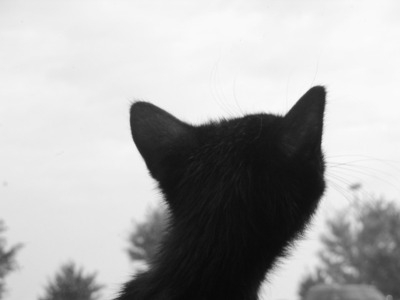
Practicing Reverent Curiosity

kittenwindow

“Novel-writing is not so much a profession as a yoga, or ‘way’, an alternative to ordinary life-in-the-world.” — John Gardner

On Thanksgiving Day, I was hit with a bad cold. I spent two days pretending the cold wasn’t actually there and that I could go on functioning as if I were well. By the third day, I had to admit that I really was sick — and this meant I had to let go of my need for that thing I fondly call “momentum.”

I like the feeling of momentum. I like the idea that I am moving forward. The trouble comes in when I start to believe I can truly control exactly how things move.

When I returned to working on my novel after being sick, I felt disconnected from what I really wanted to say, at a loss with the story. My characters seemed like they were doing silly things, just marking time, moving around the rooms of my pages for no purpose.

Yesterday, during a group writing sprint with other members of Jenna Avery’s Just Do the Writing Accountability Circle, I went to the page with the same feeling of stuckness and confusion about my story that I’ve had lately. “This is terrible!” a familiar voice inside me piped up. “You have to get over this! You need to make this story work!” (No pressure, or anything.)

When, as a coach, I work with a client who’s stuck, I often use metaphor to help them see their situation clearly. I asked for a helpful image to come to me, and the image that bubbled up in my mind was my cat, when we have a vet visit scheduled and he’s caught on to the fact that the cat carrier has entered the room. Once he gets under the bed, my mission is impossible: he knows he can hide there from me as long as he wants, because I can’t physically pick up the bed and get him out. And we’ve certainly had incidents where I’ve chased him around the house, and sometimes I end up standing the cat carrier on its end and stuffing him into it while he braces his back legs on its sides and writhes furiously. I hate this. And, of course, so does he.

There was this one time, though, when my cat snuck under the bed and I just didn’t have it in me to figure out a way to get him out and stuff him into the cat carrier. I set the carrier on the floor in the living room and sat down in a chair. I called the vet and told them we probably weren’t going to make it to our appointment.

The vet’s assistant was completely laidback about this. “Come on in if you catch him,” she said, laughing.

I sat quietly in my chair. Really, chasing my cat just didn’t seem worth it. He wasn’t ill; it was just a routine check-up since he’s getting into his senior years.

Within fifteen minutes, my cat emerged from beneath the bed and tentatively walked into the living room. He saw me sitting in the chair, looking quite harmless; he approached the cat carrier and sniffed at it. Then he began to investigate the carrier very thoroughly, with a kind of reverent curiosity. It was like he wanted to fully understand this instrument of his impending doom.

I realized that I was treating my story the way I treat my cat when I just want to get him to the damn vet. I stuff him into a box and endure his plaintive meows, feeling like a world-class jerk. Because I want to fix things. Because I want to make sure I’m doing the right thing. Because I’m driven by a kind of urgency.

Obviously, sometimes my cat needs to go to the vet and we do engage in this routine (though I’ve gotten quieter and better at doing sneak attacks, so neither of us struggle as much these days — usually).

But does this pattern work with my novel, with my characters?

I was stuck and overwhelmed because I was invested in the idea that my story needed to be “fixed,” that it contained a problem that needed to be solved. There are certainly plenty of books and advice out there that can tell me how to “fix my novel problem.” And some of them can be very helpful, at certain points in the process. But I realized yesterday that approaching my story in this top-down way, as if it was something I could fix from the outside by forcing it into a box of my choosing, was disconnecting me from anything the story had to show me, from letting it reveal itself.

When I sat back, relaxed, and made the choice to approach my story with that reverent curiosity my cat is so good at, I discovered a fascinating thing: I got really interested in my story again. I wasn’t trying to make it be, or do, anything; I was just interested in it. That all-important question, “What is it about?” welled up in me, and I realized I knew exactly what it was about. I also realized that this novel does not want to be as long as I’ve been thinking it should be. It just might want to be a novella. It knows what it is; and I’ve been so set on “fixing it” that I’ve lost touch with the thread that connects one scene to the next.

My story started to move again. I wrote beyond the 0ne-hour set time of the group sprint, I was so caught up in it.  Hallelujah! I understand my story better. And why did I get into this writing in the first place, if not to better understand?

Can I approach my life, too, from this space of reverent curiosity? Can I step back, breathe for a moment, and give my life the space and kind attention it needs in order to be what it wants to be?

Work With Me: I love helping writers and artists who are feeling stuck. Check out my one-on-one coaching, here.

Image is “Wonder Cat” © Eden Daniel | Dreamstime.com

Your True Supporters

Sometimes, when you’re in a place of confusion and feeling really vulnerable about it, someone else steps in and seems to think they know exactly what’s going on for you. And they label what’s happening for you and because you’re not sure what’s up for you, you start to think, maybe they’re right.

Many years ago, when I’d left college and I was in a total “liminal period”, as Martha Beck would call it, I started seeing a psychotherapist who really liked to label my behavior as “healthy” or “unhealthy”. This produced a pretty strong “ick” in the pit of my stomach (a sure sign that her way of working wasn’t right for my essential self), but back then I had a longstanding habit of ignoring my body and its messages.

So for six sessions, I saw this therapist and kept hoping she’d see me. I thought if I just explained myself well enough, she’d “get me.” I remember sitting in her big black pleather chair, telling her that memories from a particular period of my life had been flooding my thoughts, and they felt vivid and compelling. It felt like there was a message for me in those memories, I told her, and I wanted to be open to it.

She stared at me flatly and said, “You’re focusing on the past so you don’t have to move forward. You’re procrastinating.”

I wondered if she was right.  I mean, it sounded right. But it didn’t feel right.

What I know now, years later, is that for me, moving forward often looks like going back — temporarily. Frequently, before I arrive at my next stop, I need to backtrack a little and gather, process, and integrate what happened “back there.” Maybe I’ve frozen certain emotions that need to be brought up, or maybe so much happened in such a short period of time that I haven’t yet caught up with myself.

I’ve written previously about the importance of trusting your own, unique process. If your process looks like mine at all, and you’re feeling like it’s messy and confusing and you’re pretty raw about it right now, don’t let anyone else tell you you’re “not moving forward.” Trust me: You are moving forward. You’re just doing it in your own circular, zig-zag way. It’s all good.

Your true supporters on your journey will honor, support (and even be enchanted by!) your process, your way of working through and coming out on the other side.

That’s why, a year or so after I stopped seeing the aformentioned therapist, I found an amazing therapist who deeply honored my process. And because she honored my process, I learned to honor it myself. And I came to trust myself. Fiercely.

Your true supporters may not “get you” one hundred percent, but they have faith that you know what’s best for you, and they remind you that you are on your own side. They know, as Rainer Maria Rilke said, that “what goes on in your innermost being is worthy of your whole love.”

But the most important thing, of course, is that you know this.


Image is BUTTERFLY © Martina Misar-tummeltshammer | Dreamstime.com

Trust your process. Yours.

I was thinking this morning about my process, of creating, of living, and about how often we hear “Trust the process.” And I think this is important. We can trust that creating is a process, and that things might not look like we thought they’d look, or work the way we thought they’d work, and that’s okay.

But I think it’s not so much about trusting the process as it is about trusting your process. You trusting yours, and me trusting mine.

Because yours, I can guarantee, does not look like mine.

You might be able to borrow something from mine, if it feels right to you. And I might think something you do sounds terrific, and might be able to add that to my process, too. And there might be something that works great for me that doesn’t work for you, at all.

I remember a while ago when a friend quit her job of many years, and she had the next job lined up so she could start it the very next day. Without even a day in between.

“You’re not taking even a couple of days off?” I said incredulously. “No,” she said. “That would make me too nervous. I don’t want any time to sit around thinking about starting the new job. I just want to start it.”

That is her process. It isn’t mine. I want time in between my biggest endeavors, so I can let go of one a bit before jumping into the other. This works great for me. I show up for the next thing rested, with fresh eyes. This is my process, now. It may not always be. But adopting my friend’s process would make me feel crazy, and mine, for her, would feel like she was forcing herself to slow down when she wanted to move right along. For her, her process creates sanity. That’s why it is hers.

We can learn a ton from others whose process rings true for us when they talk about it. Anne Lamott, Geneen Roth, Natalie Goldberg, Tori Amos — I’ve learned so much from reading and hearing these women, and many other creators, discuss their process over the past fifteen or twenty years. Because their way of processing sparks my own.

But my process is still mine. It’s not like anyone else’s. I can learn what works for someone else, and 100% of the time I’ll find out that it doesn’t work exactly that way for me.

Sometimes I hear myself complaining, “Why isn’t this working for me the way it does for her?”

But there’s a better way to phrase this. “I wonder how this could work better for me.”

This is good. This means that when I feel like I’m in new territory, and I get a suggestion from someone else and it doesn’t work for me, nothing is wrong. I’m just discovering more about my own process. Which, really, is just about the most exciting thing I can think of.

Are you struggling in your process? You don’t have to. I have openings for new clients in April. Find out more here.

Make Your Journaling Legit

For years and years and years, I’ve been a journaler. I can remember little diaries with locks and keys that my parents gave me when I was a child, with the words My Diary written in gold on their covers. At six or so, I filled the pages with sentences like “Today was good.” “I am sad.” “I love Rosie.” “Rosie loves me.” (Rosie was our dog and the subject of many of my — thankfully brief — early diary entries.)

When I was thirteen, though, I really started to journal. That is, I wasn’t just recording what happened that day — I was delving inward, trying to understand myself.

I have never, ever, had to force myself to journal. It comes to me as naturally as breathing. Anything goes in my journal, so I’m never concerned with whether or not what I write there is “good” or “right.” I have a compulsion to record, to notice, to reflect, to make connections. It’s a practice that grounds me and reveals me to myself.

It is different than, say, working on my novel. When I write fiction, I’m not delving into myself. When I write fiction, “I” disappear. Sure, all my experiences are there for me to draw upon, and they feed the fiction. But my novel is not concerned with my own self. It’s a story coming through me, filtered through my self, but really, I’m not creating it. I’m just the channel.

With journaling, I sometimes get to the place where I feel like a channel too. These are the sessions I call hardcore. As I wrote previously, I can get to a place where I know that if I allow myself to sit down with the journal, the floodgates will open. All the other days of showing up to the journal — maybe a lot of the time I’m just writing something like “I’m not sure what’s going on with me today, but I feel like crap” and going from there — allow for these glorious hardcore journaling sessions, where something I really need to know is moving through me, but I’m not controlling it. It’s usually the culmination of a lot of struggle, a lot of wondering, and a lot of surrendering — having to admit, hey, I don’t know. And then it comes through on the page and I do know.

When I was in grad school, in the awesome writing program at Columbia College Chicago, we used our journals to write about what we noticed in the published work we read, and what we noticed as we worked on our own stuff. There, too, I can remember connections being forged in a particular way on a particular day, and suddenly something I really needed to know about what I was writing would be apparent to me.

But in order to get to this place of connection, of that really cool thing opening up and coming through onto the page, I had to show up for all the days when nothing much seemed to be coming through. “I’m sad.” “I love Rosie and she loves me.” A lot of days, I don’t feel so different from that six-year-old. But it’s still important to show up, to fill the pages.

Sometimes I hear writers (including me) say, “Well, I didn’t do any real writing today. I mean, I only wrote in my journal.” Guess what? That means you did some real writing today. Recognize your journaling for what it is: It’s legit. It’s real writing, and connected to all the other writing you do. Make room for it, learn from it, be totally in love with it. It’s you.

Image is DESERT © Loredana Marchesin | Dreamstime.com

The Message of Hesitation

What’s happening when we’re not sure, when we actually find ourselves stopping on the way to something we thought we wanted?

I asked myself this question today when I found myself feeling agitated and hesitant in the face of an opportunity that presented itself. And, to complicate things further, that age-old question I tend to torture myself with reared its head: Am I just procrastinating?

As I’ve written about previously, when we are truly procrastinating, there is a simplicity to what is going on. We know we want, or need, to do something (say, the laundry), but we’re enjoying sitting on the couch. Or, maybe I know I want to work on that chapter of my novel but I’m not sure where to go next. So I find I’m not getting over to the desk.

Today was different, though. An opportunity showed up and a part of me said, “Maybe I should jump on that.” But I couldn’t seem to do it. My body actually seemed to move away when I tried to move myself toward the opportunity. And then it didn’t move at all. I stalled.

The first tip-off was my use of the word should. Should is often (though not always) an indicator that some part of me is afraid. Yes, believe it or not, should frequently equals this: I’m afraid I’m going to miss out. I’m afraid someone (maybe me) is going to think poorly of me if I don’t. I’m afraid this might be my last chance to do X.

When I hear myself using the word should, it’s very likely my inner lizard is freaking out. “Should” is one of those words that almost always requires some investigation.

The next tip-off was my use of the word “jump”. Now, jumping can feel fun and exciting, but in this case, I noticed it was frought with a kind of urgency, a tangle of knots in my stomach that felt heavy as bowling balls. Some of my worst decisions have come from that urgent place. I highly recommend not making decisions (especially big ones) from a place of urgency or panic. If you’ve ever been in a true emergency situation, you probably noticed in retrospect that you simply acted. You grabbed your child or your cat or your goldfish and you left the house where you smelled smoke and called 911. You felt a pain in your stomach and you knew something wasn’t right and you got yourself to the ER.

Urgency and panic come up when we feel like we should be acting, but we’re not clear enough about what we want to know which action to take. And our minds start spinning out stories of future deprivation, poverty, hopelessness, madness, isolation.

When I noticed today that I was feeling urgent about taking a certain action, but hesitated in the face of it, I knew my hesitation was good. It was a message: you’re not clear. What do you need? Do you need more information? Do you need to give yourself a day to think about things? Are you trying to deny or ignore your intuition?

I know that when I answer these questions and come to a place of relative peace, I will know what to do. And if this opportunity wasn’t the right one, I can be sure that more will present themselves. That’s the cool thing about opportunity: not only does it knock twice, it knocks every freaking day, if you’re open to it.

Let Your Wisdom Come Through

I’ve noticed that when I’m getting close to some kind of major insight — some piece of wisdom about myself or my life that I very much need in order to move forward — I usually become resistant to receiving it. That is, I have a hard time allowing myself to be in “receptive” mode, where I can access the insight, and I crank up my activities.

My latest way of distracting myself is by playing Galaga. If you were also a kid in the ’80s, you might remember this was an Atari arcade game that came out around 1981. I’ve been playing it on my TV, for old timesake, remembering how much fun it was to shoot rows of insect-like creatures who rain fire on me.

It’s fine, and joyful, to play Galaga when I’m not using it to distract myself from something else. But lately I’ve noticed I’ve been intending to write in my journal around 9 p.m. or so, when I suddenly think to myself, I’ll just play Galaga for a few minutes and then I’ll write.

Only I end up playing Galaga for two hours, and then I’m very sleepy and the journaling doesn’t get done.

And the reason my journal has been calling to me — in that subtle, quiet voice it has — is because it’s time for some wisdom to come through. And the way that often happens for me is through journaling.

But I’m not letting it come through. I’m distracting myself, and not just with Galaga. And I’ve been feeling distanced from myself, agitated, even kinda hostile and angry with myself.

If history is any indicator, there’s a very good chance that when I actually sit down with my journal for a good amount of time and let whatever wants to come up come up, come out, move through me, I will feel a hell of a lot better. What I’ve learned is that the bigger the insight that’s ready to come up, the more I avoid being open to receiving it.

Why? Because it isn’t necessarily easy to sit still, to write, to be, and get in touch with whatever it is. There’s usually some scary stuff hanging around the insight, protecting it, and I need to chip away at that — or, even better, be very gentle with the scary stuff and let it know it’s okay to unclench itself from my newborn insight and deliver the insight into my arms.

Eventually, I know I will step away from the Galaga game and be with whatever it is that wants me to know it. And I also know, if history is any indicator, that it is better if I can do this sooner rather than later. Though I am aware, too, with deep certainty, that the wisdom that wants to come through always arrives at the perfect moment: when I am ready for it.

Do you find yourself avoiding opening up to your insights, getting quiet enough to hear them? What allows you to listen? I’d love to hear how this process works for you.