Embracing the beauty of being on the fence

ducksonfence

One of the most painful things we can experience, at times, is that feeling of being “on the fence.”

We’re not quite at “yes”, but it doesn’t exactly feel like a “no” either. This can happen with a creative project, a relationship, a job, or even an event we’re not sure we want to attend.

I know I can be a world-class waffler. Sometimes something is clearly a “hell yes” or a “hell no”, and there’s always a sense of relief for me when that’s the case. Because often, I have a whole bundle of feelings around something — an unwieldy mix of half-yeses, half-no’s, and everything in between.

I have a fascination for the murky, the muddy, the not-quite-clear. My partner said the other day, while I was debating whether or not I wanted to go out of town with him, that while he sees about two and a half sides to every situation and thinks that’s enough, I see eight sides and like to go for thirty.

Fair enough. Sometimes I love that I embrace the gray areas, the not-quite-defined. But it can also make life harder than it needs to be.

Because sometimes, I think I’m on the fence but I’m just plain fooling myself. Sometimes, I’m not on the fence at all but I’m afraid to own my “hell no” or my “hell yes.”

I’ve discovered over the years that there’s a true difference in feel between times I am genuinely on the fence and times when my “I’m not sure” is actually a cover-up for a yes or a no I’m afraid to see.

It’s all about how it feels in my body.

A true “hell no” for me feels like a hand pressing again my abdomen — a firm, strong hand. It’s a boundary; it makes me think of a drum skin pulled taut, with no give left. No. Not going there. Done. Or, eh, that just doesn’t feel right to me, for now.

A true “hell yes” for me feels like an opening. A “yes” for me is in my chest. My body lifts up and forward when I feel a true yes — it’s like an invisible string extends from my breastbone, right around the area of my heart, and pulls me toward what I want.

A true yes does not actually feel like a decision at all, much of the time — I simply find myself moving toward whatever it is. (As Byron Katie says, when we have the necessary information, decisions tend to make themselves.)
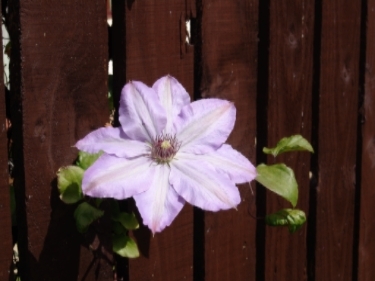
flowerfence

So what does the dreaded “fence” feel like? I’d like to first point out that, largely, what makes the fence painful is the belief that we should be off it. That being “on the fence”, feeling “maybe” instead of yes or no, means something is wrong.

When I’m genuinely on the fence (and not pretending to be there because I’m afraid of my yes or my no and what they might mean), there is a true sense of curiosity. Again, I feel it in my body. Curiosity shows up in my abdomen, chest, throat and jaw. It starts in my abdomen and moves upward — there’s a ticklish quality to it, a momentum that is born of wonder.

In fact, a good sign that I’m genuinely unsure is I hear myself saying “I wonder” and “what if?” a lot, in a musing, reverent way. I don’t mean “what if” here in the worrying, fearful sense. I mean it in the creative sense.

It’s like when I’m writing fiction, and I’m testing out story possibilities. What if she does this? And then he reacts by doing that? And then that causes this? It feels more like playing than the tense, cramped feeling that comes from analysis paralysis, from trying to “figure it all out and get it right.”

There is nothing wrong with being “on the fence”, unless we are perpetually there. In fact, when we are on the fence, it is a great opportunity to know ourselves intimately. It is autobiographical. No two people will be “on the fence” about the same situation in the same way.

I do a lot of “fence work” with my coaching clients because people often seek out a coach when they’re struggling with a big decision. Sometimes their truth is that they’ve already reached a “hell yes” or a “hell no” and they simply need to permission to see it and support in owning it.

And sometimes, they need support in embracing the beauty of their particular fence.

Very often, we can only step off the fence into the lush grass on the other side when we deeply get how the fence is serving us. It’s okay to be there for a while, as long as our being there is true for us. And if our truth is that we’re ready to jump off the fence — or shimmy down ever so gently — it’s okay to get support in doing that.

How do you know the difference between a true yes and a true no for yourself? How do they feel different than when you are genuinely “on the fence”? I’d love to hear your take on this!

Above images © Susinder | Dreamstime Stock Photos and © Steve Sharp | Dreamstime Stock Photos, respectively.

Squirrel wisdom (or, the power of a good question)

squirrelfoodA couple of weeks ago, I was sitting at my kitchen table with my journal, and I paused to stare out the window. It was cold out, bitterly cold, and I watched a squirrel make her way up a telephone pole across the parking lot with a frozen piece of hamburger bun.

When the squirrel had made it almost to the top of the pole, just inches from the wire she wanted to access in order to make it across to the tree branches many yards away, she dropped the bread. I watched it plummet — its trajectory was swift, and it bounced twice on the pavement.

On realizing she had dropped the bread, the squirrel immediately — and I mean immediately — turned around and started down the pole to retrieve it. It took her a while; eventually, she got to the pavement, located the bread (which was about twice the size of her head), put it in her mouth and headed back up the pole.

The squirrel had very little — if any — reaction to her loss of the bread. She simply noticed it had fallen and recalculated.

But here was my reaction, from the kitchen window: Oh my God! All that work and she drops it! Poor squirrel! What a hard life she has in the winter! It’s not fair! All that work just to get a scrap of bread! What if she drops it again? What then? Why is life so hard?

I watched as the squirrel made it up the pole a second time, this time without dropping the bread. She balanced with it on the wire and managed to reach the tree branches, at which point I stopped observing her because I couldn’t bear to see her drop it a second time. If she did, that would mean … what?

I was making the squirrel’s dropping the bread, or potentially dropping the bread, mean all sorts of things. Bad, sad, things.

But the squirrel wasn’t making it mean anything. She was just going on with life, not shaking her little squirrel fist at the heavens and saying, Woe is me! What a pitiful squirrel life I lead, dropping bread left and right! How will I ever eat? I am so incompetent and life is unfair to me!

What are you making it mean? is one of my favorite questions ever. I learned to employ this question during my life coach training back in 2010, and once I learned it I didn’t know how I’d lived without it. It’s probably one of my favorite questions to use with my clients, too.

Our thinking is often automatic. It bypasses our conscious awareness and, before we know it, we’re off into all kinds of stories.

Notice what I did when the squirrel dropped the bread? My mind just went there. It applied all my human concerns to the squirrel and her squirrel-ness. It took maybe three seconds — if that — for my mind to go from noting that the squirrel had dropped the bread to asking an unanswerable question: “Why is life so hard?”

It’s worth it — so worth it — to slow down and observe our thinking. We can’t stop our minds from spewing out thoughts — some research shows that we think thousands of thoughts per day — but we can step back and notice how what we’re thinking is affecting us.

Sometimes (often!) I respond to myself the way I did to the squirrel. Something doesn’t turn out the way I wanted it to, or it’s harder than I thought it would be, and my mind is off and running — I shouldn’t have tried, what’s the point, that was so hard there’s no way I can do it again, why is life so unfair? 

It’s not bad, or wrong, that I have these thoughts. It’s what minds do. The not-so-great thing is when I believe them and take action (or not) accordingly.

When the “bad thing” happens, when I drop my proverbial bread, this is where What are you making it mean? can be a really helpful question to pose to myself. (Notice the difference in feel between this question and a profoundly unhelpful question like “why is life so unfair?”)

Humans are not squirrels, and not meant to be, but I’d like to become a little more like the squirrel. A little more undaunted, a little less self-pitying, a little less thwarted by inevitabilities that have absolutely nothing to do with me. Life is unfair (okay, I guess you can argue that thought, if you want to!). But the squirrel in her squirrel-ness reminds me that what I do with that fact is up to me.

(Two of my favorite resources for noticing and working with my thoughts are Byron Katie’s The Work, and Brooke Castillo’s Self-Coaching 101.)

What are you making it mean? I’d love to hear what you notice about how your reactions shape your world. (Noticing is always the first step!)

Need some support in bringing your creative work into the world? Check out the ways we can work together, here.

Above image is “Squirrel Food” © David James | Dreamstime Stock Photos