Hearing my voice in a noisy world

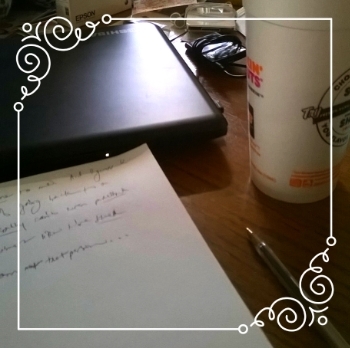
my daily journaling station

my daily journaling station

I grew up in a chaotic and noisy home. I’m not sure why it was this way — we were (and are) a loving family, and our propensity is more toward the introvert side of the personality type spectrum. But with three kids, two dogs (and an assortment of other animals), and two working parents for most of my childhood, privacy and peace were hard to come by.

The only way I knew to get true quiet was to stay home sick from school. Then everyone else would be gone (except the dogs) and I could absorb the quiet of the house, the ticking of clocks, watch how the sunlight moved across the floor as morning drifted into afternoon.

I craved quiet, solitary time as a kid. I wanted to be able to hear myself think. But home was loud and school was loud and my friends seemed loud.

Seventh grade was different because my family moved to Hawaii for the year, something I resisted, kicking and screaming. People said, “You must be crazy not to want to go to Hawaii!”

But to my twelve-year-old self who craved fitting in and stability more than anything else, a move to a faraway place for just one year would be one more thing that made me different, one more thing that told my peer group, “She isn’t like us. She doesn’t fit.”

A life-altering thing came out of our year in Hawaii, however. My English teacher handed out black-and-white composition books and required us to keep journals.

I knew I liked to write, and prior to this, I had dabbled in journaling, but it was more of the “this is what I did today” variety. My teacher encouraged us to really get our thoughts on the page. What was important to us? What did we think about the books we read in class? What scared us? What filled us with joy?

I was hooked. I used all the pages in the first composition book and my words spilled over onto the cardboard back cover.

Finally, I could hear my own voice. I could read my own thoughts on the pages of the composition book. And my teacher validated it all — keeping a journal was a good thing. A healthy thing. It would help me know myself.

In all honesty, I don’t think I fully internalized what my teacher said at the time. This is probably adult me looking back and superimposing herself onto twelve-year-old me. But what I do know for sure is that I was hungry to keep a journal. It became a home for me, the only true safe space I could think of at the time.

Later, in my early twenties, I took frequent trips to New York City, and I remember sitting in the airport one day, my notebook spread out on my lap. I realized I felt at home in O’Hare Airport, waiting for my flight, despite the swirl of activity and noise around me. I wrote in my notebook that day, “As long as I can write in my journal, I can be at home anywhere. My journal is the only home I need.”

I smile a little at my early-twenty-something self now, because I am far less nomadic in spirit than I was then. Now, I like a home base that goes beyond my journal (I am a true homebody at heart despite my love of discovering new places).

But I am still in touch with the “me” who believed that, armed with my journal, I could feel safe enough to take on the world.

Decades after discovering the mysteries and joys of the depths of the black-and-white composition book in a classroom of girls in black-and-white uniforms at St. Andrew’s Priory School in Honolulu, I still meet with my journal at my dining room table every day. (Except now it’s a sketch book with wide, blank pages, so I can draw pictures next to my thoughts, too.)

And every time I put my pen on that page, I’m cutting through the chaos of not just the world, but my mind. I’m safe, and I’m home, and I know who I am, once again.

If you, too, keep a journal, what is the greatest benefit of journaling for you? I’d love to hear from you.

This post is my contribution to the Five-Year Anniversary Celebration of  #JournalChat Live. I’ve been proud to be a guest on #JournalChat Live several times. You can learn more about #JournalChat Live, including how to join the Facebook group, here.


When you’re overwhelmed, get specific

blurrySomething I’ve noticed while working with clients who are “overwhelmed” is that, often, we remain in overwhelm because we are not getting specific enough.

We’re not specific about what exactly it means when we say “I’m overwhelmed.”

In this way, overwhelm is kind of like a stifling blanket of vagueness. We keep spinning in it, saying things like, “I just want to stop being overwhelmed” or “I feel so overwhelmed I can’t move forward.”

That’s the trick (and sometimes the gift) of overwhelm — it keeps us in the dark about what’s really going on with us. It keeps us spinning, obsessing, fighting, or zoning out.

Sometimes it is effective, when we realize we’re overwhelmed, to cut right through the “overwhelm story” and ask ourselves how we want to feel. And then, when we know how we want to feel, we can ask ourselves what would help us feel that way.

Sometimes, though, it’s more helpful to actually pull apart the overwhelm — to look at it as a mass that is made up of a number of components, and get really specific about those components.

What we call “overwhelm” is, in many ways, an attempt to focus on too much at once. So if we pull apart the elements of it, we can start to see what it is made up of. We can start to remove focus from pieces of it, and focus only on what we choose to focus on.

For example, as I mentioned in my last post, I have a move on the horizon, but I don’t know exactly where or when I’ll be moving. I am dying for more clarity around this move — the uncertainty, on some days, feels like it’s driving me crazy!

What I noticed a few days ago is that even though I have this fairly giant thing on my horizon, which is requiring a certain amount of focus and energy (looking at finances, neighborhoods, apartments, storage possibilities), I’d been demanding of myself that I focus on other “big things” as well. And my attention had become scattered and paper-thin.

So yesterday, I let go of a freelance project I’d taken on because it seemed like a good opportunity.

What I found was that even though my mind couldn’t pass up the opportunity, it was actually a terrible time to bring in another thing to take energy and focus from me, especially when it was a thing that didn’t totally light me up.

When I let go of the project, I also felt the overwhelm whoosh out of my body. From this place of more lightness and peace, my move and the elements surrounding it feel so much more doable.

Here are a few ways to get specific about what’s really going on if you’re feeling overwhelmed:

* Instead of saying, “I’m overwhelmed,” say, “I’m sensing overwhelm within me.”

This will create separation between you and the feeling of overwhelm. (You are not the feeling!) Then see what comes up. What happens when you recognize that you are bigger than the feeling of overwhelm?

* Give yourself ten minutes to write down what you’re feeling overwhelmed about.

Do this stream-of-consciousness — don’t try to “get it right.” (And don’t go on for longer than ten minutes — set a timer if you must.)

Then, read over what you’ve written. Notice what jumps out at you. Is there something here that you’re giving a lot of attention to that doesn’t warrant it? Is there anything you wrote down that you can just drop? Does it truly all have equal priority? (My guess is no!)

It can help to consult your “future self” here. If you were to ask you-five-years-from-now which of these issues is important, what does “future you” have to say?

* Bring your focus to your body.

What does your body feel like right now, while you’re in this space of overwhelm? Is it tightness in your abdomen, a clenched jaw, a headache? Shallow breathing? As you breathe, notice what thoughts bubble up for you with these body sensations.

The thought I had was, “If I don’t do this project, I’ll regret it.” I asked myself if this thought was true. What felt more true was, “If I DO this project, I’ll regret it.” That felt more true because doing the project was adding to my to-do list during an already stressful time, rather than taking away stress by giving me an opportunity! And that made it easier to let go.

* Ask yourself if perfectionism plays a role in your overwhelm.

Frequently, the idea that we have to “do it all well” triggers overwhelm because on some level we know it’s not possible or worthwhile. This creates a conflict — part of our attention is on “doing it all well” and part of our attention is on that nagging knowledge that we can’t do it all well.

If you had permission to show up for all parts of your life with C+ rather than A+ effort, how would that change your feeling of overwhelm? Is it possible that showing up in and of itself is enough?

What helps you break down this thing we call “overwhelm”? I’d love to hear what works for you.

And, if you’re struggling with overwhelm on an ongoing basis, you may want to check out my Stellar Self-Care (for Sensitive Creatives) program. You can learn more about that, and my other offerings, here.

Image is “Railway Station Through Glass Brick,” © Bx3t | Dreamstime Stock Photos

The difference between self-care and self-indulgence

strongtreesI have to admit that I’ve been pretty on edge lately. At times I feel unsafe. The house I rent is up for sale, and I know I need to move soon.

Being in limbo mode with my living space brings up all my “stuff” around safety, feeling like I don’t have a true home base, and, well, strangers. Strangers coming through my home and seeing all my stuff, deciding if they’re interested in living here themselves.

It’s weird and, somehow, it makes me feel like a little kid. It brings up the part of me that wants to hide out.

And so, I’ve had to practice extra self-care in order to stay sane, to feel safe.

I’ve had to remind myself, it’s okay, you’re an adult, you can take care of yourself with these strangers who suddenly show up.

I’ve had to pause and ground myself, remind myself to breathe, more than usual.

What’s interesting is how, because I’m also extra-busy right now, another voice comes up a lot.

It’s a high-pitched voice that snaps at me, “What’s with all this self-care stuff? Self-care? Aren’t you being just a little self-indulgent? I mean, look at all you have to do! And you’re letting yourself sleep an hour later than usual?”

This voice is old. Years ago, I thought “self-care” meant taking bubble baths and sitting on a cushion drinking tea. Or spa treatments. Or buying expensive moisturizers.

Self-care can look like those things, but what I’ve come to realize over the past twenty years is that it goes much, much deeper.

What I’ve also come to realize is what self-care is not: it’s not self-indulgence. There’s a big difference, but I think many of us confuse these two terms, which are most definitely not interchangeable.

I’ve mentioned quite a few times on this blog that in my twenties I developed a chronic illness and ended up in the hospital. Then and only then was my cynical twenty-five-year-old too-hip-to-do-self-care self forced to recognize that I had to take better care of me.

That’s all self-care is, really. It’s acknowledging that without putting YOU at the center of your life, there ultimately is no life that feels like you.

Many of the clients I’ve worked with over these past several years have had a pattern in common: feeling bad about not showing up for their creative work in the world as fully as they’d like because they just can’t make it important enough to put themselves front and center in their own lives.

Or: They’re doing their creative work in the world, they’re getting it out there, but they’re so overwhelmed and overstimulated from both the work itself and their interactions with others that they’re totally depleted and aren’t sure they can go another step on their journey.

Self-care, in my book, is about recognizing that YOU are at the center of any creative journey you’re on. Both when you begin the journey, and during it.

And yet, so many of us have a judge-y inner voice like mine that insists that taking good care of ourselves might just actually be, you know, self-indulgence.

How is self-care different from self-indulgence?

For me, “self-care” is about noticing what I am needing — truly needing — in the physical, emotional, and spiritual realms, and making it important that I provide it for myself.

The focus of self-care is not doing, but noticing and acknowledging — and then doing, if necessary. (Often, practicing better self-care means practicing un-doing!)

It’s the noticing and acknowledging piece that we tend to lose sight of in our driven society. And often, when we do notice and acknowledge, we don’t allow ourselves to know what we know about what we need.

Self-indulgence, on the other hand, is fueling the part of us that doesn’t notice or acknowledge what we need. 

Self-indulgence is buying six more sweaters when we already have fifty and only wear ten (I’m raising my hand here!) — and the buying of the sweaters feels like an avoidance rather than a coming home.

It’s eating or checking Facebook or staying on the phone too long or having an extra glass of wine or pushing ourselves to work longer hours in order to avoid checking in with ourselves.

It may feel good or “righteous” or like we “deserve it” in the moment, but in the long run it’s actually continuing to do something that hurts when we know it hurts us.

Self-indulgence can also look like committing to something, or someone, and only giving it half our effort, or half our attention. It can look like always holding back just that little bit so we’re never fully present to our lives.

Now, I do want to emphasize that a little indulgence is not wrong, and sometimes it’s exactly what we need. (Particularly if we have a tendency toward perfectionism, we may need to “balance ourselves out” a little with some indulgence.)

The key is to be honest with yourself. When are you crossing the line from enjoyment to making yourself sick with enjoyment (I’m thinking about French silk pie here) simply because it’s hard to be present with yourself?

When are you crossing the line from doing an extra hour of work on the book you’re writing to feeling burned out but forcing yourself to continue? That, too, is self-indulgence. It’s starting to hurt, not help, and you’re rationalizing doing it anyway.

Self-indulgence always has a seed of avoiding ourselves in it; self-care always feels like coming home to ourselves. That’s how we know the difference.

And so, all this extra grounding myself and focusing on my breath and allowing myself to sleep more than usual? I know it’s self-care because it feels like coming home. Which reminds me that home is within me, wherever I happen to be. It’s a great reminder when my external living space is in flux.

What challenges you about practicing self-care, especially during times of a lot of stress when you need it the most? I’d love to hear from you.

And, I have a new program called Stellar Self-Care (for Sensitive Creatives). If you’re wanting to put YOU at the center of your life, or get back to it, I’d love to be that support for you. You can learn more about the program, here.

Image is “Sunset at Peace” © Shannan Thiel | Dreamstime Stock Photos