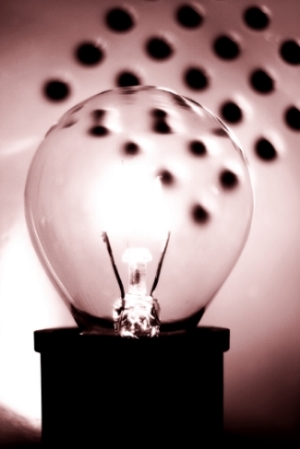
Two ways to deal with “idea paralysis”

sepiabulb2

A while ago, I had a session with someone who had so many ideas, she felt paralyzed as to which to choose and where to begin. Every time she took a little action on an idea, another one of her ideas started to haunt her and she was sure that one was better. So she’d stop working on the current thing and start this other thing. And then the other thing wouldn’t feel quite right, and some shiny new idea would start hovering and she’d drop the current thing and start in on the shiny new thing. And so on.

I so relate to this. It doesn’t happen to me that frequently, but when it does, it is crazymaking. What’s going on when we’re knee-deep in a sea of ideas and we just can’t choose, or stick with one long enough to bring it to completion?

For me, there are one of a couple of things happening:

1) Perfectionism has reared its oh-so-troublesome head.

We’re wanting the idea to be the be-all and end-all of ideas, rather than a stepping stone to what the idea can become. There’s no way an idea won’t transform as we work on it, so most of the time, it’s not going to stay the same as the seedling in our heads. But if we have perfectionistic tendencies, we want to know it’s going to be great, it’s going to knock everybody’s socks off. We can’t know that at the beginning of the process. We can’t know that at the end of the process.

Our own interest in the idea has to be enough. The only thing we have an absolute guarantee of is that we will check in with ourselves about how we are responding to our idea, from day to day. And I can guarantee you that our relationship to it will change from day to day, week to week.

Perfectionists often feel “it’s not quite right, so I’m not ready to begin.” My question to perfectionists (and that includes myself!) is: Is there enough here for me to work with? Is there enough here to sustain my interest, for now?

When I was in college, I had a screenwriting teacher I remember really well because he talked a lot about things that I sensed were true, but didn’t yet have the life experience to know were true. He looked at twenty or so pages of the screenplay I was writing and said, “You don’t have to telegraph your themes to the audience. The themes that are important to you as a writer are going to be there because they’re important to you. They can’t not be there. So stop telegraphing your themes and just tell the story.”

This felt like a huge relief. And I think this applies to those of us who struggle over choosing the “perfect” idea. No matter which idea we pick, the common theme behind it is going to be US. Just because you decide to tell the story about the guy who goes fishing with his estranged father instead of the story about the woman who learns her teenage son is in trouble with the law doesn’t mean your usual themes of loss, loneliness, heartache and redemption are not going to be there. They’ll be there because you will be there.

So relax. You, and the things that are important to you, will be there, in spades, no matter what path you choose.

And, on the flipside:

2) You may be knee-deep in ideas because you are only knee-deep. And what you really need is to be completely submerged in one idea, so your heart is engaged. In other words, there may be a bunch of ideas swirling around your ankles but they’re not really involving the whole of you, so it’s easy to jump off of one and onto another.

I’m reminded of someone I know who, many years ago, was caught up in romantic involvements with two different guys. Time went on and on, and she just couldn’t decide between the two. Finally, she ended both relationships, realizing that neither of these guys was a “hell, yes!” for her and that was why she couldn’t decide. The question wasn’t actually “which of these men is the better choice?” but “who am I and what do I really care about?”

If you’re flitting from one idea to the next, stop. Take some time out and ask yourself, what do I really want? Why am I doing this (writing, artwork, coaching, whatever it may be)? How can you engage the whole of you — starting with your heart, which tells you what you care about the most — in your creative process? And go from there.

Looking at it this way, you’re not choosing the idea so much as letting it choose you. And when something chooses us, there’s no contest.

(On this topic, I highly recommend Miranda July’s wonderful memoir, “It Chooses You.”)

Do you struggle with “idea paralysis”? How do you decide which idea to choose? Or do you let it choose you? I’d love to hear, in the comments.

Work With Me: I have a couple of openings for new coaching clients, starting in July. Interested? See if we might be a good fit, here.

Image is “Sepia Bulb” © Graham Stewart | Dreamstime Stock Photos

Honoring the pace of your dream

caterpillar

Often I hear from my clients that their dreams are progressing much more slowly than they’d like. Because I love to work with people on clearing out the “stuck stuff” that keeps them from deeply engaging with their creative work (or play, as I prefer to call it), clients usually come to me when they are in this space. Either they feel disconnected from their creativity, or they are judging their process for being “too slow” and therefore creating a feeling of stuckness around their process.

Our creative projects, our creative visions and dreams, have different ways of unfolding. Some of these unfold very quickly, so quickly it can feel frightening. I remember writing a short story that poured out of me so fast I felt like the top of my head was going to come off. Truly, it felt like I did not “write” this story — it had its own momentum and its own timing, and that happened to be an extremely fast “birth” from inside of me into the physical world.

I’ve experienced this type of velocity with other creative projects, but more often than not, the pace of my creative projects and dreams tends to be much slower. When the dream is large, like writing a book or creating a business, we often have a huge learning curve, even if it is something we’ve done before. The new book (or business) is a completely different entity from the old one, and the guideposts we created in the process of doing the previous thing may no longer apply. We must discover new ones.

It’s important to accept that we are not necessarily in control of the pace of a creative project. I know that can feel frustrating to hear when we have deadlines we want to meet, or if we feel we haven’t put our creative work into the world as much as we’d like, but it’s still important to honor. My friend and fellow writer and coach Terri Fedonczak (with whom I participate in Jenna Avery’s Writer’s Circle*), often said during the process of writing her forthcoming book, “I am not the timekeeper.”

I love this. It’s true — we can plan and plan, but within each creative dream lies the knowledge of its own unfolding. When we allow a dream to unfold at the pace that feels right and juicy to us — no matter how slow or fast we judge it to be — we are creating a solid foundation for that dream. We’re creating a dream that’s got legs.

If we rush our vision, or, at the other extreme, try to halt its momentum because the momentum is unsettling to us, the project can either burn itself out before it has a chance to truly take root within us, or lose its glow for us because it’s not allowed to fly as fast as it wants to.

If the process of creating your dream feels like it is moving too slow, ask yourself:

* Slow by whose standards?

* Why do I think I need to move faster? What do I believe would be gained, or lost, by moving faster? Is this true?

* Do I have enough support (inner and outer) for this project or dream?

* If I totally trusted myself and the unfolding of this dream, would I be okay with this pace?

If your project, vision or dream feels like it’s moving too fast and you’re getting scared, here are some things to remember:

* It’s essential to develop a practice of grounding and centering yourself regularly, particularly if you are highly sensitive. Your nervous system is going to be more reactive to rapid change than that of the “average” person, and you are going to need to practice radical self-care now more than ever.

* It’s important — and totally valid — to feel safe. At the same time, we can feel unsafe when in fact we truly are safe. Ask yourself: How can I create a feeling of deep inner safety for myself, even if my external world feels like it’s moving too quickly for me right now?

* When change is moving quickly — and that change feels like it is good for us — we are also growing and changing very quickly. When I’m in a period of rapid change, I know that the “me” who does not feel capable of handling the change today will be more than capable of handling that change tomorrow, or tonight, in the moment I am called on to handle it.

Accepting the pace of our dreams starts with deep self-acceptance. When we’re not accepting of an aspect of ourselves, we are going to project that onto our dream and thwart the growth of that dream.

Think of your creative dream as a child: some kids need lots of time to play in blissful solitude; others run right out into the throng and play until they drop. If the kid who needs to play mostly alone, at her own pace, is forced out into the throng, she suffers and withdraws. If the kid who wants to immediately join the pack and play hard until the sun sets is forced into slower, solitary play, he feels isolated and suffers.

If you can accept your own needs AND the needs of your particular vision, your dream will unfold in a way that’s good for you AND the dream.

How do you deal with the unfolding of your creative projects? What have you learned about yourself along the way? I’d love to hear in the comments.

Work With Me: Need some support in allowing your creative vision to unfold? I have openings for new coaching clients. Find out more, here!

*And: Tomorrow, June 13, is the last day to register for the next session of Jenna Avery’s Writer’s Circle. If you’d like to develop a more regular writing habit with group support, check it out here.

Image is “Caterpillar” © Christy Mitchell | Dreamstime Stock Photos