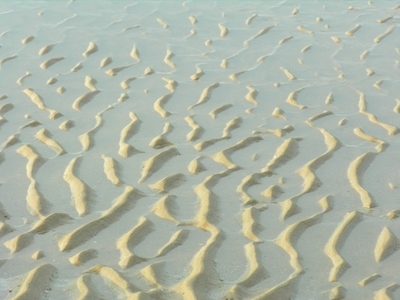
Creative Ebbs: Not the Same as Stuckness

If you think about any relationship you’ve ever had, you’ll notice that there were phases to the relationship. Sometimes you were sitting on the couch shoulder to shoulder eating cookie dough ice cream and watching Netflixed episodes of “The Office” (British version, preferably) and you couldn’t stop laughing and finishing each other’s sentences. Other times, you were kind of quiet and it was just nice. Other times you went rollerskating and you couldn’t stop falling down, in a good way.

And then there were those times when there was just nothing to say. Phone calls felt heavy; there were lots of long pauses, and not the good kind. You got on each other’s nerves without meaning to; previously endearing odd little habits began to seem like dealbreakers.

Maybe in your younger years, the not-so-good times felt like sound reasons to end the relationship; but as you got older and had more experience, you began to see that it was important to ride them out because the ice-cream-on-the-couch times could always come back.

You have a relationship with your creativity, too. And it needs to be accepted, nurtured and protected just like any other relationship you care about. But a lot of times (and what I see happening most often with my clients) is that we either neglect this relationship or ignore it — or, at the other end of the spectrum, we push it so hard and try to control it so much that it withers or hides from us.

Accept that your relationship with your creativity has seasons, cycles, ebbs and flows. You can — believe it or not — trust these ebbs and flows. Most of us are afraid to trust them. We love the flow, but the ebb, not so much.

So I won’t talk about what to do when you’re in creative flow. Most of us love that place. I’ll address the dreaded ebb (though you shouldn’t dread it — it’s really simply the yin to the yang that is the flow).

A creative ebb is a period in which nothing much feels like it’s happening creatively for you. It’s not the same thing as feeling stuck — stuck has to do, usually, with your fears around what you’re creating, or when you’ve reached, say, the middle of your novel and you have no idea what happens next and nothing you try feels right. When we’re stuck, it’s important to bring our fears to light and give them voice so we don’t dig our wheels further into the mud.

An ebb is a bit different. You might feel it for a few days or weeks after you’ve had a period of unusually high creativity. I used to create and sell these little paintings, mostly of cats. The way my process worked was I’d get a very clear picture of what I wanted to paint in my mind, often when I was out walking, and then I’d come home and get out one of my little canvases and the image would flow out onto it, usually quite similar to what I’d envisioned.

For a period of time, I did about three of these paintings a week. And the more people bought them the more I wanted to create them. But after about nine months or so of this, the ideas gradually stopped coming. I didn’t rush to my canvases the way I had. The art I created didn’t feel as inspired to me. Some of it wasn’t selling.

I was at an ebb. How do I know it was an ebb? Well, luckily for me, in this case I’d thought of this artwork as pure fun, not at all my “life’s work” or “serious art” — I didn’t have any of those ideas attached to it that can create stuckness because we make it so big and important. So when the “flow” stopped happening, I didn’t freak out. I just kind of noticed. By now I was about to move into a new home anyway, so I focused on that. The part of me that did the paintings rested.

And within about six weeks, I was ready to go again. I starting getting new ideas and now I was incorporating collage into the paintings. I began selling them again and I got my first overseas customers.

Creative ebbs don’t necessarily last for weeks. The ebb can occur, on a smaller scale, on a daily basis, when you do your writing in the morning, say, and it goes amazingly well but by evening you’re wiped out. That evening time is what Julia Cameron calls “filling the well” time. Although it’s true that the more I create, the more creative energy I tend to have, it’s also true that a prime component to our creativity is this resting phase, whether that’s a few minutes, a few hours, or a few days.

So what do you do when you’re faced with a creative ebb? Ideally, not much of anything — putter, water plants, daydream. But I know that doesn’t sit well with you if you make your living through your creativity, or if you’re on a tight deadline. In those cases, let the resting, “be-ing” energy be there as much as you can, while keeping up a regular creative habit. Sometimes this looks like doing the minimum that needs to be done and calling it a day.

Whatever you do, don’t demand of yourself that you reach for the creative high you experience when you’re in creative flow. That, my friend, is a sure-fire recipe for getting stuck.

Allow the ebb. The ebb is your friend. When the flow returns, you’ll reap the benefits of the ebb and see just how much richness that “fallow” period has brought to your creativity.

Announcement: This Thursday, Aug. 2, is the last day to sign up for the next session of Jenna Avery’s Just Do the Writing Accountability Circle. I’m Jenna’s co-coach, and I’ve also been a participant in this group for nearly a year. It’s a great way to develop a regular writing habit and get group support. Check it out here!

Also: I’ll have openings for new coaching clients starting in mid August. If you’re feeling stuck or scared around your creativity, or it seems like life just won’t stop getting in the way, feel free to set up a free consultation with me.

Image is MUD FLATS © Slidepix | Dreamstime.com

Creating: There’s No Right Way to Do It

A friend of mine recently attended her first ever writing class. She was really nervous. She didn’t know if she’d “fit” there. She thought maybe she wasn’t brilliant or wacky or temperamental enough to be a writer.

She showed up, and things were going along okay, and then the teacher said this: “If you’re not willing to reveal everything about yourself, you have no business being a writer.”

Ouch. My friend felt like a hermit crab retreating into its shell. It had been hard enough just getting herself to the class, and now here’s someone in a position of authority saying that if she doesn’t put it all out there, she has no right to write.

Here’s the thing:

When we begin something new, we are tentative. This is normal. Feeling tentative does not mean we are not serious or that we “won’t make it.” We need to start small, and stretch ourselves a little each time we begin again. And little by little, we become less tentative. We take bigger risks.

When we create, we are exposing pieces of ourselves. We are saying, in essence, this is what fascinates me, this is what I struggle with, this is what I really care about. And that can be hard. That can be terrifying. Particularly if we’re just starting out. And even if we’re seasoned creators, we continue to explore new territory and there’s always an element of fear in that.

Starting small and feeling tentative about it is so much better than not starting at all.

And this is exactly why we need to start small if we are really, really afraid. If you get vertigo when you stand on a chair, you don’t climb up a bell tower and look down (well, unless you are Jimmy Stewart in Vertigo, but you get my point).

Some new writers are excited and motivated by the idea of  “laying it all on the line.” And that’s terrific.

But if you’re not excited and motivated by that, if it scares the hell out of you, that doesn’t make you any less a writer. And you shouldn’t have to hide this fear because you’re afraid someone will tell you that if you don’t want to lay it all on the line, it means you “don’t really want it.”

And here’s another truth: The more you care about something, the more tender the subject, the closer it is to your very essence, the harder it’s going to be to write about — or, at least, the harder it’s going to be to share with others.

But this doesn’t mean that, if you’re not feeling ready to do that now, you have no business being a writer. It just means you’re not feeling ready to do that now.

Here’s a question I like: What might help me to feel a little more okay about starting?

Obviously, the idea that she had to be willing to reveal everything about herself shut my friend down. She didn’t want to return to the second writing class; she didn’t even want to write.

So here’s what we worked out together. We changed “I have to be willing to reveal everything about myself” to “I’m willing to reveal some things about myself.” This felt much better to her. And here’s another thought that felt true for her: “I have the right to be a writer because I have a deep desire to write.”

I tell this story because we create resistance when we believe black-and-white, all-or-nothing thoughts about our creativity. There’s no “right” way to create. You can be a “real” writer even if you are not putting one hundred percent of your inner turmoil out there for the world to see.

Here’s what I’ve found: I can usually do more and go farther than I thought I could. But I don’t find that out if I don’t give myself full permission to meet myself where I am. If I set up a challenge for myself that feels insurmountable (or, when it comes down to it, undesirable), I’m going to shut down.

So give yourself full permission to be a beginner (and we’re all beginning, again and again and again). If someone criticizes you for being “too tentative,” or “not serious,” say, “‘I am serious. I’m seriously tentative. I’m trying something new.” And then tell them they have to stop criticizing you. And this goes double if you’re criticizing yourself.

If a belief shuts you down, it’s not the truth for you. There are as many kinds of creators as there are human beings who have the desire to create. And we’re all motivated in different ways. It’s not one-size-fits-all, and thank goodness for that.

Image is MESSY PAINTS © Paige Foster | Dreamstime.com

Getting out of analysis paralysis (or: what to do when you don’t know what to do)

A couple of my clients, both writers, have been struggling with “analysis paralysis.” They’re ultra-verbal, extremely articulate, and live a lot in their heads. And they’re both also funny and intelligent and sensitive and downright awesome. And I don’t like seeing them in so much stress. So, of course, we wanted to find out how to move them out of it.

Both of them said they had reached a point where they just didn’t know what the hell to do about the particular bundle of issues they were wrestling with. Because there were a lot of issues, and they’d gone over every possible option a thousand times, and looked at it all from every possible angle, and nothing solved the problem. And now they felt totally stuck and spent.

And I so, so get it. In fact, I’d been in the process of curling up in that very same corner (the one I’d so handily painted myself into). And it’s always interesting to see what you’re going through mirrored back to you, but when it’s somebody else’s stuff, you have the ability to see it more clearly.

There’s a correlation between people who tend to be perfectionistic (me!) and “mistake-avoidant” (me!) and people who get stuck in analysis paralysis. We think there’s got to be a right option, a right path, and we’re convinced that we can somehow keep ourselves from ever having any regrets if we can just find it, so we go into the spin cycle of analysis. We try to “think” our way out of whatever is overwhelming us, and in the process, we overwhelm ourselves more by imagining every eventuality.

And in the darkest, heaviest times, this is the stuff depression is made of. Because every option we see has a “yeah, but” attached to it, and since we’re using the minds that created the issues in the first place to try to find our way out of them, we’re truly in a stuck-leading-the-stuck place and more thinking is absolutely not going to help us now.

For those of us who tend to be very verbal and in our heads, it is vital that we connect with our bodies when we are freaking out — though this is probably going to be the last thing we “think” we should do.

That’s why the last time I got massively stuck in analysis paralysis, I got up from my desk (where I was surrounded by words: email notifications, my open notebook, my daily planner) and went into the kitchen and did the dishes.

In fact, Byron Katie actually has a concept called “doing the dishes.” It means, just do that one simple thing that needs to be done. That’s all you ever have to do. Everything else is just a thought, usually a thought about the future or the past.

My clients and I came up with several ways to pull ourselves out of an analysis paralysis “emergency state,” all based on the concept of simplifying and getting into the moment. And because, if you’re in this state, it is indeed vital to keep things simple, I’ve kept the list to three things.

1) Do something that requires physical movement. Think manual labor (like my doing the dishes, or vacuuming), or taking a walk to the post office — no mental heavy lifting. (Again: you don’t want to get more verbal at these times — that’s part of the problem. You want to get into your body.)

2) If you only do one thing (remember, we’re focusing on simplifying here), let it be giving yourself permission to stop beating yourself up for getting into analysis paralysis and everything that has contributed to it. Really, that’s all. Permission to stop beating yourself up. You don’t even have to stop. You just have to give yourself permission to do so.

3) Let go of one thing in your physical space. Yes, get rid of it. Take it to the trash. (If you’re like me, and you believe that even empty boxes of Kleenex just might have feelings, be very, very gentle as you do.) And, since our intention is to simplify and not complicate things here, it has to be something you absolutely have been meaning to get rid of. Don’t get caught up in wondering if you really want to get rid of it, because then you’re right back into analysis paralysis. Then: Notice how it feels to have let go of that object, whatever it was. See if you feel just the tiniest bit lighter. If it feels right, you can continue letting go of things. (I did this with two drawers of clothing recently.) But only if it feels right.

What are your techniques for getting yourself out of analysis paralysis? I’d love to know.

This week:

I have two openings for new coaching clients in July. Are you a sensitive creator who feels stuck or overwhelmed? Contact me to set up a free consultation.

And: This Thursday, July 5, is the last day to register for the next session of Jenna Avery’s Just Do the Writing Accountability Circle. I am one of the coaches, and I’ve also been a participant in this group since it started last September. In that time, I’ve completed two previously unfinished novel drafts. If you’re feeling stuck or like you just can’t develop a solid writing habit on your own, I highly recommend you check it out!

Image is TRAFFIC SIGN © Zdenek | Dreamstime.com