Creativity and the selves within us

Lately with the wonderful creators I’m coaching, I’m noticing a theme of “shoulds.”

“I should be taking more risks with my writing.”

“I shouldn’t be spending so much time lolling around on the beach.”

“I shouldn’t be taking on so many creative projects” or, the flipside, “I should be trying harder to get out there and be more creative.”

First of all, creativity isn’t something you do. It’s something you are.

Our projects are simply a way of tapping the creativity that is always within us, giving it a form. It’s important to remember this, because our minds tend to work in a black-and-white way: “I’m creative when I’m sitting at the computer typing the words of my novel, but I’m not creative when I’m doing the dishes.” (Check out my previous post on defining creativity.)

Actually, you are creative when you are doing both. Creativity is simply the energy of life moving through us, and our particular perspective on that energy at that particular moment. It is always available. 

And, we all have different selves within us. I know I have an adventurous self who loves the idea of living on the edge, taking creative risks, going all out in search of a particular truth (I saw the awesome “Prometheus” last night, and I came out of the theater totally in touch with the adventurous risk-taker part of me).

But I also have many other selves within me. One of my core selves is about twelve years old, vulnerable, self-conscious, unsure of her place in the world and wanting very much to feel safe and cherished. This self is often completely at odds with the risk-taker part of me. And she needs a very particular kind of care.

A quick way for me to get into “shoulds” and create big-time resistance is to ignore the needs of one self or another.

If I ignore the needs of the risk-taker, I find I’m playing it safe (this particularly shows in my writing, when I read what I wrote the day before and realize I’m bored; I just don’t care about what I’m writing because the stakes aren’t high enough).

If I ignore the needs of the vulnerable twelve-year-old who craves safety and boundaries, I wear myself out, I throw myself into situations and relationships without questioning whether or not they are good for this part of me. I find I’m pushing and forcing myself a lot. I can also feel angry, teary, and like I am betraying myself. I may attempt to do something (write about a topic that is tough for me, for example) before I have built the inner resources to go there.

But it’s not an either/or. It’s a both/and. Believe it or not, I can meet the needs of both of these aspects of myself (and the many others as well — though I won’t necessarily be able to meet the needs of all of them at the same time). I can fuel the risk-taking needs of my inner adventurer and also reassure my inner twelve-year-old that I won’t drag her along on these risk-taking expeditions unless she is ready and willing.

This might look like, for example, taking on writing material that feels challenging and scary and risky, but promising myself that I will stop for the day if it starts to feel overwhelming and I’m physically tired or emotionally upset. I can continue the next day, if it continues to feel right for all of me.

And listening to as many aspects of ourselves as we can is beautiful for whatever we’re creating. The more we honor our complexity, the more complex and wondrous our creations will be.

How do you meet the needs of the different selves within you, and what impact does this have on your creativity? I’d love to hear your story.

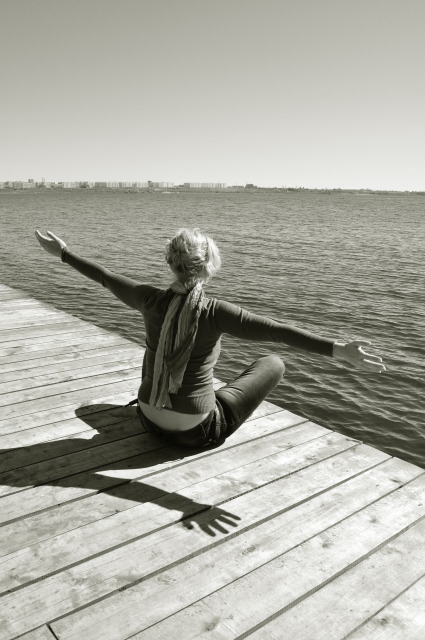
Image is FREE TIME, ENJOYING THE SUN © Svetlana Komolova | Dreamstime.com

Noticing you’re “in it”: what does perfectionism look like?

This is the final post in my May article series on perfectionism and how it interferes with our creativity — and how we can recognize it before it has its way with us! There’s plenty more on this site about perfectionism, as well as its partner in crime, procrastination — just click on the Categories listing on the right.

It can be tricky to recognize when we’re in the grip of perfectionism, because we often applaud ourselves for the very behavior it creates. I struggled so much with overachieving as a child that by the time I was fifteen years old, I burned out and literally had no clue as to why I did anything at all — all I knew was that nothing I did gave me the sense of satisfaction I wanted it to give me for very long. The why beneath what we do is important; in fact, it’s essential.

Perfectionistic behavior is fear-based. We’re acting to secure what we think we’d be lost without. We do more because we fear that if we don’t, we won’t have enough.

When we take action from a place of wholeness and authenticity, we act based on the conviction that we are already secure. We do more because we enjoy it, because it enhances our lives. We stop when we’ve had enough.

So, how can you tell you’re in perfectionism’s clutches?

You can tell by the way you feel. For me, that’s often urgent, anxious, overly driven (I feel I can’t stop or slow down), a tight stomach, clenched jaw, contracted body, slumped-over posture. I physically “clench up”, become smaller than I actually am. Sometimes I feel extra-irritated and want to snap at people.

(Can you imagine the extra burden we place on ourselves when we sit down and try to create from this feeling, from this place?)

Sometimes, though, I’m not necessarily in touch with my feelings or my body. I’m totally in my head, and although I know lots of techniques for getting into my body, I don’t always do them because my mind is telling me I don’t have time, or there’s no point (tricky, tricky mind!).  This is when I can look to my behavior for clues.

For me, perfectionism manifests itself in the following behaviors:

* Going above and beyond just because I can; staying really, really on top of things (i.e. responding to emails immediately; setting daily goals that are way bigger than they actually need to be because my ego likes the way they look).

* Saying YES a lot, when I really mean maybe, or no. Often I do this to avoid conflict. Will saying no really create conflict? I can always say, “Let me think about that,” instead of “yes.”

* Finishing what I’ve planned to do for the day and then doing more, rather than, as we like to say in Jenna Avery’s Writer’s Circle, “declaring myself satisfied!” A similar version of this is sneaking “doing” into time I’ve set aside for “being.”

* People-pleasing and all its graspy little offspring. This can look like refusing to set boundaries around my time and energy, or affecting an “always smiling” persona so I don’t “upset anyone.”

* Cutting back on, or cutting out, fun activities until I’ve “gotten it all done.”

* Using the terms “should” and “have to” a lot.

Any of these behaviors are good pointers, alerting me that I’m “in it.” The value in noticing them is that when they go unchecked, I get further and further cut off from my true feelings, my true needs. Stopping them before they snowball can prevent the build-up that creates “the backlash” (a term I got from Cynthia Curnan, author of “The Care and Feeding of Perfectionists”), where I burnout, crash, and want to remain immobile for hours or days at a time because I’ve pushed and criticized myself for so long.

What behaviors alert you that you’re “in it”? Jot down a list of these (writing them down really helps you remember them) and the next time you notice yourself doing them, pause and course-correct until your actions stem from what you authentically want. It is so worth it.

If you struggle with perfectionism (or what can often be its flipside, procrastination), check out my one-on-coaching, here. I have a ton of tools in my arsenal to help you!

Image is PRICKLY PEAR CACTUS © Ronalesa Salstrand | Dreamstime.com